Posts Tagged ‘religion’
“Even a fool who keeps silent is considered wise; when he closes his lips, he is deemed intelligent.”*…

A substantial– and important– look at a troubling current aflow in the world of technology today: Emily Gorcenski on the millenarianism and manifest destiny of AI and techno-futurism…
… Early Christian missionaries traveled the pagan lands looking for heathens to convert. Evangelical movements almost definitionally involve spreading the word of Jesus Christ as a core element of their faith. The missionary holds the key that unlocks eternal life and the only cost is conversion: the more souls saved, the holier the work. The idea of going out into the world to spread the good word and convert them to our product/language/platform is a deep tradition in the technology industry. We even hire people specifically to do that. We call them technology evangelists.
Successful evangelism has two key requirements. First, it must offer the promised land, the hope of a better life, of eternal salvation. Second, it must have a willing mark, someone desperate enough (perhaps through coercion) to be included in that vision of eternity, better if they can believe strongly enough to become acolytes themselves. This formed the basis of the crypto community: Ponzi schemes sustain only as long as there are new willing participants and when those participants realize that their own continued success is contingent on still more conversions, the incentive to act in their own best interest is strong. It worked for a while to keep the crypto bubble alive. Where this failed was in every other aspect of web3.
…
There’s a joke in the data science world that goes something like this: What’s the difference between statistics, machine learning, and AI? The size of your marketing budget. It’s strange, actually, that we still call it “artificial intelligence” to this day. Artificial intelligence is a dream from the 40s mired in the failures of the ’60s and ’70s. By the late 1980s, despite the previous spectacular failures to materialize any useful artificial intelligence, futurists had moved on to artificial life.
Nobody much is talking about artificial life these days. That idea failed, too, and those failures have likewise failed to deter us. We are now talking about creating “cybernetic superintelligence.” We’re talking about creating an AI that will usher a period of boundless prosperity for humankind. We’re talking about the imminence of our salvation.
The last generation of futurists envisioned themselves as gods working to create life. We’re no longer talking about just life. We’re talking about making artificial gods.
…
I’m certainly not the first person to shine a light on the eschatological character of today’s AI conversation. Sigal Samuel did it a few months back in far fewer words than I’ve used here, though perhaps glossing over some of the political aspects I’ve brought in. She cites Noble and Kurzweil in many of the same ways. I’m not even the first person to coin the term “techno-eschatology.” The parallels between the Singularity Hypothesis and the second coming of Christ are plentiful and not hard to see.
…
… The issue is not that Altman or Bankman-Fried or Andreesen or Kurzweil or any of the other technophiles discussed so far are “literally Hitler.” The issue is that high technology shares all the hallmarks of a millenarian cult and the breathless evangelism about the power and opportunity of AI is indistinguishable from cult recruitment. And moreover, that its cultism meshes perfectly with the American evangelical far-right. Technologists believe they are creating a revolution when in reality they are playing right into the hands of a manipulative, mainstream political force. We saw it in 2016 and we learned nothing from that lesson.
Doomsday cults can never admit when they are wrong. Instead, they double down. We failed to make artificial intelligence, so we pivoted to artificial life. We failed to make artificial life, so now we’re trying to program the messiah. Two months before the Metaverse went belly-up, McKinsey valued it at up to $5 trillion dollars by 2030. And it was without a hint of irony or self-reflection that they pivoted and valued GenAI at up to $4.4 trillion annually. There’s not even a hint of common sense in this analysis.
This post won’t convince anyone on the inside of the harms they are experiencing nor the harms they are causing. That’s not been my intent. You can’t remove someone from a cult if they’re not ready to leave. And the eye-popping data science salaries don’t really incentivize someone to get out. No. My intent was to give some clarity and explanatory insight to those who haven’t fallen under the Singularity’s spell. It’s a hope that if—when—the GenAI bubble bursts, we can maybe immunize ourselves against whatever follows it. And it’s a plea to get people to understand that America has never stopped believing in its manifest destiny.
David Nye described 19th and 20th century American perception technology using the same concept of the sublime that philosophers used to describe Niagara Falls. Americans once beheld with divine wonder the locomotive and the skyscraper, the atom bomb and the Saturn V rocket. I wonder if we’ll behold AI with that same reverence. I pray that we will not. Our real earthly resources are wearing thin. Computing has surpassed aviation in terms of its carbon threat. The earth contains only so many rare earth elements. We may face Armageddon. There will be no Singularity to save us. We have the power to reject our manifest destinies…
Eminently worth reading in full: “Making God,” from @EmilyGorcenski (a relay to mastodon and BlueSky).
See also: “Effective Obfuscation,” from Molly White (@molly0xFFF) and this thread from Emily Bender (@emilymbender).
* Proverbs 17:28
###
As we resist recruitment, we might spare a thought for Ada Lovelace (or, more properly, Augusta Ada King, Countess of Lovelace, née Byron); she died on this date in 1852. A mathematician and writer, she is chiefly remembered for her work on Charles Babbage‘s proposed mechanical general-purpose computer, the Analytical Engine— for which she authored what can reasonably be considered the first “computer program.” She was the first to recognize that the machine had applications beyond pure calculation, and so is one of the “parents” of the modern computer.

“In all chaos there is a cosmos, in all disorder a secret order”*…
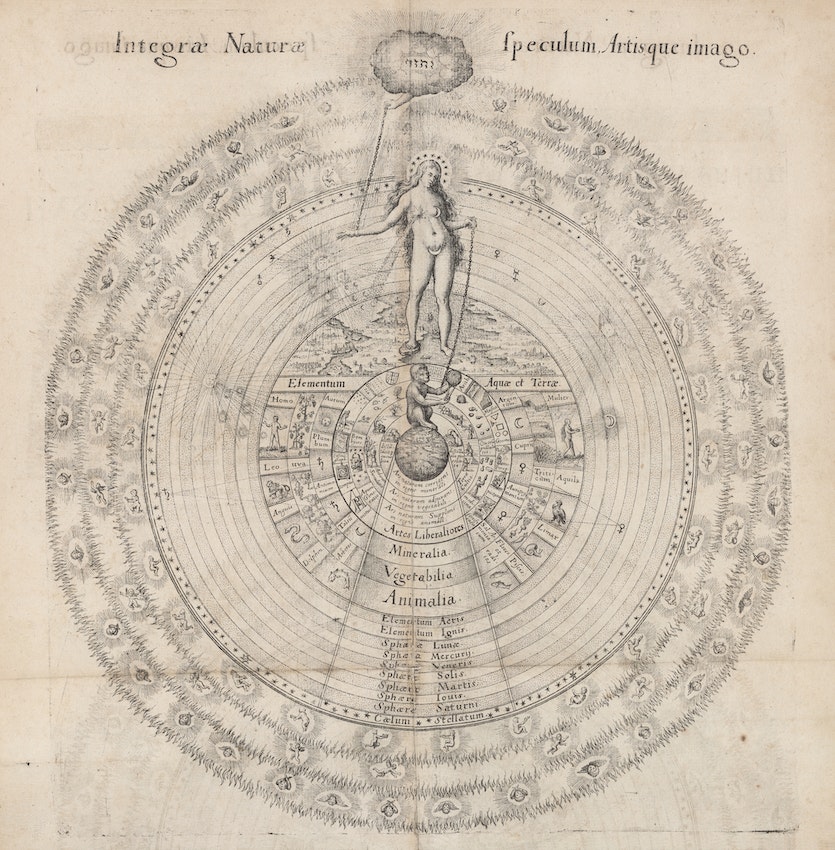
Between 1617 and 1621 the English physician and polymath Robert Fludd published his masterpiece Utriusque Cosmi . . . Historia, a two-volume work packed with over sixty intricate engravings. Urszula Szulakowska looks at the philosophical and theological ideas behind the extraordinary images found in the first volume, an exploration of the macrocosm of the universe and spiritual realm…
Robert Fludd was a respected English physician (of Welsh origins) employed at the court of King James I of England. He was a prolific writer of vast, multi-volume encyclopaedias in which he discussed a universal range of topics from magical practices — such as alchemy, astrology, kabbalism, and fortune-telling — to radical theological thinking concerning the interrelation of God with the natural and human worlds. However, he also proudly displayed his grasp of practical knowledge, such as mechanics, architecture, military fortifications, armaments, military manoeuvres, hydrology, musical theory and musical instruments, mathematics, geometry, optics, and the art of drawing, as well as chemistry and medicine. Fludd used the common metaphor for the arts as being the “ape of Nature”, a microcosmic form of how the universe itself functioned.
Fludd’s most famous work is the History of the Two Worlds (Utriusque Cosmi . . . Historia, 1617-21) published in two volumes by Theodore de Bry in Oppenheim. The two worlds under discussion are those of the Microcosm of human life on earth and the Macrocosm of the universe (which included the spiritual realm of the Divine).
Fludd himself was a staunch member of the Anglican Church. He was educated in the medical profession at St. John’s College in Oxford. At the turn of the seventeenth century, he set out for an extended period of travel on the continent. He spent a winter with some Jesuits, a Roman Catholic order deeply opposed to Protestantism who, nevertheless, tutored Fludd on magical practices. Fludd, however, always claimed to have worked out the theological and magical systems in his first volume of the Utriusque Cosmi . . . Historia (1617) during his undergraduate days at Oxford. In this work Fludd devised a lavishly illustrated cosmology based on the chemical theory of Paracelsus, in which the materials of the universe were separated out of chaos by God who acted in the manner of a laboratory alchemist…
All of Fludd’s treatises were lavishly illustrated with extraordinary engravings, unique in their form and subject matter, which have the visionary quality of a genuine spiritual seer and which exerted an influence on his contemporary occultists such as Michael Maier, Jacob Boehme, and Johannes Mylius. Fludd himself designed these images and they were engraved by the artisans employed at his publishers. (Some of his own original drawings still exist for the first volume of the Utriusque Cosmi . . . Historia, 1617)…

Read on for more explanation and many more mesmerizing images. A 17th century “theory of everything”: “Robert Fludd and His Images of The Divine,” in @PublicDomainRev.
* Carl Jung
###
As we think holistically, we might recall that it was on this date in 1859 that our perspective was shifted in a different kind of way: Charles Darwin published The Origin of the Species. Actually, on that day he published On the Origin of Species by Means of Natural Selection, or the Preservation of Favoured Races in the Struggle for Life; the title was shortened to the one we know with the sixth edition in 1872.

“Don’t let us forget that the causes of human actions are usually immeasurably more complex and varied than our subsequent explanations of them”*…

Further, in a fashion, to yesterday’s post: Patricia Fara explains how the tension between religion and science as arbiters of knowledge came to head in the French Revolution, and how that inspired Lambert Adolphe Jacques Quetelet, a Belgian astronomer, mathematician, statistician, and sociologist, to introduce a radically new way of thinking about human beings:
… God had been forcefully excluded from astronomy during the French Revolution, when Pierre-Simon Laplace rewrote Newton’s ideas to create his deterministic cosmos, in which scientific laws govern every movement of every planet with no need for divine intervention. Inspired by this success, a Belgian astronomer called Alphonse Queteler decided that human societies are also controlled by laws. Each country has its own statistical patterns that remain constant from year to year–suicide and crime rates, for instance–and so Quetelet suggested that an ‘average man’ can consistently encapsulate a nation’s characteristics. Politicians should, Quetelet prescribed, operate like social physicists and try to improve average behaviour rather than worry about extreme anomalies. For him, variations from the statistical mean were–like planetary wobbles–imperfections to be smoothed out so that overall progress could be ensured.
Quetelet had introduced a radically new way of thinking about human beings. As one of his admirers put it, ‘Man is seen to be an enigma only as an individual, in mass, he is a mathematical problem.’ Quetelet’s successors took his ideas in many different directions. For one thing, his work was valuable politically because it could be interpreted in different ways. While conservatives insisted that little could be done to alter the current system, radicals accused governments of impeding the natural course of progress, and Utopians–such as Karl Marx–envisaged harmonious societies governed by nature’s own laws guaranteeing improvement. Data collection projects proliferated, and statisticians searched for laws governing every aspect of life, ranging from the weather to the growth of civilization, from stock market fluctuations to the incidence of disease. Many scientists took their ideas from Quetelet rather than from abstract textbooks–but they added their own twist. Whereas Quetelet regarded individual deviations from the norm as errors to be eliminated, scientists set out to study how variations occur…
An excerpt from Fara’s Science: A Four Thousand Year History, via the invaluable Delanceyplace.com (@delanceyplace): “God, Science, and Data.”
* Fyodor Dostoevsky, The Idiot
###
As we focus on frames, we might spare a thought for a man who kept his eye on the individual, Wilhelm Reich. A medical doctor and psychoanalyst, he was a member of the second generation of analysts after Sigmund Freud. Reich developed a system of psychoanalysis concentrating on overall character structure, rather than on individual neurotic symptoms. His early work on psychoanalytic technique was overshadowed by his involvement in the sexual-politics movement and by “orgonomy,” a pseudoscientific system he developed. He also built a device he called a cloud buster, with which he claimed he could manipulate the weather by manipulating the “orgone” in the atmosphere. Reich’s claims aroused much controversy; and he was taken to court for fraud by the Food and Drug Administration (FDA). The court ordered his books and research burned and his equipment destroyed. Reich was sentenced to prison where he died of heart failure on this date in 1957.

“Nothing can better cure the anthropocentrism that is the author of all our ills than to cast ourselves into the physics of the infinitely large (or the infinitely small)”*…

And very eye-opening it can be. Jason Kottke reports on an article in the most recent issue of the American Journal of Physics with the understated title of “All objects and some questions.”
You just have to admire a chart that casually purports to show every single thing in the Universe in one simple 2D plot. [As the article’s author explain:]
In Fig. 2 [above], we plot all the composite objects in the Universe: protons, atoms, life forms, asteroids, moons, planets, stars, galaxies, galaxy clusters, giant voids, and the Universe itself. Humans are represented by a mass of 70 kg and a radius of 50 cm (we assume sphericity), while whales are represented by a mass of 10^5 kg and a radius of 7 m.
The “sub-Planckian unknown” and “forbidden by gravity” sections of the chart makes the “quantum uncertainty” section seem downright normal — the paper collectively calls these “unphysical regions.” Lovely turns of phrase all.
But what does it all mean? My physics is too rusty to say, but I thought one of the authors’ conjectures was particularly intriguing: “Our plot of all objects also seems to suggest that the Universe is a black hole.”…
Is the universe a black hole? (and other provocative propositions): @kottke on a recent scientific paper: “The Plot of All Objects in the Universe.”
* Julio Cortázar, Around the Day in Eighty Worlds
###
As we size up scale, we might recall that it was on this date in 451 that a different kind of attempt to reconcile the finite and the infinite began: the first session of the Council of Chalcedon (in modern-day Turkey) was opened. The fourth ecumenical council of the Christian church, it was attended by over 520 bishops or their representatives (making it the largest and best documented of the first seven ecumenical councils). It was convened by the Roman emperor Marcian to re-assert the teachings of the ecumenical Council of Ephesus against the heresies of Eutyches and Nestorius— whose teachings attempted to dismantle and separate Christ’s divine nature from his humanity (Nestorianism) and further, to limit Christ as solely divine in nature (Monophysitism).
The Council succeeded in that task. As Jaroslav Pelikan characterized their findings:
We all teach harmoniously [that he is] the same perfect in godhead, the same perfect in manhood, truly God and truly man, the same of a reasonable soul and body; homoousios with the Father in godhead, and the same homoousios with us in manhood … acknowledged in two natures without confusion, without change, without division, without separation.
… which marked a turning point in the Christological debates. But it also generated heated disagreements between the council and the Oriental Orthodox Church, which saw things differently– a contention that informed the separation of the Oriental Orthodox Churches from the rest of Christianity… and led to the Council being remembered as “Chalcedon, the Ominous.”

“When demons are required someone will always be found to supply the part”*…

… Interestingly, that role, Professor Martha Rampton explains, has evolved…
Christianity developed in a world with a well-articulated understanding of a multilayered and hierarchical universe that was, above all, animated. Most inhabitants of the ancient world envisioned cosmic energy as alive, meaning that the essence of physicality, spirituality and ethics rested in a host of supernatural sentient beings. Among those beings were demons who dwelt in the space between the earth and the Moon.
In the mid-2nd century, CE Justin Martyr explained the role of demons in Christian thought. The sons of God succumbed to intercourse with human women, and they begot children called the Nephilim (meaning giants). The progenies of the Nephilim were demons. These demons enslaved the human race, sowing wars, adulteries, licentiousness and every kind of evil. All the pagan gods, Justin warned, were, in fact, demons who haunt the earth. The North African bishop Augustine offered a different genealogy. He identified demons as the rebel angels who fought alongside and suffered the same fate as Lucifer (also known as Belial, Beelzebub, the Devil, Satan, and the ‘Day Star’) whom God cast out of heaven after he mounted a failed rebellion.
Both pagan and Christian ideologies envisioned demons in prominent roles but, for pagans, demons could be both good and bad. They resembled deities in that they shared in their immortality, but they were also subject to obnoxious, irrational cravings. Demons were positioned between humans and gods, and could act as guardian angels. Demons were corporeal, though of a material much lighter than, and superior to, the human form; they could move faster than mortals, read thoughts, and slip in and out of spaces impossible for the human body to occupy.
For the Church, all demons were malevolent. Christians saw demons as shape-shifters who copulated promiscuously with human beings, controlled the weather, sickened their victims, flew through the atmosphere, impersonated the dead, predicted the future, and were always to be feared…
Rampton then leads us through the shaping thoughts of Lactantius, Augustine, and others…
… The foundational metaphors of Christianity and paganism differed and conflicted with one another. The importance of place emerged for Christians as they crafted a new identity and a way to express it through ritual. Pagans looked to the natural world for meaning. Christian identity, on the other hand, was manifest in human-made consecrated structures such as churches and shrines. The new place of worship had to be one where demons did not feel welcome. When Christians established consecrated sites (the settings of ritual), they were often competing with pagan holy places that abounded in the world of nature – spots near lakes, beneath trees, at hallowed rocks, and in forests. Although Near Eastern and Mediterranean religions were temple-oriented with a sophisticated concept of enclosed ceremonial, the common person did not, as a rule, enter the hallowed domain, and most popular ritualistic, religious activity took place in the fields or outside the temple precinct – in short, out of doors.
Christians created a new kind of space where demons dared not tread and in which continuity with old rites and the worldview they stored were thwarted. These churches provided a clean slate on which Christians could write in the language of ritual. The building became a symbol for the new religion. It was more than just a different location from those frequented by pagan celebrants and inhabited by their demonic deities. It was a new concept of place particular to Christianity – cleansed of demons, consecrated to that special creator god who does not inhere in his creation (trees, rocks, springs) and should not be worshipped through it. Nothing filled demons with dread and kept them at bay like a sanctified church. The motif of demons fleeing in terror from a consecrating bishop was familiar in late antiquity when the fight against idolatry was a matter of openly confronting pagan cults. In the 3rd century, Gregory the Miracle-Worker prayed at the local temple, and the next morning the temple warden could not induce a lingering demon to enter. Christian structures were fortifications against demons.
…
The distinctive Christian approach to death emerged as a central feature in the competition with pagans for cultural dominance. Despite the radical differences in pagan and Christian notions of mortality, there were also similarities, and these frustrated the new religion in its effort to establish itself as unique.
Necromancy in the ancient world pertained to the practice of calling the dead back to life for the purpose of learning the future. Pagan works portray contact with the dead as ghoulish and repugnant, but, if approached gingerly and undertaken for desirable ends, it was justified. Revivification of the dead was a major feat that required concentrated syncopation with cosmic powers, and such collaboration was realised and made safe through carefully executed rituals. For example, in his novel The Golden Ass, the 2nd-century pagan philosopher Apuleius relates a story of the corpse of Thelyphron, whom the Egyptian prophet Zatchlas temporarily revivifies so that the deceased can solve a mystery regarding his sudden demise…
Many people in late antiquity saw Jesus and his followers as necromancers. This perception brought forth persistent denials from some of the best minds of the Patristic era. In one respect, pagans were right, Jesus had redefined death, and Christians did approach the deceased differently than their polytheistic neighbours. Whereas most pagan cults dreaded, shunned and burned the dead, Christians formed tender and mutually beneficial relationships with the spirits (and, in some cases, the material remains) of those who ceased to exist on a mortal plane. Rather than ostracising the dead beyond the city limits, by the 2nd century, Christians sought out the remains of their loved ones.
The idea that the dead could live again was a central tenet of Christian belief. Following his resurrection, Jesus assured humanity that they could have eternal life. In the Gospel of Matthew, Jesus invests the disciples with the power to emulate his miracles, including resuscitating the dead. In the Gospel of John, Jesus revivifies Lazarus who had been gone for four days.
…
Early Christians bristled when others censured them for necromancy, certainly because the efficacy of the necromantic art rested on demons of the lower air, but also because they sought to distinguish themselves from the many other religions and belief systems in the ancient world. Christian authors worked tirelessly to defend Jesus specifically and Christians generally against accusations of maleficium (malignant magic). Throughout the Early Middle Ages (c500-1000), Christian writers insisted that the power of their holy men and women rested not on demons that lurked between the Moon and the earth, and not on elaborate rites, but on faith, simple Christian rituals, and ultimately on God alone. Elaborate rituals equated to demonism…
Christians walked a tightrope on the issue of revivification. The earliest Christian theologians were univocally in harmony with their pagan neighbours on the evils of using (or trying to use) the deceased either for fortune-telling or to exploit the power of death’s liminal state for nefarious purposes. Dealings with reanimated corpses involved the worst sort of traffic with demons. Yet Jesus and his closest male followers resuscitated the deceased, and all Christians honoured the spirits and bodily remains of departed saints and fostered friendly relationships with these special dead. In the end, through sermons from the pulpit and private correction in the confessional, Christian intellectuals were able to convince converts that Christian resurrection was different from necromancy.
…
Christianity was ultimately successful at establishing itself as the only legitimate religion in the Roman world. However, the struggle for supremacy was protracted and hard fought. The Church was met with the challenge of facing down an ancient, finely-chiseled and much beloved cultural system of which demons and magic were a part. Christianity’s success was due, in part, to the development of a new and thoroughgoing system of rituals responsive to its own worldview…
The history of Christian belief- it took a tremendous effort to distinguish early Christianity from the finely tuned world of pagan beliefs and rituals: “Miracles not magic,” in @aeonmag.
* Margaret Atwood
###
As we go deep on demons, we might recall that it was on this date in 306 that Constantine I (AKA Constantine the Great) was proclaimed Roman emperor by his troops. Nine years later, on this date in 315, the Arch of Constantine was completed near the Colosseum in Rome to commemorate Constantine’s victory over rival emperor Maxentius at the Milvian Bridge.
In the meantime, Constantine had warmed and then converted to Christianity. He played an influential role in the proclamation of the Edict of Milan in 313, which declared tolerance for Christianity in the Roman Empire. And he convened the First Council of Nicaea in 325, which produced the statement of Christian belief known as the Nicene Creed.

You must be logged in to post a comment.