Posts Tagged ‘theory of everything’
“For what man in the natural state or course of thinking did ever conceive it in his power to reduce the notions of all mankind exactly to the same length, and breadth, and height of his own? Yet this is the first humble and civil design of all innovators in the empire of reason.”*…

A “theory of everything” (a Grand Unified Theory on steriods)– a (still hypothetical) coherent theoretical framework of physics containing and explaining all physical principles– is the holy grail of physicists. Natalie Wolchover checks in on the most recent front-runner in the hunt…
Fifty-eight years after it first appeared, string theory remains the most popular candidate for the “theory of everything,” the unified mathematical framework for all matter and forces in the universe. This is much to the chagrin of its rather vocal critics. “String theory is not dead; it’s undead and now walks around like a zombie eating people’s brains,” the former physicist Sabine Hossenfelder said on her popular YouTube channel in 2024.
String theory is a “failure,” the mathematical physicist and blogger Peter Woit often says. His complaint is not that string theory is wrong — it’s that it’s “not even wrong,” as he titled a 2006 book. The theory says that, on scales of billionths of trillionths of trillionths of a centimeter, extra curled-up spatial dimensions reveal themselves and particles resolve into extended objects — strands and loops of energy — rather than points. But this alleged substructure is too small to detect, probably ever. The prediction is untestable.
A further problem is that uncountably many different configurations of dimensions and strings are permitted at those tiny scales; the theory can give rise to a limitless variety of universes. Amid this vast landscape of solutions, no one can hope to find a precise microscopic configuration that undergirds our particular macroscopic world.
These issues are profound indeed. Yet in my experience, the typical high-energy theorist in a prestigious university physics department still thinks string theory has a good chance of being correct, at least in part. The field has become siloed between those who deem it worth studying and those who don’t.
Recently, a new angle of attack has opened up. An approach called bootstrapping has allowed physicists to calculate that, under various starting assumptions about the universe, a key equation from string theory naturally follows. For some experts, these findings support the notion of “string uniqueness,” the idea that it is the only mathematically consistent quantum description of gravity and everything else.
Responding to one bootstrap paper on her YouTube channel, mere weeks after the “undead” comment, Hossenfelder said it was “string theorists do[ing] something sensible for once.” She added, “I’d say this paper strengthens the argument for string theory.”
Not everyone agrees, but the findings are reviving an important question. “This question of ‘Does string theory describe the world?’ has just been so taboo,” said Cliff Cheung, a physicist at the California Institute of Technology and an author of the paper discussed by Hossenfelder. Now, “people are actually thinking about it for the first time in decades.”
Getting wind of this work, I wanted to drill down on the logic and examine how the string hypothesis is faring these days…
And so she does: “Are Strings Still Our Best Hope for a Theory of Everything?” from @nattyover.bsky.social in @quantamagazine.bsky.social. Eminently worth reading in full.
Compare/contrast with: “Where Some See Strings, She Sees a Space-Time Made of Fractals.”
* Jonathan Swift, A Tale of a Tub
###
As we grapple with Godel, we might spare a thought for Hermann Rorschach; he died on this date in 1922. A psychiatrist and psychoanalyst, his education in art helped to spur the development of a set of inkblots that were used experimentally to measure various unconscious parts of the subject’s personality. Rorschach knew the human tendency to project interpretations and feelings onto ambiguous stimuli and believed that the subjective responses of his subjects enabled him to distinguish among them on the basis of their perceptive abilities, intelligence, and emotional characteristics. His method has come to be known as the Rorschach test, iterations of which have continued to be used over the years to help identify personality, psychotic, and neurological disorders.
Perhaps his insight that we humans tend “to project interpretations and feelings onto ambiguous stimuli” can inform our understanding of physicists trying to construct mental/conceptual models of our reality, which they’ve been doing for a very long time, and of the limitations of that quest.

“In all chaos there is a cosmos, in all disorder a secret order”*…
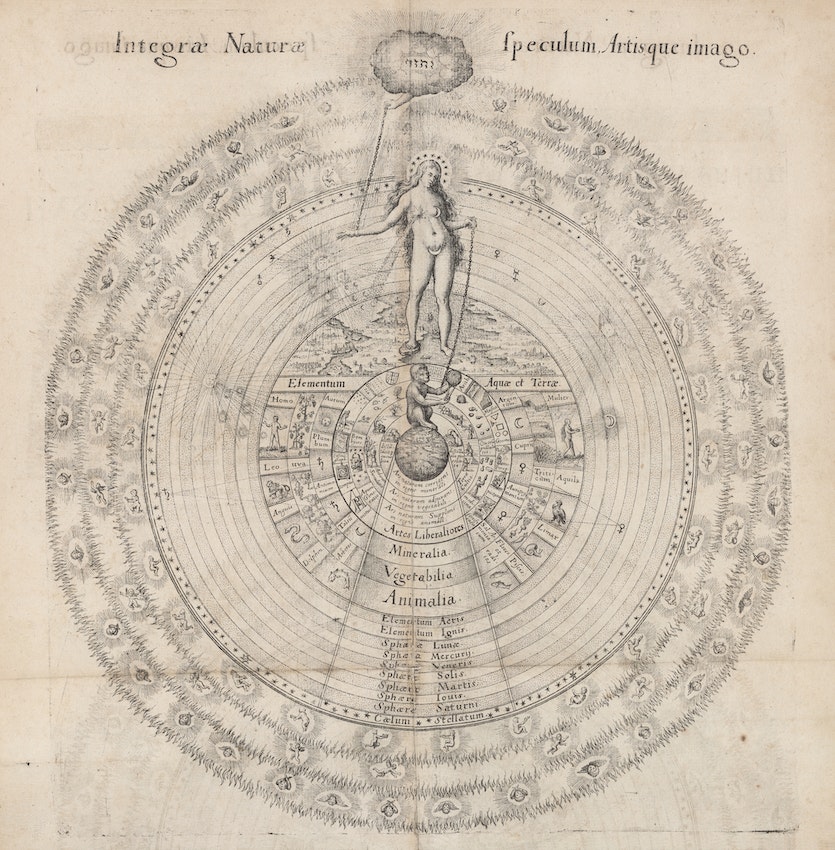
Between 1617 and 1621 the English physician and polymath Robert Fludd published his masterpiece Utriusque Cosmi . . . Historia, a two-volume work packed with over sixty intricate engravings. Urszula Szulakowska looks at the philosophical and theological ideas behind the extraordinary images found in the first volume, an exploration of the macrocosm of the universe and spiritual realm…
Robert Fludd was a respected English physician (of Welsh origins) employed at the court of King James I of England. He was a prolific writer of vast, multi-volume encyclopaedias in which he discussed a universal range of topics from magical practices — such as alchemy, astrology, kabbalism, and fortune-telling — to radical theological thinking concerning the interrelation of God with the natural and human worlds. However, he also proudly displayed his grasp of practical knowledge, such as mechanics, architecture, military fortifications, armaments, military manoeuvres, hydrology, musical theory and musical instruments, mathematics, geometry, optics, and the art of drawing, as well as chemistry and medicine. Fludd used the common metaphor for the arts as being the “ape of Nature”, a microcosmic form of how the universe itself functioned.
Fludd’s most famous work is the History of the Two Worlds (Utriusque Cosmi . . . Historia, 1617-21) published in two volumes by Theodore de Bry in Oppenheim. The two worlds under discussion are those of the Microcosm of human life on earth and the Macrocosm of the universe (which included the spiritual realm of the Divine).
Fludd himself was a staunch member of the Anglican Church. He was educated in the medical profession at St. John’s College in Oxford. At the turn of the seventeenth century, he set out for an extended period of travel on the continent. He spent a winter with some Jesuits, a Roman Catholic order deeply opposed to Protestantism who, nevertheless, tutored Fludd on magical practices. Fludd, however, always claimed to have worked out the theological and magical systems in his first volume of the Utriusque Cosmi . . . Historia (1617) during his undergraduate days at Oxford. In this work Fludd devised a lavishly illustrated cosmology based on the chemical theory of Paracelsus, in which the materials of the universe were separated out of chaos by God who acted in the manner of a laboratory alchemist…
All of Fludd’s treatises were lavishly illustrated with extraordinary engravings, unique in their form and subject matter, which have the visionary quality of a genuine spiritual seer and which exerted an influence on his contemporary occultists such as Michael Maier, Jacob Boehme, and Johannes Mylius. Fludd himself designed these images and they were engraved by the artisans employed at his publishers. (Some of his own original drawings still exist for the first volume of the Utriusque Cosmi . . . Historia, 1617)…

Read on for more explanation and many more mesmerizing images. A 17th century “theory of everything”: “Robert Fludd and His Images of The Divine,” in @PublicDomainRev.
* Carl Jung
###
As we think holistically, we might recall that it was on this date in 1859 that our perspective was shifted in a different kind of way: Charles Darwin published The Origin of the Species. Actually, on that day he published On the Origin of Species by Means of Natural Selection, or the Preservation of Favoured Races in the Struggle for Life; the title was shortened to the one we know with the sixth edition in 1872.

“Men knew better than they realized, when they placed the abode of the gods beyond the reach of gravity”*…

In search of a theory of everything…
Twenty-five particles and four forces. That description — the Standard Model of particle physics — constitutes physicists’ best current explanation for everything. It’s neat and it’s simple, but no one is entirely happy with it. What irritates physicists most is that one of the forces — gravity — sticks out like a sore thumb on a four-fingered hand. Gravity is different.
Unlike the electromagnetic force and the strong and weak nuclear forces, gravity is not a quantum theory. This isn’t only aesthetically unpleasing, it’s also a mathematical headache. We know that particles have both quantum properties and gravitational fields, so the gravitational field should have quantum properties like the particles that cause it. But a theory of quantum gravity has been hard to come by.
In the 1960s, Richard Feynman and Bryce DeWitt set out to quantize gravity using the same techniques that had successfully transformed electromagnetism into the quantum theory called quantum electrodynamics. Unfortunately, when applied to gravity, the known techniques resulted in a theory that, when extrapolated to high energies, was plagued by an infinite number of infinities. This quantization of gravity was thought incurably sick, an approximation useful only when gravity is weak.
Since then, physicists have made several other attempts at quantizing gravity in the hope of finding a theory that would also work when gravity is strong. String theory, loop quantum gravity, causal dynamical triangulation and a few others have been aimed toward that goal. So far, none of these theories has experimental evidence speaking for it. Each has mathematical pros and cons, and no convergence seems in sight. But while these approaches were competing for attention, an old rival has caught up.
The theory called asymptotically (as-em-TOT-ick-lee) safe gravity was proposed in 1978 by Steven Weinberg. Weinberg, who would only a year later share the Nobel Prize with Sheldon Lee Glashow and Abdus Salam for unifying the electromagnetic and weak nuclear force, realized that the troubles with the naive quantization of gravity are not a death knell for the theory. Even though it looks like the theory breaks down when extrapolated to high energies, this breakdown might never come to pass. But to be able to tell just what happens, researchers had to wait for new mathematical methods that have only recently become available…
For decades, physicists have struggled to create a quantum theory of gravity. Now an approach that dates to the 1970s is attracting newfound attention: “Why an Old Theory of Everything Is Gaining New Life,” from @QuantaMagazine.
* Arthur C. Clarke, 2010: Odyssey Two
###
As we unify, we might pause to remember Sir Arthur Stanley Eddington, OM, FRS; he died in this date in 1944. An astrophysicist, mathematician, and philosopher of science known for his work on the motion, distribution, evolution and structure of stars, Eddington is probably best remembered for his relationship to Einstein: he was, via a series of widely-published articles, the primary “explainer” of Einstein’s Theory of General Relativity to the English-speaking world; and he was, in 1919, the leader of the experimental team that used observations of a solar eclipse to confirm the theory.

You must be logged in to post a comment.