Posts Tagged ‘general relativity’
“Reality favors symmetry”*…
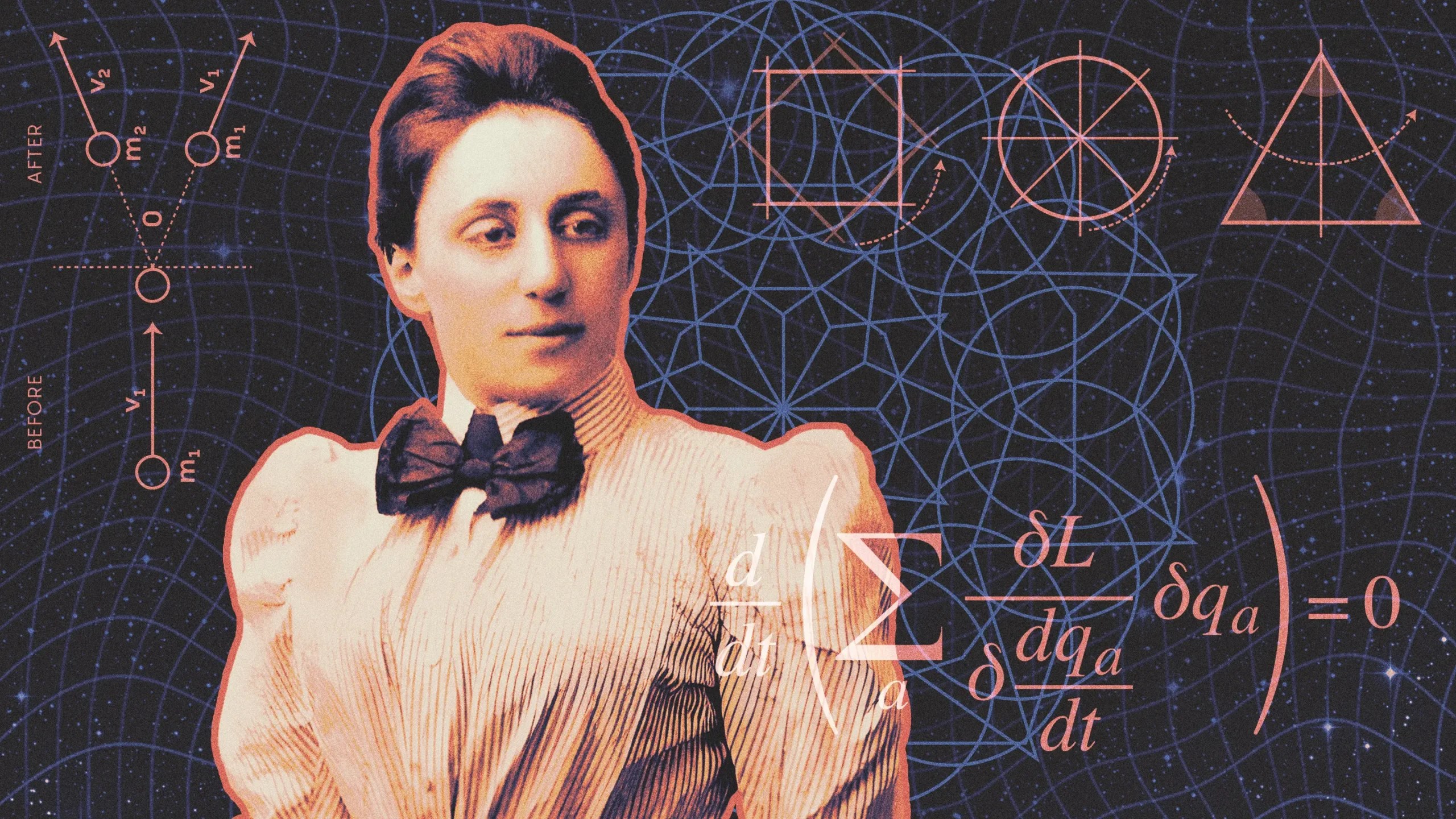
Emmy Noether showed that fundamental physical laws are themselves a consequence of simple symmetries. As Shalma Wegsman explains, a century later, her insights continue to shape physics…
In the fall of 1915, the foundations of physics began to crack. Einstein’s new theory of gravity seemed to imply that it should be possible to create and destroy energy, a result that threatened to upend two centuries of thinking in physics.
Einstein’s theory, called general relativity, radically transformed the meaning of space and time. Rather than being fixed backdrops to the events of the universe, space and time were now characters in their own right, able to curve, expand and contract in the presence of matter and energy.
One problem with this shifting space-time is that as it stretches and shrinks, the density of the energy inside it changes. As a consequence, the classical energy conservation law that previously described all of physics didn’t fit this framework. David Hilbert, one of the most prominent mathematicians at the time, quickly identified this issue and set out with his colleague Felix Klein to try to resolve this apparent failure of relativity. After they were stumped, Hilbert passed the problem on to his assistant, the 33-year-old Emmy Noether.
Noether was an assistant in name only. She was already a formidable mathematician when, in early 1915, Hilbert and Klein invited her to join them at the University of Göttingen. But other faculty members objected to hiring a woman, and Noether was blocked from joining the faculty. Regardless, she would spend the next three years prodding the fault line separating physics and mathematics, eventually setting off an earthquake that would shake the foundations of fundamental physics.
In 1918, Noether published the results of her investigations in two landmark theorems. One made sense of conservation laws in small regions of space, a mathematical feat that would later prove important for understanding the symmetries of quantum field theory. The other, now just known as Noether’s theorem, says that behind every conservation law lies a deeper symmetry.
In mathematical terms, a symmetry is something you can do to a system that leaves it unchanged. Consider the act of rotation. If you start with an equilateral triangle, you’ll find that you can rotate it by multiples of 120 degrees without changing how it looks. If you start with a circle, you can rotate it by any angle. These actions without consequences reveal the underlying symmetries of these shapes.
But symmetries go beyond shape. Imagine you do an experiment, then you move 10 meters to the left and do it again. The results of the experiment don’t change, because the laws of physics don’t change from place to place. This is called translation symmetry.
Now wait a few days and repeat your experiment again. The results don’t change, because the laws of physics don’t change as time passes. This is called time-translation symmetry.
Noether started with symmetries like these and explored their mathematical consequences. She worked with established physics using a common mathematical description of a physical system, called a Lagrangian.
This is where Noether’s insight went beyond the symbols on the page. On paper, symmetries seem to have no impact on the physics of the system, since symmetries don’t affect the Lagrangian. But Noether realized that symmetries must be mathematically important, since they constrain how a system can behave. She worked through what this constraint should be, and out of the mathematics of the Lagrangian popped a quantity that can’t change. That quantity corresponds to the physical property that’s conserved. The impact of symmetry had been hiding beneath the equations all along, just out of view.
In the case of translation symmetry, the system’s total momentum should never change. For time-translation symmetry, a system’s total energy is conserved. Noether discovered that conservation laws aren’t fundamental axioms of the universe. Instead, they emerge from deeper symmetries.
The conceptual consequences are hard to overstate. Physicists of the early 20th century were shocked to realize that a system that breaks time-translation symmetry can break energy conservation along with it. We now know that our own universe does this. The cosmos is expanding at an accelerating rate, stretching out the leftover light from the early universe. The process reduces the light’s energy as time passes…
… Noether’s theorem has shaped the quantum world too. In the 1970s, it played a big role in the construction of the Standard Model of particle physics. The symmetries of quantum fields dictate laws that restrict how fundamental particles behave. For instance, a symmetry in the electromagnetic field forces particles to conserve their charge.
The power of Noether’s theorem has inspired physicists to look toward symmetry to discover new physics. Over a century later, Noether’s insights continue to influence the way physicists think…
“How Noether’s Theorem Revolutionized Physics,” from @shalmawegs in @QuantaMagazine.
* Jorge Luis Borges
###
As we contemplate cosmology, we might send insightful birthday greetings to the man who “wrote the book” on perspective, Leon Battista Alberti; he was born on this date in 1404. The archetypical Renaissance humanist polymath, Alberti was an author, artist, architect, poet, priest, linguist, philosopher, cartographer, and cryptographer. He collaborated with Toscanelli on the maps used by Columbus on his first voyage, and he published the the first book on cryptography that contained a frequency table.
But he is surely best remembered as the author of the first general treatise– Della Pictura (1434)– on the the laws of perspective, which built on and extended Brunelleschi’s work to describe the approach and technique that established the science of projective geometry… and fueled the progress of painting, sculpture, and architecture from the Greek- and Arabic-influenced formalism of the High Middle Ages to the more naturalistic (and Latinate) styles of Renaissance.


“Men knew better than they realized, when they placed the abode of the gods beyond the reach of gravity”*…

In search of a theory of everything…
Twenty-five particles and four forces. That description — the Standard Model of particle physics — constitutes physicists’ best current explanation for everything. It’s neat and it’s simple, but no one is entirely happy with it. What irritates physicists most is that one of the forces — gravity — sticks out like a sore thumb on a four-fingered hand. Gravity is different.
Unlike the electromagnetic force and the strong and weak nuclear forces, gravity is not a quantum theory. This isn’t only aesthetically unpleasing, it’s also a mathematical headache. We know that particles have both quantum properties and gravitational fields, so the gravitational field should have quantum properties like the particles that cause it. But a theory of quantum gravity has been hard to come by.
In the 1960s, Richard Feynman and Bryce DeWitt set out to quantize gravity using the same techniques that had successfully transformed electromagnetism into the quantum theory called quantum electrodynamics. Unfortunately, when applied to gravity, the known techniques resulted in a theory that, when extrapolated to high energies, was plagued by an infinite number of infinities. This quantization of gravity was thought incurably sick, an approximation useful only when gravity is weak.
Since then, physicists have made several other attempts at quantizing gravity in the hope of finding a theory that would also work when gravity is strong. String theory, loop quantum gravity, causal dynamical triangulation and a few others have been aimed toward that goal. So far, none of these theories has experimental evidence speaking for it. Each has mathematical pros and cons, and no convergence seems in sight. But while these approaches were competing for attention, an old rival has caught up.
The theory called asymptotically (as-em-TOT-ick-lee) safe gravity was proposed in 1978 by Steven Weinberg. Weinberg, who would only a year later share the Nobel Prize with Sheldon Lee Glashow and Abdus Salam for unifying the electromagnetic and weak nuclear force, realized that the troubles with the naive quantization of gravity are not a death knell for the theory. Even though it looks like the theory breaks down when extrapolated to high energies, this breakdown might never come to pass. But to be able to tell just what happens, researchers had to wait for new mathematical methods that have only recently become available…
For decades, physicists have struggled to create a quantum theory of gravity. Now an approach that dates to the 1970s is attracting newfound attention: “Why an Old Theory of Everything Is Gaining New Life,” from @QuantaMagazine.
* Arthur C. Clarke, 2010: Odyssey Two
###
As we unify, we might pause to remember Sir Arthur Stanley Eddington, OM, FRS; he died in this date in 1944. An astrophysicist, mathematician, and philosopher of science known for his work on the motion, distribution, evolution and structure of stars, Eddington is probably best remembered for his relationship to Einstein: he was, via a series of widely-published articles, the primary “explainer” of Einstein’s Theory of General Relativity to the English-speaking world; and he was, in 1919, the leader of the experimental team that used observations of a solar eclipse to confirm the theory.

“Black holes are the seductive dragons of the universe”*…

Just when the confirmation of gravity waves seemed conclusively to affirm Einstein’s theory of general relativity…
If you thought regular black holes were about as weird and mysterious as space gets, think again, because for the first time, physicists have successfully simulated what would happen to black holes in a five-dimensional world, and the way they behave could threaten our fundamental understanding of how the Universe works.
The simulation has suggested that if our Universe is made up of five or more dimensions – something that scientists have struggled to confirm or disprove – Einstein’s general theory of relativity, the foundation of modern physics, would be wrong. In other words, five-dimensional black holes would contain gravity so intense, the laws of physics as we know them would fall apart…
“If naked singularities exist, general relativity breaks down,” said one of the team, Saran Tunyasuvunakool. “And if general relativity breaks down, it would throw everything upside down, because it would no longer have any predictive power – it could no longer be considered as a standalone theory to explain the Universe.”
If our Universe only has four dimensions, everything is cool, and ring-shaped black holes and naked singularity are not a thing. But physicists have proposed that our Universe could be made up of as many as 11 dimensions. The problem is that because humans can only perceive three, the only way we can possibly confirm the existence of more dimensions is through high-energy experiments such as the Large Hadron Collider…
More at “A five-dimensional black hole could ‘break’ general relativity, say physicists.”
* Robert Coover, A Child Again
###
As we marvel at models, we might send very carefully-crafted birthday greetings to Jacques de Vaucanson; he was born on this date in 1709. A mechanical genius, de Vaucanson invented a number of machine tools still in use (e.g., the slide rest lathe) and created the first automated loom (the inspiration for Jacquard). But he is better remembered as the creator of extraordinary automata. Among his most famous creations: The Flute Player (with hands gloved in skin) and The Tambourine Player, life-sized mechanical figures that played their instruments impressively. But his masterpiece was The Digesting Duck; remarkably complex (it had 400 moving parts in each wing alone), it could flap its wings, drink water, eat grain– and defecate.
Sans…le canard de Vaucanson vous n’auriez rien qui fit ressouvenir de la gloire de la France. (Without…the duck of Vaucanson, you will have nothing to remind you of the glory of France)
– Voltaire

Adventures in Cosmology: Starting out Simply…
 Why was entropy so low at the Big Bang? (source: Internet Encyclopedia of Philosophy)
Back in 2010, SUNY-Buffalo physics professor Dejan Stojkovic and colleagues made a simple– a radically simple– suggestion: that the early universe — which exploded from a single point and was very, very small at first — was one-dimensional (like a straight line) before expanding to include two dimensions (like a plane) and then three (like the world in which we live today).
The core idea is that the dimensionality of space depends on the size of the space observed, with smaller spaces associated with fewer dimensions. That means that a fourth dimension will open up — if it hasn’t already — as the universe continues to expand. (Interesting corollary: space has fewer dimensions at very high energies of the kind associated with the early, post-big bang universe.)
Stojkovic’s notion is challenging; but at the same time, it would help address a number of fundamental problems with the standard model of particle physics, from the incompatibility between quantum mechanics and general relativity to the mystery of the accelerating expansion of the universe.
But is it “true”? There’s no way to know as yet. But Stojkovic and his colleagues have devised a test using the Laser Interferometer Space Antenna (LISA), a planned international gravitational observatory, that could shed some definitive light on the question in just a few years.
Read the whole story in Science Daily, and read Stojkovic’s proposal for experimental proof in Physical Review Letters.
As we glance around for evidence of that fourth dimension, we might bid an indeterminate farewell to Ilya Prigogine, the Nobel Laureate whose work on dissipative structures, complex systems, and irreversibility led to the identification of self-organizing systems, and is seen by many as a bridge between the natural and social sciences. He died at the Hospital Erasme in Brussels on this date in 2003.
Prigogine’s 1997 book, The End of Certainty, summarized his departure from the determinist thinking of Newton, Einstein, and Schrödinger in arguing for “the arrow of time”– and “complexity,” the ineluctable reality of irreversibility and instability. “Unstable systems” like weather and biological life, he suggested, cannot be explained with standard deterministic models. Rather, given their to sensitivity to initial conditions, unstable systems can only be explained statistically, probabilistically.
 source: University of Texas
You must be logged in to post a comment.