Posts Tagged ‘Darwin’
“Unhappy is the land that needs a hero”*…

To the extent that evolutionary biologist and sociobiologist Robert Trivers has been in the news over the last decade, it has been for his entanglement with and highly-questionable defense of Jeffrey Epstein. But as Lionel Page reminds us, two decades before that– well before he could have known the execrable “financier”– Trivers made hugely important contributions to his field…
Steve Stewart-Williams announced… that Robert Trivers passed away.
Trivers was one of the most—perhaps the most—influential evolutionary biologists of the 20th century. His work should be much more widely known in social and behavioural sciences, in particular in economics, as Trivers’ intellectual approach is very much in line with a game theoretic understanding of social interactions.
It is hard to overstate the importance of his work. Einstein famously published four groundbreaking papers in 1905, a year often referred to as his “Annus mirabilis”, during which he revolutionised physics. Trivers might be said to have had a “Quinquennium Mirabile” for the five years between 1971 and 1976, during which he produced a series of ideas that revolutionised evolutionary biology…
[Page unpacks four of those contributions: Reciprocal Alturism, Parental Investment, Parental Offspring Conflict, and Self-Deception, each fascinating…]
… Trivers has been one of the most influential evolutionary biologists, and his papers are still worth reading today. His insights, published more than 50 years ago, are fascinating. They often align very well with economic theories of behaviour, and it is therefore regrettable that his ideas are not more well-known in economics, and in particular in behavioural economics.
A key feature of Trivers’ take across these contributions was to see that beneath the world of social interactions we observe, there are deep structures in terms of incentives that shape the game we play. Understanding these games and their structures helps us make sense of the seemingly endless complexity of human psychology and social dynamics. In several key contributions, Trivers helped lift the veil on the underlying logic of human behaviour…
From cooperation to conflict: the evolutionary grammar of social interactions: “The fascinating insights of Robert Trivers” from @lionelpage.bsky.social.
For more on Trivers and the controversies in his life (Epstein, but also the Black Panthers and a Rutgers set-to), all of which followed the burst of productivity described above, see here.
And for some thoughts on how one might reconcile appreciation for a scientist’s work with abhorence of his later sins, see “Ghosts of Science Past Still Haunt Us. We Can Put Them to Rest.“
* Bertolt Brecht (through the mouth of Galileo, in The Life of Galileo)
###
As we linger over legacies, we might send material birthday greetings to a man who helped lay the groundwork for the field to which Trivers contributed, Ludwig Büchner; he was born on this date in 1824. A philosopher, physiologist, and physician, he became one of the leading exponents of 19th-century scientific materialism. Büchner was an early champion of Darwin’s theory of evolution, endorsing it within a decade of its first issuance, then did much to spread it by citing and building on it in his own books.
As far as we know, Büchner’s life was free of the scandal and conflict that plagued Trivers. He taught at the University of Tübingen and published dozens of books and papers. Later in his life he founded he “German Freethinkers League” (“Deutsche Freidenkerbund”) and served as a member of the second chamber of the Landstände of the Grand Duchy of Hesse as a representative of the German Free-minded Party from 1884 to 1890. He was the younger brother of Georg Büchner, a famous revolutionary playwright, and Luise Büchner, a women’s rights advocate; and he was the uncle of Ernst Büchner, inventor of the Büchner flask.

“No man is an island, / Entire of itself; / Every man is a piece of the continent, / A part of the main.”*…

Individualism has been been a growing force in cultures around the world since the Enlightenment; it picked up momentum in the 20th century (c.f., e.g., Adam Curtis’ masterful Century of Self [and here]); and has become a– if not the— foundational concept in liberalism. But, Nils Gilman argues, the biological discovery of the holobiont gives the lie to “the autonomous individual” in a way that has massive implications not only for how we think about, but also how we govern ourselves…
We like to believe we end at our skin. This is the primary hallucination of modern political philosophy in the West, the foundational axiom upon which we have erected our laws, our economics, and our sense of self-worth. Philosophical liberalism imagines human individuals as discrete, bounded entities — monads moving through space, contained entirely within a fleshy envelope that separates “self” from “other.” This architectural model of the human being underpins the political concept of the autonomous liberal subject, just as it grounds the social scientific commitment to methodological individualism. It asserts that the basic unit of human reality is the singular actor, the “I” that thinks, chooses, and owns.
However, this model is a biological fiction. It is a map that corresponds to no territory found in nature. Over the last three decades the life sciences have undergone a quiet revolution that renders the classical liberal view of the subject not merely philosophical debatable, yet factually incorrect. The concept of the holobiont, coined by Adolf Meyer-Abich in 1943 but popularized in the anglophone world by Lynn Margulis in the 1990s, has shattered the idea of the unitary organism. We now know that every macro-organism is actually a dynamic ecosystem, a chimera composed of a host and billions of symbiotic microbes that function as a distinct, integrated biological unit. You are not a single entity. You are a walking coral reef, a plural assemblage of human and non-human cells negotiating a fragile, continuous existence. Roughly half the cells in your body are not human; they are bacterial, fungal, and viral. They do not merely hitch a ride. They digest your food, regulate your immune system, modulate your mood, and structure the development of your brain.
The implications of this biological reality for political theory are cataclysmic. The entire edifice of Liberalism, from Hobbes and Locke to modern libertarianism, rests on the assumption of the “atomic individual” — a sovereign state of one. This core concept of liberal political theory posits a world of separate, self-governing agents who enter into contracts and demand rights to protect their private sphere from intrusion. The liberal subject claims (and demands) to be walled off, protected, and kept clean of the influence of others.
Biology exposes this desire for total autonomy as not just false, but a death wish. In the logic of the holobiont, absolute immunity is not health; it is starvation. A body hermetically sealed against the “other” dies. Our physical existence requires constant contamination and collaboration with foreign agents. We cannot be “self-made” because we are constitutively “made-with.” Donna Haraway describes this shift as moving from autopoiesis (self-making) to sympoiesis (making-with). We do not precede our relationships; our relationships constitute us. If the political subject is physically constituted by “others,” the concept of self-sovereignty collapses. One cannot be the sole monarch of a kingdom occupied by foreign powers that provide the essential infrastructure for the kingdom’s survival…
[Gilman elaborates on the implications both for our political and management systems and for the social sciences that study them. And he explores why this new perspective is hard to internalize and embrace…]
The resistance to this holobiontic perspective is fierce because it is terrifying. As Rudyard Kipling observed (in a quote often misattributed to Nietzsche), “The individual has always had to struggle to keep from being overwhelmed by the tribe. If you try it, you will be lonely often, and sometimes frightened. But no price is too high to pay for the privilege of owning yourself.” The autonomous liberal subject offers psychological safety. It promises control. It tells us that we are captains of our souls. Embracing the holobiont requires admitting that we are porous, vulnerable, and inextricably entangled with things we cannot control. It demands that we surrender the fantasy of the impermeable border. The skin is not a wall; it is a heavily trafficked interface. The state is not a fortress; it is a metabolic node in a planetary flow.
We are living through the friction between our laws and our biology. We legislate for individuals, yet we live as assemblages. We worship independence while our bodies are grounded in interdependence. The future of political theory cannot simply be an adjustment of liberal categories. It requires a fundamental ontological revision that starts with relation rather than separation. We must stop trying to protect the self from the world and begin understanding the self as a spatially intensified instantiation of the world.
Clinging to the myth of the autonomous subject is a massive act of collective denial. It represents a refusal to look at the microscope and see the legions teeming inside us. We construct our societies around a myth of being that does not correspond to biogeochemical reality. The cost of this error is everywhere apparent — in the degradation of our ecology, the polarization of our politics, and the isolation of our private lives. We try to seal ourselves off, creating sterile environments that make us sick, physically and politically. The holobiont offers a different path, one that acknowledges that to be one is always to be many. We are not solitary thinkers looking out at nature. We are nature looking at itself, through a lens made of billions of other lives. The sovereign is dead. Long live the swarm…
“The Sovereign Individual Does Not Exist,” from @nilsgilman.bsky.social.
Further complicating the issue: “Externalities, Rights, and the Problem of Knowledge,” from Cyril Hédoin:
Very short summary: This essay explains how the knowledge problem [the challenge of a central authority having the information needed to make rational decisions for a complex system like a society] applies to the definition of jurisdictional rights. Jurisdictional rights define spheres of individual sovereignty. Rights are appropriately defined if they internalize all potential externalities. However, individuals may disagree about what counts as an externality. This disagreement stems from individuals’ preferences, which are typically dispersed and local. I discuss various solutions to this problem, including the use of polycentricity...
[Image above: source]
* John Donne
###
As we incorporate the interconnected, we might recall that it was on this date in 1859 that our perspective was shifted in a different kind of way: Charles Darwin published The Origin of the Species. Actually, on that day he published On the Origin of Species by Means of Natural Selection, or the Preservation of Favoured Races in the Struggle for Life; the title was shortened to the one we know with the sixth edition in 1872.

“The most important factor in survival is neither intelligence nor strength but adaptability”*…

Indeed. Scientists have accepted this precept since Charles Darwin‘s publication of Origin of the Species. But how– and at what pace– does that adaptation happen? From those earliest days, the assumption was that change/adaptation happened slowly, roughly evenly– gradually– over time.
But in 1972, paleontologists Niles Eldredge and Stephen Jay Gould published a landmark paper developing their theory and called it punctuated equilibria. Their paper built upon Ernst Mayr‘s model of geographic speciation, I. M. Lerner‘s theories of developmental and genetic homeostasis, and their own empirical research. Eldredge and Gould proposed that the degree of gradualism commonly attributed to Darwin is virtually nonexistent in the fossil record, and that stasis dominates the history of most fossil species. Rather, they argued, when significant evolutionary change occurs, it is generally restricted to rare and geologically rapid events of branching speciation called cladogenesis (the process by which a species splits into two distinct species, rather than one species gradually transforming into another).
Jake Buhler reports on recent work that confirms the punctuated equilibrium theory and adds more detail…
Over the last half-billion years, squid, octopuses and their kin have evolved much like a fireworks display, with long, anticipatory pauses interspersed with intense, explosive changes. The many-armed diversity of cephalopods is the result of the evolutionary rubber hitting the road right after lineages split into new species, and precious little of their evolution has been the slow accumulation of gradual change.
They aren’t alone. Sudden accelerations spring from the crooks of branches in evolutionary trees, across many scales of life — seemingly wherever there’s a branching system of inherited modifications — in a dynamic not examined in traditional evolutionary models.
That’s the perspective emerging from a new mathematical framework (opens a new tab) published in Proceedings of the Royal Society B that describes the pace of evolutionary change. The new model, part of a roughly 50-year-long reimagining of evolution’s tempo, is rooted in the concept of punctuated equilibrium, which was introduced by the paleontologists Niles Eldredge and Stephen Jay Gould in 1972.
“Species would just sit still in the fossil record for millions of years, and then all of a sudden — bang! — they would turn into something else,” explained Mark Pagel, an evolutionary biologist at the University of Reading in the United Kingdom.
Punctuated equilibrium was initially a controversial proposal. The theory diverged from the dominant, century-long view that evolution adhered to a slow, steady pace of Darwinian gradualism, in which species incrementally and almost imperceptibly developed into new ones. It opened the confounding possibility that there was a discontinuity between the selection processes behind the microevolutionary changes that occur within a population and those driving the long-term, broad-scale changes that take place higher than the species level, known as macroevolution.
In the decades since, researchers have continued to debate these views as they’ve gathered more data: Paleontologists have accumulated fossil datasets tracing macroevolutionary changes in ancient lineages, while molecular biologists have reconstructed microevolution on a more compressed timescale — in DNA and the proteins they encode.
Now there are enough datasets to more fully test the theories of evolutionary change. Recently, a team of scientists blended insights from several evolutionary models with new methods to build a mathematical framework that better captures real evolutionary processes. When the team applied their tools to a selection of evolutionary datasets (including their own data from research into an ancient protein family), they found that evolutionary spikes weren’t just common, but somewhat predictably clustered at the forks in the evolutionary tree.
Their model showed that proteins contort themselves into new iterations more rapidly around the time they diverge from each other. Human languages twist and recast themselves at the bifurcations in their own family tree. Cephalopods’ soft bodies sprout arms and bloom with suckers at these same splits.
The new study adds to previous support for the punctuated equilibrium phenomenon, said Pagel, who wasn’t involved in the project. However, the rapid evolutionary behavior isn’t a unique process separate from natural selection, as Eldredge and Gould suggested, but rather the result of periods of extremely rapid adaptation propelling evolutionary change.
“This is really a rather beautiful story in the philosophy of science,” Pagel said…
Read on for the fascinating story of the updated evolutionary model shows that living systems evolve in a split-and-hit-the-gas dynamic, where new lineages appear in sudden bursts rather than during a long marathon of gradual changes: “The Sudden Surges That Forge Evolutionary Trees,” from @jakebuehler.bsky.social in @quantamagazine.bsky.social.
Given the strains that the Antropocene is putting on our environment, this could be timely…
* Charles Darwin
###
As we dissect development, we might spare a thought for Barabara McClintock; she died on this date in 1992. A cytogeneticist, she is regarded as one of the most important figures in the history of genetics. In the 1940s and 50s McClintock’s work on the cytogenetics of maize led her to theorize that genes are transposable – they can move around – on and between chromosomes. McClintock drew this inference by observing changing patterns of coloration in maize kernels over generations of controlled crosses. The idea that genes could move did not seem to fit with what was then known about genes, but improved molecular techniques of the late 1970s and early 1980s allowed other scientists to confirm her discovery. She was awarded the 1983 Nobel Prize in Physiology or Medicine, the first American woman to win an unshared Nobel Prize.
For more on McClintock’s work and its legacy, see here and here.

“Man is not disturbed by events, but by the view he takes of them”*…

From Stripe Partners, a framework for rethinking the way we talk about the AI future…
AI is both a new technology and a new type of technology. It is the first technology that learns and that has the potential to outstrip its makers’ capabilities and develop independently.
As Large Language Models bring to life the realities of AI’s potential to operate at unprecedented, ‘human’ levels of sophistication, projections about its future have gained urgency. The dominant framework being applied to identify AI’s potential futures is 165 years old: Charles Darwin’s theory of evolution.
Darwin’s evolutionary framework is rendered most clearly in Dan Hendycks work for the Center for AI Safety which posits a future where natural selection could cause the most influential future AI agents to have selfish tendencies that might see AI’s favour their own agendas over the safety of humankind.
The choice of Natural Selection as a framework makes sense given AI’s emerging status as a quasi-sentient, highly adaptive technology that can learn and grow. The choice is a response to the limitations inherent in existing models for technological adoption which treat technologies as inert tools that only come to life when used by people.
The risk in applying this lens to AI is that it goes too far in assigning independent agency to AI. Estimates on the timing of the emergence of ‘Artificial General Intelligence’ vary, but spending some time with the current crop of Generative AI platforms confirms the view that AI’s with intelligences that are closer to humans are some way off. In the interim using natural selection as a lens to understand AI positions humans as further out of the developmental loop than is actually the case. Competitive forces whether market or military will shape AI’s development, but these will not be the only forces at play and direct interaction with humans will be the principal driver for AI’s progress in the near term.
A year ago we wrote about the opportunity to reframe the impact of AI on organisations through the lens of Actor Network Theory (ANT). More than a singular theory, ANT describes an approach to studying social and technological systems developed by Bruno Latour, Michel Callon, Madeleine Akrich and John Law in the early 1980s.
ANT posits that the social and natural world is best understood as dynamic networks of humans and nonhuman actors… In our 2023 piece we suggested that ANT, with its focus on framing society and human-technology interactions in terms of dynamic networks where every actor whether human or machine impacts the network, was a useful way of exploring the ways in which AI will impact people, and people will impact AI.
A year on the value of ANT as a framework for exploring AI’s future has become clearer. The critical point when comparing an ANT frame to an evolutionary one is the way in which the ANT framing highlights how AI will progress with and through people’s interactions with it. When viewed as an actor in a network, not a technology in isolation, AI will never be separate from human interventions…
A provocative argument, well worth reading in full: “Why the debate about the future of AI needs less Darwin and more Latour,” from @stripepartners.
Apposite: “Whose risks? Whose benefits?” from Mandy Brown.
* Epictetus
###
As we reframe, we might recall that it was on this date in 1946 that an ancestor of today’s AIs, the ENIAC (Electronic Numerical Integrator And Computer), was first demonstrated in operation. (It was announced to the public the following day.) The first general-purpose computer (Turing-complete, digital, and capable of being programmed and re-programmed to solve different problems), ENIAC was begun in 1943, as part of the U.S’s war effort (as a classified military project known as “Project PX“); it was conceived and designed by John Mauchly and Presper Eckert of the University of Pennsylvania, where it was built. The finished machine, composed of 17,468 electronic vacuum tubes, 7,200 crystal diodes, 1,500 relays, 70,000 resistors, 10,000 capacitors and around 5 million hand-soldered joints, weighed more than 27 tons and occupied a 30 x 50 foot room– in its time the largest single electronic apparatus in the world. ENIAC’s basic clock speed was 100,000 cycles per second (or Hertz). Today’s home computers have clock speeds of 3,500,000,000 cycles per second or more.

“In all chaos there is a cosmos, in all disorder a secret order”*…
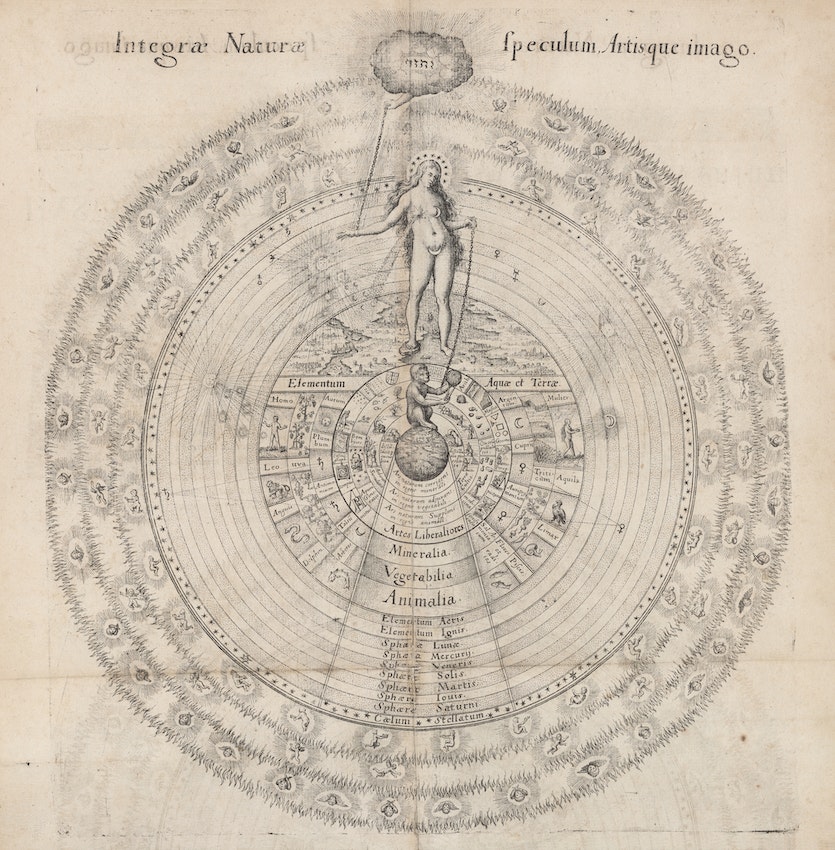
Between 1617 and 1621 the English physician and polymath Robert Fludd published his masterpiece Utriusque Cosmi . . . Historia, a two-volume work packed with over sixty intricate engravings. Urszula Szulakowska looks at the philosophical and theological ideas behind the extraordinary images found in the first volume, an exploration of the macrocosm of the universe and spiritual realm…
Robert Fludd was a respected English physician (of Welsh origins) employed at the court of King James I of England. He was a prolific writer of vast, multi-volume encyclopaedias in which he discussed a universal range of topics from magical practices — such as alchemy, astrology, kabbalism, and fortune-telling — to radical theological thinking concerning the interrelation of God with the natural and human worlds. However, he also proudly displayed his grasp of practical knowledge, such as mechanics, architecture, military fortifications, armaments, military manoeuvres, hydrology, musical theory and musical instruments, mathematics, geometry, optics, and the art of drawing, as well as chemistry and medicine. Fludd used the common metaphor for the arts as being the “ape of Nature”, a microcosmic form of how the universe itself functioned.
Fludd’s most famous work is the History of the Two Worlds (Utriusque Cosmi . . . Historia, 1617-21) published in two volumes by Theodore de Bry in Oppenheim. The two worlds under discussion are those of the Microcosm of human life on earth and the Macrocosm of the universe (which included the spiritual realm of the Divine).
Fludd himself was a staunch member of the Anglican Church. He was educated in the medical profession at St. John’s College in Oxford. At the turn of the seventeenth century, he set out for an extended period of travel on the continent. He spent a winter with some Jesuits, a Roman Catholic order deeply opposed to Protestantism who, nevertheless, tutored Fludd on magical practices. Fludd, however, always claimed to have worked out the theological and magical systems in his first volume of the Utriusque Cosmi . . . Historia (1617) during his undergraduate days at Oxford. In this work Fludd devised a lavishly illustrated cosmology based on the chemical theory of Paracelsus, in which the materials of the universe were separated out of chaos by God who acted in the manner of a laboratory alchemist…
All of Fludd’s treatises were lavishly illustrated with extraordinary engravings, unique in their form and subject matter, which have the visionary quality of a genuine spiritual seer and which exerted an influence on his contemporary occultists such as Michael Maier, Jacob Boehme, and Johannes Mylius. Fludd himself designed these images and they were engraved by the artisans employed at his publishers. (Some of his own original drawings still exist for the first volume of the Utriusque Cosmi . . . Historia, 1617)…

Read on for more explanation and many more mesmerizing images. A 17th century “theory of everything”: “Robert Fludd and His Images of The Divine,” in @PublicDomainRev.
* Carl Jung
###
As we think holistically, we might recall that it was on this date in 1859 that our perspective was shifted in a different kind of way: Charles Darwin published The Origin of the Species. Actually, on that day he published On the Origin of Species by Means of Natural Selection, or the Preservation of Favoured Races in the Struggle for Life; the title was shortened to the one we know with the sixth edition in 1872.
You must be logged in to post a comment.