Posts Tagged ‘Darwin’
“For you formed my inward parts; you knitted me together in my mother’s womb. I praise you, for I am fearfully and wonderfully made.”*…

DNA is indisputably important to biological development. But, Alfonso Martinez Arias argues, far from being a blueprint for an organism, genes are mere tools used by life’s true expert builders: cells…
… Over the past century, scientists have discovered a material explanation for the source of life, one that needs no divine intervention and provides a thread across eons of time for all beings that exist or have ever existed: deoxyribonucleic acid — DNA. While there is little doubt that genes have something to do with what we are and how we come to be, it is difficult to answer precisely the question of what their exact role in all of this is.
A closer look at how genes work and what they can accomplish, compared to what they are said to achieve, casts doubt on the assertion that the genome in particular contains an “operating manual” for us or any other living creature. When it comes to the creation of organisms, we’ve overlooked — or, more accurately, forgotten — another force. The origin and power of that force are cells.
What makes you and me individual human beings is not a unique set of DNA but instead a unique organization of cells and their activities…
A fascinating essay, adapted from Martinez Arias’ forthcoming book, The Master Builder- How the New Science of the Cell Is Rewriting the Story of Life: “Cells, Not DNA, Are The Master Architects Of Life,” in @NoemaMag.
[Image above: source]
* Psalm 139: 13–14
###
As we delve into design, we might send insightful birthday greetings to Ernst Mayr; he was born on this date in 1904. A taxonomist, tropical explorer, ornithologist, philosopher of biology, and historian of science, he is best remembered as one of the 20th century’s leading evolutionary biologists. His work contributed to the conceptual revolution that led to the modern evolutionary synthesis of Mendelian genetics, systematics, and Darwinian evolution, and to the development of the biological species concept.
His theory of peripatric speciation (a more precise form of allopatric speciation which he advanced), based on his work on birds, is still considered a leading mode of speciation, and was the theoretical underpinning for the theory of punctuated equilibrium, proposed by Niles Eldredge and Stephen Jay Gould. Mayr is sometimes credited with inventing modern philosophy of biology, particularly the part related to evolutionary biology, which he distinguished from physics due to evolutionary biology’s introduction of (natural) history into science.

“The excitement that a gambler feels when making a bet is equal to the amount he might win times the probability of winning it.”*…

This afternoon’s Super Bowl is yet to be played, but it is already destined for the record books…
The American Gaming Association expects 50.4 million Americans to wager legally on the game (up over 61% from last year), for a total of $16 Billion at stake (more than twice last year’s betting). To put this into context, in 2022, U.S. legal gambling totaled about $55 billion.
It will also be the first Championship game with an on-site sports book (though attendees don’t need to leave their seats to wager; Arizona is one of the 33 states [plus D.C.] in which they can make bets in licensed betting shops on the way to the game… or, of course, they can just use their phones to bet online).
Sports betting is exploding in the U.S. About 20% of U.S. adults said that they had placed sports bets in 2022. Some of those bets were through legal channels. But The AGA estimates that American also wagered almost $64 billion in 2021 with illegal sports books– part of the $511 Billion bet on those books, iGaming websites, and “skill games.”
These figures exclude the purchase of state lottery tickets, which has grown to over $100 billion. The average American spent $46 on lottery tickets in the U.S. in 2022; but the amounts varied wildly from state-to-state– in Massachusetts, residents spent an average of $805.30.
See also: “How Sports Betting Upended the Economies of Native American Tribes.”
* Blaise Pascal, whose correspondence with Pierre de Fermat on gambling laid the foundation for the modern theory of probability
###
As we wonder about wagering, we might send insightful birthday greetings to Charles Darwin; he was born on this date in 1809. A naturalist, geologist, and biologist, he is widely known for his contributions to evolutionary biology. His proposition that all species of life have descended from a common ancestor is now generally accepted and considered a fundamental concept in science.
In a 1858 joint publication with Alfred Russel Wallace, he introduced his scientific theory that this branching pattern of evolution resulted from a process he called natural selection, in which the struggle for existence has a similar effect to the artificial selection involved in selective breeding. Darwin published a more complete version of his theory of evolution, with compelling evidence. in his 1859 book On the Origin of Species.
Darwin’s scientific discovery is the unifying theory of the life sciences, explaining the diversity of life– for which he has been described as one of the most influential figures in human history.

“Look deep into nature, and then you will understand everything better”*…

Philip Ball unpacks the geometric rules that define eyes, honeycombs, and soap bubbles…
How do bees do it? The honeycombs in which they store their amber nectar are marvels of precision engineering, an array of prism-shaped cells with a perfectly hexagonal cross-section. The wax walls are made with a very precise thickness, the cells are gently tilted from the horizontal to prevent the viscous honey from running out, and the entire comb is aligned with the Earth’s magnetic field. Yet this structure is made without any blueprint or foresight, by many bees working simultaneously and somehow coordinating their efforts to avoid mismatched cells.
The ancient Greek philosopher Pappus of Alexandria thought that the bees must be endowed with “a certain geometrical forethought.” And who could have given them this wisdom, but God? According to William Kirby in 1852, bees are “Heaven-instructed mathematicians.” Charles Darwin wasn’t so sure, and he conducted experiments to establish whether bees are able to build perfect honeycombs using nothing but evolved and inherited instincts, as his theory of evolution would imply.
Why hexagons, though? It’s a simple matter of geometry. If you want to pack together cells that are identical in shape and size so that they fill all of a flat plane, only three regular shapes (with all sides and angles identical) will work: equilateral triangles, squares, and hexagons. Of these, hexagonal cells require the least total length of wall, compared with triangles or squares of the same area. So it makes sense that bees would choose hexagons, since making wax costs them energy, and they will want to use up as little as possible—just as builders might want to save on the cost of bricks. This was understood in the 18th century, and Darwin declared that the hexagonal honeycomb is “absolutely perfect in economizing labor and wax.”
Darwin thought that natural selection had endowed bees with instincts for making these wax chambers, which had the advantage of requiring less energy and time than those with other shapes. But even though bees do seem to possess specialized abilities to measure angles and wall thickness, not everyone agrees about how much they have to rely on them. That’s because making hexagonal arrays of cells is something that nature does anyway…
More at: “Why Nature Prefers Hexagons,” from @philipcball in @NautilusMag.
* Albert Einstein
###
As we study structure, we might spare a thought for Agostino Bassi; he died on this date in 1856. An entomologist, he discovered that the muscardine disease of silkworms was caused by a very small parasitic organism, a fungus that would be named eventually Beauveria bassiana in his honor. The insight led him to argue that not only animal (insect), but also human diseases are caused by other living microorganisms (e.g., measles, syphilis, and the plague)– meaning that he preceded Louis Pasteur in the discovery that microorganisms can be the cause of disease (the germ theory of disease).

“The element of mystery to which you want to draw attention should be surrounded and veiled by a quite obvious, readily recognisable commonness”*…
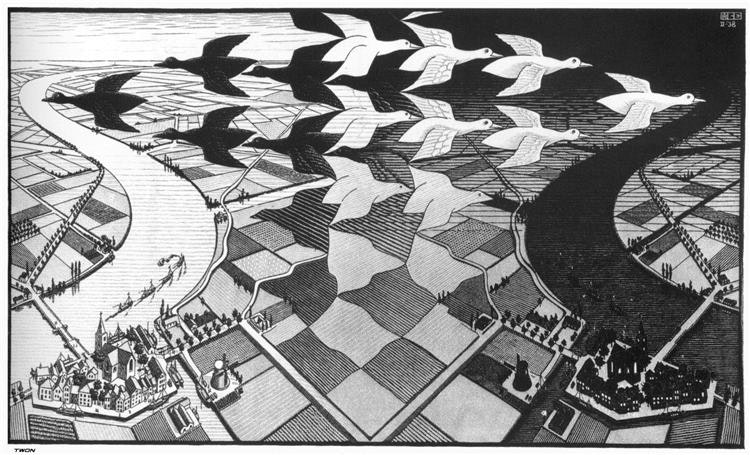
An appreciation of the marvelous M.C. Escher…
Despite being a fan of Rennaisance Art and the work of the Impressionists, he feels increasingly pulled in a different direction…
When you look at this picture, you’re flipping between world views. Either you’re seeing the white birds, and the bright, presumably sunlit day scene with its cheerful flotilla of steam ships puffing their way upriver – or you’re seeing the black birds, and your eye is drawn to the night-shrouded landscape where the houses have their lights on and the sky’s already eaten the horizon & is creeping nearer…
Except, that’s not quite right. The black birds are in the daylight side, and the white ones are flying into the night. These aren’t just mirror images: they’re like the Ancient Chinese yin-yang symbol, each side containing part of its opposite…
Escher’s love of the fantastical is primarily inspired by what he sees around him, not what he can dream up out of next to nothing… By looking closely at the real world, and trying to understand how it works, Escher will invite his initially small but intensely loyal fanbase to explore some very strange mysteries indeed.
…

It’s the 1960s now, and nonconformity is all the rage. Hair is getting longer, psychedelics-powered artistry is flourishing, and anything that seems to scream to hell with the rules is increasingly in vogue… Because of the fantastical elements of his work, Escher is acquiring a reputation as a surrealist. As a self-identifying “reality enthusiast,” it’s the very last thing he wants. Take Ascending & Descending, where he’s clearly turning his imagination to the futility of so much in the human-centred world. In a letter to a friend, he says:
“Yes, yes, we climb up and up, we imagine we are ascending; one step is about 10 inches high, terribly tiring – and where does it get us? Nowhere.”
But until the end of his career, his work will continue to speak to something deeper – a rebellion against human incuriosity, or a constant rallying-cry for the act of paying attention…
Read it in full: “Fooling With Certainty: The Impossibly Real Worlds Of MC Escher,” from Mike Sowden (@Mikeachim)
* M. C. Escher
###
As we look closely, we might recall that it was on this date in 1859 that our perspective was shifted in a different kind of way: Charles Darwin published The Origin of the Species. Actually, on that day he published On the Origin of Species by Means of Natural Selection, or the Preservation of Favoured Races in the Struggle for Life; the title was shortened to the one we know with the sixth edition in 1872.

(Roughly) Daily will be on a brief Thanksgiving hiatus, returning when the the tryptophan haze has passed…
“I like it when a flower or a little tuft of grass grows through a crack in the concrete. It’s so f#@kin’ heroic.”*…

From dilapidated power plants, abandoned medical facilities, and amusement parks left in rusted ruin, the compelling scenes that French photographer Jonathan Jimenez, aka Jonk (previously), captures are evidence of nature’s endurance and power to reclaim spaces transformed by people. Now compiled in a new book titled Naturalia II, 221 images shot across 17 countries frame the thriving vegetation that crawls across chipped concrete and architecture in unruly masses.
This succeeding volume is a follow-up to Jonk’s first book by the same name and focuses on the ways the ecological crisis has evolved during the last three years. He explains the impetus for the book in a statement:
On the one hand, the situation has deteriorated even further with yet another species becoming extinct every single day. Global warming continues and has caused repeated natural catastrophes: floods, fires, droughts, etc. On the other hand, our collective awareness has widely increased. We are still a long way from the commitment needed to really change things, but we are heading in the right direction. Millions of initiatives have already emerged, and I hope that my photos and the message contained within them can play a small part in the collective challenge facing us all…

More at “Nature Resurges to Overtake Abandoned Architecture in a New Book of Photos by Jonk” and at his site.
On an apposite note: “Forest the size of France regrown worldwide over 20 years, study finds.”
* George Carlin
###
As we inspect the inexorable, we might spare a thought for Hugo Marie de Vries; he died on this date in 1935. A botanist, he introduced the experimental study of organic evolution– and was, thus, was one of the first geneticists. His rediscovery in 1900 (simultaneously with the botanists Carl Correns and Erich Tschermak von Seysenegg) of Gregor Mendel’s principles of heredity and his theory of biological mutation, though considerably different from a modern understanding of the phenomenon, resolved ambiguous concepts concerning the nature of variation of species that, until then, had precluded the universal acceptance and active investigation of Charles Darwin’s system of organic evolution.
He suggested the concept of genes and introduced the term “mutation”, and developed a mutation theory of evolution.

You must be logged in to post a comment.