Posts Tagged ‘heredity’
“An understanding of the natural world, and what’s in it is a source of not only great curiosity but great fulfillment”*…
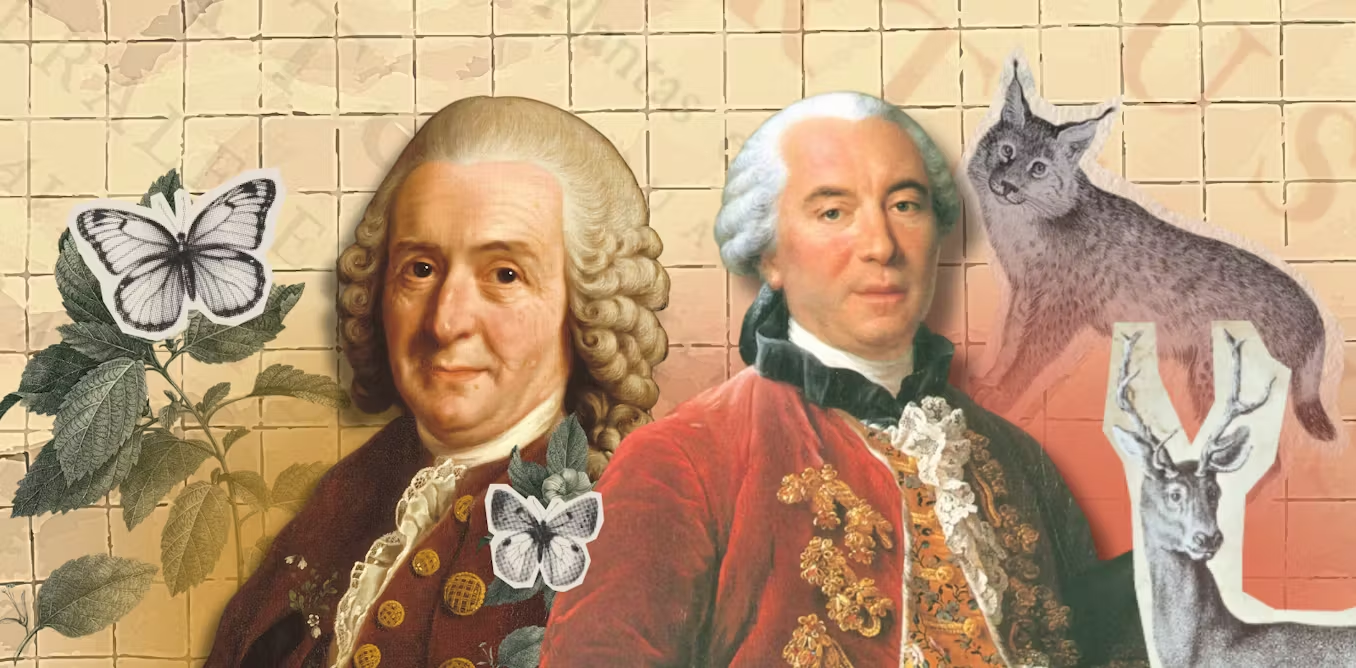
Ah yes, but in what does that understanding consist? John Long considers the competing frameworks of Linnaeus and Buffon…
The modern science biography must hold back no punches in its mission to represent the subject’s life, equally celebrating their great works while including their personal shortcomings.
Jürgen Neffe’s Einstein: A Biography (2005) and Dava Sobel’s The Elements of Marie Curie (2024) are wonderful examples of this style. Such books succeed in clearly explaining the complex science of their subject’s work for non-scientific readers, enabling a deep appreciation of their achievements and bringing them to life as rounded, flawed humans.
The modern science biography must hold back no punches in its mission to represent the subject’s life, equally celebrating their great works while including their personal shortcomings.
Jürgen Neffe’s Einstein: A Biography (2005) and Dava Sobel’s The Elements of Marie Curie (2024) are wonderful examples of this style. Such books succeed in clearly explaining the complex science of their subject’s work for non-scientific readers, enabling a deep appreciation of their achievements and bringing them to life as rounded, flawed humans.
Jason Roberts’ Every Living Thing – The Great and Deadly Race to Know all Life is another of these rare works. This engrossing, precisely researched book focuses on two central characters born in the same year: Carl Linnaeus (1707-1778), a Swede, and Frenchman Georges-Louis LeClerc, the Compte de Buffon (1707-1788), better known as just Buffon.
Roberts’ book won the 2025 Pulitzer Prize for biography. His writing pulls the reader effortlessly through the story, revealing delightful, unexpected twists and turns in the two men’s complex and disparate lives. Each worked diligently to reach a level of global notoriety for their many published books. Both are revered in the natural history world today.
Linnaeus, a biologist and physician, is known for his system of hierarchical classification: how all living things comprise a genus and species, (we humans are Homo sapiens), which fit into families, orders, classes and so on. (A good many intermediate ranks were added later). While his work has been hugely influential, Linnaeus is portrayed by Roberts at times as being lazy, vain and unethical.
Linnaeus was primarily driven to be the first to name new species. Buffon was working on a grand thesis of how all life’s organisms function and are related to one another. A wealthy count who inherited a vast fortune at the age of ten, Buffon trained as a lawyer but became fascinated by the trees that grew in his large garden.
Buffon is best known today for his extensive books on natural history and works on mathematics and cosmology. He calculated the Earth was much older than the Bible predicted and that life sprung from unorganised matter. He explored the relationships between organisms rather than how they were classified. His core work formed the basis for modern evolutionary theory.
Why was all this important? At the time, the task of classifying plants was vital to the growing economies of nations. Travellers to the far reaches of the globe brought back examples of economically valuable new species, like plant foods, medicinal plants or beautiful ornamental specimens.
The author’s central thesis is Linnaeus was not as brilliant as history paints him and Buffon was a far greater genius for his day.
Where does genius come from, Roberts asks? Is it inherent by birth, grown from an inspiring education, or is it something within that is nurtured by passion?
Both these brilliant men who made a lasting mark on science came from not very inspiring families. Nor did they excel at school or university. This story shows success in academic work is not just about intellect, but intimately tied to the ethics and morality of doing research…
Eminently worth reading in full: “How do we understand life on Earth? A prize-winning biography charts the tension between two types of science ‘genius’” from @theconversation.com.
* David Attenborough, who also observed, “We moved from being a part of nature to being apart from nature.”
###
As we noodle on knowing, we might send birthday greetings to Gregor Mendel; he was born on this date in 1822 (though some sources give the date as July 20). A botanist, geneticist, and monk, he pioneered in the study of heredity.
Mendel spent his adult life with the Augustinian monastery in Brunn, where as a plant experimenter, he was the first to lay the mathematical foundation of the science of genetics, in what came to be called Mendelism. Over the period 1856-63, Mendel grew and analyzed over 28,000 pea plants. He carefully studied for each their plant height, pod shape, pod color, flower position, seed color, seed shape and flower color. He made two very important generalizations from his pea experiments, known today as the Laws of Heredity, and coined the genetic terms recessiveness and dominance. He read a paper on his studies in 1865 to the Brünn Society for Natural Sciences in Moravia– but it lay unappreciated until 1900.

“The unexamined life is not worth living”*…

Diana Gitig reports on research that suggests that some of us agree more actively with Socrates than do others– and for a baked-in reason…
People who enroll in genetic studies are genetically predisposed to do so.
According to the Catalogue of Bias, ascertainment bias occurs when a sample being studied is not representative of the target population. This can produce misleading or even false conclusions, and it can be hard to detect since it cannot usually be identified by examining the sample alone. This is why many studies try to use variables other than participation in the study to make sure their samples are as representative as possible.
Studies examining how a particular treatment affects a particular health outcome often try to handle ascertainment bias by adjusting for “covariates,” things like education level or socioeconomic status, that could affect health outcomes independently of the treatment. But Stefania Benonisdottir and Augustine Kong at Oxford’s Big Data Institute have just demonstrated that we can determine if genetic studies are biased using nothing but the genes of the participants.
And they used that technique to show that there’s a genetic contribution that influences the tendency to participate in genetic studies…
People in a genetic database have segments of DNA in common unexpectedly often: “Want to have your genes tested? It might be genetic,” in @arstechnica.
The Benonisdottir and Kong paper, in Nature Genetics, is here.
* Socrates
###
As we battle bias, we might send systemic birthday greetings to Sergei Winogradsky; he was born on this date in 1856. A microbiologist, ecologist, and soil scientist, he discovered chemoautotrophy (now better known as known as chemosynthesis) and the the Nitrogen cycle— which is to say that he pioneered the cycle-of-life concept.


“I like it when a flower or a little tuft of grass grows through a crack in the concrete. It’s so f#@kin’ heroic.”*…

From dilapidated power plants, abandoned medical facilities, and amusement parks left in rusted ruin, the compelling scenes that French photographer Jonathan Jimenez, aka Jonk (previously), captures are evidence of nature’s endurance and power to reclaim spaces transformed by people. Now compiled in a new book titled Naturalia II, 221 images shot across 17 countries frame the thriving vegetation that crawls across chipped concrete and architecture in unruly masses.
This succeeding volume is a follow-up to Jonk’s first book by the same name and focuses on the ways the ecological crisis has evolved during the last three years. He explains the impetus for the book in a statement:
On the one hand, the situation has deteriorated even further with yet another species becoming extinct every single day. Global warming continues and has caused repeated natural catastrophes: floods, fires, droughts, etc. On the other hand, our collective awareness has widely increased. We are still a long way from the commitment needed to really change things, but we are heading in the right direction. Millions of initiatives have already emerged, and I hope that my photos and the message contained within them can play a small part in the collective challenge facing us all…

More at “Nature Resurges to Overtake Abandoned Architecture in a New Book of Photos by Jonk” and at his site.
On an apposite note: “Forest the size of France regrown worldwide over 20 years, study finds.”
* George Carlin
###
As we inspect the inexorable, we might spare a thought for Hugo Marie de Vries; he died on this date in 1935. A botanist, he introduced the experimental study of organic evolution– and was, thus, was one of the first geneticists. His rediscovery in 1900 (simultaneously with the botanists Carl Correns and Erich Tschermak von Seysenegg) of Gregor Mendel’s principles of heredity and his theory of biological mutation, though considerably different from a modern understanding of the phenomenon, resolved ambiguous concepts concerning the nature of variation of species that, until then, had precluded the universal acceptance and active investigation of Charles Darwin’s system of organic evolution.
He suggested the concept of genes and introduced the term “mutation”, and developed a mutation theory of evolution.

“Just as the twig is bent, the tree’s inclined”*…

In certain forests, when you look up you will see a network of cracks formed by gaps between the outermost edges of the tree branches. It looks like a precisely engineered jigsaw puzzle, each branch growing just perfectly so it almost—but not quite—touches the neighboring tree. This beautiful phenomenon is called crown shyness.
Crown shyness doesn’t happen all the time, and scientists aren’t completely certain why it happens at all…
The forest keeps its secrets… Despite decades of study– and a profusion of postulation– no one yet fully understands “The Mysteries of Crown Shyness.”
* Alexander Pope
###
As we keep to ourselves, we might spare a thought for Gregor Johann Mendel; he died on this date in 1884. After a profoundly-unpromising start, Mendel became a scientist, Augustinian friar, and abbot of St. Thomas’ Abbey in Brno, Moravia (today’s Czech Republic). A botanist and plant experimenter, he was the first to lay the mathematical foundation of the science of genetics (of which he is now consider the “Father”). Over the period 1856-63, Mendel grew and analyzed over 28,000 pea plants. He carefully studied the height, pod shape, pod color, flower position, seed color, seed shape and flower color of each– and from those observations derived two very important generalizations, known today as the Laws of Heredity.

Feeling blue?…

Your correspondent recently received an email from a genealogically-inclined first cousin concerning a possible common ancestor, one Martin Fugate, who, it appears, may be our great-great-great-great-great-grandfather. Grandpa Martin was an orphan, an immigrant from France to Kentucky in the late 18th Century– unremarkable for the time in any way, but one: he seems to have introduced into his bloodline a rare condition called “methemoglobinemia“… that’s to say, for generations to come many offspring were (and are) born with blue skin coloring…
Benjamin “Benjy” Stacy so frightened maternity doctors with the color of his skin — “as Blue as Lake Louise” — that he was rushed just hours after his birth in 1975 to University of Kentucky Medical Center.
As a transfusion was being readied, the baby’s grandmother suggested to doctors that he looked like the “blue Fugates of Troublesome Creek.” Relatives described the boy’s great-grandmother Luna Fugate as “blue all over,” and “the bluest woman I ever saw.”
In an unusual story that involves both genetics and geography, an entire family from isolated Appalachia was tinged blue. Their ancestral line began six generations earlier with a French orphan, Martin Fugate, who settled in Eastern Kentucky.
Doctors don’t see much of the rare blood disorder today, because mountain people have dispersed and the family gene pool is much more diverse. But the Fugates’ story still offers a window into a medical mystery that was solved through modern genetics and the sleuth-like energy of Dr. Madison Cawein III, a hematologist at the University of Kentucky’s Lexington Medical Clinic…
Read the rest of this ABC News story here. And find a more complete version of the history in the Science 82 report here.
As we remind ourselves that in-breeding isn’t restricted to the South, we might recall that it was on this date in 1828 that John Adams II, son of then-President John Quincey Adams, married his first cousin, Mary Catherine Hellen, in a White House ceremony. John II’s grandfather, President John Adams, had married his third cousin, Abigail Smith. Intermarriage skipped a generation with John Quincy Adams, who married a non-relative.
Then, in 1853, John II’s and Mary’s daughter, Mary Louisa Adams, also married a family member–her second cousin, William Clarkson Johnson, the son of her first cousin, Abigail Louisa Smith Adams– President John Adams’ great-grandson… notable for two reasons: both bride and groom were descended from President John Adams, and at the same time, it was the first marriage between descendants of two different presidents.
 John Adams II (source)
You must be logged in to post a comment.