“It may have been quixotic, but it was magnificent”*…
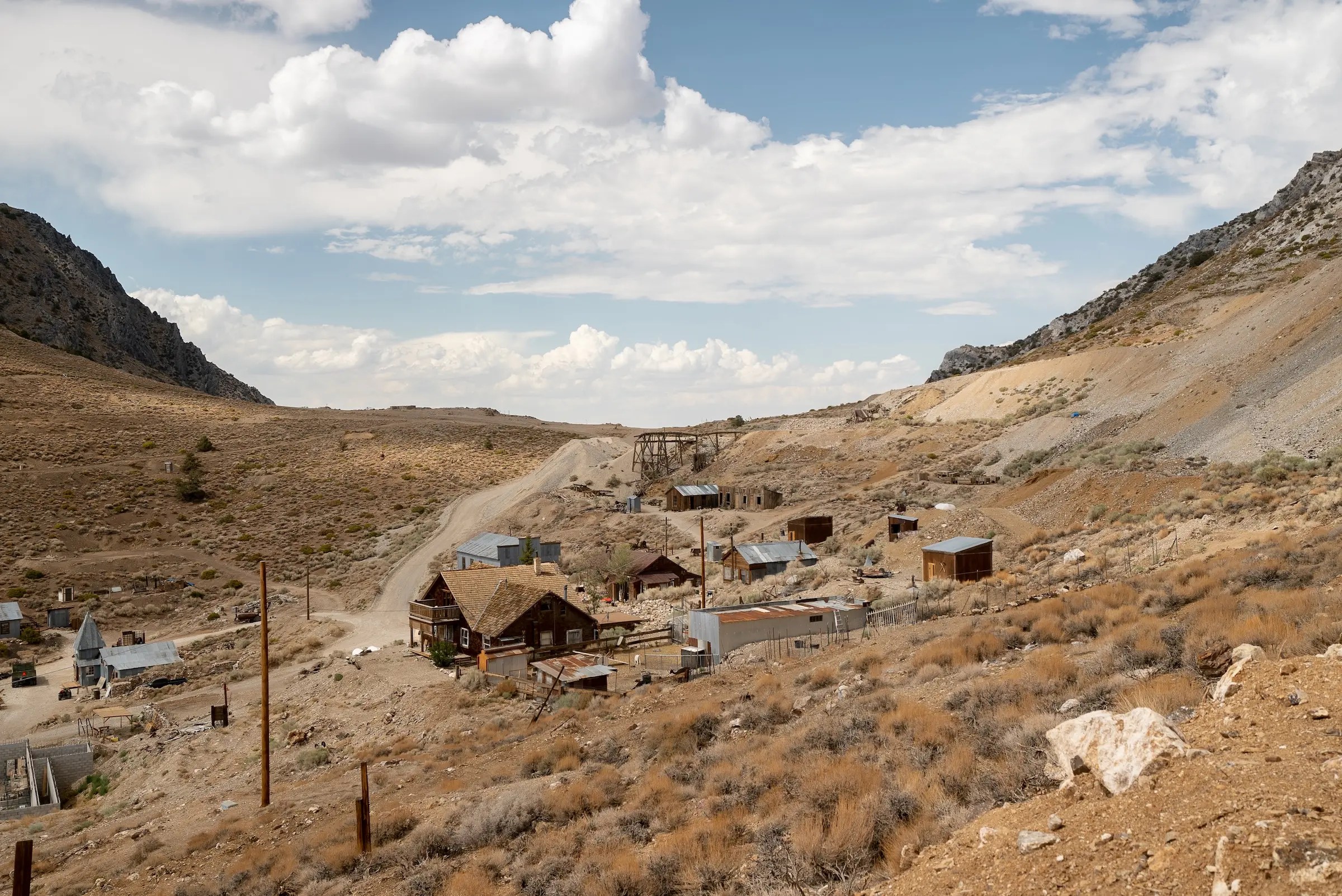
In July of 2018, Brent Underwood purchased the former mining town of Cerro Gordo alongside the abandoned Cerro Gordo Mines for $1.4 million. His plan was– and is– to develop the town into an artist destination for tourists and group events, while maintaining the historic nature of the property.
He checks in on how it’s going…
If you ever plan on riding out a pandemic in an abandoned mining town at 8,200 feet, there are a few things I’d recommend bringing: a four-wheel-drive truck, more than a few days of food, and at least some decent boots.
I brought none of these.
Instead, I arrived at Cerro Gordo, California, in the middle of a blizzard in March 2020, driving a base model Tacoma, and wearing white Allbirds, a few inches of ankle showing. A quarter mile from town, my bald tires slid off the road, the truck got stuck, and I walked the rest of the way in.
Six years later, I’m still here. I’ve traded my Allbird slippers for steel-toed boots and my Tacoma for a Tundra. And most of the things that once felt absurd—like getting buried in snow in March—barely register. My mailbox is an hour away and 4,500 feet in elevation below me. My driveway is an eight-mile dirt road that is almost never maintained. My bathroom is an outhouse where, on windy days, dust of questionable origin comes up through the floorboards. In the winter, sometimes I wake up to the thermometer reading 17 degrees. Indoors.
But the strangest thing about living here, after a decade of living in cities like New York and Austin, is how quickly it stops feeling strange at all.
Maybe I shouldn’t be surprised. Thousands of people have chosen to live in Cerro Gordo over the years. In the late 1800s, it was home to California’s largest silver mine, surrounded by hundreds of buildings and thousands of residents. There were at least five hotels, seven saloons, two brothels, three general stores, multiple restaurants, barber shops, and even doctors and lawyers—but no jail…
The rest of his remarkable report: “What It’s Actually Like to Live in an Abandoned California Ghost Town,” from @outsidemag.bsky.social.
For a reverse angle, see this story of a centuries-old practice: “How Rome’s Urban Shepherds Adapt and Survive”
* J. M. Barrie, Peter and Wendy (better known as Peter Pan)
###
As we get away from it all, we might recall that it was on this date in 1217 that The Charter of the Forest was first issued by the young King Henry III (acting under the regency of William Marshal, 1st Earl of Pembroke) as a complementary charter to Magna Carta from which it had evolved. The Charter of the Forest re-established rights of access for free men to the royal forest that had been eroded by King William the Conqueror and his heirs. Many of its provisions were in force for centuries afterwards. Indeed, In 1154, King Henry II had placed new restrictions and levies on woodland, fields, and heathland.
While Magna Carta dealt largely with the rights of barons, The Charter of the Forest restored to the commoner some fundamental rights, privileges, and protections against the abuses of an encroaching aristocracy. It returned rights to the common man including access, pasture, grazing, turf cutting, and firewood collection, and ended harsh penalties.

You must be logged in to post a comment.