Posts Tagged ‘ghost town’
“It may have been quixotic, but it was magnificent”*…
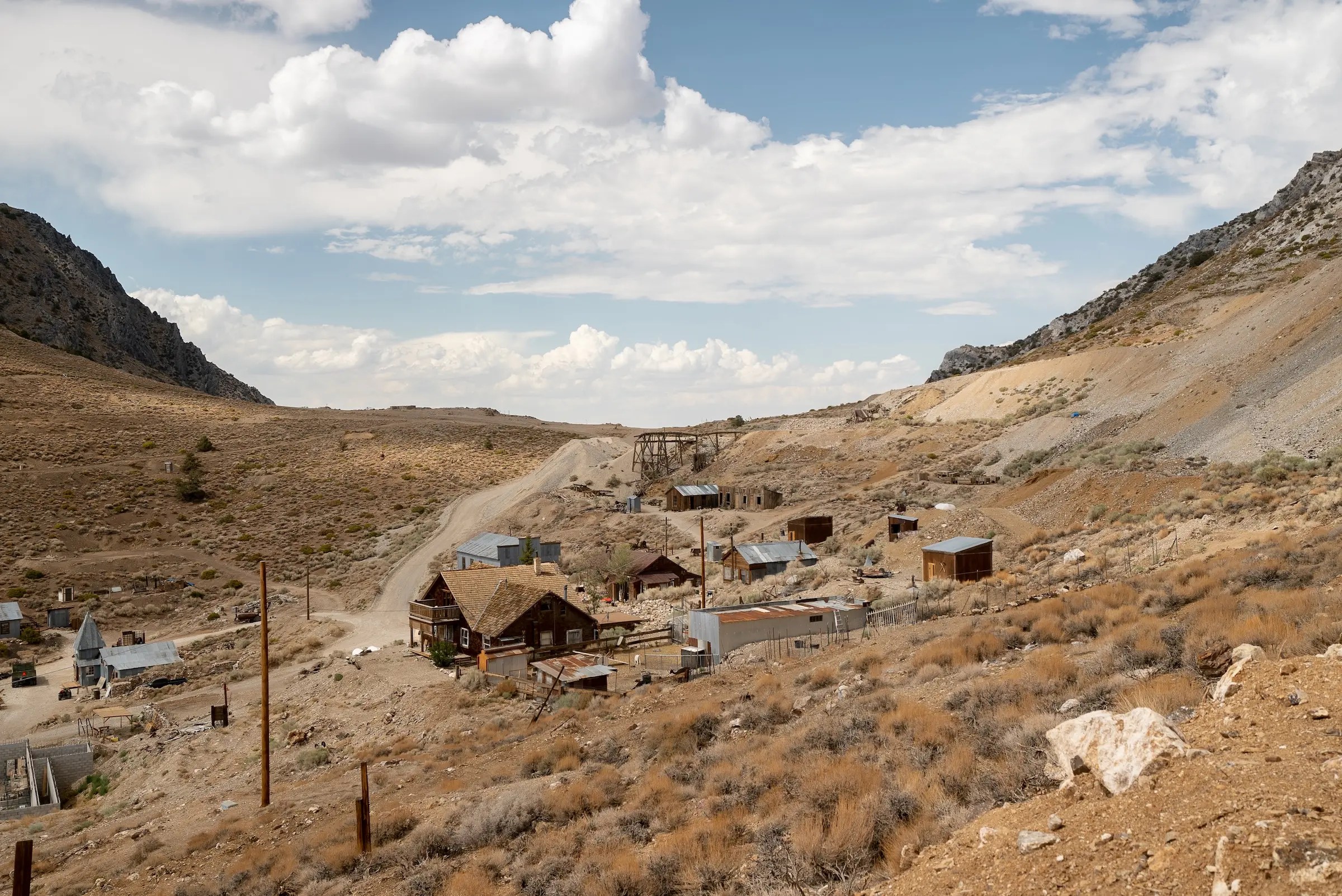
In July of 2018, Brent Underwood purchased the former mining town of Cerro Gordo alongside the abandoned Cerro Gordo Mines for $1.4 million. His plan was– and is– to develop the town into an artist destination for tourists and group events, while maintaining the historic nature of the property.
He checks in on how it’s going…
If you ever plan on riding out a pandemic in an abandoned mining town at 8,200 feet, there are a few things I’d recommend bringing: a four-wheel-drive truck, more than a few days of food, and at least some decent boots.
I brought none of these.
Instead, I arrived at Cerro Gordo, California, in the middle of a blizzard in March 2020, driving a base model Tacoma, and wearing white Allbirds, a few inches of ankle showing. A quarter mile from town, my bald tires slid off the road, the truck got stuck, and I walked the rest of the way in.
Six years later, I’m still here. I’ve traded my Allbird slippers for steel-toed boots and my Tacoma for a Tundra. And most of the things that once felt absurd—like getting buried in snow in March—barely register. My mailbox is an hour away and 4,500 feet in elevation below me. My driveway is an eight-mile dirt road that is almost never maintained. My bathroom is an outhouse where, on windy days, dust of questionable origin comes up through the floorboards. In the winter, sometimes I wake up to the thermometer reading 17 degrees. Indoors.
But the strangest thing about living here, after a decade of living in cities like New York and Austin, is how quickly it stops feeling strange at all.
Maybe I shouldn’t be surprised. Thousands of people have chosen to live in Cerro Gordo over the years. In the late 1800s, it was home to California’s largest silver mine, surrounded by hundreds of buildings and thousands of residents. There were at least five hotels, seven saloons, two brothels, three general stores, multiple restaurants, barber shops, and even doctors and lawyers—but no jail…
The rest of his remarkable report: “What It’s Actually Like to Live in an Abandoned California Ghost Town,” from @outsidemag.bsky.social.
For a reverse angle, see this story of a centuries-old practice: “How Rome’s Urban Shepherds Adapt and Survive”
* J. M. Barrie, Peter and Wendy (better known as Peter Pan)
###
As we get away from it all, we might recall that it was on this date in 1217 that The Charter of the Forest was first issued by the young King Henry III (acting under the regency of William Marshal, 1st Earl of Pembroke) as a complementary charter to Magna Carta from which it had evolved. The Charter of the Forest re-established rights of access for free men to the royal forest that had been eroded by King William the Conqueror and his heirs. Many of its provisions were in force for centuries afterwards. Indeed, In 1154, King Henry II had placed new restrictions and levies on woodland, fields, and heathland.
While Magna Carta dealt largely with the rights of barons, The Charter of the Forest restored to the commoner some fundamental rights, privileges, and protections against the abuses of an encroaching aristocracy. It returned rights to the common man including access, pasture, grazing, turf cutting, and firewood collection, and ended harsh penalties.

“I am a ruin myself, wandering among ruins”*…

The abandoned Hachijo Royal Hotel on the island of Hachijojima
Japan is in some sense uniquely blessed as a land of ruins. Its rapidly aging population, low birth rate, urbanization and lack of immigration have left a legacy of ghost towns and more than 8 million abandoned homes, or akiya. That tally could hit 21.5 million, one-third of all residences nationwide, by 2033, according to the Nomura Research Institute.
Abandoned homes are ubiquitous in rural Japan, posing health and safety hazards to locals, but they can even be found in central Tokyo, vacant edifices that for whatever reason owners refuse to demolish and rebuild.
In addition to the scourge of abandoned homes, Japan is dealing with lingering effects of the asset-inflated bubble economy of the 1980s and 1990s that saw the construction of numerous hotels, theme parks and other leisure facilities that went bust when the bubble burst. Some money-losing facilities, including the ill-fated Canadian World in Ashibetsu, Hokkaido, themed on the popular “Anne of Green Gables” novels by Lucy Maud Montgomery, were rehabilitated into public parks. But in all too many cases, others were left to rot…
More on the “ghost towns” of Japan at “The lure of Japan’s mysterious ruins.”
* Heinrich Heine
###
As we keep our ear peeled for echoes, we might we might send majestic 100th birthday greetings to the U.S. National Park Service; it was founded on this date in 1916.

You must be logged in to post a comment.