“History Does Not Repeat Itself, But It Rhymes”*…
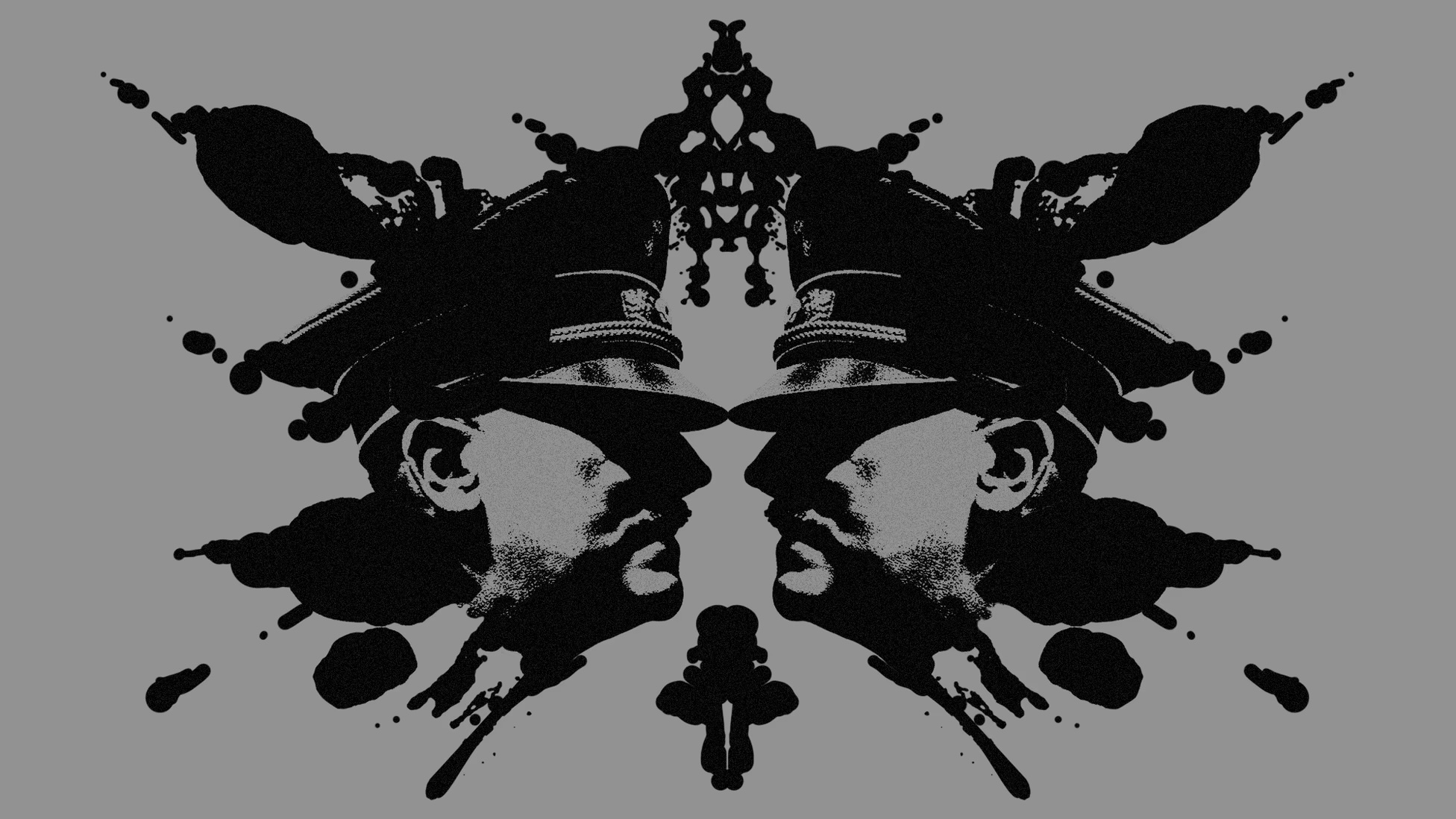
The estimable Tim Ryback on the secret government report that previewed Hitler’s final two years in power…
In the Spring of 1943, Walter C. Langer, a psychoanalyst at Harvard [see here], received a query from William J. Donovan, the head of the U.S. government’s Office of Strategic Services, the covert-operations predecessor to the CIA. Donovan was interested in commissioning Langer to prepare a psychological profile of Adolf Hitler.
“What we need is a realistic appraisal of the German situation,” Donovan told Langer. “If Hitler is running the show, what kind of a person is he? What are his ambitions? How does he appear to the German people? What is he like with his associates?” The OSS chief wanted to understand Hitler’s “psychological make-up—the things that make him tick.” Donovan was especially keen to know how Hitler might respond to increasing adversity.
Hitler was used to winning. From 1933 to 1943, the Nazi leader had marched from one stunning political and military triumph to the next, securing the chancellorship, crushing the German constitutional order, annexing Austria, dismembering Czechoslovakia, and then invading Poland, France, Belgium, the Netherlands, Denmark, countries across North Africa, and Russia. Until 1943, Hitler had seemed to be an inexorable political and military force, smashing constitutional guardrails, shredding international treaties, breaking trade alliances, upending the international order, and ultimately plunging the entire world into war.
But then came military reversals that stopped Hitler in his tracks: El Alamein, in November 1942, then Stalingrad, in January 1943. Donovan wanted to know how Hitler would react—militarily, politically, personally—if the tides of war began to change. “Do you suppose you could come up with something along these lines?” Donovan asked Langer.
This was the first time the U.S. government would commission a psychological profile of a foreign leader to determine his possible future courses of action. Donovan was not interested in an academic study. Rather, he wanted a “realistic appraisal” that might provide actionable intelligence about what the führer might do next.
Langer engaged three fellow psychoanalysts—one from Harvard, one from the New School for Social Research, and one of the New York Psychoanalytic Institute—and set to work. He immersed himself in Hitler’s speeches and writings. He read both volumes of Mein Kampf front to back. He collected newspaper clippings and magazine articles. He interviewed former Hitler associates who had broken with the Nazi leader and were now living in exile.
“The world has come to know Adolph Hitler for his insatiable greed for power, his ruthlessness, cruelty and utter lack of feeling, his contempt for established institutions and his lack of moral restraints,” Langer wrote in framing the scope of his work. “In the course of relatively few years he has contrived to usurp such tremendous power that a few veiled threats, accusations or insinuations were enough to make the world tremble.” It was only when the world wearied of Hitler’s threats and bluster, “and concluded that it was all a bluff,” Langer wrote, that the Nazi leader had “initiated the most brutal and devastating war in history.”
Hitler was a man, Langer was told repeatedly, with an insatiable ego who needed to be the center of attention, always, everywhere. Hitler saw himself as the ultimate authority in all matters regardless of their import or insignificance. “It makes little difference whether the field be economics, education, foreign affairs, propaganda, movies, music or women’s dress,” Langer reported. “In each and every field he believes himself to be an unquestioned authority.”…
[Ryback further describes Langer’s unpacking of Hitler’s psche, concluding…]
… Although this was likely not the kind of “actionable intelligence” that the OSS chief had been seeking, Langer, schooled in Freudian psychology, devoted much of his report to psychoanalysis of the Nazi leader. “Hitler’s outstanding defense mechanism is one commonly called projection,” Langer wrote. “It is a technique by which the ego of an individual defends itself against unpleasant impulses, tendencies or characteristics by denying their existence in himself while he attributes them to others.”
As evidence, Langer noted that Hitler accused his political opponents of the “bombardment of lies” that Hitler himself assailed them with. Hitler’s hatred of the Jews, Langer theorized, emanated from hatred of himself: Hitler’s “own personal problems and conflicts were transferred from within himself to the external world where they assumed the proportions of racial and national conflicts.”
Langer attributed Hitler’s rages, hatreds, obsessions, and delusions to an unhappy childhood with a brutish father and an emotionally battered but loving mother. Langer also spent considerable time analyzing Hitler’s preoccupation with architectural projects—in particular, the Eagle’s Nest, outside Berchtesgaden, Germany.
“First there is a long hard road, then a heavily guarded entrance, a trip through a long tunnel to an extremely inaccessible place. There one can be alone, safe and undisturbed, and revel in the joys that Mother Nature bestows,” Langer wrote. “From a symbolic point of view one can easily imagine that this is a materialization of a child’s conception of the return to the womb.”
By October 1943, when Langer’s report was rushed to completion at Donovan’s insistence, Hitler was on his back heel but hardly finished. London was being pummelled. Rumors of a Wunderwaffe, a “miracle weapon,” that could change the course of the war proliferated. German physicists, led by Werner Heisenberg, were at work on an atomic bomb.
Göring had already developed a prototype for a delivery mechanism—the Messerschmitt Me 264, dubbed the “Amerika Bomber”—and Manhattan was its first target. Hitler “described the skyscrapers being turned into gigantic burning torches, collapsing upon one another, the glow of the exploding city illuminating the dark sky,” Hitler’s armament minister, Albert Speer, recalled. “With such range we could repay America a thousandfold for the destruction of our cities.”
Not until the final three pages of his long report did Langer provide the “realistic appraisal” of Hitler’s potential courses of action that Donovan had been seeking. Based on his interviews and his review of 11,000 pages of source materials, Langer discerned scenarios for Hitler’s possible reactions were he to face ultimate defeat. Langer thought it unlikely that Hitler would try to escape to another country, as dictators were known to do—because “nothing would break the myth” of Hitler as a great leader more assuredly than running away.
Although Langer doubted that Hitler would allow himself to fall into the hands of the Allies, he did not rule out the possibility that the führer’s warped personality could welcome such an outcome, citing the case of a 16th-century religious fanatic who, when his theocratic cult was disbanded, asked to be paraded around in a cage. “In Hitler’s case such an outcome seems remote,” Langer wrote, “but it is difficult to estimate the extent to which an extreme masochist will go in order to gratify these tendencies.”
Langer did think it possible that Hitler would sacrifice himself in combat. “When he is convinced that he cannot win, he may lead his troops into battle and expose himself as the fearless and fanatical leader,” Langer wrote. But it was equally likely, Langer concluded, that Hitler would suffer a complete nervous breakdown. “Hitler has many characteristics which border on the schizophrenic,” Langer continued. “This would not be an undesirable eventuality from our point of view since it would do much to undermine the Hitler legend.”
Langer presciently posited suicide as the most likely scenario. He knew that Hitler had always been a man whose “infantile thinking” drove him to extremes and blinded him to compromise. Hitler sacrificed an entire army at Stalingrad, and his entire Afrika Korps in Tunisia. Langer cited Hitler’s fatalistic fanaticism verbatim: “We shall not capitulate … no, never. We may be destroyed, but if we are, we shall drag a world with us … a world in flames.”
If anything, Langer suggested, the worse things got for Hitler, the more intransigent he would become. “He will fight as long as he can with any weapon or technique that can be conjured up to meet the emergency,” Langer concluded. “The course he will follow will almost certainly be the one that seems to him to be the surest road to immortality and that at the same time wreaks the greatest vengeance on a world he despises.” It is fortunate that Hitler never had access to a nuclear button.
Eminently worth reading in full: “The Mind of a Megalomaniac” (gift article) from @theatlantic.com.
* Frequently attributed to Mark Twain, but more likely from Theodor Reik
###
As we hear the echoes, we might also recall that it was on this date in 1863 that Abraham Lincoln delivered a 270-word speech at the dedication of a military cemetery. Now known as the Gettysburg Address, it was delivered at the Soldiers’ National Cemetery, now known as Gettysburg National Cemetery, on the grounds where the Battle of Gettysburg— the Civil War’s deadliest and most decisive battle– had been fought four and a half months earlier.
Four score and seven years ago our fathers brought forth on this continent, a new nation, conceived in Liberty, and dedicated to the proposition that all men are created equal.
Now we are engaged in a great civil war, testing whether that nation, or any nation so conceived and so dedicated, can long endure. We are met on a great battle-field of that war. We have come to dedicate a portion of that field, as a final resting place for those who here gave their lives that that nation might live. It is altogether fitting and proper that we should do this.
But, in a larger sense, we can not dedicate—we can not consecrate—we can not hallow—this ground. The brave men, living and dead, who struggled here, have consecrated it, far above our poor power to add or detract. The world will little note, nor long remember what we say here, but it can never forget what they did here. It is for us the living, rather, to be dedicated here to the unfinished work which they who fought here have thus far so nobly advanced. It is rather for us to be here dedicated to the great task remaining before us—that from these honored dead we take increased devotion to that cause for which they gave the last full measure of devotion—that we here highly resolve that these dead shall not have died in vain—that this nation, under God, shall have a new birth of freedom—and that government of the people, by the people, for the people, shall not perish from the earth.
— Abraham Lincoln (the Bliss version, written and signed by Lincoln after the speech as a favor for a friend)

You must be logged in to post a comment.