“Those who first invented and then named the constellations were storytellers. What it changed was the way people read the night sky.”*…
Scheduling Note: (Roughly) Daily will be off tomorrow, but should return on Saturday…
Astronomers, photographers, and star gazers in general have been living with (that’s to say, looking for out-of-the-way locations in order to avoid) light pollution for over a century. But of late, they’ve been grappling with a newer challenge: bright satellites that stand, like grafitti, between observers — no matter how remote — and the treasures of the night sky.
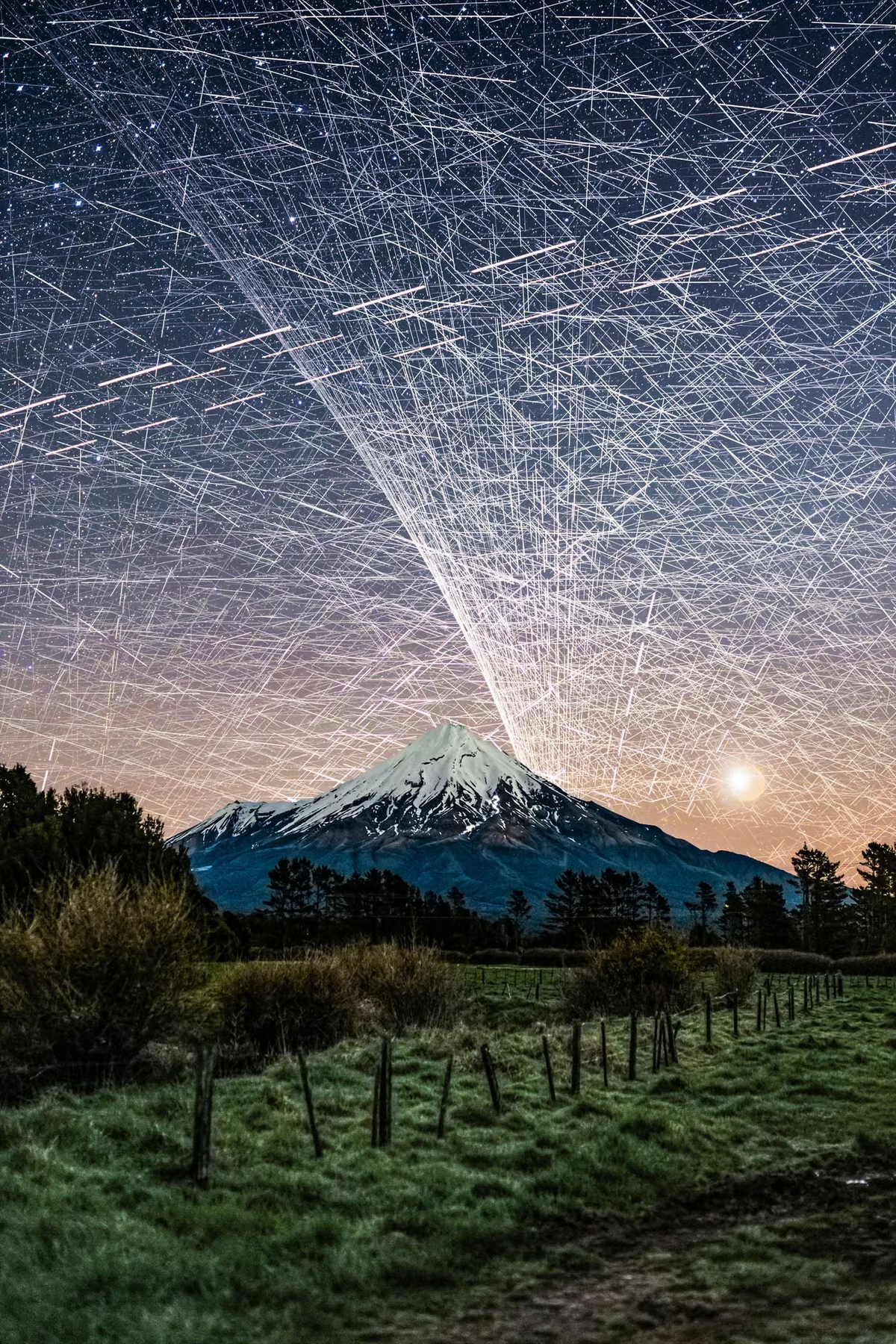
Photographer Brendan Larsen created a striking demonstration, as Kottke.org reports..
To create this composite image [and as above], photographer Brendan Larsen captured almost 600 photographs over a two-hour period and then manually stitched them together.
This is the most time-consuming photo edit I’ve EVER done!
I left my camera photographing the night sky over Mt Taranaki [see here] for nearly TWO HOURS, capturing 578 photographs.
The result? An estimated 14,450 satellite trail appearances, representing approximately 1,400 individual satellites! 😱
I manually masked in EVERY SINGLE TRAIL from the original photographs — approximately 45 HOURS of editing to create this one image!
The Guardian has more on how he created the image (which, despite many online commenters’ beliefs, is not AI):
Larsen, 51, says he set his camera up to take an unlimited number of eight-second-long shots, with a two-second gap in between each photo. “I left her running for two hours and captured 578 photos … That was the easy part.”
The hard part came next. Larsen spent about 45 hours layering the individual photos – each of which contained about 25 satellites – over one another, using Adobe Photoshop. Much of the time was spent painstakingly erasing stars, to reveal the satellites.
“I could start to see the pattern emerging and realised: ‘Wow, this looks really awesome.’ I knew if I carried on it would look even better and more impressive in terms of satellite numbers.” [source article]
Fellow photographer Vincent Laforet called Larsen’s image “an important photograph”:
I was initially startled. Then confused. Then fascinated all in quick succession.
And then I felt a deep sense of betrayal once I realized that what I was tracking with my eyes were a series of small satellites. And btw: that they likely had ruined my long exposure that I was capturing at the time.
I remember asking in the moment:
Who gave anyone permission do this?
What’s between us and the stars: “Stunning Image of Our Satellite-Choked Night Skies,” from @kottke.org.
###
As we search the skies, we might send far-sighted birthday greetings to Audouin Dollfus; he was born on this date in 1924. An astronomer and aeronaut, he was the successor to Bernard Lyot as the principal French authority on the solar system; Dollfus discovered Janus, a moon of Saturn.
While Dollfus made use of terrestrial telescopes, he was creative in finding a way past the challenges of light pollution and closer to the objects of his study. With his father (the aeronautical pioneer Charles Dollfus), he holds several world records in ballooning, including the first stratospheric flight in France. He was the first to carry out astronomical observations from a stratospheric balloon, in particular to study Mars in a detailed way.
The asteroid 2451 Dollfus is named in his honor, and one of the largest craters on Mars was also named for him.


You must be logged in to post a comment.