Posts Tagged ‘ruins’
“We moralize among ruins”*…
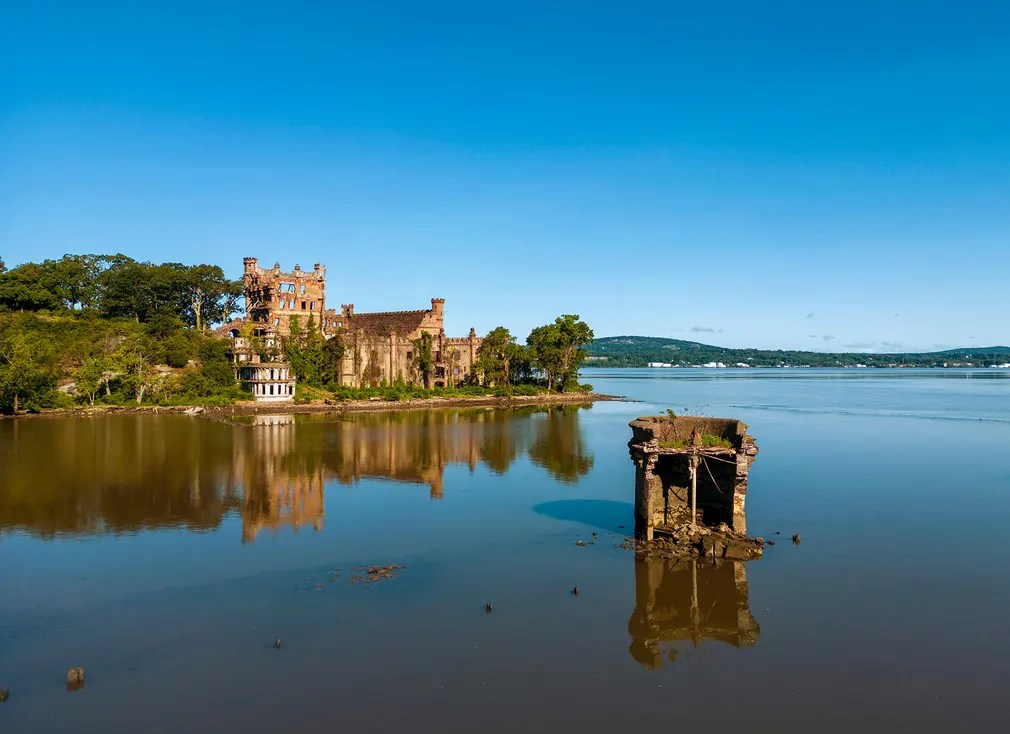
Via The Guardian…
Photographer Phillip Buehler, who captured the death of the American mall in a 2022 photo series, has a new exhibition of pictures from the last 50 years that trace the often forgotten history of the islands surrounding Manhattan. No Man Is an Island: Poetry in the Ruins of the New York Archipelago is now on show until 23 June at the Front Room Gallery in Hudson, New York…
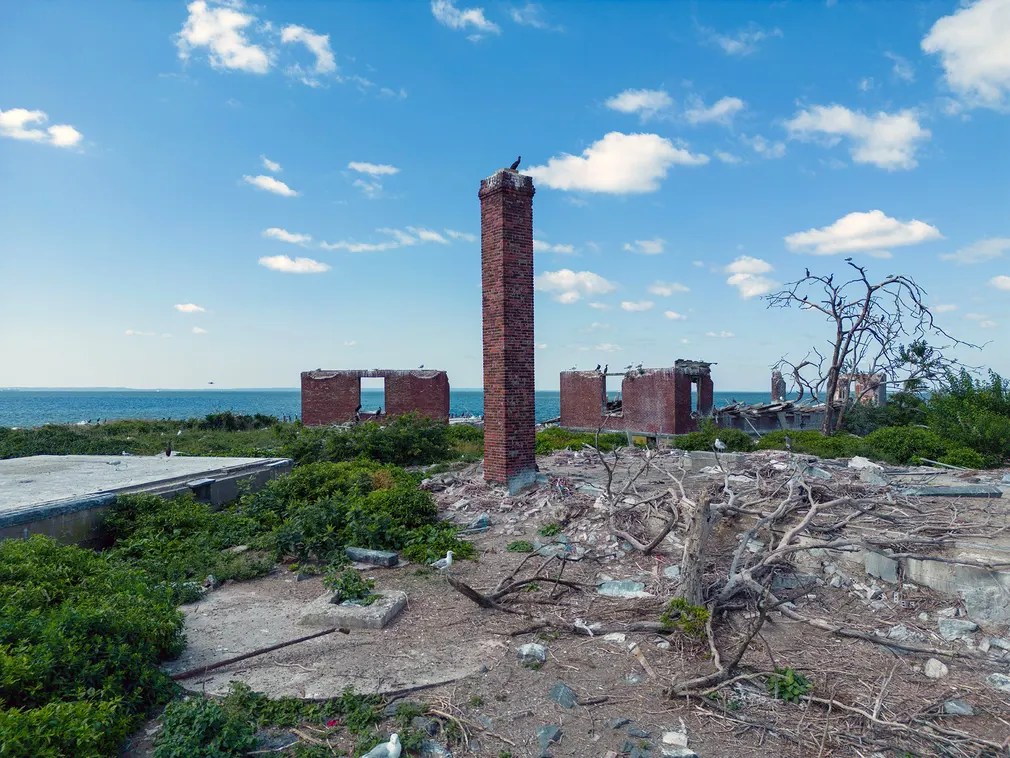

All photos by Phillip Buehler (and here). More of this series: “The inaccessible and abandoned islands of New York – in pictures,” via @guardian.
And for companions to Buehler’s earlier series on abandoned malls, see here and here.
* Benjamin Disraeli
###
As we ponder passage, we might recall that it was on this date in 1878, the original Tay Bridge was officially opened by Queen Victoria. It carried a single rail line across the Forth of Tay on the east coast of Scotland. At almost 2 miles in overall length, it was the world’s longest bridge at the time.
It’s designer, Sir Thomas Bouch, a railway engineer and executive, was knighted for engineering and overseeing the building of the bridge— on which an estimated 75 people died when, the following year, unable to withstand high winds, it collapsed. An enquiry found Bouch to be liable, by virtue of bad design and construction; he died four months after the verdict.
Bouch and his creation are thus also indirectly responsible for the best-known poem, “The Tay Bridge Disaster,” by the gentleman widely considered to have been the worst published poet in British history, William Topaz McGonagall (and here).

“But the landscape of devastation is still a landscape. There is beauty in ruins.”*…

The sparsely populated community of Wonder Valley, California, is a collection of shacks known locally as Jackrabbit Homesteads. Sitting abandoned against a dusty landscape, the worn cabins inspired a series by Berlin-based photographer Helin Bereket…
“I knew little about this place but was drawn to it by the sheer aesthetic of abandonment and isolation, alienation and wreckage, uncanniness and history unknown,” says Helin. During a recent visit to the Golden State, she decided to drive around and discover more about these so-called Jackrabbit Homesteads. The renowned cabins lie east of Twentynine Palms, a city in San Bernardino County, California, that serves as one of the entry points to Joshua Tree National Park. “I had no plan, my eyes scanning the desert landscape,” she says. “Shack-leftovers stuck out from the backdrop where sandy desert blended with the sun. I thought of taming this contrast by harmonising the colour palette and kept wondering about the human traces in what seemed to be a reckless wilderness.”
Why the buildings? These shacks are the last witness of the 1938 Small Tract Act that enabled Americans to obtain five sandy acres of land deemed unusable by the state. As the condition for owning the land was to build a small shack on the plot, many prefabricated or handmade structures were installed in the Mojave Desert, especially in the 1950s and the ’60s.
“Among the thousands of dwellers were veterans with lung problems seeking a cure in the hot desert air,” explains Helin. But today, hardly anyone remains…

Back to nature: “Photographs of abandoned shacks in California’s sparse community of Wonder Valley,” from @Helin__Bereket in @creativeboom.
See also: “Abandoned buildings seen reclaimed by nature.”
* Susan Sontag
###
As we ruminate on ruins, we might recall that it was on this date in 2009 that Kodak ceded the victory of digital photography and announced that it would discontinue the production and sale of Kodachrome print and slide film, a repository of “precious memories” since 1935.

“What’s it mean; are you determined / To make modern all mankind?”*…

Over the past century, there have been numerous expeditions to find a mythical lost city in the Mosquitia rainforest. La Ciudad Blanca keeps being discovered, over and over again; practically any time anyone finds the remains of any settlement, they call it that. I know of half a dozen large sites that have each been deemed ‘the White City’; there must be others. In all cases, the ‘discoverers’ are outsiders, and their find is presented as a heroic accomplishment. They want us to believe that they are intrepid explorers – achieving what others couldn’t because of their guts, money, technology, business acumen and grit.
Nothing in their description is accurate. The cities aren’t lost; the people living in these areas know all about them. And the original legends do not even reference cities; rather, they refer to locations that, for whatever reason, represent a golden age for indigenous communities. Even the landscape is not particularly dangerous; children grow up there, after all…
Archaeologist Christopher Begley asks: “Ancient ruins keep being ‘discovered’: were they ever lost?”
###
As we dig, we might send acquisitive birthday greetings to Baron Nils Erland Herbert Nordenskiöld; he was born on this date in 1877. A Swedish archeologist and anthropologist, he was a foremost scholar of South American Indian culture in his time. From 1913, he built an extensive collection of “discovered and recovered” South American native artifacts at the Gotebörg Ethnographic Museum, which he headed. His work was influential in the study of archaeology and anthropology throughout Scandinavia.

“I am a ruin myself, wandering among ruins”*…

The abandoned Hachijo Royal Hotel on the island of Hachijojima
Japan is in some sense uniquely blessed as a land of ruins. Its rapidly aging population, low birth rate, urbanization and lack of immigration have left a legacy of ghost towns and more than 8 million abandoned homes, or akiya. That tally could hit 21.5 million, one-third of all residences nationwide, by 2033, according to the Nomura Research Institute.
Abandoned homes are ubiquitous in rural Japan, posing health and safety hazards to locals, but they can even be found in central Tokyo, vacant edifices that for whatever reason owners refuse to demolish and rebuild.
In addition to the scourge of abandoned homes, Japan is dealing with lingering effects of the asset-inflated bubble economy of the 1980s and 1990s that saw the construction of numerous hotels, theme parks and other leisure facilities that went bust when the bubble burst. Some money-losing facilities, including the ill-fated Canadian World in Ashibetsu, Hokkaido, themed on the popular “Anne of Green Gables” novels by Lucy Maud Montgomery, were rehabilitated into public parks. But in all too many cases, others were left to rot…
More on the “ghost towns” of Japan at “The lure of Japan’s mysterious ruins.”
* Heinrich Heine
###
As we keep our ear peeled for echoes, we might we might send majestic 100th birthday greetings to the U.S. National Park Service; it was founded on this date in 1916.

You must be logged in to post a comment.