Posts Tagged ‘The Tay Bridge Disaster’
“We moralize among ruins”*…
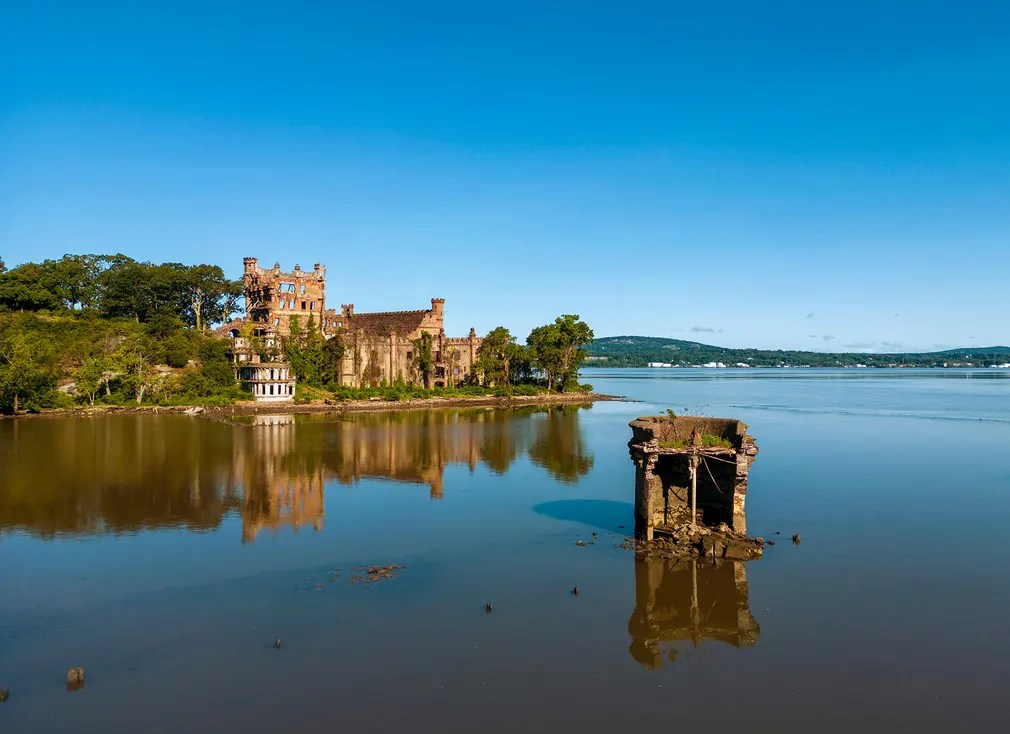
Via The Guardian…
Photographer Phillip Buehler, who captured the death of the American mall in a 2022 photo series, has a new exhibition of pictures from the last 50 years that trace the often forgotten history of the islands surrounding Manhattan. No Man Is an Island: Poetry in the Ruins of the New York Archipelago is now on show until 23 June at the Front Room Gallery in Hudson, New York…
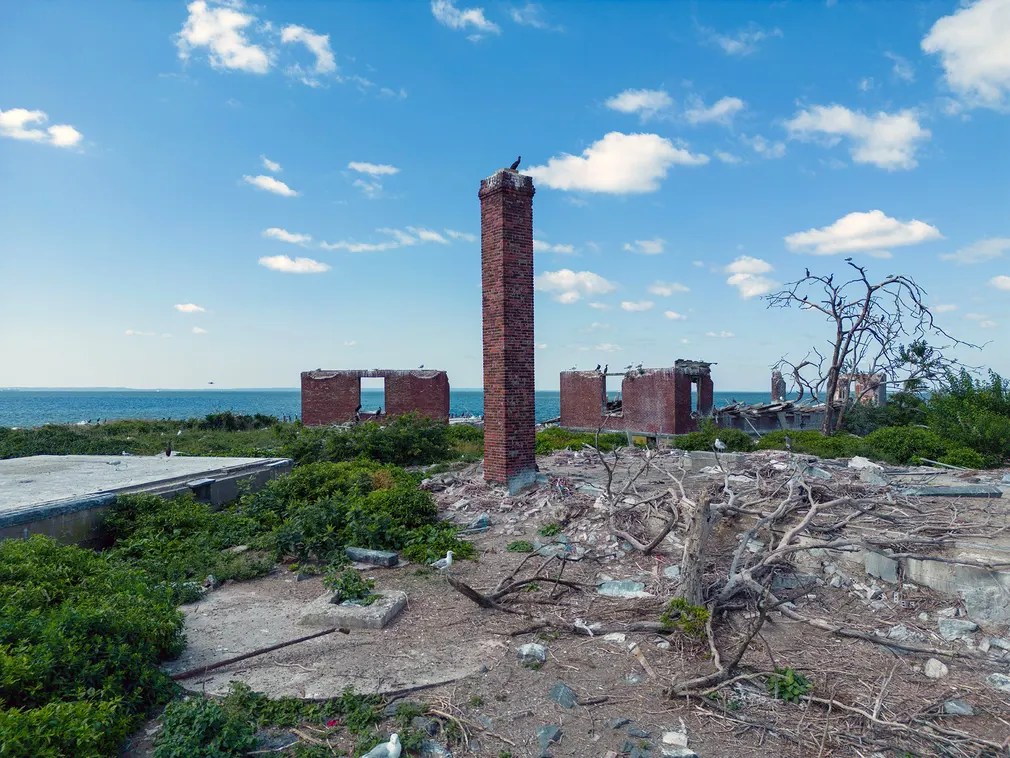

All photos by Phillip Buehler (and here). More of this series: “The inaccessible and abandoned islands of New York – in pictures,” via @guardian.
And for companions to Buehler’s earlier series on abandoned malls, see here and here.
* Benjamin Disraeli
###
As we ponder passage, we might recall that it was on this date in 1878, the original Tay Bridge was officially opened by Queen Victoria. It carried a single rail line across the Forth of Tay on the east coast of Scotland. At almost 2 miles in overall length, it was the world’s longest bridge at the time.
It’s designer, Sir Thomas Bouch, a railway engineer and executive, was knighted for engineering and overseeing the building of the bridge— on which an estimated 75 people died when, the following year, unable to withstand high winds, it collapsed. An enquiry found Bouch to be liable, by virtue of bad design and construction; he died four months after the verdict.
Bouch and his creation are thus also indirectly responsible for the best-known poem, “The Tay Bridge Disaster,” by the gentleman widely considered to have been the worst published poet in British history, William Topaz McGonagall (and here).

“All poets write bad poetry. Bad poets publish them, good poets burn them.”*…

Thunderstorm with the Death of Amelia, by William Williams, 1784. Photograph © Tate (CC-BY-NC-ND 3.0).
Readers may recall an earlier nod to William Topaz McGonagall, widely considered to be the worst published poet in British history. McGonagall, best known for his widely-excoriated verse recounting of “The Tay Bridge Disaster,” distributed his poems, often about momentous events, on handbills and performed them publicly (often, it is reported, to cat calls and thrown food). And he collected his verse into volumes including Poetic Gems, More Poetic Gems, Still More Poetic Gems, Further Poetic Gems, and Yet Further Poetic Gems. Imagine your correspondent’s surprise and delight to find a learned appreciation of McGonagall’s place in poetic history:
Not unjustly, McGonagall is rarely mentioned without an epithet: some version of “the worst poet in the English language.” And by any reasonable account, any judgment based on the most universally shared values of poetics, prosody, and taste, there is little to admire in McGonagall. The rest of his corpus shares—replicates, really—the faults of “The Tay Bridge Disaster”: its lapses into bathos, its involuted syntactical structures, its rhymes so slanted as to be more or less horizontal.
There have been worse poets, of course, and as such it would be more accurate to describe McGonagall as the worst famous poet in the English language, a testament in part to the man’s powers of self-promotion and the caprices of literary history. But McGonagall’s notoriety still owes much to the singularly strange power of his own badness. There’s something, I think, in poems like “The Tay Bridge Disaster”—as well as McGonagall’s many poems on his great themes of death and destruction—that is worth examining; something that might redeem him, ever so slightly, from the annals of amusing semi-obscurity; something unsettling about his ostensibly blinkered artistic vision that might help to account for why he lingers as the patron saint of misbegotten verse…
On William Topaz McGonagall, the worst famous poet in the English language: “The Disaster Poet.”
(Readers will find a selection of McGonagall’s poems here.)
* Umberto Eco
###
As we bathe in bathos, we might spare a thought for the decidedly more-accomplished poet (and playwright, artist, biologist, theoretical physicist, and philosopher) Johann Wolfgang von Goethe; he died on this date in 1832. Probably best remembered these days for Faust, he was “the master spirit of the German people,” and, after Napoleon, the leading figure of his age.

You must be logged in to post a comment.