Just 14 months after agreeing to buy the controlling interest in the L.A. Lakers at a valuation of $10 billion, Mark Walter found himself in a spot of trouble and needed to sell. Joshua Kushner (who recently tried to buy a big stake in the World Cup) and Bob Iger stepped right up, and agreed to buy his share at a valuation of @$12.5 billion. Kushner is a bona fide billionaire; Iger is an almost-billionaire; together, their net worth is something like $6 billion. Under the NBA’s rules, Mr, Kushner’s investment vehicle, Thrive Eternal, cannot invest more than 20 percent in the Lakers; so, unless they get a waiver, it’s likely that Kushner and Iger will finance the balance of their purchase personally (and/or with funds from rich friends).
As Eben Novy-Williams observes, this transaction is just the latest in a long line of folks with relatively fresh fortunes buying into the big leagues…
Sports team sales tend to reflect what’s happening in the broader economy. During the dot-com boom, many of those newly-minted millionaires found their way to sports (Ted Leonsis, Mark Cuban, Paul Allen, Henry Samueli and John Moores). That gave way to the real estate boom, and those buyers followed (Stephen Ross, Stan Kroenke, Jimmy Haslam, the Lerners, the Wilfs). More recently, it’s been the finance, private equity and hedge fund titans (Josh Harris, Wes Edens, Marc Lasry, Tony Ressler, David Tepper, Tom Gores, the list goes on and on)… – source
And as the title quote (from Carlyle [and here] co-founder and Baltimore Orioles co-owner David Rubenstein) suggests, this make a very straightforward kind of mercenary sense– major professional sports franchises have historically outperformed traditional indexes like the S&P 500 over the long term. And it stands to reason: scarcity value, legal local monopolies, and lucrative media rights make for a heady brew.
In a recent Substack post, Derek Thompson takes stock of the situation. After his own review of the Lakers deal, he puts it into context…
… In an age of surging wealth inequality, where stock market valuations routinely outpace median income growth by surreal factors, there is a live debate over whether billionaires should exist at all. The strongest argument for their rightfulness is that some people amass ten-figure wealth by building companies; by working within free markets to invent new technologies that millions or billions of people choose to use; and by managing complex enterprises that create billions or trillions of dollars in consumer welfare and investor value. But even this steelman case for billionaires presents as a kind of taunting insult to what often passes for sports ownership today. Professional-sports ownership offers the already-impossibly-rich a unique opportunity to become vastly richer, not necessarily by working, building, inventing, or doing anything positive at all, but rather by merely sitting on top of an asset that American law has conspired to make absurdly scarce and luridly profitable.
A thought experiment. Imagine if a diabolical oligarchic elite wanted to build an efficient and low-risk machine for turning their already-elevated wealth into exospherically extreme wealth. What might such a devious group of self-serving plutocrats want?
Unleash the forces of capitalism! you might think. But no, absolutely not. Capitalism is markets, and markets are ruthless. What you should want is legal permission to create a monopoly that builds a moat deep enough to keep all competition out. That way, you’ve got something much better than capitalism: artificial scarcity and pricing power without the risk of unwanted rivals.
Get the government off your back! you might say. Wrong again. You know what’s nicer than getting the government off your back? Getting the government on your side. You should crave dependable government subsidies to pad your profits.
So say, for example, that you wanted to set up this money machine in American professional sports. Your devious plan: shield leagues from antitrust law so owners can enjoy monopoly profits; use that market power to extract money from local governments; and rewrite the tax code to hand sports owners special advantages.
Lo and behold, all of this exists…
[Thompson unpacks the particulars: sports leagues are basically legal oligopolies; labor law makes sports ownership even sweeter; sports stadiums have become legal ransom; and team-owner tax benefits put the cherry on top. He concludes…]
… People sometimes compare buying sports franchises to buying works of fine art—say, a Monet, a Calder, or a Rodin. In both cases, the simplest answer to the common question “Why is that thing worth so much?” is always “Because someone rich was willing to pay it.”
But there is an important difference between the factors that push up the value of Monet paintings and those of sports franchises. Think about why a Monet painting is so valuable. Setting aside the irresolvable debate about the ineffable nature of beauty and quality and artistic pleasure, the underlying fact is that a Monet painting is valuable because it was painted by Claude Monet, a famous individual who once lived, and is now dead. The finality and scarcity of the Impressionist oeuvre—the fact that one can buy a painting from Monet’s Rouen Cathedral series and not worry that he will paint 100 more tomorrow—is a function of his mortality. There is no scientific or technological means by which anyone can exhume and reanimate Monet’s skeleton, sit the zombie upright in a chair, hand him a paintbrush, an easel, and a cup of tea, and say, “Now that you’re all settled, I’d like 500 additions to the Rouen Cathedral series.”
But the scarcity of sports franchises emerges from the laws of mankind, not the laws of nature. It benefits from a set of rules, laws, and customs that we made up and that can be redrawn in a way that Rouen’s facade never will be.
I am not a fan of conspiracies, and I am not a socialist. But nothing makes me feel more socialist than the public, out-in-the-open conspiracy to buttress the value of sports assets, whose lush beneficiaries tend to be impossibly rich already. Solutions here are hard. Many fans like the weird, market-warping rules of professional sports, which often promote parity and competition and keep favorite players on long contracts; plus, I don’t think doubling the number of NBA or NFL teams is particularly desirable among most fans. But ameliorations are possible. Tax law could further restrict the ability to team owners to amortize. And honestly, I don’t know why some local governments shouldn’t own stakes in the professional sports teams that they often directly finance. I’m not sure exactly how this would work, and I’m sure that there would be some negative side effects of literally socializing the already-kinda-socialist dynamic of professional sports. But the status quo is vile enough to justify some experiments. What we have today is a handful of lucky, franchise-owning billionaires who get to sit at a poker table where every card they turn over has a face or an ace. I wouldn’t call it cheating. I wouldn’t call the legal structure of American sports cheating or corrupt. I would call it … the law. But the law is bad.
And for a different kind of context, see the source of the pull quote in the intro, “The Lakers Are a Massive Bet on AI Disruption,” in which Novy-Williams suggests that Kushner is “buying the Lakers because sports are relatively insulated from the economic havoc looming from the rest of his portfolio. That’s not a hedge against AI, it’s a doubling down.”
As we play ball, we might recall that it was on this date in 1920 that the owners of the Canton Bulldogs, Akron Pros, Cleveland Indians, and Dayton Triangles met in Canton, Ohio, and formed the American Professional Football Association– which proceeded to add teams and, in 1922, renamed itself the National Football League– the NFL.
At the outset, the APFA/NFL was very different from the behemoth it would become:
This new organization did not resemble a league as we would know it today, but was more like a professional association whose sole functions were membership and articulation of some general principles. Perhaps the best modern-day analogy would be a weak form of the NCAA. As can be imagined, the league office had no influence on anybody. It set no schedules, leaving each team to arrange its own slate. – Pro Football: The Early Years: An Encyclopedic History, 1895–1959
Still, there were hints even then of what was to come. The owners who created the “league” agreed to introduce a salary cap for the teams, to refrain from signing players under contract with another team, and to hold a league championship competition.
… Yes… but Maitreyi Anantharaman asks, which victors. A Sunday football installment…
In late July, before a game against the Boston Red Sox, Bryce Harper sat slumped in a chair in the Philadelphia Phillies clubhouse, a baseball bat in hand. Philadelphia was the latest stop on Rob Manfred’s leaguewide speaking tour; ahead of a CBA negotiation that virtually everyone in baseball expects to involve a 2027 work stoppage, the MLB commissioner spent the summer visiting all 30 teams, trying to get players on board with his plans to restructure the league’s economics. When the subject of a salary cap came up late in the meeting, Harper rose from his seat. He walked closer to Manfred until their noses almost touched, and told the commissioner that if Manfred wanted to talk salary cap, he could “get the fuck out of our clubhouse.”
A couple months later, at the Minnesota Lynx’s end-of-season press conference, Napheesa Collier had some words for her league’s commissioner, too. The WNBA is in the thick of labor talks these days: The league and players’ union recently agreed to extend their collective bargaining negotiating period through January. Collier’s sport is undergoing its own economic transformation. Amid a women’s basketball boom, WNBA team prices have skyrocketed, and the league’s new media rights deal is valued at a figure six times the old one. Today’s labor fight pits players who feel they’ve driven this growth against the owners who feel they’re owed for years of losses. In Collier’s telling, commissioner Cathy Engelbert is a poor steward for the moment, a leader who takes the WNBA’s talent for granted. “The league believes it succeeds despite its players, not because of them,” Collier said, adding later that “the best players in the world” had “the worst leadership in the world.” The measure she took was public and not so lurid a confrontation as Harper’s—no baseball bats involved. But the basic idea was the same: to establish whose clubhouse it really is.
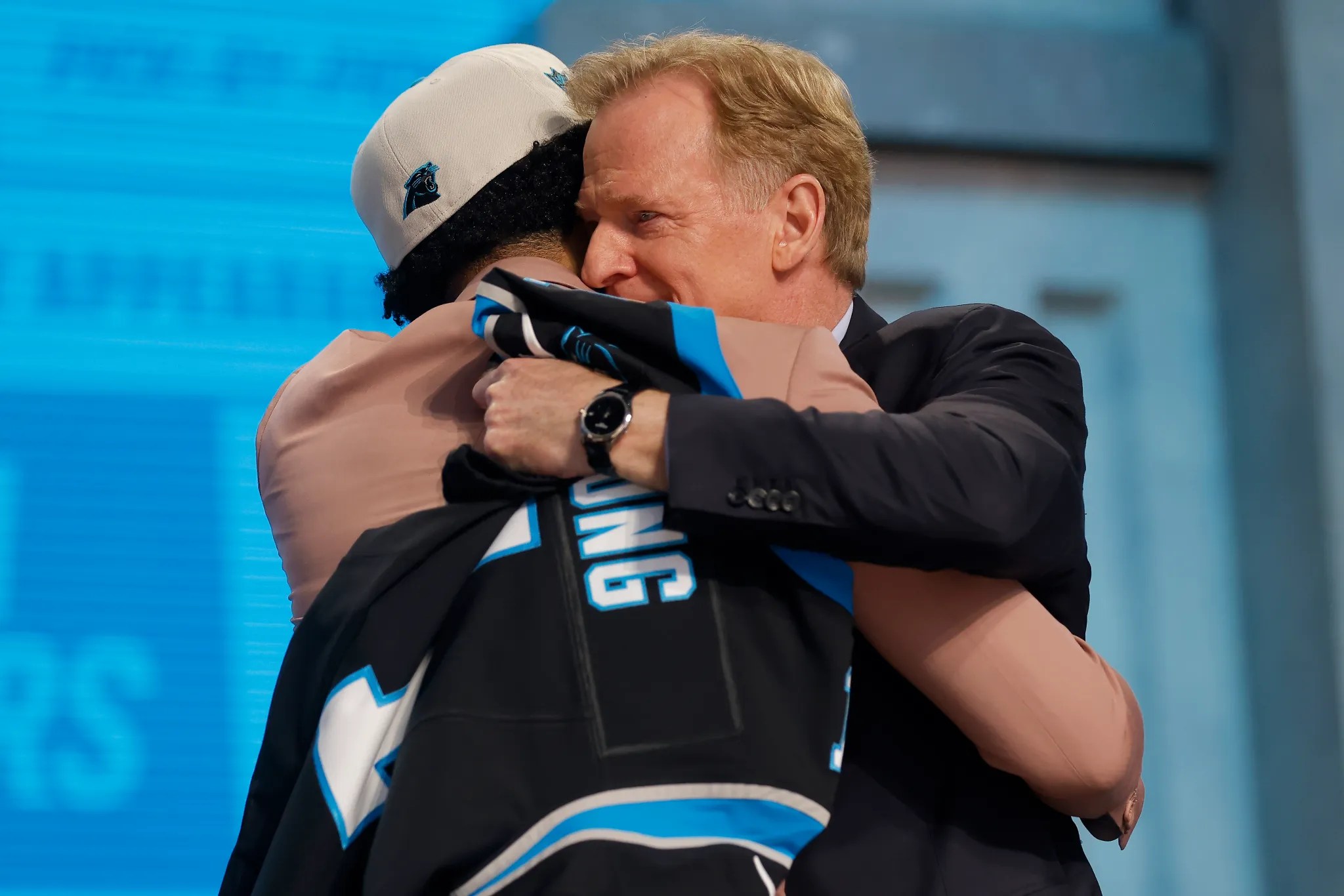
For an emblem of player-commissioner relations in the NFL today, the New York Times reporter Ken Belson writes, look to the “Roger Goodell Bro Hug.” [see the picture above] Every spring, the newest first-round picks bound across the NFL draft stage and wrap their arms around the commissioner. Sometimes they lift him off his feet. A hug Goodell shared with Baltimore Ravens draftee Malaki Starks this past April lasted 21 seconds. Speaking to Belson, an agent laments the annual show of affection for management, though he can’t help but admire the bleak triumph it signals: “You have to give kudos to the NFL for making it that way.”
Apposite: “Big Blue Machine“- on big money in sports and what it can buy (“When the Dodgers spend nearly $500 million on salaries, including deferred payments and tax penalties, one sees the American way of life come into focus anew: a few at the top thriving in the abundance of Ezra Klein’s wet dreams, the rest of us surviving on scraps…”)
* William L. Marcy (a U. S. Senator in 1832, justifying President Jackson’s “spoils system”)
###
As we ponder plutocrats, we might spare a thought for George “The Gipper” Gipp; he died on this date in 1920. Notre Dame’s first All-American football player, he succumbed at age 25 to a streptococcal throat infection and pneumonia three weeks after a victory over Northwestern in his senior season and was the subject of Rockne’s “Win just one for the Gipper” speech. In the 1940 film Knute Rockne, All American, he was portrayed by Ronald Reagan.
Bowling has been around for over 5,000 years; it’s played by over 120 million people in more than 90 countries, almost 70 million of whom are in the U.S. But, as Dave Denison reports, the state of play is challenged…
Bowling is an old sport—ancient, really… There’s a lot of churn in the bowling world; alleys go out of business all the time. I bowled in leagues for several years at a venerable old heap just outside of Boston. Opened in 1942 and originally called the Turnpike Bowladrome (for its location on the Concord Turnpike in Cambridge), it had one level devoted to candlepin bowling, a once-popular New England variant, and an upper floor for regular tenpin. I met people in the leagues with whom I would otherwise never have rubbed shoulders: a genial postal worker with noticeably less genial political views; a retired military man who also ran the nearby Air Force base’s bowling alley; and a Thai immigrant who told me he developed his technique by watching YouTube videos—he delivered the ball with a precise, balletic style. I even got to know the mechanic who fixed the automatic pinsetters and ran the machine that oiled the lanes. But developers had been eyeing the land for years, and finally, in its seventy-fifth year, the place then called Lanes & Games fell to the wrecking ball, replaced by a “luxury” apartment complex.
Most longtime bowlers can tell a similar story. Their home lanes were sitting on land too valuable to justify its use as a bowling alley. Or their family-owned center had no one to maintain the business. Or there just weren’t as many regulars as there used to be. It’s been said that the industry overbuilt when the development of automatic pinsetters in the 1940s led to a bowling boom in the 1950s and 1960s. Bowling leagues were especially popular in the industrial Midwest, where factory workers could bowl and drink beer after a shift. Budweiser sponsored a team in 1954 that launched bowlers Dick Weber and Don Carter to fame. Four years later, the Professional Bowlers Association was founded in Akron, Ohio, giving superstars like Weber, Carter, and the dominant left-hander Earl Anthony the chance to go on tour and make a good living.
But the number of bowling centers in the United States, which peaked at about twelve thousand in the mid-1960s, has been steadily falling for four decades. The number was down to about 3,800 in 2023, according to the USBC. Political scientist Robert D. Putnam [see here] famously cited the decline of league bowling in his 2000 book Bowling Alone as one of many indicators that civic engagement was collapsing across America, noting that league bowling declined by 40 percent between 1980 and 1993. The updated figure is even more dramatic: from a high of about 9.8 million league bowlers at the end of the 1970s, the number of USBC members in leagues for the 2022–23 season was 1.09 million. That’s a decline of 89 percent…
Denison explores the consequences of the consolidation of ownership (of both lanes and equipment manufacturers– spoiler alert: private equity) and the impact of technology. But mostly (and best), he explores the culture of the pastime.
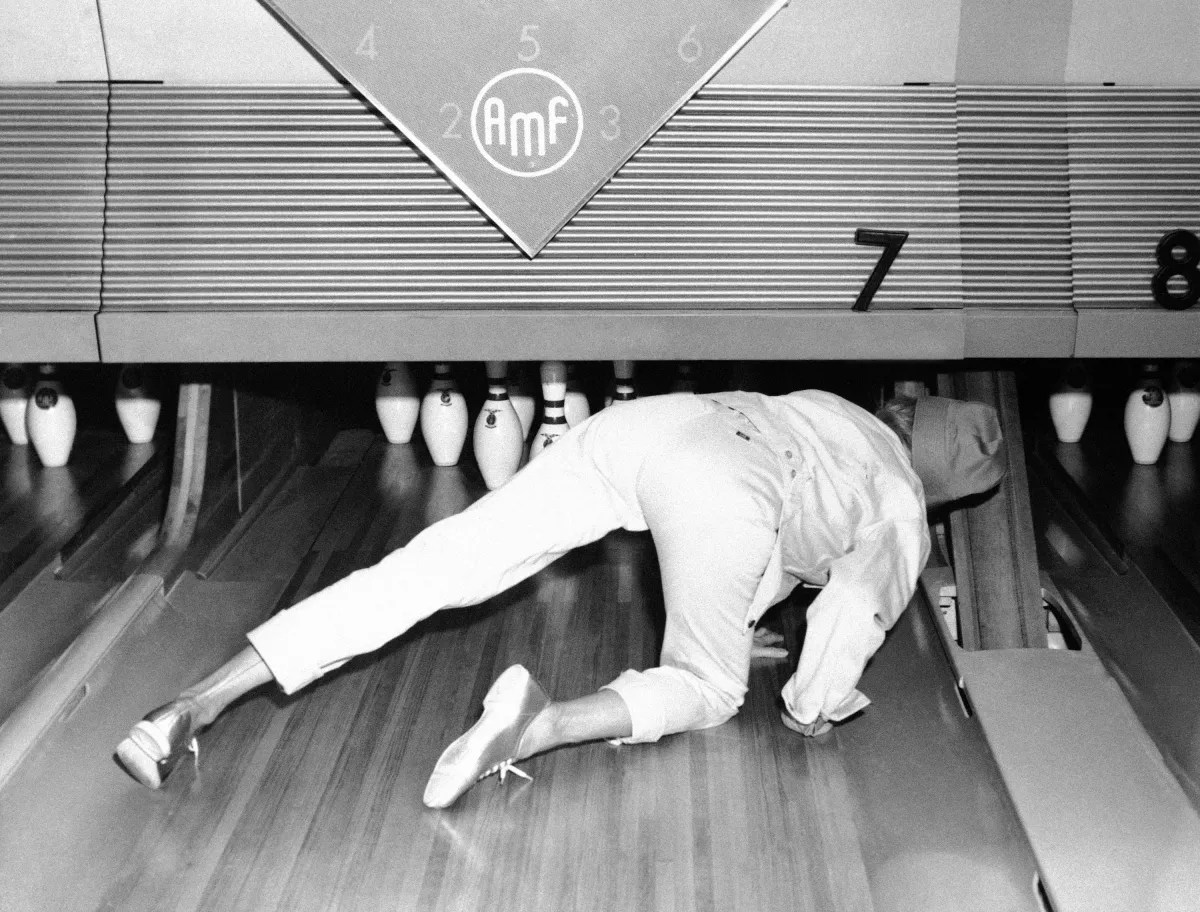
As we grab our balls, we might recall that it was on this date in 1960 that Marlene Dietrich visited a new bowling facility in Knokke-le Zoute, Belgium to roll a few frames and to inspect their new automatic pin-setting equipment.
Marlene studying the workings of the automatic pinspotter (source)
The enshittification of the major social media platforms has become impossible to ignore… and has led many to predict a more decentralized future for the web. But as William Gibson famously observed, “the future is already here, it’s just not evenly distributed.”
Case in point: Ben Smith‘s blockbuster Semafor post on the flourishing ecology of private chat groups that has emerged, starting with…
Chatham House, a giant and raucous Signal group that forms part of the sprawling network of influential private chats that began during the fervid early days of the COVID-19 pandemic, and which have fueled a new alliance of tech and the US right. That same week in Chatham House, Lonsdale and the Democratic billionaire Mark Cuban sparred over affirmative action, and Cuban and Daily Wire founder Ben Shapiro discussed questions of culture and work ethic.
This constellation of rolling elite political conversations revolve primarily around the venture capitalist Marc Andreessen and a circle of Silicon Valley figures. None of their participants was surprised to see Trump administration officials firing off secrets and emojis on the platform last month. I did not have the good fortune to be accidentally added to one of the chats, which can be set to make messages disappear after just 30 seconds.
But their influence flows through X, Substack, and podcasts, and constitutes a kind of dark matter of American politics and media. The group chats aren’t always primarily a political space, but they are the single most important place in which a stunning realignment toward Donald Trump was shaped and negotiated, and an alliance between Silicon Valley and the new right formed. The group chats are “the memetic upstream of mainstream opinion,” wrote one of their key organizers, Sriram Krishnan, a former partner in the venture capital firm Andreessen Horowitz (typically styled a16z) who is now the White House senior policy adviser for AI.
Of course, these are hardly the only power group chats. Anti-Trump liberals are now coordinating their responses on Signal. There are group chats for Black political elites and morning show producers. A vast and influential parallel set of tech conversations take place on WhatsApp. There’s a big China-friendly group over on WeChat. Elite podcasters have one…
… Many of the [Chatham House] chatters celebrate their success in driving the ascendant politics of the Trump era, which they hope will bring back patriotic industry and traditional cultural norms. Some who have left or lurk consider it a sinister phenomenon in which Andreessen exerted unspoken gravitational pull, as one participant put it: “You’d see that the writers were bending toward the billionaires, and even the ones who prided themselves on being iconoclastic were bending to the tastes and the centers of gravity of power.”…
… You should therefore be very suspicious of anyone who claims to be in the Genuine Ideas business but who is afraid to fully speak their mind in public. For the past half decade at least, America has been bombarded with the grumblings of influential people griping that they are not “allowed” to say what they really think, these days. Because of wokeness, and witch hunts, and things like that. What do they mean when they argue that they are not “allowed” to say something? Do they mean that they might be snatched by government agents and deported for writing a humanitarian op-ed in a student newspaper? No. What they mean, usually, is that they hold opinions that many people would find objectionable and if they say those opinions out loud people will get mad at them. In many cases, they also hold prestigious positions at media or business or academic institutions that claim to have some anodyne progressive values, and because their objectionable ideas are objectionable in the specific sense of “being some variety of bigotry,” their colleagues at those institutions would be mad at them, making their lives unpleasant. (It is darkly funny that, in the years that all of these people have been complaining about the woke censorship they are suffering, the people who have actually suffered the most professional retaliation for voicing their beliefs have been those who spoke out for the human rights of Palestinians. That has proven to be far more dangerous to one’s livelihood than being a bigot.)
It is important to notice the fact that, in truth, all of these whining people very much are allowed to say what they think. They sure can. No one is stopping them. What they are really objecting to is not censorship, but rather the honest reactions that their honest ideas will elicit. In other words, they cannot handle The Discourse. They are not equipped to participate in the Ideas industry. They are unable to carry the burden of telling the truth as they see it. This is fine, if you’re a regular person; no one is obligated to get yelled at for their beliefs. But it is not fine if you are someone—a writer, a leader, an intellectual influencer of the public—who is supposed to be pushing ideas. Those people must either say what they believe, change what they believe, or accept the fact that they are intellectual cowards.
These are the things that I thought last night when I read Ben Smith’s Semafor story about the many exclusive group chats, full of pundits and quasi-journalists and Substack writers and Silicon Valley business titans and political activists, that have served as private petri dishes of reactionary thinking since the start of the pandemic. It is a juicy story, replete with tales of the wounded signatories of the infamous Harper’s Letter forming and reforming little Signal chat groups where they could hold masturbatory agreement sessions with Marc Andreesen and Mark Cuban and similar tech gurus who fancy themselves masters of the nation’s future. Over and over again, participants in these chats explain that they were places where they could speak more openly than they would in public. “People during 2020 felt that there was a monoculture on social media,” goes one typical comment from an entrepreneur, “and if they didn’t agree with something, group chats became a safe space to debate that, share that, build consensus, feel that you’re not alone.” It’s not just the businessmen— “Group chats are now where everything important and interesting happens,” agrees one popular blog thinkfluencer, who presumably is not giving his public readers his important or interesting stuff…
… Sometimes you say what you think, and guess what happens? People get mad. People yell at you. Yes. That goes with the territory. I will put the = hate mail and death threats and angry internet comments that I received during my Gawker years up against anyone’s. And, hey: that’s the fucking job. Whether you write for Gawker or Substack or the New York Times or Harper’s—or whether you are a CEO or tech visionary or a venture capitalist who goes to the Aspen Ideas festival and has a bazillion Twitter followers—the only requirement of the job is to speak your mind honestly. Because, because, by asking the public to listen to you, you are telling the public that they will be getting, as best as you can manage it, your truest ideas. We ask people to give us their attention, and their time, and in turn we give them our honest thoughts. When you are operating in this world and you stop giving people your honest thoughts, you begin ripping people off.
Feel free to hide your honest thoughts in private group chats if you like. Rather than speaking forthrightly, retreat into a little hole where you can stage manage and coordinate the rollout of soft versions of your unpopular ideas in friendly forums. But if you do, don’t pretend that you are a member in good standing of the (absurd, enraging, pompous, but ultimately socially valuable) Ideas industry. Say what you think, cowards! Or stop pretending that your beliefs are important enough for other people to care about in the first place…
… it’s worth pointing out that the dynamics of these group chats only makes sense when you keep in mind that these people are doing something literally everyone on Earth does — post in a group chat — but think they literally invented the future of media. Peak rich guy brain at work here. They, also, spent the lead up to Semafor publishing their piece freaking out about it, which hilariously hyped the shit out of it.
The interesting thing here, though — well, beyond the fact that we now have hard evidence that a secret network of the country’s richest men have been using Signal groups to coordinate a soft coup and inadvertently crashed the global economy in the process — is the timing. According to Semafor, the big digital rats nest of middle-life-crisis-havers started forming after Andreessen published the “It’s Time To Build” blog post, one of the many manifestos he would publish during his manic post-COVID era. The essay went viral on Clubhouse (lol) and led to the earliest versions of these group chats forming on, first, WhatsApp, and, then, Signal.
I was particularly vicious about Clubhouse when it launched, a site I’ve often referred to as a dinner party simulation app. And I was especially angry that the social network was being astroturfed into a “thing” by men like Andreessen. To me, Clubhouse stands as the moment Silicon Valley fully lost the plot, effusively hyping up an app that literally just let them hear their own voices. The snake finally eating its own tail. As I wrote back in 2021, “Clubhouse, by the very fact both its initial user base and its subsequent hype was basically dreamt up by Silicon Valley insiders, was, in my opinion, a test of whether or not venture capitalists had enough influence to dream up a new — honestly, very bad — social network and force it upon the rest of the internet.”
Well, it turns out Clubhouse’s hilariously fast crashout did not deter these guys from continuing to try and make fetch happen and they’ve spent the last four years coordinating behind the scenes to remake the country in their own image. Well, at least until President Donald Trump’s tariff announcement last month, which seems to have really broken the right-wing tech coalition that’s been flourishing on Signal since COVID.
And according to Semafor, these group chats did have a profound impact on how we’ve understood the world for the last four years. These groups coordinated harassment campaigns — they especially hate journalist Taylor Lorenz, apparently — and affected how narratives were shaped online and in the media.
Networked oligarchy, but, also, the most typical radicalization story you could ever tell. Men, isolated by the pandemic, found each other on a public network, Clubhouse, and moved to a dark social platform, Signal, to speak more freely and openly and then spent years radicalizing each other. This is as true for the Silicon Valley dorks as it is for QAnon as it is incels as it is for ISIS. And it’s darkly funny that some of the men who built the internet as we currently use it were not immune from the indoctrinating social pathways they funded or built. Or to put it more simply: Silicon Valley has secretly getting very high on their own supply for years.
But the ultimate takeaway is that, yes, the intellectual dark web is real. The right wing are working together closely. They are texting each other constantly and sharing resources and tactics and if we have any shot at getting ourselves out from under their thumb, we have to have the same level of coordination…
The future of the web- not so “public” (nor “civil”) discourse?
* Michel Foucault, The Archaeology of Knowledge and The Discourse on Language
###
As we ponder pontificators, we might recall that it was on this date in 2015 that a baseball game between the Chicago White Sox and the Baltimore Orioles at Camden Yards in Baltimore set the all-time low attendance mark for Major League Baseball: zero fans were in attendance for the game, as the stadium was officially closed to the public due to the 2015 Baltimore protests over police brutality to Freddie Gray.
Fueled by its viral moments of crystalline violence, the combat sport of Professional Slap Fighting—in which combatants take turns smacking each other in the face—is soaring in popularity online and off. The estimable Ander Monson (and here) investigates…
The image that I can’t forget—the one that truly pulls me into the savage, surreal, and ridiculously compelling world of professional slap fighting—is the open hand of heavyweight champion Damien “the Bell” Dibbell smashing into the giant bearded face of Ryan “the King of Kings” Phillips in slow motion. In the moment, I can’t tell whether my horror or pleasure is greater. Phillips’s eyes are closed, all 255 pounds of him anticipating the blow, hoping to endure it so he can return fire. He can’t move to evade the slap. That’s not allowed in this relatively new, super-fast-growing combat sport. Flinching is a foul—spiritually, the greatest foul in slap fighting—and the penalty is that your opponent gets an extra chance to smash you in the face. So you just have to take the blow. Dibbell’s slap takes maybe a second to deliver in real time. Phillips drops—whatever was him, gone at least briefly—and his body crumples to the ground…
The moment Ryan “the King of Kings” Phillips was KO’d by the heavyweight champ, Damien “the Bell” Dibbell, at Power Slap 7
… Most articles incorrectly trace slap fighting back to a 2019 video from a Russian strongman competition that went viral. But they’re wrong, at least according to JT Tilley, CEO of SlapFIGHT Championship (SFC), the original slap-fighting league, which continues as an underground, more intimate alternative to [the newer, better financed, and bigger] Power Slap. Tilley tells me that he started slap fighting as a rules-based sport four years earlier, in 2015, after he saw a viral video from Lubbock, Texas…
… It was after seeing that video and the response online, says Tilley, that he decided to “invent” slap fighting as a proper sport. That meant giving it shape and rules. And also trying to make it safe—by which he means safer relative to what it was at the time, which was a total free-for-all. The underground videos he was watching online were wild and compelling, sure. But he remembers thinking, Somebody’s going to die out there. So Tilley worked out a simple set of rules and the format. SFC started streaming its first events in 2017, and from there it grew.
The sport began to catch on overseas, including in Eastern Europe. A couple years after Tilley launched SFC, he was asked to consult with an unregulated Polish slapping show called PunchDown. Tilley says he told the organizers that they needed to incorporate his safety rules to protect the fighters. They didn’t. And shortly after that, someone did die. In 2021, Artur “Waluś” Walczak, a Polish bodybuilder, suffered a stroke in PunchDown 5 and died in the hospital. People freaked out. PunchDown disappeared, and, briefly, so did every other slap-fighting organization except for SFC.
But the visceral appeal of slap fighting was too potent not to attract new competition. And soon it caught the eye of the unofficial king of combat sports himself. In 2022, Dana White, the longtime president and impresario of the Ultimate Fighting Championship (UFC), founded Power Slap in Vegas, based on SFC’s rules and even using some of its fighters. Power Slap held its first bouts in January 2023, debuting on the TV network TBS. The initial ratings were disappointing, however, so Power Slap moved exclusively online, where it has been booming ever since.
The metrics tell the story of slap fighting’s social-media popularity. From April 2023 to early May 2024, Power Slap’s YouTube subscribers jumped from 121,000 to 2.4 million and its Facebook followers more than doubled, from 1.6 million to 3.3 million. The Power Slap YouTube channel has racked up more than a billion views in roughly two years. And White has leveraged that audience to help Power Slap acquire sponsors such as Anheuser-Busch, Crypto.com, and Fanatics. SlapFIGHT can’t match the speed and scale of Power Slap’s growth trajectory, but it still boasts a pretty robust global following. The SFC YouTube channel has some 250,000 subscribers, with more than 57 million views since it launched. Tilley claims that SFC has garnered more than 2.5 billion views globally across all platforms and says the league has been televised in Hungary, Switzerland, Germany, the South Pacific, Nigeria, and the Middle East. Its most recent event, says Tilley, was seen online by 500,000 people live.
Slap fighting is unsafe, but all combat sports are. This is why we watch them. Frankly, most contact sports are dangerous, points out Power Slap president Frank Lamicella, who was tapped by White to run the league. The proven connection between football and CTE doesn’t seem to be hurting the NFL, after all. Both Lamicella and Tilley say that slap fighting is safer than boxing or MMA. Lamicella, who happens to be a lawyer, rattles off a whole list of medical precautions his league takes. Power Slap errs on the side of safety, he says. “So far we’ve had zero positive CT scans and really a very low hospital-transport rate compared to other combat sports.” Plus, he points out, no one is being forced to compete in his sport. “We live in a country where it’s capitalism and your freedom to do what two people want,” he says. “Look, people want to fight. We provide the platform to do it; we spend the money to make sure they’re safe and healthy. We make sure it’s as safe as possible.”…
… I met Tilley, the SFC founder and CEO. A former wrestler, Motown singer, comedian, and Hall of Fame MMA promoter, he is a big, burly, likable guy who recently turned fifty. He has a promoter’s jovial personality, a genuine smile, and an infectious enthusiasm for slap fighting and especially for the people who slap and get slapped. He is the face of SFC and, with retired MMA star Mark “the Hammer” Coleman, does the play-by-play on all the SFC live streams. From our first communication, he was super welcoming and described what they do as a family operation. That would come to be echoed by nearly every person involved with SFC. Tilley is a self-described inventor of “bullshit sports,” as he told me with a laugh, like carjitsu, “jujitsu but inside of a car,” a new sport for which he signed a deal with ESPN; ultimate tire wrestling, “a big stack of tractor tires, and your objective is to stuff the other guy inside the hole,” also ESPN bound; beast ball, “one-on-one football in a shipping-container unit”; sumo boxing, which I couldn’t entirely figure out; and a new one he was developing where two guys get roped together as in the “Beat It” video and have to fight…
* Paul Fussell, Class: A Guide Through the American Status System
###
As we trade blows, we might recall that it was on this date in 1980 that LOT Polish Airlines Flight 007 experienced engine failure and crashed on approach to Okęcie Airport in Warsaw. All 87 people on board were killed, including 14 boxers and 8 staff members of the U.S. boxing team and Polish pop singer Anna Jantar. Future world heavyweight champion boxer Tony Tucker was supposed to be on Flight 007 but could not go because of a shoulder injury.







You must be logged in to post a comment.