Posts Tagged ‘sports’
“I set records that will never be equaled, 90% I hope are never printed”*…

The Inimitable Ray Ratto in the always-illuminating Defector on the legend that was Bob Uecker, who died, ten days shy of his 91st birthday, on January 16…
It is not difficult to find people who loved Bob Uecker unreservedly. There is a good reason for this: He was the last genuinely and instinctively funny person in baseball history. He was the god of Milwaukee even if you include all the Green Bay Packers going back to before Vince Lombardi. He was the face and voice of baseball cinema, the man whose line-reading made “Ju-u-u-u-st a bit outside” so good that “iconic” doesn’t remotely cover its impact. Even if you’re not a seamhead, you likely came across Bob Uecker and smiled.
So Thursday’s announcement that Uecker has died at age 90, due to small cell lung cancer, came as a blow. Nine decades is a good long run, but there was never a sense that he was running out of material; Uecker was still a joy to hear on Brewers broadcasts even in Year 54 of being the voice of Wisconsin baseball for two-and-a-half generations. The reaction to his passing was unanimous in the same ways and for the same reasons that the response to Vin Scully’s death was unanimous—it was an outpouring of both sadness at the loss and gratitude for all the time we got to spend with him. In an epochally angry time in America, at a moment when it isn’t hard to find even anti-puppy polemics with a keystroke, Uecker gets a pass from most everyone. Yes he defined baseball, but he also managed to become more than merely Mister Baseball. From the moment of his first appearance on Johnny Carson’s definitive version of the Tonight Show, which Uecker earned merely by mastering the tripartite arts of comedy writing, unabashed self-deprecation, and martini-dry humor, he was recognizable as that rarest of Americans, the guy you’d sit back down to listen to even if you were already halfway out the door. Put another way, Norm Macdonald thought he was one of the funniest men he ever met. Beat that with a stick.
He did WrestleManias. He starred in a not-entirely-forgettable sitcom, Mr. Belvedere. He did Major League and Homeward Bound; he did Puppy Dog Pals and Futurama. He did beer commercials that didn’t make you want to hurl bricks through your appliances. He did a Hall of Fame speech that exceeds all other such orations by a significant margin because he’d had years to perfect it, even though his playing career was its direct antithesis. Uecker was skilled enough to remain in the major leagues for six years, and smart enough to parlay a lifetime batting average of .19973—not .200, which is what his Baseball Reference page reads—into a career. One-ninety-nine-and-change. He managed to make that his calling card until he could replace it with his far superior ability to help others enjoy their day.
Like Scully, Uecker passed through life with almost no detractors, and not just because his methodology was to beat everyone to the detracting. He gave off an aura of knowing who he was and was not. Just as important, he knew where he was and was not. Uecker was more than content with being the definition of Milwaukee, staying in the Brewers’ radio booth for more than half a century, all while doing the movies and ads and national broadcasts that somehow made him even more Milwaukee-centric. It was an act of rooting to the ground that is almost unheard of today. Uecker didn’t put a shine on the Brewers when they didn’t deserve one, but he didn’t kick them when they were down, either. That’s because he wasn’t parlaying the Brewers gig into some better team in a bigger city. Mostly, he was revered for never leaving town even when Los Angeles might have been more logistically favorable. Who knew that being grounded was the best way to fly?
There will be flurries of other tributes in the next few days, from all corners; Uecker covered a great deal of ground despite starting his public life in a perpetual squat. Unlike nearly every other athlete of his era, Uecker was actually far better and more popular at everything that wasn’t athletics-based. He got 90 years out of this simple-to-explain-and-hard-to-deliver formula, and he succeeded less by luck or planning and more by simply being what he was—the guy who made everyone happier by the simple act of entering their space…
“Bob Uecker Was Just the Best” (gift article) from @rayratto.bsky.social in @defector.bsky.social.
* Bob Uecker, in his Hall of Fame speech
###
As we honor the authentic, we might spare a thought for Henry Louis “Hank” Aaron; he died on this date in 2021. Considered one of the greatest Major League baseball players in history, he spent 21 seasons with the Milwaukee/Atlanta Braves in the National League (NL) and two seasons with the Milwaukee Brewers in the American League (AL). At the time of his retirement, Aaron held most of the game’s key career power-hitting records. He broke the long-standing MLB record for career home runs held by Babe Ruth and remained the career leader for 33 years, until Barry Bonds surpassed his famous total of 755 in 2007. He hit 24 or more home runs every year from 1955 through 1973 and is one of only two players to hit 30 or more home runs in a season at least fifteen times.
Aaron and Uecker were teammates in Milwaukee…
“If you can’t spot the sucker in the first half hour… then you are the sucker”*…

Patrick Redford in the always-enlightening (and entertaining) Defector, on ESPN’s pivot to wagering…
Like an anglerfish lighting its lure, ESPN is attempting to use the shiny bauble of its broadcast rights and import within the sports media world to tempt people onto its gambling platform. The Worldwide Leader signed a 10-year, $2 billion deal with Penn Entertainment one year ago, on the theory that a fusion of ESPN’s brand with Penn’s sportsbook would make for a serious player in the sports gambling world. That theory, which has borne dubious results thus far, depends upon ESPN transforming itself into a gushing firehose of gambling sludge.
To that end, the company broadcast its gambling show ESPN Bet on regular ESPN for the first time this week, shuffling it over from lesser auxiliary ESPNs onto the main channel for the purpose of shoving the words ESPN Bet—also the name of the company’s sportsbook—in front of as many people as possible before football season. I watched both of this week’s episodes, curious what sort of impression the company would try to make. What strategies would it use to turn parlays into paydays? What I saw was an hour-long advertisement that made thin, watery attempts to justify itself as programming, which it is not. The point of ESPN Bet, italicized, is not to make you smarter about sports or give you good picks, but to divert the nascent gambler away from the two biggest sportsbooks in the country and onto ESPN Bet, plain text.
The show is hosted by Tyler Fulghum and Joe Fortenbaugh. It adheres to a very simple pattern: Here is something you can bet on (e.g.: NFL Comeback Player of the Year, the Cincinnati Reds, Israel Adesanya); here are the odds; here is an affirmative or negative case for why to bet or not bet on or against those odds. There are various gimmicky setups that don’t so much disguise this basic loop as they merely vary its cadence…
…
… Something as abstract as LSU and Miami’s making the College Football Playoff four months from now is already banal talk-show fodder on its own; ESPN Bet‘s outlook is even more refracted. The topic is not whether one or both of those teams make the CFP, but rather how correctly those teams’ respective chances of making the CFP are calibrated on this gambling app. The drama, to the extent there is any, is located not in anything that happens on the field or court, but essentially in arbitrage. ESPN Bet is SportsCenter, but about a number instead of a game.
The ostensible point is to make you, the viewer, a more informed gambler so you can make money. There are a number of lies being told here. The most obvious one concerns the topline nature of the operation: Casinos exist to separate you from your money, not to help you take theirs. No matter how spiffy Fortenbaugh’s mustache is—personally, I think he looks cool; Ray Ratto says he looks like “Ronald Colman in a 1953 black-and-white movie” and clearly means this as a bad thing—and how convincing he is about the solidity of the Orioles money line, anyone who is thinking about this rationally has to know there is no algorithmic way to beat the computers. Rather, if there is, it will not be broadcast in public by the very entity that stands to lose money off anybody learning it. There are sharps and there is everyone else, a dissonance that makes ESPN Bet‘s false performance of gambling knowledge all the more icky.
If you are serious about any of this, you know you’re being sold something. The show knows it’s selling you something, and while this is occasionally acknowledged—Fortenbaugh mentioned on Monday where the sharp money was going, which should prompt any viewer to ask what that makes them—the predatory artifice of ESPN Bet is only barely subtext. The specifics are interesting to the extent that they’re pushing a ton of football futures bullshit, as football is the most gambled upon sport in the U.S. But really, all that matters is that Fulghum and Fortenbaugh look you in the eye and say the words “ESPN Bet.” The show is straightforwardly an ad for the app, which ESPN executives have openly talked about on earnings calls.
The incentives are obvious. DraftKings and FanDuel have roughly equal shares of a combined 74.5 percent of the U.S. gambling market. ESPN Bet, meanwhile, controls a paltry 3.2 percent as of the second quarter of the fiscal year, which is down from 4.7 percent in the first quarter. They are getting crushed. ESPN Bet’s competitors are an order of magnitude larger because of first mover advantage, and the only strategic fulcrum ESPN has to utilize is its essentiality as a broadcaster. ESPN’s value proposition is that unlike DraftKings or FanDuel, it operates a vast media apparatus, one that can set itself on a gentle slope, sliding its audience inexorably toward gambling on their phones. An example of that approach’s noxiousness in practice, as Kathryn Xu wrote earlier this year, is the win probability graphic ESPN slaps on baseball broadcasts. But don’t just take our word for it. Here’s Penn CTO Aaron LaBerge on his company’s earnings call last week:
For example, when we have account linking in November, if you place a parlay on ESPN Bet, it’s going to appear in the ESPN app. You have to do no work. It’s going to be seamless. If anyone here has placed a parlay of more than two or three legs, you know that’s a struggle. And so, it’s just going to be like magic for you to actually consume that within ESPN. (source)
“Magic” is offensively lofty rhetoric to use about “consum[ing] that” when the sum total of “that” is losing $15 on a Jalen Williams-centric parlay without having to leave the ESPN appsphere. In the case of something like the Tigers’ birdbrained same game parlays, there is at least baseball (albeit Detroit Tigers baseball) at the core of the experience. Gambling content that is attached, remora-like, to the side of a sports-watching experience is annoying but ultimately ignorable. ESPN Bet is the gambling content shorn of the sports, like if your spam folder was a TV show.
Consider the question of what sort of audience ESPN Bet is even for. Anyone sharp and dedicated enough to actually make money on sports gambling is not getting their picks from two energetic guys on the TV. A viewer rational enough to know this is a sucker’s game will find ESPN Bet equally useless if not outright reprehensible. A viewer who wants to learn something about sports or have fun will find far better options.
What is actually sinister about this show isn’t its adjacency to gambling, but its nihilism. At best this is a show for nobody. Background music hums along behind the hosts throughout the broadcast, an obvious sign that this is intended less as programming you are meant to pay any actual attention to and more as something engineered to run in the background while you wait out an oil change or a connecting flight, a dog whistle audible to the most abject of marks. It is scarcely distinguishable from the commercials that break up its runtime, as it is itself a commercial. The show walks backward, away from the viewer, hoping to draw them into the void…
“‘ESPN Bet’ Is A Black Hole” (gift article) from @redford in @DefectorMedia.
See also: “Sports Betting Is Legal, and Sportswriting Might Never Recover.”
And for a different (and equally astounding/depressing) example of the outsized impact of money on sports see “Ex-Pac-12 Teams Will Face Some of The Worst Travel Distances in Power-Conference History,” from @Neil_Paine.
* Mike McDermott (Matt Damon) in Rounders
###
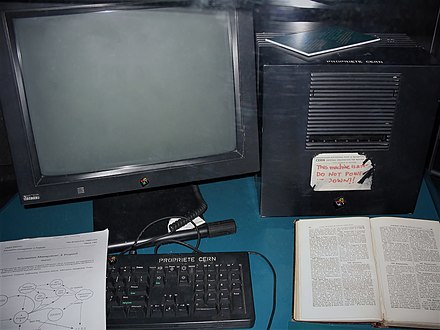
As we look for the line, we might recall that it was on this date in 1991 that the World Wide Web was introduced to the world at large.
In 1989, Tim Berners-Lee (now Sir Tim) proposed the system to his colleagues at CERN. He got a working system implemented by the end of 1990, including a browser called WorldWideWeb (which became the name of the project and of the network) and an HTTP server running at CERN. As part of that development, he defined the first version of the HTTP protocol, the basic URL syntax, and implicitly made HTML the primary document format.
The technology was released outside CERN to other research institutions starting in January 1991, and then– with the publication of this (likely the first public) web page— to the whole Internet 32 years ago today. Within the next two years, there were 50 websites created. (Today, while it is understood that the number of active sites fluctuates, the total is estimated at over 1.5 billion… more than a handful, gambling sites.)
“What dreadful hot weather we have! It keeps me in a continual state of inelegance.”*…

… and it’s likely, climate scientists Matthew Barlow and Jeffrey Basara suggest, to get more uncomfortable still…
… Although heat waves are a natural part of the climate, the severity and extent of the heat waves so far this year are not “just summer.”
A scientific assessment of the U.S. heat wave estimates that heat this severe and long-lasting was two to four times more likely to occur today because of human-caused climate change than it would have been without it. This conclusion is consistent with the rapid increase over the past several decades in the number of U.S. heat waves and their occurrence outside the peak of summer…
… Although heat waves are a natural part of the climate, the severity and extent of the heat waves so far this year are not “just summer.”
A scientific assessment of the U.S. heat wave estimates that heat this severe and long-lasting was two to four times more likely to occur today because of human-caused climate change than it would have been without it. This conclusion is consistent with the rapid increase over the past several decades in the number of U.S. heat waves and their occurrence outside the peak of summer…
At the peak of the last ice age, some 20,000 years ago, when the Northeast U.S. was under thousands of feet of ice, the globally averaged temperature was only 10.8 F (6 C) cooler than now. So, it is not surprising that 2.2 F (1.2 C) of warming so far is already rapidly changing the climate.
Countries promised in 2015 as part of the Paris Agreement to keep warming well under 2 C, but current government policies around the world won’t meet those goals. Temperatures are on pace to continue rising, with the increase likely to more than double again by the end of the century.
While this summer is likely be one of the hottest on record, it is important to realize that it may also be one of the coldest summers of the future…

Read on for more on: “How climate change is heating up the weather, and what we can do about it,” from @MathewABarlow and @OUWXDoc in @ConversationUS.
See also: “The rise of the truly cruel summer,” (gift article) from @TheEconomist.
* Jane Austen, in a letter to her sister dated 18th September, 1796
###
As we chill, we might recall that it was on this date in 1922, the day before his 19th birthday, that Ralph Samuelson invented water skiing. Samuelson had already mastered aquaplaning (riding on a sheet of wood while being pulled by a powerboat) but wanted a summer equivalent of snow skiing. He had unsuccessfully tried barrel staves and snow skis before succeeding with 8 foot long pine boards, the front tip of which he bent up (by boiling them in his mother’s kettle). His first successful outing, on a wide portion of the Mississippi River near Lake City, Minnesota, involved starting on an aquaplane, then stepping off onto the skis.
Samuelson didn’t patent his invention, nor was his work sufficiently publicized at the time to prevent U.S. Patent 1,559,390 for water skis from being subsequently issued, on October 27, 1925, to prolific inventor Fred Waller, who marketed his product as “Dolphin Akwa-Skees.” (Waller also invented Cinerama, which he used to publicize his skis…) Still, Samuelson, who became a turkey farmer, was a guest of honor at a water skiing 50th anniversary in 1972, and was inducted into the Water Ski Hall of Fame in 1977. His slightly-modified second pair (the first pair broke) still exists, and are on display at the Lake City Chamber of Commerce.

“The only reason for time is so that everything doesn’t happen at once”*…

Our lives are spread across range of ways that we spend our time. A newly-published study tracks time-use around the world…
How do you spend each day? Researchers sought answers to that basic question from people of various ages living around the world. They report that on an average day, people spend more than a third of their time focused on matters of health, happiness and keeping up appearances.
“We found that the single largest chunk of time is really focused on humans ourselves, a little more than 9 hours,” explained study author Eric Galbraith, of McGill University in Montreal, Canada. “Most of this—about 6.5 hours—is doing things that we enjoy, like hanging out, watching TV, socializing and doing sports,” he said. Reading and gaming also fall within this rubric.
The other 2.5 hours (out of the 9) are spent on hygiene, grooming and taking care of our own health and that of our kids, said Galbraith, a professor in the department of earth and planetary sciences.
Sleep and bedrest occupy the next largest chunk of time: more than 9 hours on average. That sounds like a lot of shut-eye, but Galbraith stressed this number reflects the average across the full age span, so it includes kids who might sleep up to 11 hours a day. “It also includes time in bed and not sleeping, which can be as much as one hour per day,” he said…
The remaining minutes? They seem to go toward getting organized, moving about or producing, creating and maintaining things and spaces…
For more findings and background on the methodology: “Sleep, cleaning, fun: Research reveals the average human’s day worldwide,” in @physorg_com.
* Albert Einstein
###
As we contemplate chronology, we might recall that it was on this date in 2011 that the Swedish game design house Mojang Studios released the first full version of Minecraft. A sandbox game created by Markus “Notch” Persson, it has become the best-selling video game in history, with over 300 million copies sold– and countless hours consumed…

“There are more things in heaven and Earth, Horatio, / Than are dreamt of in your philosophy”*…

Those were the days…
Ah, polo, that sport of kings, where players race down the field atop horsepowered beasts. Behold their mallets and wheels, whirling throughout the chukka; inhale the earthy scent of mown grass, leather, and gasoline; listen to those bumping bodies, as the transmission’s planetary gearset reins in speed. You’re less likely to find this game played before Pimm’s-sipping crowds, however. It is auto polo — a short-lived sport thought to have been created as an advertising stunt to sell Ford Model Ts in 1911.
Invented, or at least popularized, by the Topeka car salesman Ralph “Pappy” Hankinson, auto polo quickly spread across the United States. Five thousand people supposedly attended the first round, played between the Red Devils and Gray Ghosts on an alfalfa field in Kansas. League matches popped up in the following years, and within a decade it was possible to spectate the sport at Madison Square Garden and Coney Island. Auto polo then went international. King George V enjoyed a match in England; French teams raced around the Place de la Concorde; and touring exhibitions introduced auto polo across continental Europe…
For more background (history, rules) and more photos (from a 1912 match held at Hilltop Park, New York): “Photographs of Auto Polo (ca. 1912),” in @PublicDomainRev.
See also: Bicycle Polo.
* Shakespeare, Hamlet
###
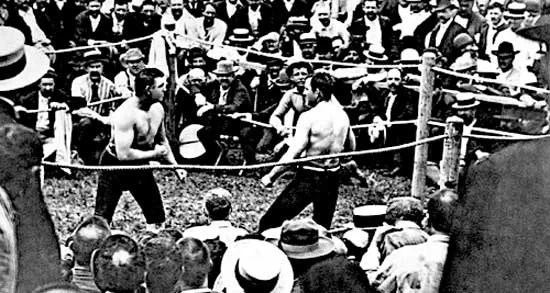
As we muse on mallets, we might recall that it was on this date in 1889 that John L. Sullivan defeated Jake Kilrain for the bare-knuckle heavyweight title at a then-undisclosed location in Richburg, Mississippi, when Kilrain’s manager threw in the towel after the 75th (1 minute) round. This was the last official bare-knuckle title fight in history as boxing adopted the Marquess of Queensberry Rules, which mandated gloves.
You must be logged in to post a comment.