Posts Tagged ‘environment’
“They paved paradise / And put up a parking lot”*…

For 60 years, Section 106 of the National Historic Preservation Act has required federal agencies to “take into account” the effects of their actions on historic properties and places, enabling public participation and comment in the process, and empowering state and local governments and Tribal communities to have a voice in the process– often leading to project improvements and better outcomes. Now, the Trump Administration is working to remove that requirement, as it is to eliminate other heritage and environmental safeguards.
The impacts are already being felt, and wholly unsurprisingly, in a sector that has been consolidated by private equity players…
Chronicle Heritage, the largest cultural resources management company in the United States, abruptly announced it was shutting down, Science has learned. The October 1 move, which has not been announced publicly [as of October 7], came as a surprise to the firm’s more than 600 employees, including numerous archaeologists and paleontologists who were recalled from digs and other projects around the world.
“Our response was absolutely shock, anger, sadness, and fear,” said one employee who asked to remain anonymous.
Chronicle Heritage, which was backed by venture capitalists and formed through the merger of several smaller firms, was a major player in the for-profit cultural heritage industry. It had more than 20 offices and an estimated annual revenue of $100 million. Such firms are often contracted to conduct legally required archaeological surveys and other reviews prior to major development projects. They have been a major source of archaeological data, and some observers estimate they conducted up to 90% of the archaeological research performed in the U.S. each year.
The mass layoff will leave many archaeologists without work just as the warm weather field season comes to a close. The shutdown could also complicate the stewardship of archaeological, Indigenous, and paleontological collections that the firm helped manage.
The closure also comes as the cultural resource management industry is facing profound uncertainty. President Donald Trump’s administration has proposed changes to preservation laws that could vastly reduce the number of federally funded or federally permitted projects requiring archaeological reviews. And a bipartisan group of senators has unveiled legislation, designed to streamline the issuing of federal development permits, that could also lead to fewer archaeological surveys. A broad coalition that includes archaeology organizations, historic preservation groups, and tribal nations has formed to oppose the changes…
“Archaeology megafirm abruptly shuts down“- The largest “cultural resources management” firm in the U.S. deserts the field. From @tmitchellbrown.bsky.social in @science.org.
* Joni Mitchell, “Big Yellow Taxi”
###
As we honor heritage, we might recall that it was on this date in 2024 that archaeologists from the National Academy of Sciences of Armenia and the University of Münster uncovered the remains of a previously unknown early (4th century CE) Christian church in the ancient city of Artaxata, in the heart of Armenia. This remarkable find, the oldest documented Christian church in the country, offers new insights into the spread of Christianity in the region, which was one of the earliest nations to adopt the faith.

“It is entirely possible that you get unpredictable behavior out of predictable rules”*…
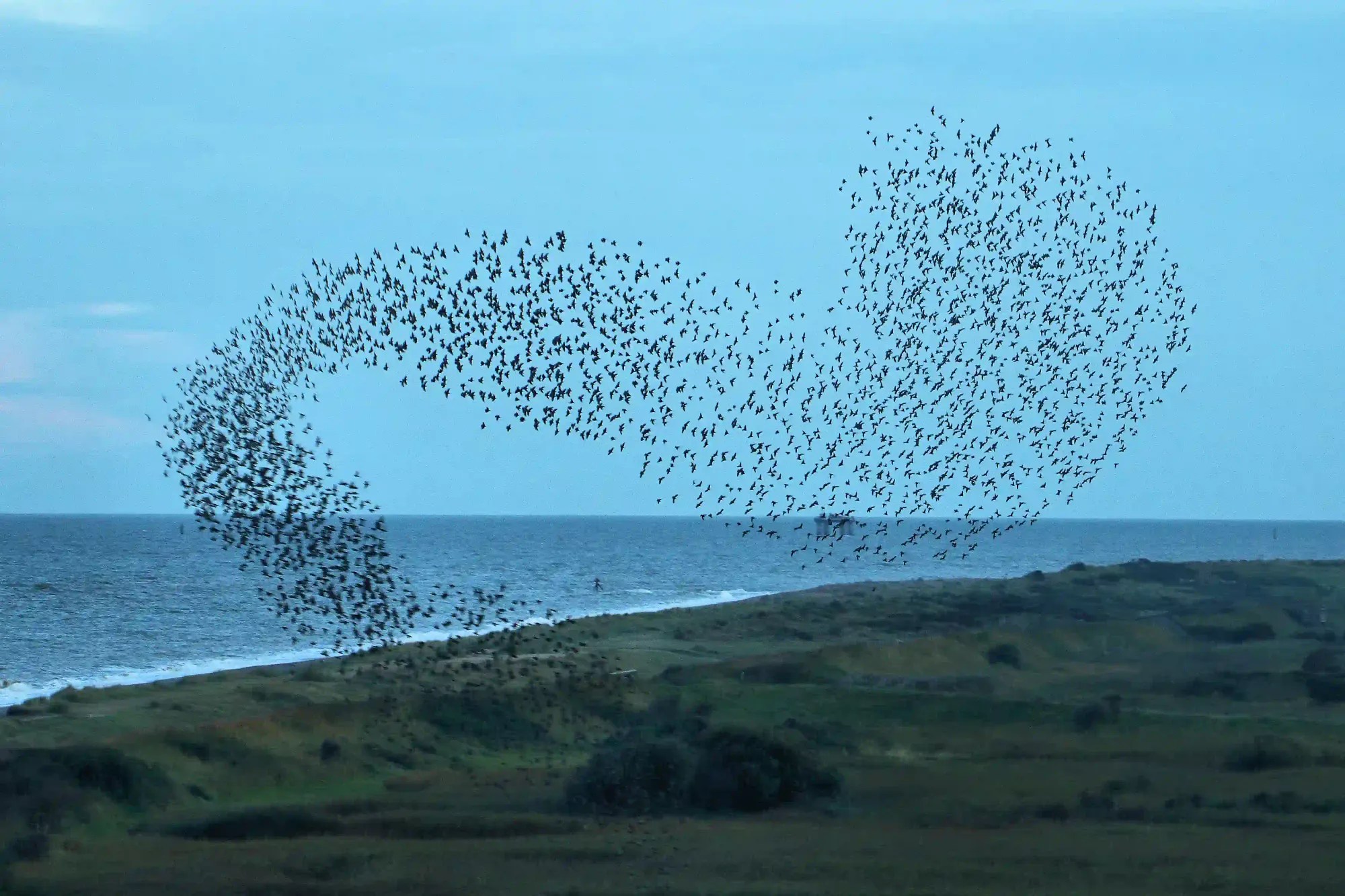
For centuries, the hypnotic winter flights of starlings were thought to be telepathy. Today, science reveals a much darker reality. Behind one of nature’s most breathtaking visual displays lies a mathematical masterpiece built entirely on fear. From The Great Planet…
During the autumn and winter months, if you look to the skies over Europe and North America about an hour before sunset, you might witness one of nature’s most breathtaking visual spectacles. These massive black clouds of tens of thousands of European starlings (Sturnus vulgaris)—constantly shifting into spheres, planes, and waves—are known in the scientific community as a “murmuration.” Named after the deep, resonant sound produced by thousands of wings beating in unison, the phenomenon looks from afar like a colossal calligraphy brushstroke across the sky or a ball of fire flickering in the wind. Yet, beyond this aesthetic illusion lies a ruthless and flawless algorithm for survival.
For centuries, researchers were baffled by how tens of thousands of birds could fly at speeds of around 45 kilometers per hour without a single collision. This coordination was so inconceivable that in 1931, prominent ornithologist Edmund Selous described it as “a madness in the sky.” To Selous, there was only one logical explanation for this complex behavior: telepathy. “They must think collectively, all at the same time,” he wrote.
Like many others, Selous assumed that complex behavior must stem from equally complex origins. However, groundbreaking observations made in 2005 by the married physicists Andrea Cavagna and Irene Giardina from the rooftop of the Palazzo Massimo in Rome revealed a truth far more striking than telepathy. Over three years of chilly evenings, the team used pairs of cameras to reconstruct the 3D positions of more than 4,000 birds in a single flock, proving that there is no overarching plan and no leader. Each starling in the flock interacts exclusively with its seven closest neighbors—a number researchers suggest might be the maximum capacity their brains can handle. The starlings do not keep track of these constantly changing alliances; they simply align their flight path with whichever seven birds are nearest, remaining close, but never too close.
The birds do not need to engage in complex communication to navigate their massive trajectories. When Charlotte Hemelrijk of the University of Groningen in the Netherlands plugged just three simple rules—avoidance, alignment, and attraction—along with basic aerodynamics into a computer model, the resulting virtual murmuration perfectly matched the real-world data gathered in Rome.
Physicists explain this vast web of interaction through the concept of “scale-free correlation.” When a starling turns, this new alignment influences its neighbors, who in turn influence theirs. Yet, unlike a children’s game of telephone, this transfer of information does not degrade with errors; instead, the errors are entirely washed away in the movement. No matter how large the flock becomes, the information arrives at the furthest edge completely uncorrupted. Even though each bird only pays attention to seven neighbors, its senses effectively extend across the entire murmuration, allowing it to instantly react to a movement hundreds of birds away. The reason the flock looks like a single entity from the outside is that, physically, it truly behaves like one.
Why do starlings expend such an immense amount of energy to constantly shift shape in the sky? For a long time, the scientific consensus leaned toward the “warmer together” hypothesis, assuming the displays served to advertise a roosting site and gather more birds for thermal benefits on cold nights. However, an analysis of over 3,000 murmurations across 23 countries, gathered through citizen science, revealed only a weak negative correlation between temperature and flock duration. The true determining factor was the “safer together” principle: defense against predators.
In approximately 30% of the recorded murmurations, birds of prey such as hawks, falcons, or harriers were present. As predators approached or actively engaged the flock, both the duration and the size of the murmuration increased…
… Millions of years of evolution have granted starlings this colossal collective intelligence, allowing them to outmaneuver even nature’s most apex aerial predators. Yet, the primary threat they face today comes not from the sky, but from human activity on the ground. While European starlings are omnivorous, they rely heavily on insect larvae, such as leatherjackets, that live in the soil beneath grasslands; as these grassy areas vanish, so does their food supply. Their habitats are rapidly shrinking due to urbanization and changing farming practices, such as moving livestock feed indoors…
… For a species to merely exist within an ecosystem, narrowly avoiding physical extinction, does not mean it has truly been saved. Earth’s most beautiful phenomena only emerge when living things can act together in great, thriving numbers. You can evolve a flawless biological algorithm based on scale-free correlation to outwit nature’s most ruthless predators, but when your habitat is suddenly paved over with concrete, evolution affords you no time to design a new defense mechanism. The fact that we have finally decoded the mathematical secret of the starling murmuration just as we are on the verge of losing it forever remains one of the most haunting questions suspended in our skies—a stark reflection of modern human hubris and our destructive relationship with the planet…
A flawless algorithm is fading from our skies: “The Mathematics of Fear: Why Starlings Murmurate.”
See also: “The brain has corridors surpassing / Material place.”
* Frank Heppner (an ornihologist who helped create the first computer simulations of bird flocks in flight)
###
As we fly, we might send beautifully-plumed birthday greetings to Elliott Coues; he was born on this date in 1842. An army surgeon, historian, writer, and geographer, he led surveys of the Arizona Territory, first in his army posting there and later as secretary of the United States Geological and Geographical Survey of the Territories.
But we remember him here for his lifelong pursuit of his boyhood passion for birds. As a teen, he met many naturalists at the Smithsonian Institution and published his first ornithological paper in 1859, at age 19. As his army assignments took him to various locations throughout the West, he continued studying the bird life in each new area, and found new species. His Key to North American Birds (1872) was the first work of its kind to present a taxonomic classification of birds according to an artificial key and promoted the systematic study of wild fowl in North America. He founded the American Ornithological Union in 1883, and was editor of its publication, The Auk.

“Food, culture, people, and landscape are all absolutely inseparable”*…

Further, in a fashion, to yesterday’s post: Stephen Lurie and our friends at The Pudding with an elegant and insightful looks at what America’s earliest restaurants can teach us about America…
The New York Public Library’s Buttolph Collection of menus, dated 1880-1920, captures the emergence of modern restaurant dining…
… A menu describes what a reataurant serves– but a menu also describes who is being served. [Collectively] they refect the class, gender, political, technological, and environmental shifts of history.
The thousands of menus in this collection document a period of fundamental transformation– and the birth of the society and the restaurant we know today.
I’ve searched through the archive to tell you that story in ten dishes. Your table is ready– right this way…
Restaurant dining in America was once an Imitation: wannabe aristocrats attempting French feasting. But as the 19th became the 20th century, the American middle class and the true American resaturant emerged: diverse, accessible, opinionated… and at times, chaotic.
From Bisque d’Ecrevisses and Celery in a Crystal Celery Vase through “cosmopolitan” and “ethnic” food to Potatoes O’Brien Au Gratin and Baked Alaska, the tasty (and illuminating) tale of dining out in America: “A History of Menus is a Menu of History,” from @luriethereal.bsky.social and @pudding.cool.
* Anthony Bourdain
###
As we dig in, we might send tasty birthday greetings to a man who has built a culinary domain that epitomizes (in its scale, at least one huge quadrant of) the current state of the restaurant business: Wolfgang Puck; he was born on this date in 1949. He made his name with Spago restaurant in Los Angeles in 1982. He now has more than 20 fine dining restaurants and dozens of pizza bars, bistros, cafes, airport restaurants, express outlets, catering services, cultural center cafes; he sells gourmet foods, cookware, and appliances; and he runs a catering empire (that has catered he official Academy Awards Governors Ball every year since 1994).

“Adaptation and mitigation are two sides of the same coin. If mitigation is about preventing the unmanageable, adaptation is about managing the unavoidable.”*…

Adapting to climate change is quickly becoming part of everyday life. Nabig Chaudhry outlines seven trends we’re seeing for 2026 and beyond…
Within the climate and scientific communities, there’s growing concern about how quickly the world is approaching (and may exceed) 2°C of warming. 2024 was the first calendar year in which global average temperature exceeded 1.5°C above preindustrial levels. The impacts of rapid warming are becoming harder to miss: The climate is changing quickly almost everywhere, local and global climate risks are growing, progress on mitigation has become more politically constrained and uncertain, and many of our systems and policies aren’t prepared for the conditions ahead.
Growing climate risk is increasing the demand for new technologies, tools, strategies, and ways of thinking about climate adaptation. Since publishing our Insights on Climate Adaptation in 2025 report, the practice of climate adaptation has continued to develop, as more people, communities, organizations, and institutions work to understand and respond to climate risks.
People use different language to describe climate adaptation (including climate resilience), but the work centers on helping people, communities, and organizations manage the risks of a changing climate. Those activities are expanding, and we can already see signs. For example, new funding and investment vehicles are emerging, such as Tailwind Futures, and adaptation is receiving more dedicated space at major climate convenings, including The Adaptation Forum, a co-hosted gathering of thought leaders in the adaptation space during Climate Week NYC 2025.
In my role as Director of Climate Adaptation Research at Probable Futures and through my PhD program at the University of California, Berkeley, I speak with experts, read emerging research, and study adaptation developments every day. Through these conversations and insights, I’ve reflected on which adaptation trends are likely to emerge and strengthen…
Chaudhry npacks seven different trends; here, let me highlight two. The first is one that (Roughly) Daily has visited before, insurance…
Elevating insurance as a force in adaptation planning, policy, and behavior
Insurance is a valuable adaptation tool, as it can transfer risk, support recovery after climate shocks, and help signal where danger is increasing through premiums, deductibles, coverage limits, or insurer retreat. It can also shape incentives, because the way risk is priced can influence whether and how people and institutions reduce exposure, strengthen buildings, or avoid certain kinds of development.
As climate risks grow, damage to property and homes becomes more frequent and severe. Property owners are experiencing those shocks both physically (flooding, fire, wind damage, etc.) and financially as insurance markets adjust and recalibrate in response to changing probabilities and severities. Insurance markets have begun reflecting climate risk, and those changes are starting to influence where and how people build homes and infrastructure, where they invest in property, and where they choose to live.
A useful example of how insurance is beginning to influence adaptation efforts in the public sphere is Strengthen Alabama Homes, a program of the Alabama Department of Insurance. The program provides grants to help homeowners retrofit their homes and roofs to reduce wind damage from extreme winds and storms. Homeowners who participate can receive discounts on the wind portion of their homeowner’s insurance premium, which makes insurance not only a tool for recovery but also a tool for encouraging adaptation before exposure occurs.
Insurance pricing is one way climate risk is made visible, priced, and acted on through adaptation. I expect that insurance will increasingly influence adaptation planning, policy, and behavior, not only by helping people recover after climate shocks, but by shaping the choices people make before those shocks occur. The development of the insurance industry will therefore be an important factor in adaptation. If insurers become a source not only of risk pricing but also of risk information, adaptation guidance, and incentives to reduce risk, they could help more people act before losses occur. But that would require a meaningful shift in the role of insurance companies, from mainly pricing and transferring risk to also helping people reduce it…
The second goes to the contentious topic of geoengineering…
Expanding debate around the role of climate intervention
As warming continues, risks keep growing. We have more, clearer, worrisome signals that irreversible change, tipping points, and local climate changes so severe that adaptation is impractical if not impossible, are not far off. In response, people and institutions are starting new conversations about global-scale responses. One of those responses is climate intervention, sometimes called geoengineering.
Climate intervention generally refers to intentional efforts to alter Earth’s systems in order to counteract some of the effects of climate change. It can include approaches that remove carbon dioxide from the atmosphere, as well as approaches that reflect a portion of sunlight back into space, such as stratospheric aerosol injection.
Its relationship to adaptation is uneasy, but important. If climate intervention is, at its core, an effort to manage the otherwise unmanageable risks of global climate change, then is it another tool for adapting to climate change, or is it something fundamentally different? There is no consensus, and there may never be, not least because global action will cause uneven responses locally. We don’t know much about the potential impacts of some climate interventions, how they could affect different regions unequally, or what long-term consequences they may have for Earth’s climate and natural systems.
There are good reasons to have informed conversations and do fundamental research on intervention. People with adaptation expertise can help explore, illuminate, and explain what climate intervention could mean for society and nature. There are also likely to be benefits for adaptation professionals to participate in these conversations and research projects. Even if climate intervention is never widely deployed, the debate itself may shape adaptation thinking, climate policy, research funding, public trust, and international governance.
Climate change requires people to consider risks and options, whether for mitigation, adaptation, or intervention. Treating strategies for managing the rate, pace, and impacts of climate change as distinct and separate is unlikely to lead to good outcomes. I am hopeful that there will be more collaboration across these new fields as society faces new challenges that have a common root cause. This may include more discussion about how these technologies should be governed, whether they should receive more investment, and whether climate intervention is a possible third leg alongside mitigation and adaptation…
Eminently worth reading in full: “The near-term future of climate adaptation: emerging trends.”
* U. N. Environmental Program
###
As we prepare, we might recall (wistfully) that it was on this date in 1942 that Bing Crosby, with the Trotter Orchestra and the Darby Singers, recorded Irving Berlin’s song, “White Christmas.” According to the Guinness Book of World Records, this version is the best-selling single of all time with an excess of 50 million copies sold worldwide. (In fact, the version most often heard today is not the original. After frequent use, the master had become damaged, so on March 18, 1947, Crosby re-recorded the holiday hit.)

“It is by the deep, hidden currents that the oceans are made one”*…

A significant part of the earth’s climate infrastructure is under threat. New research suggests the Atlantic Meridional Overturning Circulation (or AMOC) could weaken by half this century with wide ranging consequences for weather, food, and sea levels across the world. Alison Smart and Charlotte Venner unpack the past and ponder the future of this critical ocean current…
London, England, and Quebec City, Canada sit at roughly the same latitude (51°N and 47°N, respectively) but have vastly different climates. Historically, Quebec City had 99 freezing days in an average year—weather you might expect from its relative proximity to the Arctic—but London only experienced three freezing days in an average year, despite being slightly further north. This difference is largely due to an ocean current called the Atlantic Meridional Overturning Circulation (AMOC), which distributes warmth from the Tropics via the Atlantic Ocean.
Now, impacts from climate change are weakening the AMOC, and it could collapse entirely in the near future. AMOC collapse would rapidly make regions of the Northern Hemisphere with historically mild weather colder and harsher, while triggering irreversible changes in the global climate.
The AMOC is both the product of a stable climate and a factor in maintaining weather patterns around the planet. To plan for future scenarios, we need to first understand how the AMOC works and what might happen if it collapses…
[Smart and Venner explain the AMOC and outline the ways in which it shapes the climate of regions around the world…]
… Even minor weakening of the AMOC can significantly impact local climates, as has happened several times in the past 12,000 years. A “Little Ice Age” occurred in Europe in the Middle Ages, likely connected to a disruption in the AMOC. Just a slight slowdown in the AMOC could make Europe colder overall, disrupt global precipitation patterns from South America to India, and worsen drought in Africa.
The more freshwater pours into the ocean, and the more ocean temperatures rise, the weaker the AMOC becomes—until, at some threshold, it could stop moving altogether.
It is possible that the AMOC will collapse entirely if warming continues. There is no agreed-upon global average temperature at which collapse becomes certain, but there are signals we can track and historical examples we can examine to predict the likelihood of collapse…
… The consequences of total AMOC collapse would be far-reaching, severe, and irreversible on timescales relevant to humans. AMOC collapse would cool parts of the Northern Hemisphere and warm parts of the Southern Hemisphere by multiple degrees Celsius and drastically alter weather around the world.
In Europe, winter temperatures would drop, cold snaps could increase, and winter storms would intensify. A 2025 research letter found that, even if global warming reached 2°C, AMOC collapse would make Europe colder than it is today, creating extreme winters in Northwestern Europe in which record cold might reach -20°C (-4°F) in London and -50°C (-58°F) in Scandinavia. Even milder cold days would increase, with approximately 150 to 180 frost days per year in Utrecht, Netherlands, compared to a historic average of about 53. Precipitation would likely shift and decrease, potentially drying out some parts of Europe and making others wetter.
Around the world, other climates would change, likely in less extreme ways.
- North America. The East Coast of North America would likely experience rapid sea level rise as the gravitational pull of the AMOC weakens, as well as cooler conditions, with some parts of Eastern Canada and the North Atlantic coast cooling by several degrees Celsius, erratic storms, weather variability, and more intense hurricanes.
- Tropics & South America. Without the AMOC, the ITCZ would shift south, potentially leading to drying in the Northern Tropics and parts of the Amazon and wetter conditions in the Southern Tropics.
- Africa. Because of the shift in the ITCZ, West Africa and the Sahel would be much drier, experiencing severe and frequent drought and reduced rainy seasons. The Sahel could possibly transition from a semi-arid climate to hot dry desert.
- Asia. Because of the shift in the ITCZ, weakened and more erratic monsoons in Asia would lead to increased drought and a higher risk of extreme precipitation events.
These changes may occur rapidly, create climate risks, and cause systemic disruption in affected regions. The collapse of the AMOC would also be a tipping point in the global climate, meaning that the changes would likely be difficult, if not impossible, to reverse on human timescales.
Once the AMOC passes a critical threshold of weakening, called a tipping point, it would continue to weaken until it collapses. AMOC collapse could also create systemic impacts that activate other tipping points as well as feedback loops that could generate further warming.
For example, if AMOC collapse contributed to changes like a permanent dieback of the Amazon Rainforest or increased ice loss, those changes would generate their own warming effect on Earth’s climate. A 2026 paper suggests that AMOC collapse would result in substantial carbon release from oceans and add around 0.2°C in additional atmospheric warming.
Reducing greenhouse gas emissions may slow warming enough to reduce weakening and delay collapse. If collapse begins, it is unlikely we could stop it. There is no feasible technological way to reengineer ocean currents…
A bracing, but important read: “A complete guide to the Atlantic Meridional Overturning Circulation (AMOC).”
See also: “What would happen if the Atlantic Meridional Overturning Circulation (AMOC) collapses? How likely is it?”
###
As we put on our sailin’ shoes, we might send interconnected birthday greetings to Andrew Sharrett; he was born on this date in 1946. An archaeologist, his application of world-systems theory to questions of change on large, often global, scale made him one of the most influential archaeologists of the late 20th/early 21st centuries. Sharrett is best known for his theory of the secondary products revolution; but his work touched on a broad range of fundamental human developmental issues: global migration and colonization, the spread of agriculture, the development of metallurgy and urbanism, and the development of new forms of consumption, to name a few. All of those dynamics were, as Sharrett observed, shaped in significant ways by the climatic conditions in which they unfolded.

You must be logged in to post a comment.