Posts Tagged ‘wildfire’
“Sooner or later everyone sits down to a banquet of consequences”*…
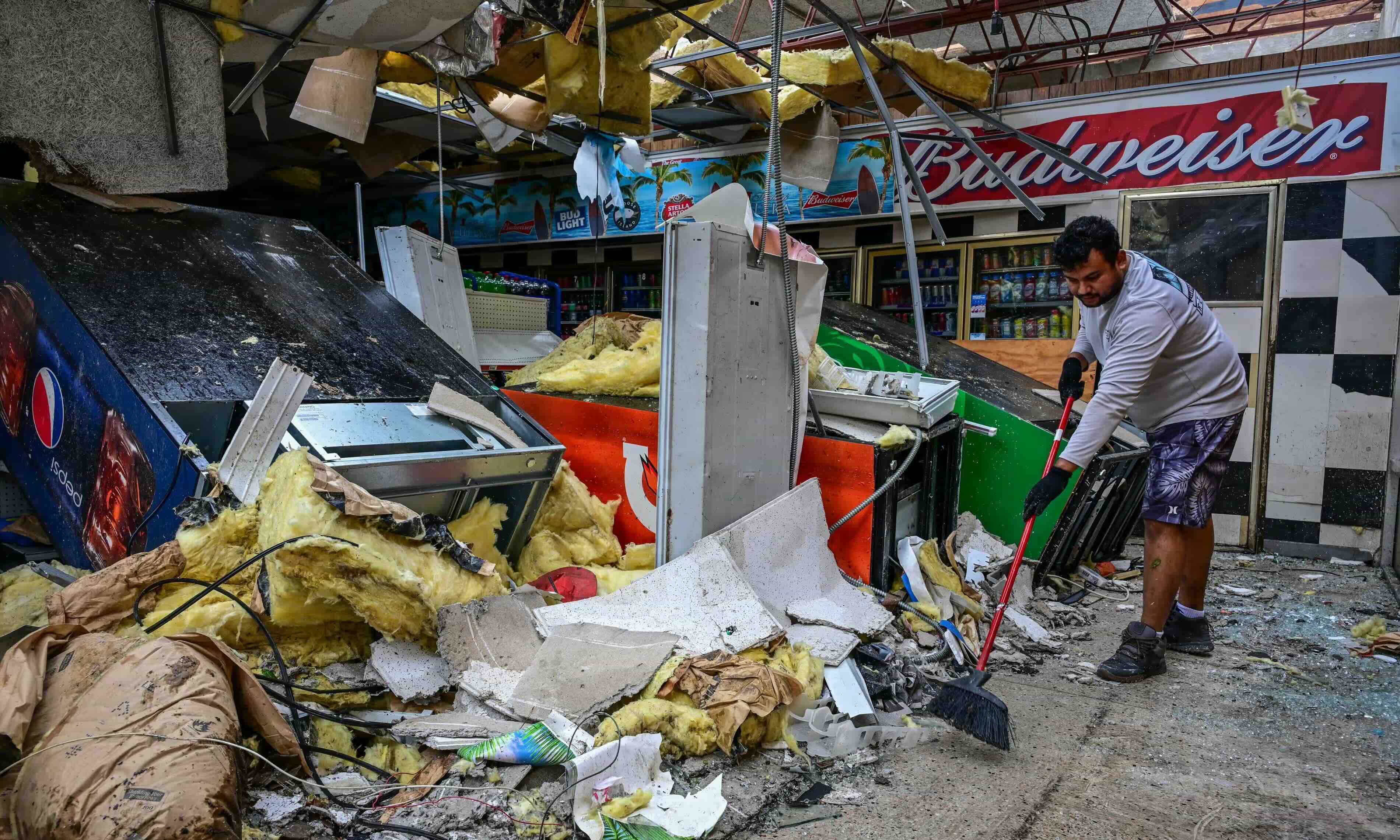
A report issued by International Chamber of Commerce late last year found that extreme weather cost $2tn globally over last decade; the U.S. suffered the greatest losses. As Damian Carrington reports, a leading insurance executive is warning that urgent action is needed to save the conditions under which markets – and civilization itself – can operate…
The climate crisis is on track to destroy capitalism, a top insurer has warned, with the vast cost of extreme weather impacts leaving the financial sector unable to operate.
The world is fast approaching temperature levels where insurers will no longer be able to offer cover for many climate risks, said Günther Thallinger, on the board of Allianz SE, one of the world’s biggest insurance companies. He said that without insurance, which is already being pulled in some places, many other financial services become unviable, from mortgages to investments.
Global carbon emissions are still rising and current policies will result in a rise in global temperature between 2.2C and 3.4C above pre-industrial levels. The damage at 3C will be so great that governments will be unable to provide financial bailouts and it will be impossible to adapt to many climate impacts, said Thallinger, who is also the chair of the German company’s investment board and was previously CEO of Allianz Investment Management.
The core business of the insurance industry is risk management and it has long taken the dangers of global heating very seriously. In recent reports, Aviva said extreme weather damages for the decade to 2023 hit $2tn, while GallagherRE said the figure was $400bn in 2024. Zurich said it was “essential” to hit net zero by 2050.
Thallinger said: “The good news is we already have the technologies to switch from fossil combustion to zero-emission energy. The only thing missing is speed and scale. This is about saving the conditions under which markets, finance, and civilisation itself can continue to operate.”
Nick Robins, the chair of the Just Transition Finance Lab at the London School of Economics, said: “This devastating analysis from a global insurance leader sets out not just the financial but also the civilisational threat posed by climate change. It needs to be the basis for renewed action, particularly in the countries of the global south.”
“The insurance sector is a canary in the coalmine when it comes to climate impacts,” said Janos Pasztor, former UN assistant secretary-general for climate change.
The argument set out by Thallinger in a LinkedIn post begins with the increasingly severe damage being caused by the climate crisis: “Heat and water destroy capital. Flooded homes lose value. Overheated cities become uninhabitable. Entire asset classes are degrading in real time.”
“We are fast approaching temperature levels – 1.5C, 2C, 3C – where insurers will no longer be able to offer coverage for many of these risks,” he said. “The math breaks down: the premiums required exceed what people or companies can pay. This is already happening. Entire regions are becoming uninsurable.” He cited companies ending home insurance in California due to wildfires.
Thallinger said it was a systemic risk “threatening the very foundation of the financial sector”, because a lack of insurance means other financial services become unavailable: “This is a climate-induced credit crunch.”
“This applies not only to housing, but to infrastructure, transportation, agriculture, and industry,” he said. “The economic value of entire regions – coastal, arid, wildfire-prone – will begin to vanish from financial ledgers. Markets will reprice, rapidly and brutally. This is what a climate-driven market failure looks like.”
No governments will realistically be able to cover the damage when multiple high-cost events happen in rapid succession, as climate models predict, Thallinger said. Australia’s disaster recovery spending has already increased sevenfold between 2017 and 2023, he noted.
The idea that billions of people can just adapt to worsening climate impacts is a “false comfort”, he said: “There is no way to ‘adapt’ to temperatures beyond human tolerance … Whole cities built on flood plains cannot simply pick up and move uphill.”
At 3C of global heating, climate damage cannot be insured against, covered by governments, or adapted to, Thallinger said: “That means no more mortgages, no new real estate development, no long-term investment, no financial stability. The financial sector as we know it ceases to function. And with it, capitalism as we know it ceases to be viable.”
The only solution was to cut fossil fuel burning, or capture the emissions, he said, with everything else being a delay or distraction. He said capitalism must solve the crisis, starting with putting its sustainability goals on the same level as financial goals.
Many financial institutions have moved away from climate action after the election of the US president, Donald Trump, who has called such action a “green scam”. Thallinger said in February: “The cost of inaction is higher than the cost of transformation and adaptation. If we succeed in our transition, we will enjoy a more efficient, competitive economy [and] a higher quality of life.”…
It’s time, if not past time, to act: “Climate crisis on track to destroy capitalism, warns top insurer,” from @dpcarrington.bsky.social in @theguardian.com.
Further to the point: “Get ready for several years of killer heat, top weather forecasters warn.”
See also: “Q&A: Kiley Bense on Climate Journalism in a New Information Environment.”
(Image above: source)
* Robert Louis Stevenson
###
As we contemplate craziness, we might recall that it was on this date in 2011 that the Wallow Fire started. A wildfire that started in the White Mountains near Alpine, Arizona, it was named for the Bear Wallow Wilderness area where the fire originated.
The fire eventually spread across the stateline into western New Mexico. By the time the fire was contained on July 8, it had consumed 538,049 acres of land, 522,642 acres in Arizona and 15,407 acres in New Mexico. It was the largest wildfire in Arizona history and did an estimated estimated cost was $109 million in damages. Smoke from the Wallow Fires and others in Arizona and New Mexico extended through Texas and Oklahoma up into the Great Lakes region, affecting air quality for large areas east of the Rocky Mountains.

“I’d rather fight 100 structure fires than a wildfire. With a structure fire you know where your flames are, but in the woods it can move anywhere; it can come right up behind you.”*…

The devastation in the Los Angeles area is just the latest reminder that wildfires are a massive problem that continues to grow. Caleb X. Cunningham, Grant J. Williamson, and David M. J. S. Bowman put the threat into alarming perspective…
Climate change is exacerbating wildfire conditions, but evidence is lacking for global trends in extreme fire activity itself. Here we identify energetically extreme wildfire events by calculating daily clusters of summed fire radiative power using 21 years of satellite data, revealing that the frequency of extreme events (≥99.99th percentile) increased by 2.2-fold from 2003 to 2023, with the last 7 years including the 6 most extreme. Although the total area burned on Earth may be declining, our study highlights that fire behaviour is worsening in several regions—particularly the boreal and temperate conifer biomes—with substantial implications for carbon storage and human exposure to wildfire disasters…
An unlocked article from Nature Ecology & Evolution: “Increasing frequency and intensity of the most extreme wildfires on earth.”
Looking forward: “Five Climate Realism Insights on California’s Wildfires.”
Apposite: “Climate Change, Disaster Risk, and Homeowner’s Insurance,” from the Congressional Budget Office.
And very practically: “Wildfire Prep.”
* Tom Watson
###
As we contemplate conflagration, we might recall that on this date in 1949, after two days in which a few flakes fell, Los Angeles “enjoyed” a real snow fall (the first that anyone can recall).

“I always tried to turn every disaster into an opportunity”*…

Hurricanes, tornadoes, floods, droughts, wildfires– they’re all on the rise, in both number and severity. Which is putting more strain on FEMA… But as Nicole Wetsman explains, FEMA is so hard to deal with that a new industry, “disaster consultants,” has emerged… and looks likely to prosper…
… FEMA is, in theory, complicated for a reason. Its labyrinth of rules is there to curb fraud and to make sure that local governments are using taxpayer money appropriately. But a laser focus on fraud prevention sometimes leads to the agency spending as much or more on documentation and reviews as the project itself should cost. “FEMA will spend thousands of dollars writing a project worksheet for $250 of eligible costs,” says Ben Rose, recovery and mitigation section chief at Vermont Emergency Management. “It’s not seeing the forest for the trees.”
And it also makes the process nearly impossible to navigate alone, particularly for cities and small towns that have never dealt with disasters before. Most don’t have any in-house emergency management experts who understand even the basics of the process. Some states, like Vermont, usually send in their own teams from emergency management departments to help cities and towns with the FEMA process. They only use consultants as force multipliers during really, really big disasters. Others, like Oregon, rely on them more often because the state just can’t maintain the level of staffing required.
That layers on additional costs for communities and, by extension, FEMA — which is well aware of the role consultants play in the public assistance program. It even pays for them: the towns, counties, or other groups applying for public assistance funding can use up to 5 percent of any grants for management costs. Still, FEMA used to be a bit dismissive toward consultants, [disaster consultantr AThat layers on additional costs for communities and, by extension, FEMA — which is well aware of the role consultants play in the public assistance program. It even pays for them: the towns, counties, or other groups applying for public assistance funding can use up to 5 percent of any grants for management costs. Still, FEMA used to be a bit dismissive toward consultants, [disaster consultant Alyssa ] Carrier says. That’s changed over the past few years. “It’s much more like, let’s work together,” she says.
…
If anything, the public assistance process has only gotten more byzantine over the past few years, experts say. The agency set up a digital portal to streamline the process of submitting public assistance grants. But it’s an undertaking to train local officials — who might have six other jobs — in that tool. “You have to upload every document and do them in a certain order,” Carrier says. “It can be hard to follow if you don’t understand the process to begin with. And one of the issues is, if you don’t do everything in order, you’ll get kicked back out and have to start all over again.”
FEMA is assessing the public assistance program with a focus on simplification, Jeremy Edwards, FEMA press secretary, said in an email to The Verge. “FEMA continues its ongoing efforts and initiatives to simplify and streamline the public assistance program,” he said.
But experts say FEMA also seems to be getting stricter with how it applies its own rules around what’s eligible for public assistance funding and around the rules cities and local governments have to follow to get that funding. Some of that is likely because of pressure from the various oversight agencies, like OIG, that come in and double-check the agency’s work. In 2016, the OIG released a report saying that FEMA wasn’t doing enough to make sure that groups receiving public assistance grants were sticking to procurement guidelines. They followed up with a similar report in 2021. “After another report like this, Public Assistance Recipients and Subrecipients should expect FEMA to take an even firmer stance on requiring compliance with procurement regulations,” wrote Michelle Zaltsberg, an attorney specializing in disaster recovery, in a blog post.
All of that oversight colors FEMA’s decisions. “Too often, FEMA prioritizes or looks through the lens of avoiding audit findings, avoiding Inspector General reports, and avoiding waste, fraud, and abuse complaints,” Phelps says. “And then like third or fourth on the list of what they try to do is help survivors.”
None of this is relieved by the growing frequency of disasters pulling the agency — and its money — in all directions. The amount distributed through public assistance funding has gone up for the past three years. There are no restrictions to the program based on dollar amounts; how much money gets spent is purely based on what’s eligible for the program. Even before the COVID-19 pandemic, the changing climate meant things like wildfires and hurricanes were appearing more frequently and in places where they may not have hit before. Before around 2015, Oregon used to average a federal disaster every 17 or 18 months, Phelps says. Since 2015, they’ve averaged a disaster declaration every seven or eight months — more than twice as often.
That leads to FEMA almost acting more as an insurance company that only pays out money when it has to than an agency providing aid, Phelps says. The first priority often seems to be making sure the paperwork is perfect…
A sobering read: “The Disaster Consultants,” from @NicoleWetsman in @verge.
* John D. Rockefeller, oil tycoon considered the richest person in American history (and possibly in modern history)
###
As we ruminate on response, we might recall that it was on this date in 1975 that Hurricane Iniki struck the Hawaiian island of Kaua’i; with winds of over 145 mph, it was the second-strongest Pacific hurricane on record, and caused around $3.1 billion (in 1992 USD) in damage and six deaths, making it the costliest natural disaster on record in the state. At the time, Iniki was the third-costliest United States hurricane. The storm struck just 18 days after Hurricane Andrew, the costliest tropical cyclone ever at the time, struck Florida.
Kauaʻi citizens were hopeful for disaster relief from the government or insurance companies, though after six months they felt annoyed with the lack of help.

“With the greater part of rich people, the chief enjoyment of riches consists in the parade of riches”*…

As insurance premiums rise, global warming’s effects are impacting collectors’ bank accounts, especially in disaster-prone states like California and Florida where risky conditions have become the norm…
Art collectors in California, Florida and other states experiencing weather-related disasters aggravated by climate change are finding fine art insurance becoming more expensive, with policies increasingly difficult to obtain (or renew) and containing new restrictions.
Earthquake-prone California, which has faced a series of massive wildfires (often followed by landslides) in recent years, is one epicentre in this struggle to find insurance coverage for homes and the art within them, with the annual cost of homeowners policies rising as much as 40% and the premiums for fine art insurance coverage increasing between 5% and 12%, according to Amee Yunn, assistant vice president of the New York-based Berkley Asset Protection, an insurance company specialising in fine art, jewellery and other high-value, personal and commercial assets. Florida, with its increasingly intense hurricanes and floods, is also a concern for the insurance industry.
“Many wealthy people flocked to Florida due to the pandemic,” Yunn says, “and they took their art with them.” That concentration of wealth assets in areas prone to flooding and hurricane damage creates significant risks to the financial wellbeing of insurance carriers. “We are seeing far more billion-dollar claims now than just 10 years ago,” Yunn says, causing companies like hers to write fewer new policies, increase their prices and add deductibles and exclusions. “The problem is acute.”
…
These days, insurance carriers track the advance of climate change as much as environmental scientists. “We have a corporate catastrophe team, which tracks the company’s total catastrophe exposure,” Yunn says. The risks from tornadoes in the Great Plains, hurricanes up and down the East Coast and earthquakes on the West Coast are well known, but the increasing intensity of hurricanes and tornadoes, as well as the rising numbers of them, are alarming signals. The tornado that ripped through Kentucky and several other states last year in a 200-mile path during the unlikely month of December was yet another sign of a climate that is becoming less predictable, as were a series of hurricanes, wildfires and freezing temperatures that have struck in Texas since 2017. In February 2021 a combination of snow, sleet and freezing rain paralysed Texas’s power grid for weeks, causing more than 200 deaths and nearly $200bn in damage.
“It would seem that there is nowhere safe from the effects of climate change,” [senior managing director at Risk Strategies Steve] Pincus says, all of which impacts the fine art insurance world, leading to higher prices and less available coverage…
“‘The only way to stop the bleeding is to stop writing policies’: climate change is making it more expensive to insure art,” from @TheArtNewspaper.
Via @WaltHickey, in his invaluable Numlock News, who observes “Listen, if ‘boo hoo, it’s getting too expensive to insure my vast art collection’ is the thing that gets rich people to actually care about climate change I’m still gonna take that as a win.”
* Adam Smith
###
As we ponder protection, we might recall that it was in this date in 1885 that the first issue of Good Housekeeping was published. A “woman’s magazine” (featuring articles on women’s interests, recipes, diet, and health), it is also known for its product testing service and its the “Good Housekeeping Seal”, a limited warranty program that is popularly known as the “Good Housekeeping Seal of Approval.” One of the oldest continuously-published magazines in the U.S., it remains popular in its category.

You must be logged in to post a comment.