Posts Tagged ‘extreme weather’
“There’s been most uncommon bad weather in them latitudes, there’s no denyin'”*…
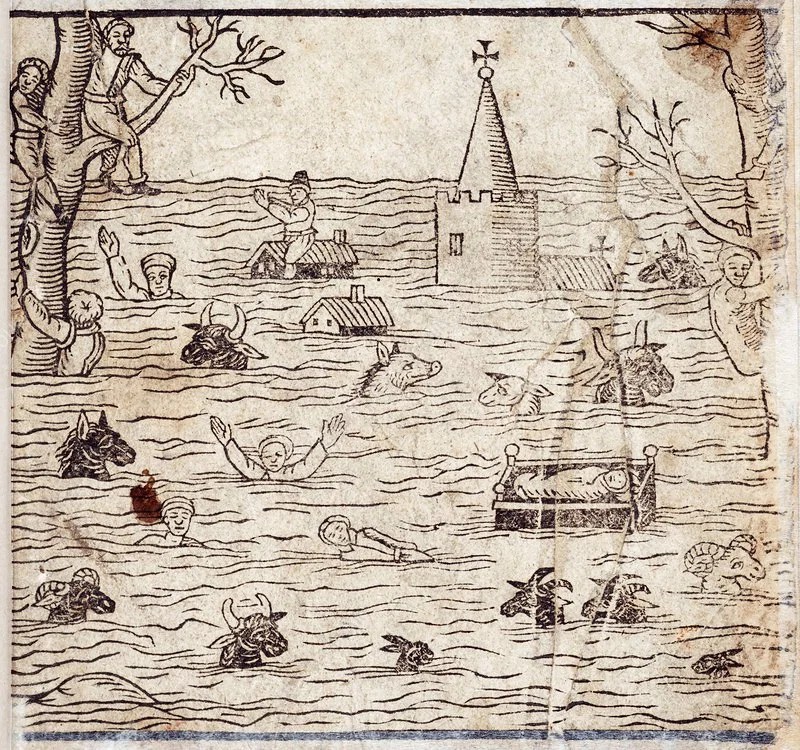
When the Bristol Channel flooded in 1607, it was not just one of the worst natural disasters in British history, it was also a sign, for many, that they had strayed from the path of God. Erik Crnkovich examines the overlap of miraculous weather and the early modern printing industry, which cultivated a thirst for all things occult, exotic, and odd…
When the Bristol Channel flooded on January 30, 1607, pamphlets describing it as God’s warning to a wayward people likewise flooded out of London’s booming presses. Rare weather events of all sorts are ironically commonplace in seventeenth-century news — a century otherwise tempestuous in its frequent, often literal, chopping and changing in church and state. In fact, the two are reflections of each other. True, British weather was consistently inconsistent during the Little Ice Age, a period of prolonged cold and wet that would not end for another two centuries. But the headlines reporting “prodigious” thunderstorms, “miraculous” apparitions, and “terrible” earthquakes were often followed by interpretations of them as moral weathervanes — divine providence, a sign to repent and return to the proverbial straight and narrow.
It is perhaps little surprise, then, that the pamphleteer William Jones rushed to the presses when a storm surge inundated 518 square kilometres surrounding the Bristol Channel. Present scholarship counts 2,000 recorded deaths, making it one of Britain’s worst natural disasters and, according to Jones, a judgement from God…
To date, recent responses to climate disasters have been notably devoid of “divine” interpretation; indeed, if anything, they’ve largely been written off as “just the weather being the weather.” As further extreme weather wreaks havoc and our online version of the “early modern printing” continues to unfold, could that change?
Floods and foreboding in 17th-Century Britain: “Wonderful Weather,” from @publicdomainrev.bsky.social.
* Charles Dickens, Dombey and Son
###
As we seek higher ground, we might recall that it was on this date in 1991 that the “Perfect Storm” formed…
On October 30, 1991, the so-called “perfect storm” formed in the North Atlantic, producing remarkably large waves along the New England and Canadian coasts. Over the next several days, the storm spread its fury over the ocean off the coast of Canada. The fishing boat Andrea Gail and its six-member crew were lost in the storm. The disaster spawned the bestselling book The Perfect Storm by Sebastian Junger and a blockbuster Hollywood movie of the same name.
On October 27, Hurricane Grace formed near Bermuda and moved toward the coast of the southeastern United States. Two days later, Grace continued to move north, where it encountered a massive low pressure system moving south from Canada. The clash of systems over the Atlantic Ocean caused 40-to-80-foot waves on October 30—unconfirmed reports put the waves at more than 100 feet in some locations. This massive surf caused extensive coastal flooding, particularly in Massachusetts; damage was also sustained as far south as Jamaica and as far north as Newfoundland… – source

“Men argue. Nature acts.”*…
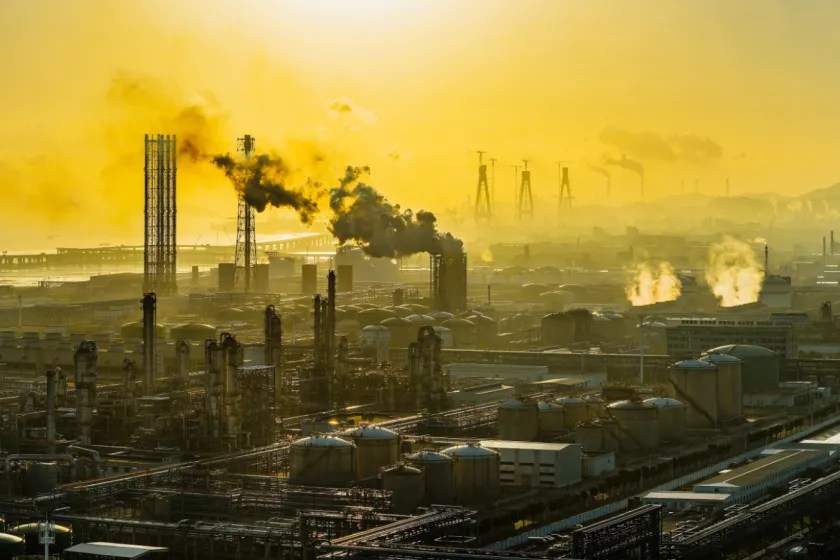
… and after Nature acts, so must we. But despite decades of warning, global emissions still aren’t falling.
As Madeleine Cuff reports, we should be springing into action…
It is now impossible for the world to limit global warming to 1.5°C above pre-industrial levels, with emissions on track to cause 2.8°C of warming by the end of the century, the UN says.
Despite increasingly urgent warnings from scientists outlining the dangers of warming above 1.5°C, global emissions aren’t yet falling and governments around the world aren’t doing anywhere near enough to decarbonise their economies.
The only way to meet the 1.5°C target now is by “overshooting” that goal in the short term, the UN said in its latest Emissions Gap report, before relying on vast amounts of global cooling, delivered via technologies such as direct air capture, in the latter half of the century.
This “lowest possible” overshoot scenario would see the global temperature rise peak at 1.7°C to 1.8°C, with a 50 per cent chance of temperatures falling back to 1.5°C by 2100. To deliver this, the world would need to cut emissions by 18 per cent by 2030, 45 per cent by 2035 and 69 per cent by 2040, relative to 2025 levels. Under current climate pledges, emissions will only fall by 5 to 8 per cent by 2030, and 11 to 15 per cent by 2035.
Many scientists are hugely sceptical that the lowest possible overshoot scenario is politically and technologically feasible, given the rapid pace of emissions cuts required and the huge volume of mechanical and natural cooling that would be needed to reduce global temperatures after 2050 to achieve it.
“We don’t know whether we can overshoot,” says Bob Watson, emeritus professor at the University of East Anglia in the UK and former chair of the Intergovernmental Panel on Climate Change. “We don’t know if any of those technologies are real, and so when people assume that we can meet 1.5°C or 2°C, and the assumption is based on overshooting and coming back, I think they’re in cuckoo land.”
Last year’s Emissions Gap report saw the UN warn that overshooting 1.5°C was now inevitable. This year’s analysis sets out new “overshoot pathways” designed to keep the 1.5°C goal – a political totem for many countries – on life support. It calls on nations to focus on delivering the “lowest possible” 1.5°C pathway.
“Overshoot is not surrender. We can still keep it as small and as short as possible – and bring temperatures back below 1.5 degrees by the end of the century,” UN Secretary-General António Guterres said in a statement.
But the UN’s new report makes it clear how far off track the world still is to deliver even this “limited overshoot” pathway. Current national policies put the world on track for 2.8°C of warming by the end of the century. If nations meet all their climate promises, that is lowered to 2.1°C. This is worse than last year’s projection of 1.9°C of warming, driven mainly by the US’s exit from the UN climate process.
Joeri Rogelj at Imperial College London says overshoot should be seen “as a failure that we try to rectify”. But he says there is still value in using the 1.5°C goal, rather than adopting a higher temperature goal that could be achieved without overshoot. “The target is still to limit harm to vulnerable and poor populations, and that we don’t do by resetting the target to an inadequate limit of 2°C, or 2.5°C,” he says. “In the public debate, this failure to stay within this most ambitious limit should re-emphasise the need to stay as close to it as possible.”
The best-case scenario now is that the planet will only temporarily breach 1.5°C of warming, but current climate pledges fall way short of that hope: “UN says 1.5°C is over and world is on track for 2.8°C of global warming” [archived version], from @tinymaddie.bsky.social in @newscientist.com.
* Voltaire
###
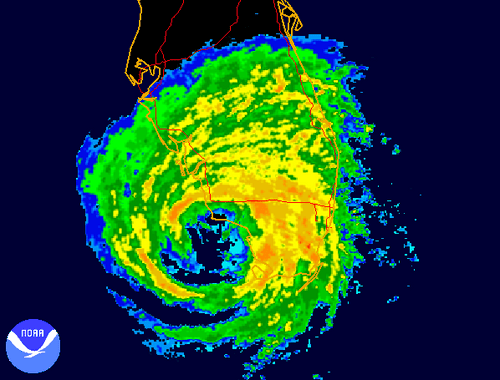
As we act to ameliorate and adapt, we might recall that it was on this date in 2015 that Hurricane Wilma made landfall in the Everglades in Florida with maximum sustained winds near 120 mph. The hurricane accelerated across south Florida and the Miami/Fort Lauderdale area, exiting the coast later the same day. There were 10 fatalities in Florida, and nearly 6 million people lost power, the most widespread power outage in Florida history. Preliminary estimates of insured losses in Florida were over $6 billion, while uninsured losses were over $12 billion.
Scientists suggest that, while climate change may not increase the total number of storms (indeed, this year’s El Nino reduced them in the Atlantic), it will intensify hurricanes, making them stronger, wetter, slower-moving, and more destructive.
“Sooner or later everyone sits down to a banquet of consequences”*…
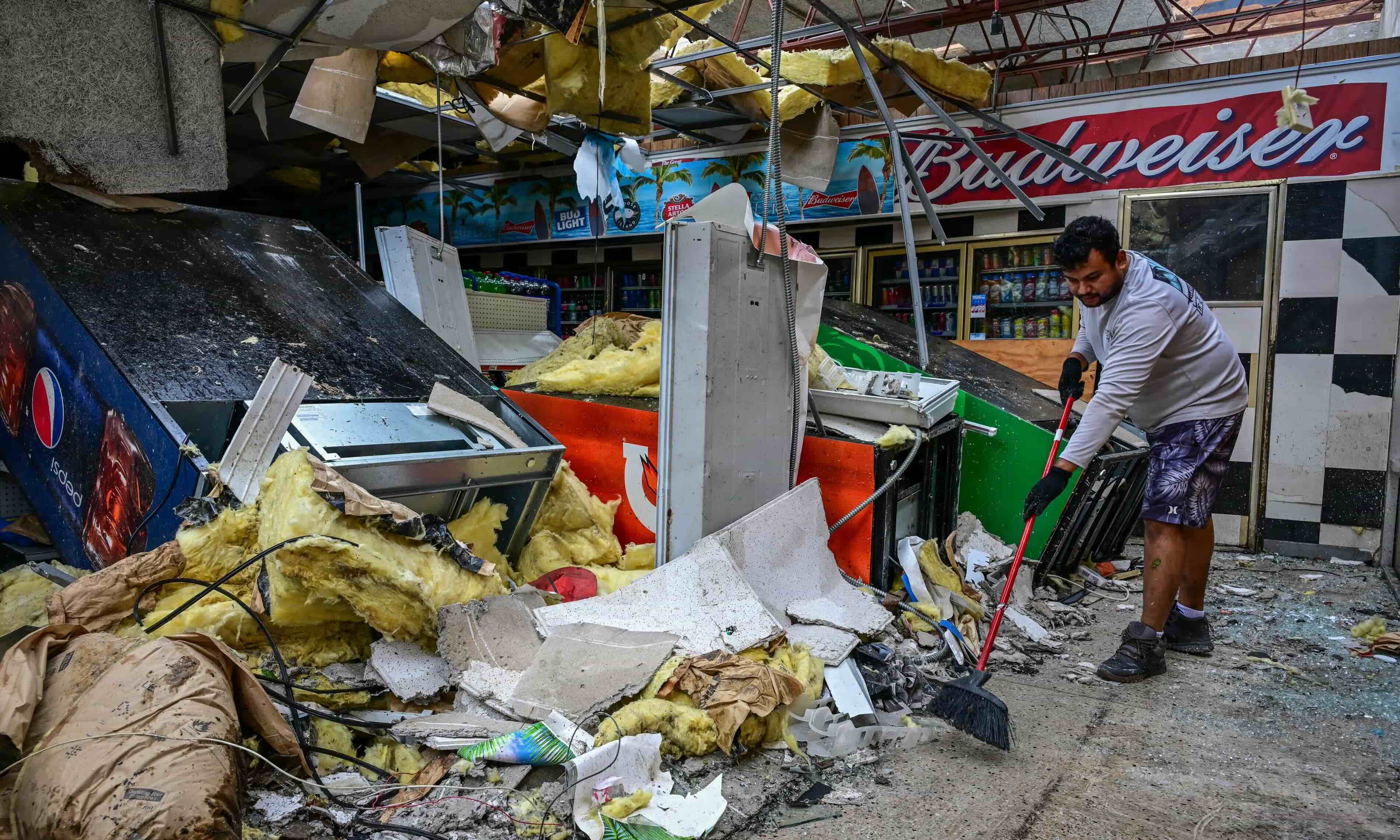
A report issued by International Chamber of Commerce late last year found that extreme weather cost $2tn globally over last decade; the U.S. suffered the greatest losses. As Damian Carrington reports, a leading insurance executive is warning that urgent action is needed to save the conditions under which markets – and civilization itself – can operate…
The climate crisis is on track to destroy capitalism, a top insurer has warned, with the vast cost of extreme weather impacts leaving the financial sector unable to operate.
The world is fast approaching temperature levels where insurers will no longer be able to offer cover for many climate risks, said Günther Thallinger, on the board of Allianz SE, one of the world’s biggest insurance companies. He said that without insurance, which is already being pulled in some places, many other financial services become unviable, from mortgages to investments.
Global carbon emissions are still rising and current policies will result in a rise in global temperature between 2.2C and 3.4C above pre-industrial levels. The damage at 3C will be so great that governments will be unable to provide financial bailouts and it will be impossible to adapt to many climate impacts, said Thallinger, who is also the chair of the German company’s investment board and was previously CEO of Allianz Investment Management.
The core business of the insurance industry is risk management and it has long taken the dangers of global heating very seriously. In recent reports, Aviva said extreme weather damages for the decade to 2023 hit $2tn, while GallagherRE said the figure was $400bn in 2024. Zurich said it was “essential” to hit net zero by 2050.
Thallinger said: “The good news is we already have the technologies to switch from fossil combustion to zero-emission energy. The only thing missing is speed and scale. This is about saving the conditions under which markets, finance, and civilisation itself can continue to operate.”
Nick Robins, the chair of the Just Transition Finance Lab at the London School of Economics, said: “This devastating analysis from a global insurance leader sets out not just the financial but also the civilisational threat posed by climate change. It needs to be the basis for renewed action, particularly in the countries of the global south.”
“The insurance sector is a canary in the coalmine when it comes to climate impacts,” said Janos Pasztor, former UN assistant secretary-general for climate change.
The argument set out by Thallinger in a LinkedIn post begins with the increasingly severe damage being caused by the climate crisis: “Heat and water destroy capital. Flooded homes lose value. Overheated cities become uninhabitable. Entire asset classes are degrading in real time.”
“We are fast approaching temperature levels – 1.5C, 2C, 3C – where insurers will no longer be able to offer coverage for many of these risks,” he said. “The math breaks down: the premiums required exceed what people or companies can pay. This is already happening. Entire regions are becoming uninsurable.” He cited companies ending home insurance in California due to wildfires.
Thallinger said it was a systemic risk “threatening the very foundation of the financial sector”, because a lack of insurance means other financial services become unavailable: “This is a climate-induced credit crunch.”
“This applies not only to housing, but to infrastructure, transportation, agriculture, and industry,” he said. “The economic value of entire regions – coastal, arid, wildfire-prone – will begin to vanish from financial ledgers. Markets will reprice, rapidly and brutally. This is what a climate-driven market failure looks like.”
No governments will realistically be able to cover the damage when multiple high-cost events happen in rapid succession, as climate models predict, Thallinger said. Australia’s disaster recovery spending has already increased sevenfold between 2017 and 2023, he noted.
The idea that billions of people can just adapt to worsening climate impacts is a “false comfort”, he said: “There is no way to ‘adapt’ to temperatures beyond human tolerance … Whole cities built on flood plains cannot simply pick up and move uphill.”
At 3C of global heating, climate damage cannot be insured against, covered by governments, or adapted to, Thallinger said: “That means no more mortgages, no new real estate development, no long-term investment, no financial stability. The financial sector as we know it ceases to function. And with it, capitalism as we know it ceases to be viable.”
The only solution was to cut fossil fuel burning, or capture the emissions, he said, with everything else being a delay or distraction. He said capitalism must solve the crisis, starting with putting its sustainability goals on the same level as financial goals.
Many financial institutions have moved away from climate action after the election of the US president, Donald Trump, who has called such action a “green scam”. Thallinger said in February: “The cost of inaction is higher than the cost of transformation and adaptation. If we succeed in our transition, we will enjoy a more efficient, competitive economy [and] a higher quality of life.”…
It’s time, if not past time, to act: “Climate crisis on track to destroy capitalism, warns top insurer,” from @dpcarrington.bsky.social in @theguardian.com.
Further to the point: “Get ready for several years of killer heat, top weather forecasters warn.”
See also: “Q&A: Kiley Bense on Climate Journalism in a New Information Environment.”
(Image above: source)
* Robert Louis Stevenson
###
As we contemplate craziness, we might recall that it was on this date in 2011 that the Wallow Fire started. A wildfire that started in the White Mountains near Alpine, Arizona, it was named for the Bear Wallow Wilderness area where the fire originated.
The fire eventually spread across the stateline into western New Mexico. By the time the fire was contained on July 8, it had consumed 538,049 acres of land, 522,642 acres in Arizona and 15,407 acres in New Mexico. It was the largest wildfire in Arizona history and did an estimated estimated cost was $109 million in damages. Smoke from the Wallow Fires and others in Arizona and New Mexico extended through Texas and Oklahoma up into the Great Lakes region, affecting air quality for large areas east of the Rocky Mountains.

You must be logged in to post a comment.