Posts Tagged ‘climate mitigation’
“Men argue. Nature acts.”*…
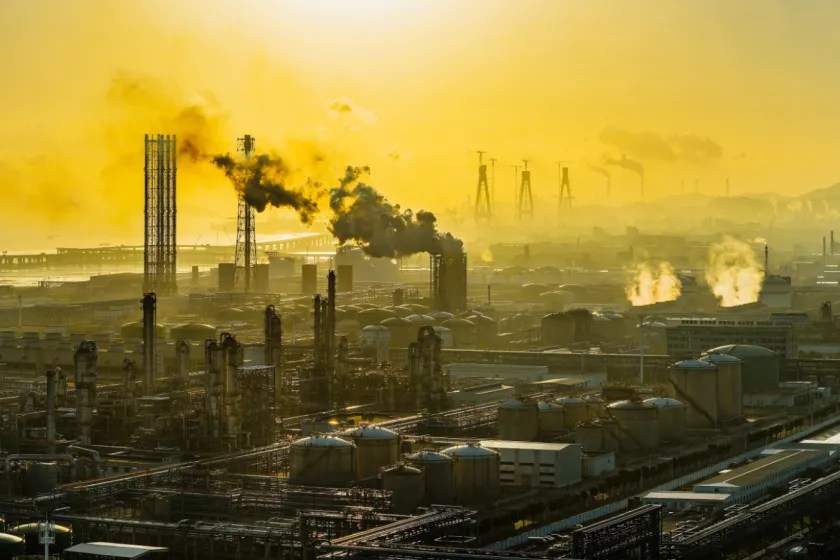
… and after Nature acts, so must we. But despite decades of warning, global emissions still aren’t falling.
As Madeleine Cuff reports, we should be springing into action…
It is now impossible for the world to limit global warming to 1.5°C above pre-industrial levels, with emissions on track to cause 2.8°C of warming by the end of the century, the UN says.
Despite increasingly urgent warnings from scientists outlining the dangers of warming above 1.5°C, global emissions aren’t yet falling and governments around the world aren’t doing anywhere near enough to decarbonise their economies.
The only way to meet the 1.5°C target now is by “overshooting” that goal in the short term, the UN said in its latest Emissions Gap report, before relying on vast amounts of global cooling, delivered via technologies such as direct air capture, in the latter half of the century.
This “lowest possible” overshoot scenario would see the global temperature rise peak at 1.7°C to 1.8°C, with a 50 per cent chance of temperatures falling back to 1.5°C by 2100. To deliver this, the world would need to cut emissions by 18 per cent by 2030, 45 per cent by 2035 and 69 per cent by 2040, relative to 2025 levels. Under current climate pledges, emissions will only fall by 5 to 8 per cent by 2030, and 11 to 15 per cent by 2035.
Many scientists are hugely sceptical that the lowest possible overshoot scenario is politically and technologically feasible, given the rapid pace of emissions cuts required and the huge volume of mechanical and natural cooling that would be needed to reduce global temperatures after 2050 to achieve it.
“We don’t know whether we can overshoot,” says Bob Watson, emeritus professor at the University of East Anglia in the UK and former chair of the Intergovernmental Panel on Climate Change. “We don’t know if any of those technologies are real, and so when people assume that we can meet 1.5°C or 2°C, and the assumption is based on overshooting and coming back, I think they’re in cuckoo land.”
Last year’s Emissions Gap report saw the UN warn that overshooting 1.5°C was now inevitable. This year’s analysis sets out new “overshoot pathways” designed to keep the 1.5°C goal – a political totem for many countries – on life support. It calls on nations to focus on delivering the “lowest possible” 1.5°C pathway.
“Overshoot is not surrender. We can still keep it as small and as short as possible – and bring temperatures back below 1.5 degrees by the end of the century,” UN Secretary-General António Guterres said in a statement.
But the UN’s new report makes it clear how far off track the world still is to deliver even this “limited overshoot” pathway. Current national policies put the world on track for 2.8°C of warming by the end of the century. If nations meet all their climate promises, that is lowered to 2.1°C. This is worse than last year’s projection of 1.9°C of warming, driven mainly by the US’s exit from the UN climate process.
Joeri Rogelj at Imperial College London says overshoot should be seen “as a failure that we try to rectify”. But he says there is still value in using the 1.5°C goal, rather than adopting a higher temperature goal that could be achieved without overshoot. “The target is still to limit harm to vulnerable and poor populations, and that we don’t do by resetting the target to an inadequate limit of 2°C, or 2.5°C,” he says. “In the public debate, this failure to stay within this most ambitious limit should re-emphasise the need to stay as close to it as possible.”
The best-case scenario now is that the planet will only temporarily breach 1.5°C of warming, but current climate pledges fall way short of that hope: “UN says 1.5°C is over and world is on track for 2.8°C of global warming” [archived version], from @tinymaddie.bsky.social in @newscientist.com.
* Voltaire
###
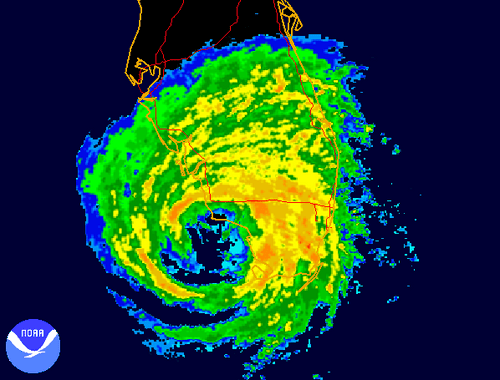
As we act to ameliorate and adapt, we might recall that it was on this date in 2015 that Hurricane Wilma made landfall in the Everglades in Florida with maximum sustained winds near 120 mph. The hurricane accelerated across south Florida and the Miami/Fort Lauderdale area, exiting the coast later the same day. There were 10 fatalities in Florida, and nearly 6 million people lost power, the most widespread power outage in Florida history. Preliminary estimates of insured losses in Florida were over $6 billion, while uninsured losses were over $12 billion.
Scientists suggest that, while climate change may not increase the total number of storms (indeed, this year’s El Nino reduced them in the Atlantic), it will intensify hurricanes, making them stronger, wetter, slower-moving, and more destructive.
“Adaptation and mitigation are two sides of the same coin. If mitigation is about preventing the unmanageable, adaptation is about managing the unavoidable.”*…

Adapting to climate change is quickly becoming part of everyday life. Nabig Chaudhry outlines seven trends we’re seeing for 2026 and beyond…
Within the climate and scientific communities, there’s growing concern about how quickly the world is approaching (and may exceed) 2°C of warming. 2024 was the first calendar year in which global average temperature exceeded 1.5°C above preindustrial levels. The impacts of rapid warming are becoming harder to miss: The climate is changing quickly almost everywhere, local and global climate risks are growing, progress on mitigation has become more politically constrained and uncertain, and many of our systems and policies aren’t prepared for the conditions ahead.
Growing climate risk is increasing the demand for new technologies, tools, strategies, and ways of thinking about climate adaptation. Since publishing our Insights on Climate Adaptation in 2025 report, the practice of climate adaptation has continued to develop, as more people, communities, organizations, and institutions work to understand and respond to climate risks.
People use different language to describe climate adaptation (including climate resilience), but the work centers on helping people, communities, and organizations manage the risks of a changing climate. Those activities are expanding, and we can already see signs. For example, new funding and investment vehicles are emerging, such as Tailwind Futures, and adaptation is receiving more dedicated space at major climate convenings, including The Adaptation Forum, a co-hosted gathering of thought leaders in the adaptation space during Climate Week NYC 2025.
In my role as Director of Climate Adaptation Research at Probable Futures and through my PhD program at the University of California, Berkeley, I speak with experts, read emerging research, and study adaptation developments every day. Through these conversations and insights, I’ve reflected on which adaptation trends are likely to emerge and strengthen…
Chaudhry npacks seven different trends; here, let me highlight two. The first is one that (Roughly) Daily has visited before, insurance…
Elevating insurance as a force in adaptation planning, policy, and behavior
Insurance is a valuable adaptation tool, as it can transfer risk, support recovery after climate shocks, and help signal where danger is increasing through premiums, deductibles, coverage limits, or insurer retreat. It can also shape incentives, because the way risk is priced can influence whether and how people and institutions reduce exposure, strengthen buildings, or avoid certain kinds of development.
As climate risks grow, damage to property and homes becomes more frequent and severe. Property owners are experiencing those shocks both physically (flooding, fire, wind damage, etc.) and financially as insurance markets adjust and recalibrate in response to changing probabilities and severities. Insurance markets have begun reflecting climate risk, and those changes are starting to influence where and how people build homes and infrastructure, where they invest in property, and where they choose to live.
A useful example of how insurance is beginning to influence adaptation efforts in the public sphere is Strengthen Alabama Homes, a program of the Alabama Department of Insurance. The program provides grants to help homeowners retrofit their homes and roofs to reduce wind damage from extreme winds and storms. Homeowners who participate can receive discounts on the wind portion of their homeowner’s insurance premium, which makes insurance not only a tool for recovery but also a tool for encouraging adaptation before exposure occurs.
Insurance pricing is one way climate risk is made visible, priced, and acted on through adaptation. I expect that insurance will increasingly influence adaptation planning, policy, and behavior, not only by helping people recover after climate shocks, but by shaping the choices people make before those shocks occur. The development of the insurance industry will therefore be an important factor in adaptation. If insurers become a source not only of risk pricing but also of risk information, adaptation guidance, and incentives to reduce risk, they could help more people act before losses occur. But that would require a meaningful shift in the role of insurance companies, from mainly pricing and transferring risk to also helping people reduce it…
The second goes to the contentious topic of geoengineering…
Expanding debate around the role of climate intervention
As warming continues, risks keep growing. We have more, clearer, worrisome signals that irreversible change, tipping points, and local climate changes so severe that adaptation is impractical if not impossible, are not far off. In response, people and institutions are starting new conversations about global-scale responses. One of those responses is climate intervention, sometimes called geoengineering.
Climate intervention generally refers to intentional efforts to alter Earth’s systems in order to counteract some of the effects of climate change. It can include approaches that remove carbon dioxide from the atmosphere, as well as approaches that reflect a portion of sunlight back into space, such as stratospheric aerosol injection.
Its relationship to adaptation is uneasy, but important. If climate intervention is, at its core, an effort to manage the otherwise unmanageable risks of global climate change, then is it another tool for adapting to climate change, or is it something fundamentally different? There is no consensus, and there may never be, not least because global action will cause uneven responses locally. We don’t know much about the potential impacts of some climate interventions, how they could affect different regions unequally, or what long-term consequences they may have for Earth’s climate and natural systems.
There are good reasons to have informed conversations and do fundamental research on intervention. People with adaptation expertise can help explore, illuminate, and explain what climate intervention could mean for society and nature. There are also likely to be benefits for adaptation professionals to participate in these conversations and research projects. Even if climate intervention is never widely deployed, the debate itself may shape adaptation thinking, climate policy, research funding, public trust, and international governance.
Climate change requires people to consider risks and options, whether for mitigation, adaptation, or intervention. Treating strategies for managing the rate, pace, and impacts of climate change as distinct and separate is unlikely to lead to good outcomes. I am hopeful that there will be more collaboration across these new fields as society faces new challenges that have a common root cause. This may include more discussion about how these technologies should be governed, whether they should receive more investment, and whether climate intervention is a possible third leg alongside mitigation and adaptation…
Eminently worth reading in full: “The near-term future of climate adaptation: emerging trends.”
* U. N. Environmental Program
###
As we prepare, we might recall (wistfully) that it was on this date in 1942 that Bing Crosby, with the Trotter Orchestra and the Darby Singers, recorded Irving Berlin’s song, “White Christmas.” According to the Guinness Book of World Records, this version is the best-selling single of all time with an excess of 50 million copies sold worldwide. (In fact, the version most often heard today is not the original. After frequent use, the master had become damaged, so on March 18, 1947, Crosby re-recorded the holiday hit.)

You must be logged in to post a comment.