Posts Tagged ‘magazines’
“If all else fails, there’s always print or web zines”*…

Gabriela Riccardi, with a history of– and an homage to– the zine…
After Martin Luther furiously (supposedly) hammered his 95 Theses to a local church door in the 16th century, chroniclers of history saw his act as plenty of things: a righteous rally against Catholic excess, a call to arms for renewed values, a firing shot for one ripper of a Reformation.
Others, though, saw it as the world’s first zine.
The zine — that unruly riff on the glossy magazine, often handmade and always self-published — has long been associated with revolution. DIY dabblers and political thought guerrillas, superfan scenesters and couriers of counterculture have all found a home in the humble zine.
Maybe that’s because a zine’s proposition — permission self-granted, gates unkept — is a boon companion to those who operate outside of the mainstream. Or maybe it’s just because they’re a lot of fun to make.
In any case, these exuberant little publications have something big to say: Small presses, indeed, can turn over heavy pages of history….
An appreciation of handcrafted publishing: “Zines: Scan and release,” from @griccardi_ in @qz.
See also: “Zines, the Punks of Print Media: A Creative Rebellion in Branding and Design” (source of the image above)
* Rudy Rucker
###
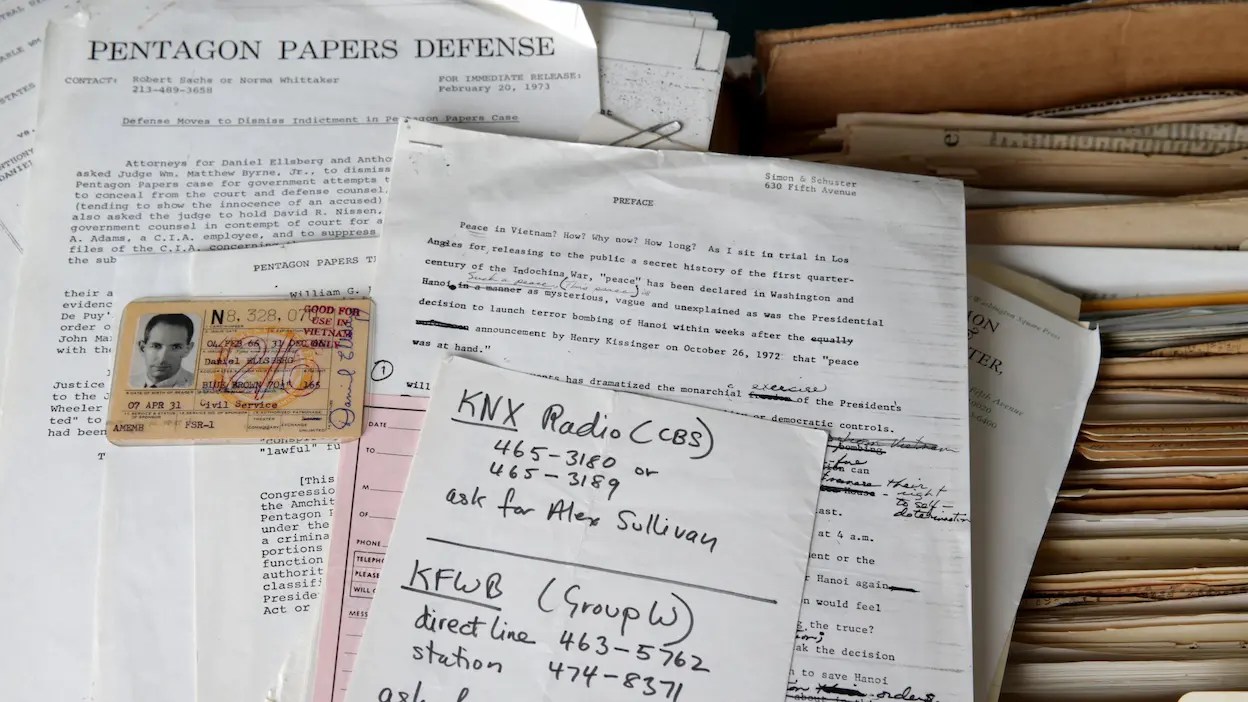
As we do it ourselves, we might recall that this date in 1972 was a milestone in (a different kind of) guerilla publishing: the New York Times begin publishing the “Pentagon Papers”…
… the 47-volume Pentagon analysis of how the U.S. commitment in Southeast Asia grew over a period of three decades. Daniel Ellsberg, a former Defense Department analyst who had become an antiwar activist, had stolen the documents. After unsuccessfully offering the documents to prominent opponents of the war in the U.S. Senate, Ellsberg gave them to the Times.
Officially called The History of the U.S. Decision Making Process on Vietnam, the “Pentagon Papers” disclosed closely guarded communiques, recommendations, and decisions concerning the U.S. military role in Vietnam during the Kennedy and Johnson administrations, along with the diplomatic phase in the Eisenhower years. The publication of the papers created a nationwide furor, with congressional and diplomatic reverberations as all branches of the government debated over what constituted “classified” material and how much should be made public.
The publication of the documents precipitated a crucial legal battle over “the people’s right to know,” and led to an extraordinary session of the U.S. Supreme Court to settle the issue. Although the documents were from the Kennedy and Johnson administrations, President Richard Nixon opposed their publication, both to protect the sources in highly classified appendices, and to prevent further erosion of public support for the war. On June 30, the Supreme Court ruled that the Times had the right to publish the material.
The publication of the “Pentagon Papers,” along with previous suspected disclosures of classified information to the press, led to the creation of a White House unit to plug information leaks to journalists. The illegal activities of the unit, known as the “Plumbers,” and their subsequent cover-up, became known collectively as the Watergate scandal, which resulted in President Nixon’s resignation in August 1974…
“I suppose illustration tends to live in the streets, rather than in the hermetically sealed atmosphere of the museum, and consequently it has come to be taken less seriously”*…
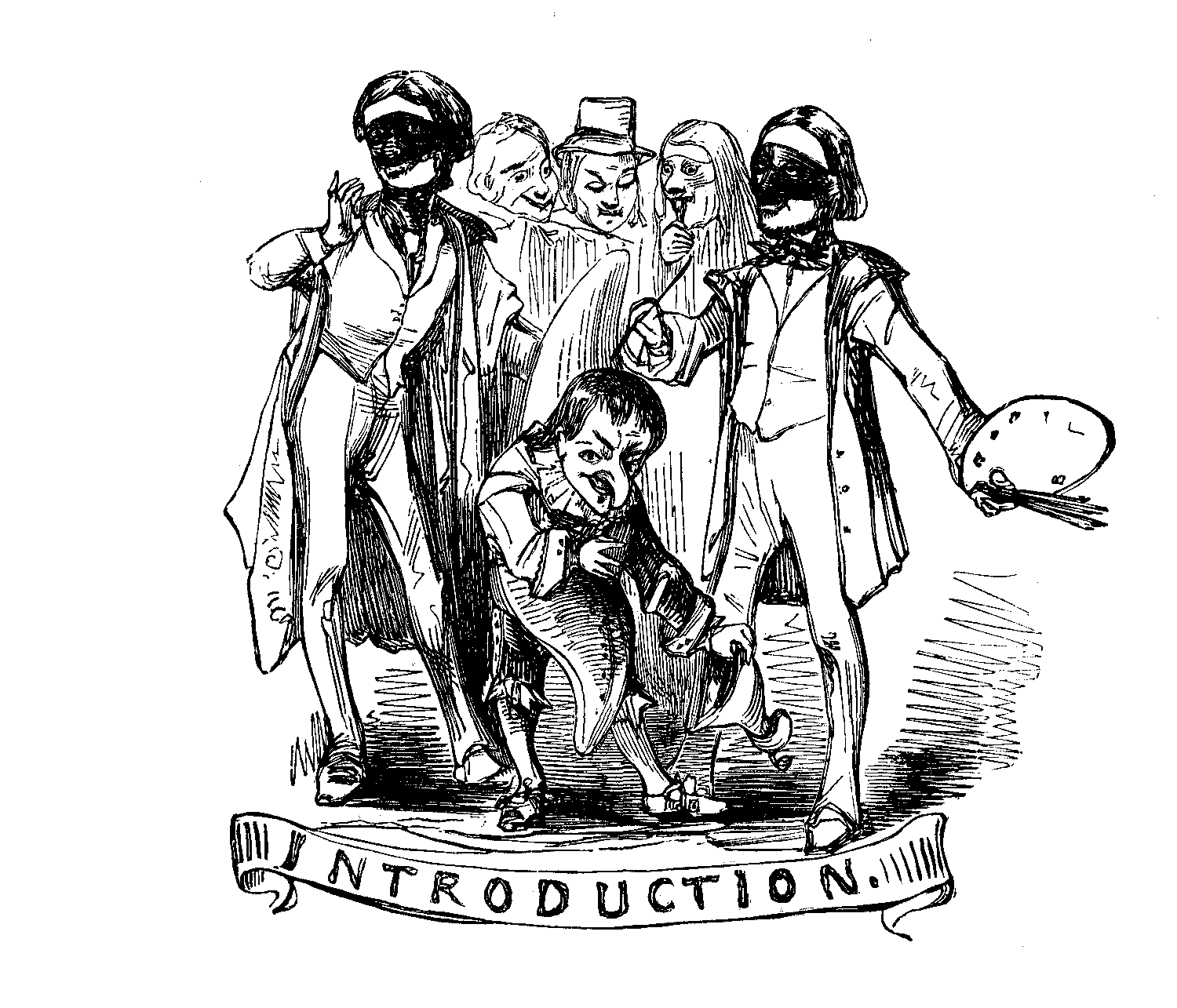
From illustrator, writer, and educator Philip Kennedy, 175 stories “illustrating” 175 years of illustration…
Illustration is a fascinating subject and yet its history is rarely told. This project aims to champion the medium and bring some inspiration, insight and knowledge to readers everywhere.
Illustration Chronicles explores a history of illustration through the images, illustrators and events of the past 175 years. Every few months the site picks a topic [e.g., Music, Animals, Satire, History] to explore. These topics inspire the types of work that get selected and once a piece has been chosen, the year it was made gets marked off the project timeline.
To learn more about Illustration Chronicles you can read a more detailed introduction here…
Take a look at the fascinating work-in-progress: “Illustration Chronicles,” from @philipkennedy.
* master illustrator Quentin Blake
###
As we delight in drawing, we might send carefully-limned birthday greetings to Barbara Cooney; she was born on this date in 1917. An illustrator and writer, primarily of children’s books, she received two Caldecott Medals for her work on Chanticleer and the Fox (1958) and Ox-Cart Man (1979), and a National Book Award for Miss Rumphius (1982). Her books have been translated into 10 languages.

“With the greater part of rich people, the chief enjoyment of riches consists in the parade of riches”*…

As insurance premiums rise, global warming’s effects are impacting collectors’ bank accounts, especially in disaster-prone states like California and Florida where risky conditions have become the norm…
Art collectors in California, Florida and other states experiencing weather-related disasters aggravated by climate change are finding fine art insurance becoming more expensive, with policies increasingly difficult to obtain (or renew) and containing new restrictions.
Earthquake-prone California, which has faced a series of massive wildfires (often followed by landslides) in recent years, is one epicentre in this struggle to find insurance coverage for homes and the art within them, with the annual cost of homeowners policies rising as much as 40% and the premiums for fine art insurance coverage increasing between 5% and 12%, according to Amee Yunn, assistant vice president of the New York-based Berkley Asset Protection, an insurance company specialising in fine art, jewellery and other high-value, personal and commercial assets. Florida, with its increasingly intense hurricanes and floods, is also a concern for the insurance industry.
“Many wealthy people flocked to Florida due to the pandemic,” Yunn says, “and they took their art with them.” That concentration of wealth assets in areas prone to flooding and hurricane damage creates significant risks to the financial wellbeing of insurance carriers. “We are seeing far more billion-dollar claims now than just 10 years ago,” Yunn says, causing companies like hers to write fewer new policies, increase their prices and add deductibles and exclusions. “The problem is acute.”
…
These days, insurance carriers track the advance of climate change as much as environmental scientists. “We have a corporate catastrophe team, which tracks the company’s total catastrophe exposure,” Yunn says. The risks from tornadoes in the Great Plains, hurricanes up and down the East Coast and earthquakes on the West Coast are well known, but the increasing intensity of hurricanes and tornadoes, as well as the rising numbers of them, are alarming signals. The tornado that ripped through Kentucky and several other states last year in a 200-mile path during the unlikely month of December was yet another sign of a climate that is becoming less predictable, as were a series of hurricanes, wildfires and freezing temperatures that have struck in Texas since 2017. In February 2021 a combination of snow, sleet and freezing rain paralysed Texas’s power grid for weeks, causing more than 200 deaths and nearly $200bn in damage.
“It would seem that there is nowhere safe from the effects of climate change,” [senior managing director at Risk Strategies Steve] Pincus says, all of which impacts the fine art insurance world, leading to higher prices and less available coverage…
“‘The only way to stop the bleeding is to stop writing policies’: climate change is making it more expensive to insure art,” from @TheArtNewspaper.
Via @WaltHickey, in his invaluable Numlock News, who observes “Listen, if ‘boo hoo, it’s getting too expensive to insure my vast art collection’ is the thing that gets rich people to actually care about climate change I’m still gonna take that as a win.”
* Adam Smith
###
As we ponder protection, we might recall that it was in this date in 1885 that the first issue of Good Housekeeping was published. A “woman’s magazine” (featuring articles on women’s interests, recipes, diet, and health), it is also known for its product testing service and its the “Good Housekeeping Seal”, a limited warranty program that is popularly known as the “Good Housekeeping Seal of Approval.” One of the oldest continuously-published magazines in the U.S., it remains popular in its category.

“For some of us, books are as important as almost anything else on earth”*…
Preserving precious publications…
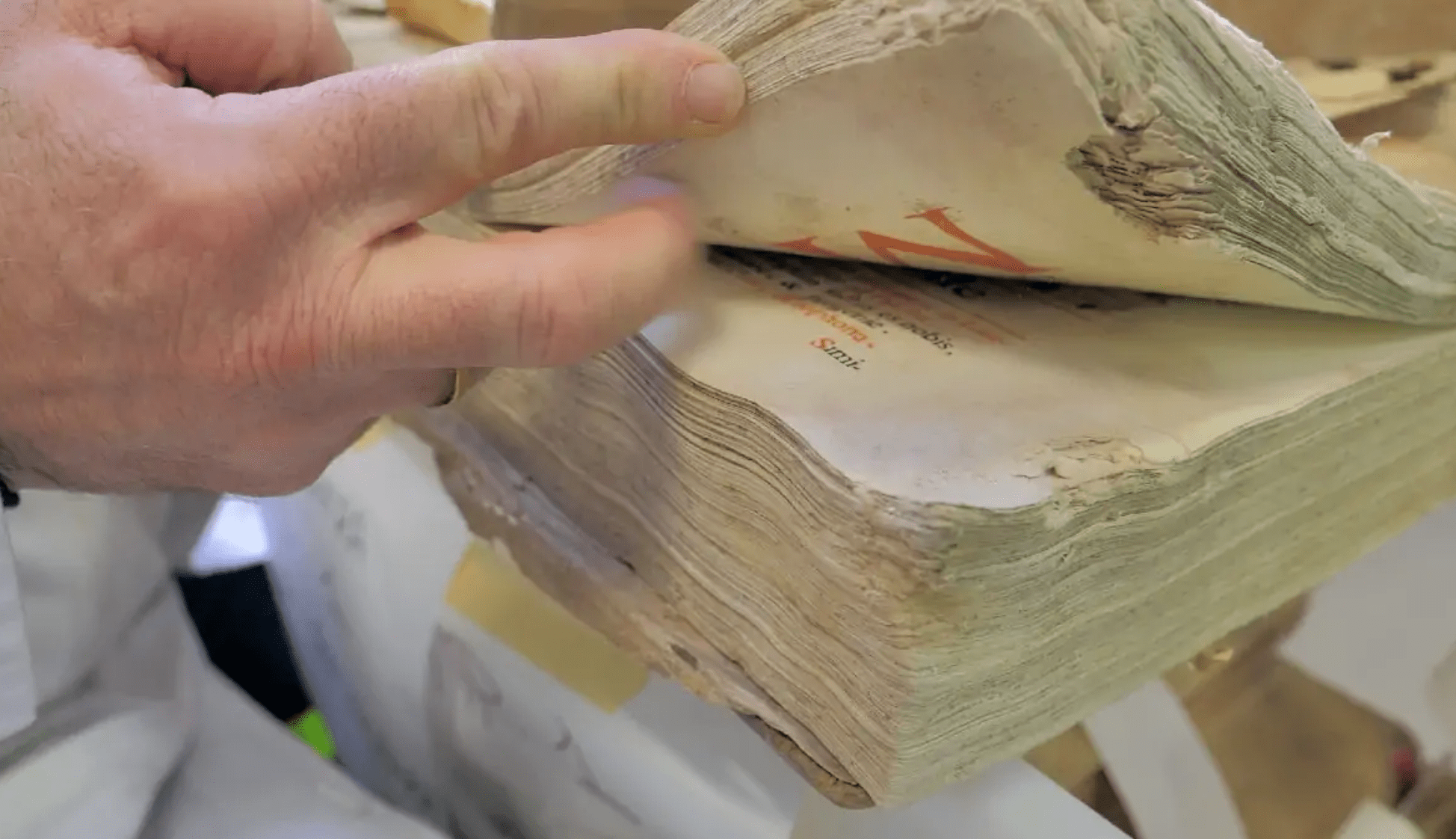
It all started in 1994. The flooding of the Po river and its tributaries had just swept away entire villages in the Piedmont region of northern Italy, leaving behind only death and debris. The whole of Italy was shocked. Of all the damage broadcast on television, one caused a particular sensation: In the village Santo Stefano Belbo, the historical archive of Cesare Pavese, one of the most famous and beloved Italian writers, was buried in mud.
The debacle particularly impressed a man named Pietro Livi, president of Frati & Livi in Bologna, a company that had been restoring and conserving ancient texts for nearly 20 years. At that time, however, no one in Italy was equipped for this kind of rescue. In the past, flooded and muddy documents were entrusted to companies that used basic restoration methods that proved both invasive and ineffective: The books were simply placed in ovens or air-dried in large rooms, which often left the texts unusable and made mold only proliferate.
So Livi decided to find out if anyone in Europe had found a more effective way to save these invaluable records of human achievement. Finally, in Austria, Livi found a freeze dryer that held some promise, but it was too big and costly for a small artisanal company like his. Then, in 2000, the Po river overflowed again. In the city of Turin, entire archives belonging to distinguished institutes and libraries ended up underwater.
At a loss for what to do, Italy’s Archival Superintendency of the Ministry of Cultural Heritage summoned Livi. By this time, Livi had established a solid reputation as a master restorer, having studied the art of book restoration with Benedictine friars. But he realized that for a project of this scope, his expertise was no longer enough; he needed a kind of Renaissance workshop, where he could collaborate with professionals from a variety of disciplines. Livi believed that the time had come where the world of artisan knowledge and the world of technology, too often considered as opposites, had to talk to each other—for the benefit of one another…
Then, on November 12, 2019, the city of Venice, one of the world’s most mythical and most admired locales, suffered its worst flood in 53 years. The swollen lagoon soaked roughly 25,000 valuable texts, including the last surviving original of one of Vivaldi’s musical scores. Frati & Livi was quickly called to the scene…
In the city of Bologna, home to the western world’s oldest university, Pietro Livi developed an unusual machine shop—part artisanal and part high-tech—built to restore damaged ancient texts to their former glory. And then came Venice’s historic floods of 2019: “Italy’s Book Doctor,” from @CraftsmanshipQ.
* “For some of us, books are as important as almost anything else on earth. What a miracle it is that out of these small, flat, rigid squares of paper unfolds world after world after world, worlds that sing to you, comfort and quiet or excite you. Books help us understand who we are and how we are to behave. They show us what community and friendship mean; they show us how to live and die.” – Anne Lamott
###
As we celebrate craft, we might we spare a thought for publishing pioneer Condé Montrose Nast; he died on this date in 1942. After serving as Advertising Director at Colliers, then a brief stint in book publishing, Nast bought a small New York society magazine called Vogue— which he proceeded to turn into the nation’s, then the world’s leading fashion magazine. While other periodical publishers simply sought higher and higher circulation, Nast introduced the “lifestyle” title, targeted to a group of readers by income level or common interest. By the time of his death, his stable of monthlies also included House & Garden, British, French, and Argentine editions of Vogue, Jardins des Modes, (the original) Vanity Fair, and Glamour; subsequently, the group added such resonant lifestyle books as Gourmet, New Yorker, and Wired.

“I suppose illustration tends to live in the streets, rather than in the hermetically sealed atmosphere of the museum, and consequently it has come to be taken less seriously”*…

But surely, it shouldn’t necessarily be so. Consider Tom Gauld (@tomgauld). He’s probably best known for his work for The New Yorker (e.g.) and The New York Times (e.g.); but he’s also an accomplished cartoonist. Your correspondent’s favorites are his on-going contributions to The Guardian Review (above and below)

… and The New Scientist…

See more of his marvelous work at his site.
* master illustrator Quentin Blake.
###
As we visualize it, we might send carefully limned birthday greetings to Richard McClure Scarry; he was born on this date in 1919. A children’s author and illustrator, he published over 300 books with total sales of over 100 million worldwide.


You must be logged in to post a comment.