Posts Tagged ‘Reformation’
“I prefer the company of peasants because they have not been educated sufficiently to reason incorrectly”*…

An excerpt from Lyndal Roper‘s Cundill Prize-Shortlisted Summer of Fire and Blood…
The German Peasants’ War was the greatest popular uprising in western Europe before the French Revolution. Like a vast contagion it spread from southwest Germany through Württemberg, Swabia, the Allgäu, Franconia, Thuringia, and Saxony to Alsace in what is now France, Austria, and Switzerland. Peasants massed in armed bands in one region, then another, and rebellion would break out even in areas far away. At its height it involved well over a hundred thousand people, perhaps many more, who joined with the rebels to bring about a new world of Christian brotherhood. And for several months, they won. Authority and rulership collapsed, and the familiar structures of the Holy Roman Empire were overturned, exposing the fragility of the existing social and religious hierarchies. People even began to dream of a new order.
But this moment did not last. In spring 1525, the ‘Aufruhr,’ or ‘turbulence,’ as contemporaries called it, had reached its height, rolling all before it. By May the tide had turned. The forces of the lords put down the revolt by slaying somewhere between seventy thousand and a hundred thousand peasants. That summer of blood, maybe 1 per cent of the population of the area of the war was killed, an enormous loss of life in just over two months.
Despite its enormity, the Peasants’ War and its bloody defeat have been forgotten in recent years. People remember the era for Martin Luther and his Reformation, which split Western Christendom forever between Catholics and those who would eventually be known as Protestants. The Peasants’ War has come to be seen as a diversion, an interlude important mainly for what it tells us about Luther, for this was the moment when Luther came out in support of the princes and against the ‘mad dogs’, the rebelling peasants. From then on, the Reformation in Germany would be conservative. Mainstream reformers would go on to ally with rulers to advance the goals of the Reformation, and when the new church was set up after the war, it would have the backing of those in power.
The Reformation’s possibilities, as well as its limits, cannot be grasped without an understanding of the Peasants’ War as the giant trauma at its center. Equally, the ideas, dreams, and hopes unleashed by the Reformation shaped the Peasants’ War. And the war, in turn, cannot be understood if it has been severed from the heady atmosphere of religious excitement in which it took place.
To understand why such a massive movement mushroomed from such small, apparently isolated beginnings in a distant corner of the empire, we need to listen to what drove the peasants. It is no accident that just three years after Luther defied the emperor and the estates of the empire, the peasants of first one or two lords and abbots decided to down tools and gather in bands.
In 1520 Luther himself had written a short but powerful tract, one of the three great Reformation writings from that year setting out his theology, titled The Freedom of a Christian. The cover of the German edition was emblazoned with the incendiary word ‘freedom.’ It was all very well for Luther’s supporters to argue later that he had meant spiritual freedom, but the fact was that many peasants in the southwest, particularly those ruled by the Catholic monasteries, convents, and abbots Luther was attacking, were serfs, owned by their masters. For them, freedom meant ending serfdom too. Despite Luther’s later condemnation, the Peasants’ War is unthinkable without the ideas he unleashed.
By standing up to the emperor, Charles V, at Worms in 1521, Luther had provided an unforgettable example of resistance. A lone monk in a borrowed cassock before an audience of dignitaries arrayed in all their finery, he had confronted the mightiest power in the land and had said his piece, refusing to recant unless convinced by ‘Holy Scripture.’ Small wonder that the peasants drew on his ideas for their cause. Small wonder they assumed he would support them.
But he did not. [see below] By late March of 1525, the peasant revolt had become a mass movement whose demands found shape in the Twelve Articles [see here and more fully, here]. These were probably composed by Sebastian Lotzer, a townsman and furrier, on the basis of hundreds of complaints that different groups of peasants had been formulating for weeks beforehand. Influenced by Martin Luther; the preacher Christoph Schappeler, himself a follower of the Swiss reformer Huldrych Zwingli; and a strain of radical evangelicalism, Lotzer helped transform a set of specific, apparently random grievances against particular lords into a wide-ranging theological vision that chimed with radical Reformation ideas.
Local spats could now feed into a mass movement that spread far beyond individual disputes between a peasant and a particularly nasty abbot or lord. Yet Lotzer did not invent this theology, nor was he the first to apply it to agricultural relations—that had already been done by the peasants themselves as they formulated their complaints. The Twelve Articles then became a document that the movement everywhere acknowledged, even when the rebels did not know exactly what the articles contained, and even though many areas revised them to suit local circumstances. Soon they were printed using the new technology made possible by the invention of movable type, and they spread all over Germany. You could pick them up and hold them in your hand, point to each demand and the biblical passages that proved their godliness.
The key thing about the Peasants’ War was that it was a mass movement. For too long, histories of the war have emphasized its leaders, men like Thomas Müntzer in Thuringia, adopted by Friedrich Engels and then by the East German regime as a revolutionary hero to rival the reactionary colossus Luther. There are indeed a series of outsize characters who populated the war: Götz von Berlichingen, the knight with the iron fist, who became a peasant leader after his mother-in-law failed to hand him his liege-lord’s summons to fight against them, or so he later claimed in his mendacious autobiography, written in his nineties. Or Florian Geyer, a noble who also led peasant armies and was finally knifed by an assassin. Or the Black Hofmännin, a peasant woman who claimed she urged on the peasant troops and rubbed the fat of the slaughtered nobles onto her shoes. Or the ‘Bauernjörg,’ Truchsess Georg von Waldburg, who led the lords’ army of the Swabian League and mercilessly torched rebel villages.
But this was a movement, not a drama of Great Men. The peasants’ side of the story has been forgotten because they did not write it down, either because they were illiterate or because they were slain or executed in the war. The winners—the lords and mainstream theologians who were the peasants’ enemies—instead wrote the history…
“How the German Peasants’ War Exposed 16th-Century Europe’s Fragile Foundations,” via @literaryhub.bsky.social.
Read Martin Luther’s (negative) reactions to the Peasants here.
* Montaigne
###
As we ponder the historicity of the history we “know,” we might spare a thought for a victim of a somewhat more successful rebellion, the wife of King Louis XVI, Marie Antoinette, who is famously remembered for responding, on being told that many of her subjects had no bread, “let them eat cake”… except that she (virtually certainly) didn’t: the phrase can actually be traced back to Jean-Jacques Rousseau‘s Confessions in 1765, when Antoinette was nine years old and had never been to France. The phrase was not attributed to Antoinette until decades after her death.
Still, she was was beheaded on this date in 1793 by the Revolutionary Tribunal of the Republican government established after the fall of the monarchy (and the execution of her husband) in the French Revolution.
Bonus: “Marie Antoinette, the original influencer” (?)

“Attention is the rarest and purest form of generosity”*…

… But that most valuable of gifts is being hijacked, subverted/converted into a commodity, and used to mold not just consumer behavior, but society-as-a-whole. We live in an attention economy, and its media/tech ownership landscape is becoming ever more consoldiated.
Kyla Scanlon unpacks the way in which concentrated ownership of media and tech and their automated manipulation reshape democracy…
It’s nearly impossible not to get lost in the news right now. I was at a wedding last week, and every conversation eventually drifted back to the same subject: the World We Are in and All That is Happening. The ground feels like it’s moving faster than anyone can feasibly keep up with.
Some people think the shift is progress. Others see collapse. Either way, the line between digital and physical life is increasingly blurry. What happens online is real life. What we consume is what we become.
Plenty of thinkers have circled this before – Postman, Debord, Huxley, Orwell on media; Machiavelli, Tocqueville, Thucydides, Gibbon on human corruptibility during times of uncertainty. The convergence of endless information and a ragebait economy creates the perfect environment for splintering how we understand the world and how we understand each other.
The deeper problem is this: we no longer trust institutions to provide truth, fairness, or mobility. Once, they were scaffolding that helped us climb from raw data to wisdom. And when that scaffolding gives out, people adapt: some over-perform in the status race (because you have to) and others defect from obligations altogether (why would I work for institutions if they don’t work for me).
There are a few ways to picture our distorted information ecosystem.
- The DIKW Pyramid (Data → Information → Knowledge → Wisdom): raw posts and clicks at the bottom, trending content in the middle, shared truths above that, and finally wisdom, the rare ability to see causes instead of just symptoms.
- Or the Ladder of Inference: we start with data, add meaning, make assumptions – and our beliefs tend to affect what data we select. Bots and algorithms hijack that ladder, nudging us toward polarized beliefs before we realize what’s happening.
Taken together, we can combine them into what we might call a hierarchy of information:
- Raw data: the endless stream of posts, likes, bot spam
- Information: headlines, hashtags, trending things
- Knowledge: the narratives we share and fight over.
- Understanding: recognizing what might not be real (or is hyperreal)
- Wisdom: systemic analysis, the ability to see causes instead of just symptoms.
Right now, we’re stuck sloshing around in the middle layers of the hierarchy: drowning in outrage, fighting over partisan hot takes, rarely reaching understanding, almost never wisdom.
Chaos always has an architect. And if we want to make sense of American democracy today, we need to understand who those architects are, and how they profit from confusion.
This polarization rests on media concentration.The Telecommunications Act of 1996 was sold as a way to increase competition in media and telecommunications, but in reality, it did quite the opposite. Within five years, four firms controlled ~85% of US telephone infrastructure. That deregulated spine carried today’s consolidation of the entire media environment – not just telephones. Newspapers. Social media. TV stations.
We have the increasing concentration of media ownership, the financialization of attention, and the transformation of information from a public good into a private commodity to be bought, sold, and manipulated…
[Scanlon characterizes and explains the concentration, examines its impacts, and unpacks the roles of bots…]
When manufacturing consensus is both cheap to produce and valuable to those who benefit from confusion, you get industrial-scale manipulation.
Truth becomes whatever can capture the most attention in the shortest amount of time. Traditional journalism, with its slow fact-checking and institutional processes, can’t compete with bot-amplified outrage. Democratic deliberation, which requires shared facts and good faith dialogue, becomes nearly impossible when the information environment is designed to maximize conflict.
We’re living in a speculation economy where perception drives value more than fundamentals. Look at the stock market: Nvidia gained $150 billion in value based the back of a $100 billion OpenAI investment (which OpenAI will use to buy more Nvidia chips). Ten companies pass hundreds of billions back and forth, and the S&P jumps like it’s measuring something real.
It’s all memes wearing suits. Meme stocks and Dogecoin at least looked like jokes; now the same speculative energy runs through the corporate core. Attention, perception, and narrative drive valuation more than production or profit.
We’ve built a world where the hierarchy of information has flipped upside down.
At the bottom, bots flood us with raw noise. In the middle, outrage and team narratives harden into “knowledge.” At the top, the ladders to wisdom like journalism, schools, civic discourse, shared institutions are weakened. The scaffolding that once helped us climb no longer holds.
The traditional solutions – fact-checking, media literacy, content moderation – assume we’re dealing with a content problem when we’re actually facing an infrastructure problem. You can’t fact-check your way out of a system designed to reward misinformation. You can’t educate your way around algorithms optimized for polarization. You can’t moderate your way past economic incentives that make confusion profitable.
Recognizing this as a market structure problem rather than an information problem changes everything. Instead of focusing on individual bad actors or specific false claims, you start thinking about the underlying systems that make manipulation both profitable and scalable.
The information wars are economic policy, determining how we allocate attention, structure incentives, and organize the flow of information that shapes every other market and political decision we make. I don’t think it’s useful to get on a Substack soapbox about this – but we need to take (1) the power of media seriously and (2) those trying to influence it extremely seriously. There is a way to get to the top of the information hierarchy! We don’t have to be stuck in these middle layers…
Follow the money: “Who’s Getting Rich Off Your Attention?” from @kyla.bsky.social
For more on how the Telecommunications Act of 1996 helped set all of this in motion, see: “On Jimmy Kimmel: It’s Time to Destroy the Censorship Machine and Repeal the Telecommunications Act of 1996” from @matthewstoller.bsky.social.
For more on thoughts on why companies are behaving in the ways they are: “Why Corporate America Is Caving to Trump” and “Media consolidation is shaping who folds under political pressure — and who could be next.”
And lest we think that this came out of nowhere: “David Foster Wallace Tried to Warn Us About these Eight Things.”
[Image above: source]
###
As we reclaim recognition, we might recall that on this date in 1452 an earlier information revolution began: Johannes Gutenberg started work on his Bible (which was completed and published in 1455). An inventor and craftsman, Gutenberg created the movable-type printing press, enabling a much faster (and cheaper) printing process. (Movable type was already in use in East Asia, but was slower and used for smaller jobs.) His Bible was his first major work, and his most impactful.
The printing press later spread across the world, leading to an information revolution– the unprecedented mass-spread of literature throughout Europe. It had a profound impact on the development of the Renaissance, Reformation, and Humanist movements.

“The historian of science may be tempted to exclaim that when paradigms change, the world itself changes with them”*…

What we now call AI has gone through a series of paradigm shifts, and there appears to be no end in sight. Ashlee Vance shares an anecdote that suggests that AI might itself be an agent (perhaps the agent) of a broader paradigm shift (or shifts)…
AI madness is upon many of us, and it can take different forms. In August 2024, for example, I stumbled upon a post from a 20-year-old who had built a nuclear fusor [see here] in his home with a bunch of mail-ordered parts. More to the point, he’d done this while under the tutelage of Anthropic’s Claude AI service…
… The guy who built the fusor in question, Hudhayfa Nazoordeen, better known as HudZah on the internet, was a math student on his summer break from the University of Waterloo. I reached out and asked to see his experiment in person partly because it seemed weird and interesting and partly because it seemed to say something about AI technology and how some people are going to be in for a very uncomfortable time in short order.
A couple days after the fusor posts hit X, I showed up at Nazoordeen’s front door, a typical Victorian in San Francisco’s Lower Haight neighborhood. Nazoordeen, a tall, skinny dude with lots of energy and the gesticulations to match, had been crashing there for the summer with a bunch of his university friends as they tried to soak in the start-up and AI lifestyle. Decades ago, these same kids might have yearned to catch Jerry Garcia and The Dead playing their first gigs or to happen upon an Acid Test. This Waterloo set, though, had a different agenda. They were turned on and LLMed up.
Like many of the Victorian-style homes in the city, this one had a long hallway that stretched from the front door to the kitchen with bedrooms jutting off on both sides. The wooden flooring had been blackened in the center from years of foot traffic, but that was not the first thing anyone would notice. Instead, they’d see the mass of electrical cables that were 10-, 25- and sometimes 50-feet long and coming out of each room and leading to somewhere else in the house.
One of the cables powered a series of mind-reading experiments. Someone in the house, Nazoordeen said, had built his own electroencephalogram (EEG) device for measuring brain activity and had been testing it out on houseguests for weeks. Most of the cables, though, were there to feed GPU clusters, the computing systems filled with graphics chips (often designed by Nvidia) that have powered the recent AI boom. You’d follow a cable from one room to another and end up in front of a black box on the floor. All across San Francisco, I imagined, twenty-somethings were gathered around similar GPU altars to try out their ideas…
Vance tells HudZah’s story, recounts the building of his fusor, explains Claude’s (sometimes reluctant) role, and raises the all-too-legitimate safety questions the experiment raises… though in fairness, one might note that the web is rife with instuctions for building a fusor, e.g., here, here, and here, some of which encuraged HudZah.
But in the end, the takeaway for Vance was not the product, but the process…
I must admit, though, that the thing that scared me most about HudZah was that he seemed to be living in a different technological universe than I was. If the previous generation were digital natives, HudZah was an AI native.
HudZah enjoys reading the old-fashioned way, but he now finds that he gets more out of the experience by reading alongside an AI. He puts PDFs of books into Claude or ChatGPT and then queries the books as he moves through the text. He uses Granola to listen in on meetings so that he can query an AI after the chats as well. His friend built Globe Explorer, which can instantly break down, say, the history of rockets, as if you had a professional researcher at your disposal. And, of course, HudZah has all manner of AI tools for coding and interacting with his computer via voice.
It’s not that I don’t use these things. I do. It’s more that I was watching HudZah navigate his laptop with an AI fluency that felt alarming to me. He was using his computer in a much, much different way than I’d seen someone use their computer before, and it made me feel old and alarmed by the number of new tools at our disposal and how HudZah intuitively knew how to tame them.
It also excited me. Just spending a couple of hours with HudZah left me convinced that we’re on the verge of someone, somewhere creating a new type of computer with AI built into its core. I believe that laptops and PCs will give way to a more novel device rather soon.
I’m not sure that people know what’s coming for them. You’re either with the AIs now and really learning how to use them or you’re getting left behind in a profound way. Obviously, these situations follow every major technology transition, but I’m a very tech-forward person, and there were things HudZah could accomplish on his machine that gave off alien vibes to me. So, er, like, good luck if you’re not paying attention to this stuff.
After doing his AI and fusor show for me, HudZah gave me a tour of the house. Most of his roommates had already bailed out and returned to Canada. He was left to clean up the mess, which included piles of beer cans and bottles of booze in the backyard from a last hurrah.
The AI housemates had also left some gold panning equipment in a bathtub. At some point during the summer, they had decided to grab “a shit ton of sand from a nearby creek” and work it over in their communal bathroom for fun.
I’m honestly not sure what the takeaway there was exactly other than that something profound happened to the Bay Area brain in 1849, and it’s still doing its thing…
Goodbye, Digital Natives; hello, AI Natives: “A Young Man Used AI to Build A Nuclear Fusor and Now I Must Weep,” from @ashleevance. Eminently worth reading in full.
And for a look at one attempt to understand what may be the emerging new pardigm(s) of which AI may be a motive part, see Benjamin Bratton‘s explantion of the work he and his collegues are doing at a new institute at UCSD: “Antikythera.” See his recent Long Now Foundation talk on this same subject here.
On the other hand: “The Future Is Too Easy” (gift article) by David Roth in the always-illuminating Defector.
(Image above: source)
###
As we ponder progress, we might spare a thought for Johannes Gutenberg; he died on this date in 1416. A craftsman and inventor, he invented the movable-type printing press. (Though movable type was already in use in East Asia, Gutenberg’s invention of the printing press enabled a much faster rate of printing.)
The printing press spread across the world and led to an information revolution and the unprecedented mass-spread of literature throughout Europe. It was a profound enabler of the arts and the sciences of the Renaissance, of the Reformation (and Counter-Reformation), and of humanist movements… which is to say that it contributed to a series of pardigm shifts.

“The great men turn out to be all alike. They never stop working. They never lose a minute. It is very depressing.”*…
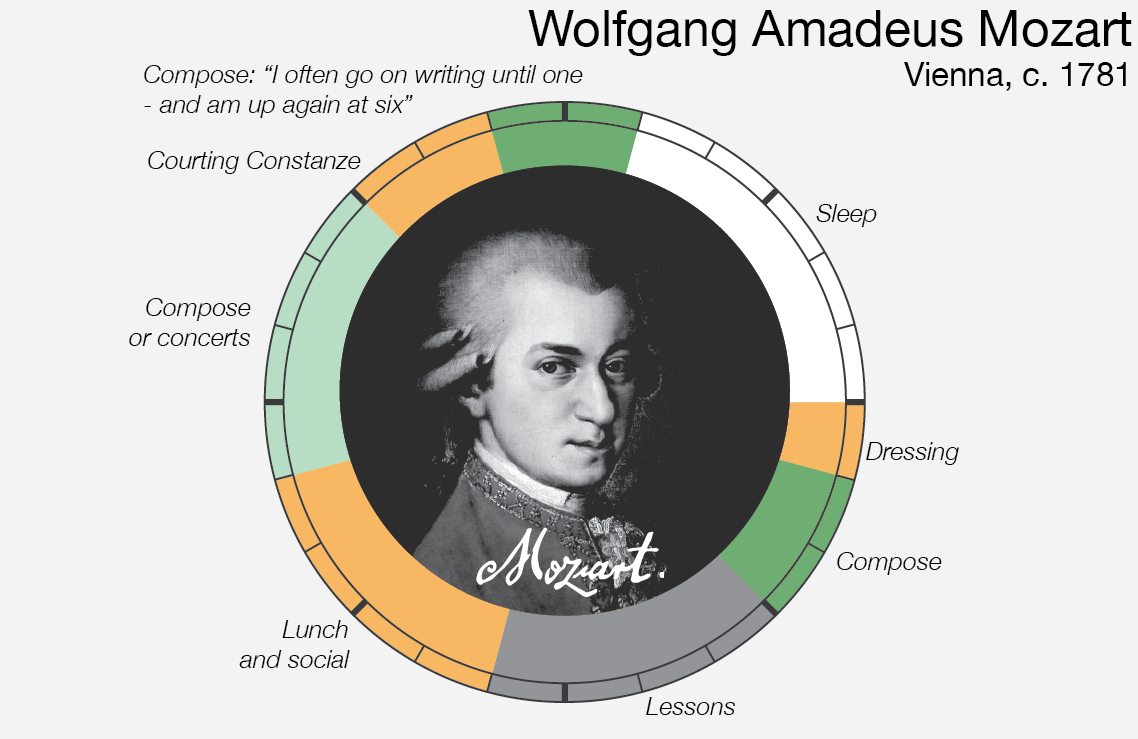
Data storyteller RJ Andrews demonstrates…
How do creatives – composers, painters, writers, scientists, philosophers – find the time to produce their opus?
Each routine day is represented as a continuous 24 hour cycle. Midnight is placed at 12 o’clock position and noon at 6 o’clock. Colors mark major categories of activity including work, sleep, and exercise…

The daily rituals of great creators: “Creative Routines,” from @infowetrust.
* Mason Curry, Daily Rituals: How Artists Work (the source of much of the data that informed the gaphics above)
###
As we contemplate cultivating customs, we might send learned birthday greetings to Desiderius Erasmus Roterodamus, better known simply as Erasmus; he was born on this date in 1466. A Catholic priest, social critic, teacher, translator, and theologian, probably best remembered for his book In Praise of Folly, he was the greatest scholar of the northern Renaissance, the first editor of the New Testament (“Do unto others…”), and an important figure in patristics and classical literature.
Erasmus had contrasting experiences of routine: on being orphaned, Erasmus was sent to a series of monastic or semi-monastic schools, which he despised both for their discipline and for their disdain of inquiry. Graduating with few prospects, he joined an Augustinian monastery where he considered his superiors “barbarians” discouraging his classical studies. On ordination, he escaped– and began a career that began in struggle (as he balanced the demands of study with those of serving as a Clerk, and Priest, a tutor… all while trying to distinguish himself as a poet.
His luck changed in 1499, when he connected with a reformist English circle (notably John Colet and Thomas More), then with radical French Franciscan Jean Vitrier, and later with the Aldine New Academy in Venice… which led, in the Reformation, to his emergence as a prime influencer of European thought. Among fellow scholars and philosophers of that era he was– and is still– known as the “Prince of the Humanists.”
Erasmus’ views were contentious on his time and elicited a good bit of criticism. While we don’t know too much about his daily routine, we do know that for the last half of his life it included enough time on a regular basis to read these attacks and to prepare and publish apologetic works in his own defense, in many cases leading to a long series of back-and-forth polemical books… kind of like Twitter feud, but at the speed of Gutenberg.

Portrait of Erasmus of Rotterdam (1523) by Hans Holbein the Younger
“If all else fails, there’s always print or web zines”*…

Gabriela Riccardi, with a history of– and an homage to– the zine…
After Martin Luther furiously (supposedly) hammered his 95 Theses to a local church door in the 16th century, chroniclers of history saw his act as plenty of things: a righteous rally against Catholic excess, a call to arms for renewed values, a firing shot for one ripper of a Reformation.
Others, though, saw it as the world’s first zine.
The zine — that unruly riff on the glossy magazine, often handmade and always self-published — has long been associated with revolution. DIY dabblers and political thought guerrillas, superfan scenesters and couriers of counterculture have all found a home in the humble zine.
Maybe that’s because a zine’s proposition — permission self-granted, gates unkept — is a boon companion to those who operate outside of the mainstream. Or maybe it’s just because they’re a lot of fun to make.
In any case, these exuberant little publications have something big to say: Small presses, indeed, can turn over heavy pages of history….
An appreciation of handcrafted publishing: “Zines: Scan and release,” from @griccardi_ in @qz.
See also: “Zines, the Punks of Print Media: A Creative Rebellion in Branding and Design” (source of the image above)
* Rudy Rucker
###
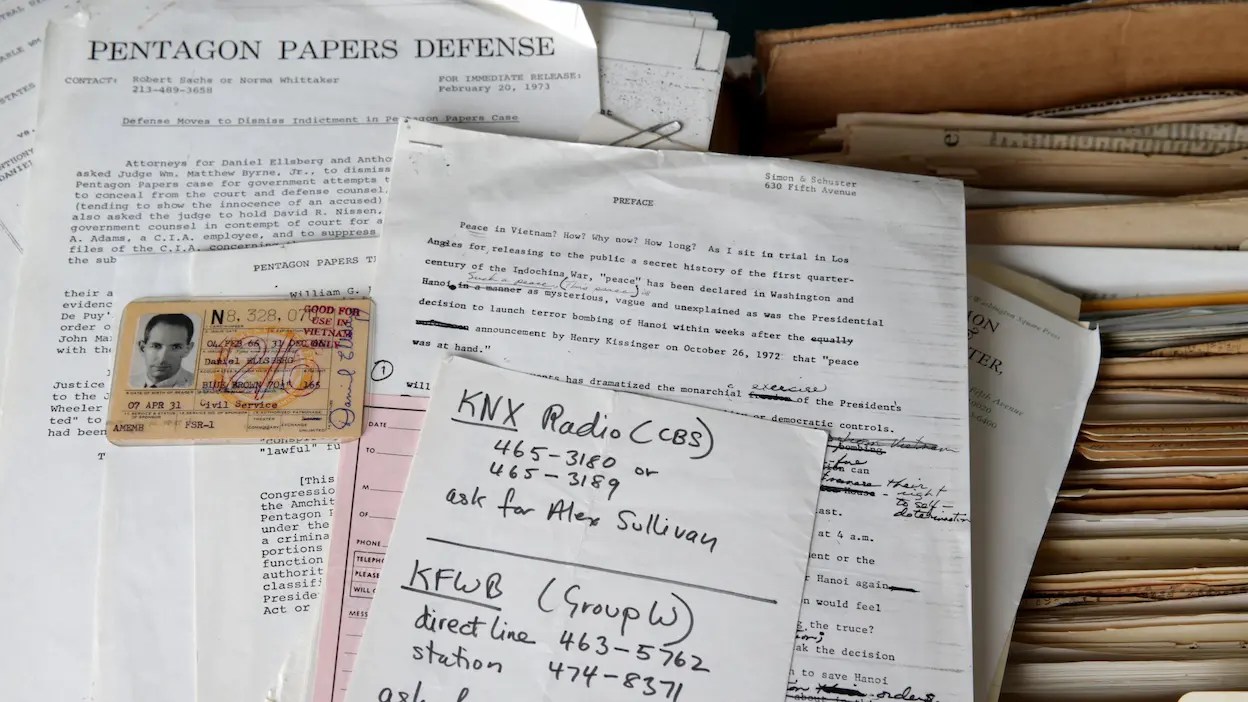
As we do it ourselves, we might recall that this date in 1972 was a milestone in (a different kind of) guerilla publishing: the New York Times begin publishing the “Pentagon Papers”…
… the 47-volume Pentagon analysis of how the U.S. commitment in Southeast Asia grew over a period of three decades. Daniel Ellsberg, a former Defense Department analyst who had become an antiwar activist, had stolen the documents. After unsuccessfully offering the documents to prominent opponents of the war in the U.S. Senate, Ellsberg gave them to the Times.
Officially called The History of the U.S. Decision Making Process on Vietnam, the “Pentagon Papers” disclosed closely guarded communiques, recommendations, and decisions concerning the U.S. military role in Vietnam during the Kennedy and Johnson administrations, along with the diplomatic phase in the Eisenhower years. The publication of the papers created a nationwide furor, with congressional and diplomatic reverberations as all branches of the government debated over what constituted “classified” material and how much should be made public.
The publication of the documents precipitated a crucial legal battle over “the people’s right to know,” and led to an extraordinary session of the U.S. Supreme Court to settle the issue. Although the documents were from the Kennedy and Johnson administrations, President Richard Nixon opposed their publication, both to protect the sources in highly classified appendices, and to prevent further erosion of public support for the war. On June 30, the Supreme Court ruled that the Times had the right to publish the material.
The publication of the “Pentagon Papers,” along with previous suspected disclosures of classified information to the press, led to the creation of a White House unit to plug information leaks to journalists. The illegal activities of the unit, known as the “Plumbers,” and their subsequent cover-up, became known collectively as the Watergate scandal, which resulted in President Nixon’s resignation in August 1974…
You must be logged in to post a comment.