Posts Tagged ‘Reformation’
“Nothing is so painful to the human mind as a great and sudden change”*…
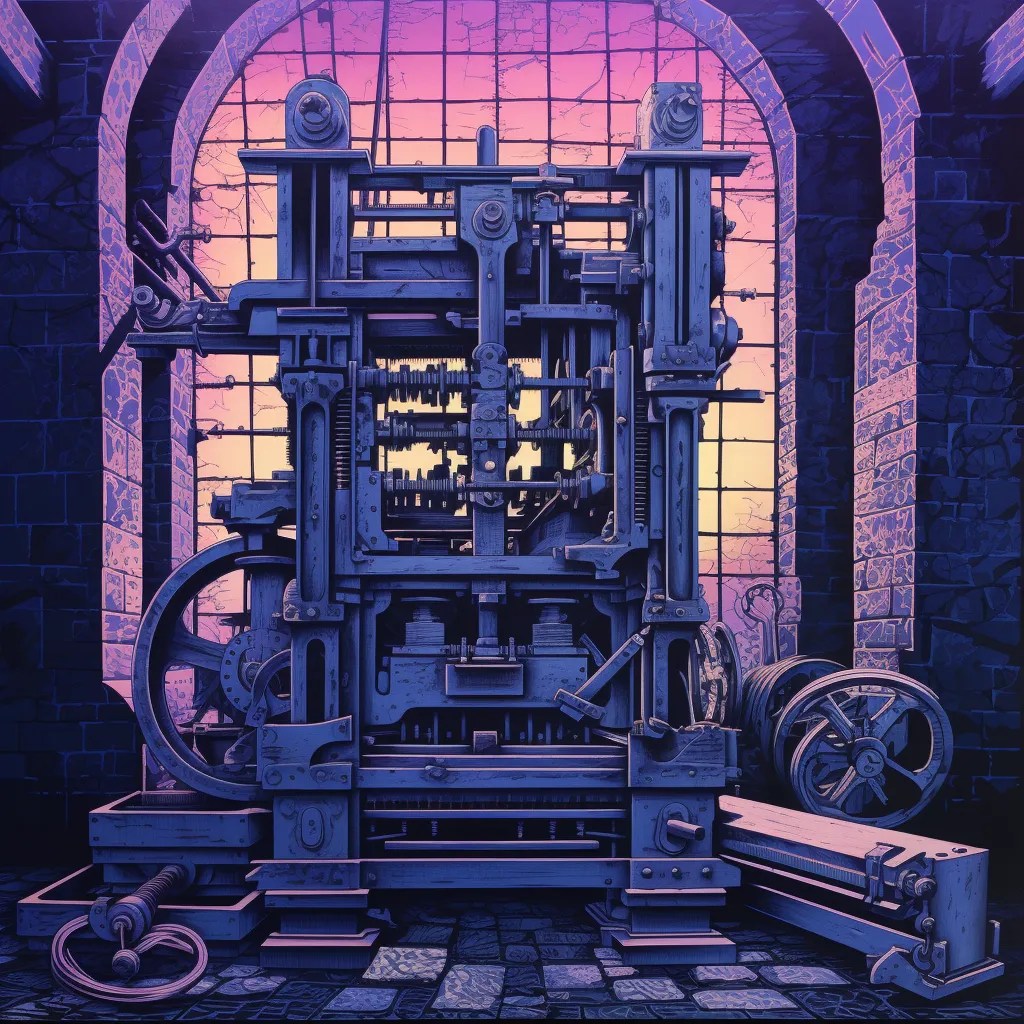
If an AI-infused web is the future, what can we learn from the past? Jeff Jarvis has some provocative thoughts…
The Gutenberg Parenthesis—the theory that inspired my book of the same name—holds that the era of print was a grand exception in the course of history. I ask what lessons we may learn from society’s development of print culture as we leave it for what follows the connected age of networks, data, and intelligent machines—and as we negotiate the fate of such institutions as copyright, the author, and mass media as they are challenged by developments such as generative AI.
Let’s start from the beginning…
In examining the half-millennium of print’s history, three moments in time struck me:
- After Johannes Gutenberg’s development of movable type in the 1450s in Europe (separate from its prior invention in China and Korea), it took a half-century for the book as we now know it to evolve out of its scribal roots—with titles, title pages, and page numbers. It took another century, until this side and that of 1600, before there arose tremendous innovation with print: the invention of the modern novel with Cervantes, the essay with Montaigne, a market for printed plays with Shakespeare, and the newspaper.
- It took another century before a business model for print at last emerged with copyright, which was enacted in Britain in 1710, not to protect authors but instead to transform literary works into tradable assets, primarily for the benefit of the still-developing industry of publishing.
- And it was one more century—after 1800—before major changes came to the technology of print: the steel press, stereotyping (to mold complete pages rather than resetting type with every edition), steam-powered presses, paper made from abundant wood pulp instead of scarce rags, and eventually the marvelous Linotype, eliminating the job of the typesetter. Before the mechanization and industrialization of print, the average circulation of a daily newspaper in America was 4,000 (the size of a healthy Substack newsletter these days). Afterwards, mass media, the mass market, and the idea of the mass were born alongside the advertising to support them.
One lesson in this timeline is that the change we experience today, which we think is moving fast, is likely only the beginning. We are only a quarter century past the introduction of the commercial web browser, which puts us at about 1480 in Gutenberg years. There could be much disruption and invention still ahead. Another lesson is that many of the institutions we assume are immutable—copyright, the concept of creativity as property, mass media and its scale, advertising and the attention economy—are not forever. That is to say that we can reconsider, reinvent, reject, or replace them as need and opportunity present…
Read on for his suggestion for a reinvention of copyright: “Gutenberg’s lessons in the era of AI,” from @jeffjarvis via @azeem in his valuable newsletter @ExponentialView.
* Mary Wollstonecraft Shelley, Frankenstein
###
As we contemplate change, we might spare a thought for Jan Hus. A Czech theologian and philosopher who became a Church reformer, he was burned at the stake as a heretic (for condemning indulgences and the Crusades) on this date in 1415. His teachings (which largely echoed those of Wycliffe) had a strong influence, over a century later, on Martin Luther, helping inspire the Reformation… which was fueled by Gutenberg’s technology, which had been developed and begun to spread in the meantime.

“Any subject is good for opera if the composer feels it so intently he must sing it out”*…

We know that opera took the form we know today in Italy the first half of the 17th century, when what had largely been ponderous courtly spectacles mutated into the lively popular art that opera has remained for the past 400 year. But why did operas as we know them become… well, operas as we know them?
Why did opera first succeed as a public art form in Venice between 1637 and 1650 when all the elements of the new form were fully evident? The answer is to be found in the conjunction between Venetian carnival festivity and the intellectual politics of Venetian republicanism during the two generations after the lifting of the papal interdict against Venice in 1607. During this extraordinary period of relatively free speech, which was unmatched elsewhere at the time, Venice was the one place in Italy open to criticisms of Counter Reformation papal politics. Libertine and skeptical thought flourished in the Venetian academies, the members of which wrote the librettos and financed the theaters for many of the early Venetian operas.
How opera became Opera: “Why Venice? Venetian Society and the Success of Early Opera,” from Edward Muir (@EdwardMuir7)
* Gian Carlo Menotti
###
As we fiddle with Fidelio, we might recall that it was on this date in 1600 that Euridice, an opera by Jacopo Peri, with additional music by Giulio Caccini, was first performed in Florence; the libretto by Ottavio Rinuccini is based on books X and XI of Ovid’s Metamorphoses. which recount the story of the legendary musician Orpheus and his wife Euridice. A presage of what was later to flourish in Venice, it is the oldest surviving opera (though the same authors wrote the now-lost Dafne two years earlier), and is generally regarded as marking the dawn of the Baroque period.

“No Man is wise at all Times, or is without his blind Side”*…

Lucas Cranach the Elder: Martin Luther, circa 1532; Hans Holbein the Younger: Portrait of Erasmus, 1523
Desiderius Erasmus of Rotterdam, the leading figure of the Northern Renaissance, is widely considered the greatest of early humanists. Five hundred years ago, he faced a populist uprising led by a powerful provocateur, Martin Luther, that resulted in divisions no less explosive than those we see in America and Europe today.
Between 1500 and 1515, Erasmus produced a small library of tracts, textbooks, essays, and dialogues that together offered a blueprint for a new Europe. The old Europe had been dominated by the Roman Church. It emphasized hierarchy, authority, tradition, and the performance of rituals like confession and taking communion. But a new order was emerging, marked by spreading literacy, expanding trade, growing cities, the birth of printing, and the rise of a new middle class intent on becoming not only prosperous but learned, too.
Erasmus became the most articulate spokesman for this class…
Around the same time that the Erasmians were celebrating the dawn of a new enlightened era, a very different movement was gathering in support of Martin Luther. An Augustinian friar then in his early thirties, Luther had developed his own, unique gospel, founded on the principle of faith. Man, he thought, can win divine grace not through doing good works, as the Latin Church taught, but through belief in Christ. No matter how sincerely one confessed, no matter how many alms one gave, without faith in the Savior, he reasoned, no one can be saved. When Luther made this “discovery,” in around 1515, he felt that he had become “altogether born again and had entered paradise itself through open gates.”…
Initially, Luther admired Erasmus and his efforts to reform the Church, but over time Luther’s inflammatory language and his stress on faith instead of good works led to a painful separation. The flashpoint was the debate over whether man has free will. In dueling tracts, Erasmus suggested that he does, while Luther vehemently objected; after that, the two men considered each other mortal enemies.
Beyond that immediate matter of dispute, however, their conflict represented the clash of two contrasting world views—those of the Renaissance and the Reformation. Erasmus was an internationalist who sought to establish a borderless Christian union; Luther was a nationalist who appealed to the patriotism of the German people. Where Erasmus wrote exclusively in Latin, Luther often used the vernacular, the better to reach the common man. Erasmus wanted to educate a learned caste; Luther, to evangelize the masses. For years, they waged a battle of ideas, with each seeking to win over Europe to his side, but Erasmus’s reformist and universalist creed could not match Luther’s more emotional and nationalistic one; even some of Erasmus’s closest disciples eventually defected to Luther’s camp. Erasmus became an increasingly marginal figure, scorned by both Catholics, for being too critical of the Church, and Lutherans, for being too timid. In a turbulent and polarized age, he was the archetypal reasonable liberal…
As Mark Twain is reputed to have observed, “history doesn’t repeat itself but it often rhymes”– the Renaissance vs. the Reformation: “Luther vs. Erasmus: When Populism First Eclipsed the Liberal Elite.”
* Desiderius Erasmus, The Alchymyst, in Colloquies of Erasmus, Volume I
###
As we celebrate critical thinking, we might recall that it was on this date in 380 that the three Emperors of the Roman Empire issued the Edict of Thessalonica, ordering all subjects of the Empire to profess the faith of the bishops of Rome and of Alexandria, making Nicene Christianity the state religion of the Roman Empire and effectively creating “Christendom.” It ended a period of religious tolerance that had been formalized in 313 when the emperor Constantine I, together with his eastern counterpart Licinius, had issued the Edict of Milan, which granted religious toleration and freedom for persecuted Christians.

“The imaginary is what tends to become real”*…

Tik-Tok of Oz, L. Frank Baum, Chicago, 1914. Courtesy, Houghton Library, Harvard University
Maps enjoy a long tradition as a mode of literary illustration, orienting readers to worlds real and imagined. Presented in conjunction with the bicentenary of the Harvard Map Collection, this exhibition brings together over sixty landmark literary maps, from the 200-mile-wide island in Thomas More’s Utopia to the supercontinent called the Stillness in N. K. Jemisin’s The Fifth Season. Visitors will traverse literary geographies from William Faulkner’s Yoknapatawpha County to Nuruddin Farah’s besieged Somalia; or perhaps escape the world’s bothers in Pooh’s Hundred Acre Wood. At this intersection of literature and cartography, get your bearings and let these maps guide your way…
The map above is one of over 60 currently on display at the exhibition Landmarks: Maps as Literary Illustration, at Harvard’s Houghton Library, as part of year-long celebration of Houghton’s 75th birthday. In addition to the examples mentioned above, the collection includes the work of authors such as J. R. R. Tolkien and the late Ursula K. Le Guin, and spans everything from love stories to fairy tales. It runs through to April 14, 2018.
See also “Charting the Geography of Classic Literature.”
* André Breton
###
As we find our way, we might send the best of all possible birthday greetings to lawyer, social philosopher, author, statesman, Renaissance humanist, and councillor to Henry VIII of England, Sir Thomas More; he was born on this date in 1478. He is probably most widely known these days as the subject of Robert Bolt’s A Man For All Seasons, which dramatized More’s fate (he was beheaded) when he refused to accept his old friend Henry VIII as Supreme Head of the newly-established Church of England. (More was acting in accordance with his opposition to Martin Luther, William Tyndale, and the Protestant Reformation… for which he was canonized in 1935 by Pope Pius XI. Interestingly, he is also remembered by the Church of England as a “Reformation martyr.”)
But also importantly for the purpose of this post, More was also the author of the widely-read and widely-influential Utopia— his map from which is on display at the Houghton.

Hans Holbein the Younger’s portrait of More
“Beer is made by men, wine by God”*…

On this day 500 years ago, an obscure Saxon monk launched a protest movement against the Catholic Church that would transform Europe. Martin Luther’s Protestant Reformation changed not just the way Europeans lived, fought, worshipped, worked and created art but also how they ate and drank. For among the things it impacted was a drink beloved throughout the world and especially in Luther’s native Germany: beer…
How the protest that Luther launched 500 years ago revamped not only how Europe worshipped but also how it drank, as he and his followers promoted hops in beer as an act of rebellion against the Catholic Church: “The Other Reformation: How Martin Luther Changed Our Beer, Too.”
* Martin Luther
###
As we tap the keg, we might recall that it was on this date in 1948 that the Ames Brothers recorded “More Beer,” released the following year as the b-side of “You, You, You Are The One” (and on the 10″ LP Hoop-De-Doo).

You must be logged in to post a comment.