Posts Tagged ‘music history’
“I believe that the Binomial Theorem and a Bach Fugue are, in the long run, more important than all the battles of history”*…

Using his “musical animation machine.” Stephen Malinowski illustrates the genius of Bach’s “Great” Fugue in G minor, BWV 542…
Q: What’s so “great” about this fugue?
A: It’s called “great” to distinguish it from the other fugue in G minor (BWV 578) which is called “little”; you can compare it here. The BWV 578 fugue is a stand-alone piece, but BWV 542 is a pair of pieces; its full title is “Fantasia and Fugue in G minor.”…
* James Hilton
###
As we marvel, we might recall that it was on this date in 1762 that Christoph Willibald Gluck‘s glorious opera Orfeo ed Euridice premiered at the Burgtheater in Vienna, in the presence of Empress Maria Theresa. The first of Gluck’s “reform” operas (which brought “noble simplicity” to what had become abstruse opera seria), it was hugely influential on subsequent German operas. Variations on its plot—the underground rescue mission in which the hero must control, or conceal, his emotions—can be found in Mozart’s The Magic Flute, Beethoven’s Fidelio, and Wagner’s Das Rheingold.

“A phenomenon like Mozart remains an inexplicable thing”*…

And now there’s more of that extraordinary phenomenon to appreciate. Sonja Anderson, with big news…
A 12-minute piece of music composed by Wolfgang Amadeus Mozart has been discovered in a library in Germany. Researchers think the composer wrote the previously unknown piece—called Serenade in C—when he was a young teenager.
The composition was hidden in the holdings of Germany’s Leipzig Municipal Libraries—some 280 miles north of Salzburg, Austria, where Mozart was born in 1756. By the age of 5, he was a child prodigy who toured Europe performing for royals and aristocrats. As a teenager, he built a reputation as a composer, spending a few years in Salzburg and Vienna before moving to Italy in 1769.
Mozart probably wrote the recently discovered composition in the mid- to late-1760s, according to a statement from the Leipzig Municipal Libraries. Library researchers were compiling an edition of the Köchel catalog, a comprehensive archive of Mozart’s work, when they stumbled across a mysterious bound manuscript containing a handwritten composition in brown ink [pictured above].
The composition is attributed to “Wo[l]fgang Mozart.” The handwriting, however, is not Mozart’s, suggesting that the manuscript is a copy of the original composition. Researchers think it was made around 1780.
Serenade in C consists of seven miniature movements for a string trio (two violins and a bass), according to a statement from the International Mozarteum Foundation, a Salzburg-based nonprofit dedicated to Mozart’s life and work. The attribution to “Wo[l]fgang Mozart” indicates that the piece is from the composer’s youth, as he started regularly adding “Amadeo” to his name around 1769…
… In his early years… Mozart wrote many chamber works like Serenade in C, which his father recorded on a list of his son’s compositions. Many of these works were thought to have been lost to history, as Leisinger says in the statement. Fortunately, this particular piece was saved—thanks to the composer’s sister.
“It looks as if—thanks to a series of favorable circumstances—a complete string trio has survived in Leipzig,” Leisinger adds. “The source was evidently Mozart’s sister, and so it is tempting to think that she preserved the work as a memento of her brother. Perhaps he wrote the trio specially for her.”…
… The newly discovered Serenade in C has been renamed Ganz kleine Nachtmusik in the Köchel catalog (presumably in reference to Mozart’s famous serenade Eine kleine Nachtmusik)…
More than 250 years after a teenage Mozart wrote “Serenade in C,” a copy of the piece has surfaced: “This Lost Mozart Composition Hasn’t Been Heard for Centuries. Now, You Can Listen to It,” from @SmithsonianMag.
* Johann Wolfgang von Goethe
###
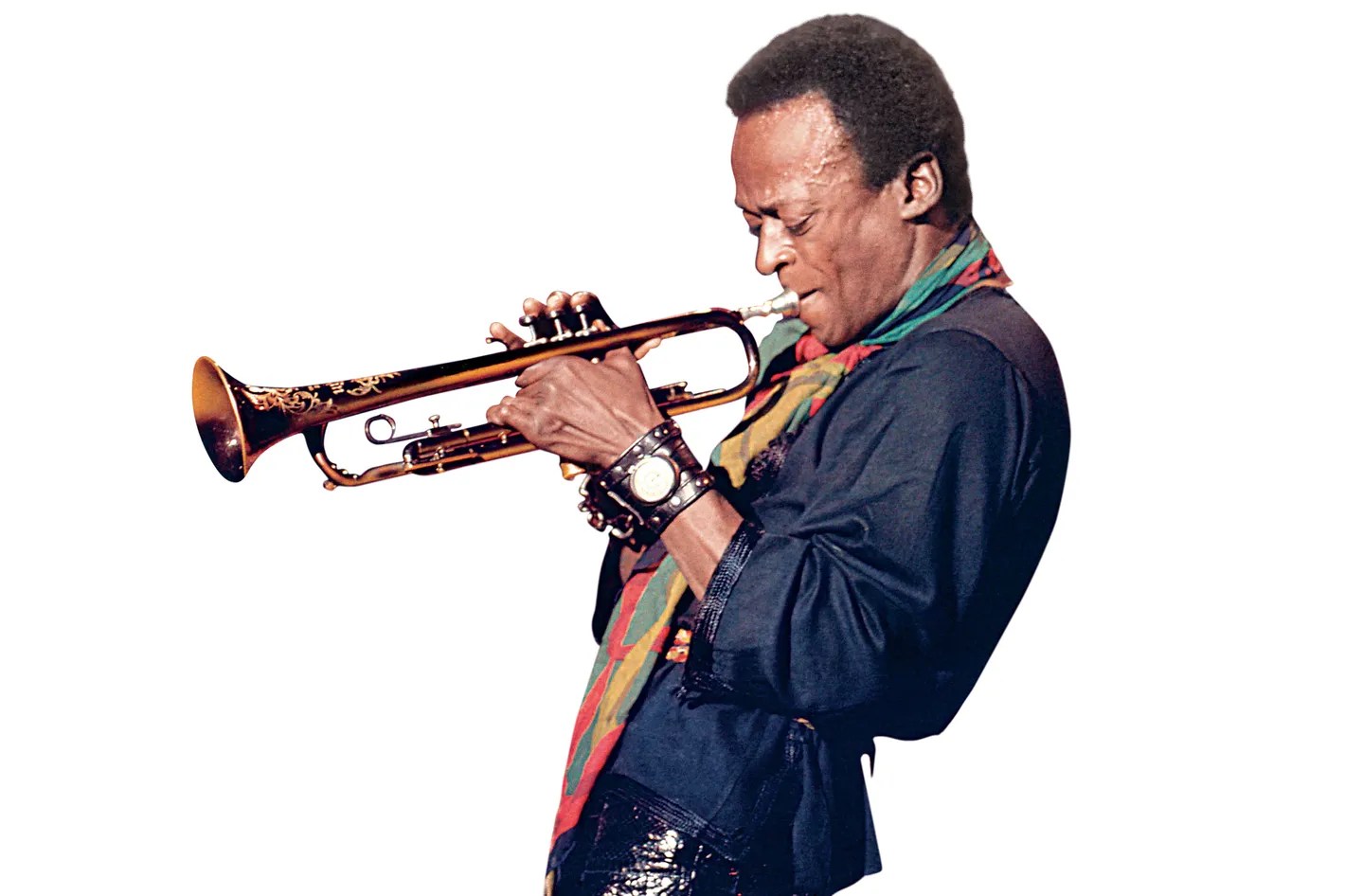
As we listen, we might spare a thought for Miles Davis; he died on this date in 1991. Rolling Stone described him as “the most revered jazz trumpeter of all time, not to mention one of the most important musicians of the 20th century.” Over a five-decade career (which began when he dropped out of Juilliard), Davis played bebop with Charlie Parker, paved the way for cool jazz with Birth of the Cool, pioneered hard bop, assembled a quintet (that included saxophonist John Coltrane and bassist Paul Chambers) and yielded ‘Round About Midnight, led a jazz orchestra (that recorded Kind of Blue among other albums), worked with bassist Ron Carter, pianist Herbie Hancock, drummer Tony Williams, and saxophonist Wayne Shorter to create the post-bop genre, and created jazz fusion with Bitches Brew.
In discussing Birth of the Cool, jazz great Azar Lawrence said of Davis what countless others have said of Davis and his other contributions: “It was such a phenomenal expression of artistry. It was like something created by Picasso or Bach or Mozart, or somebody of that stature of expression. It’s a foundational work and a musical landmark.”
“The only truth is music”*…
The pseudonymous Kerwin Fjøl on music theory and its origins…
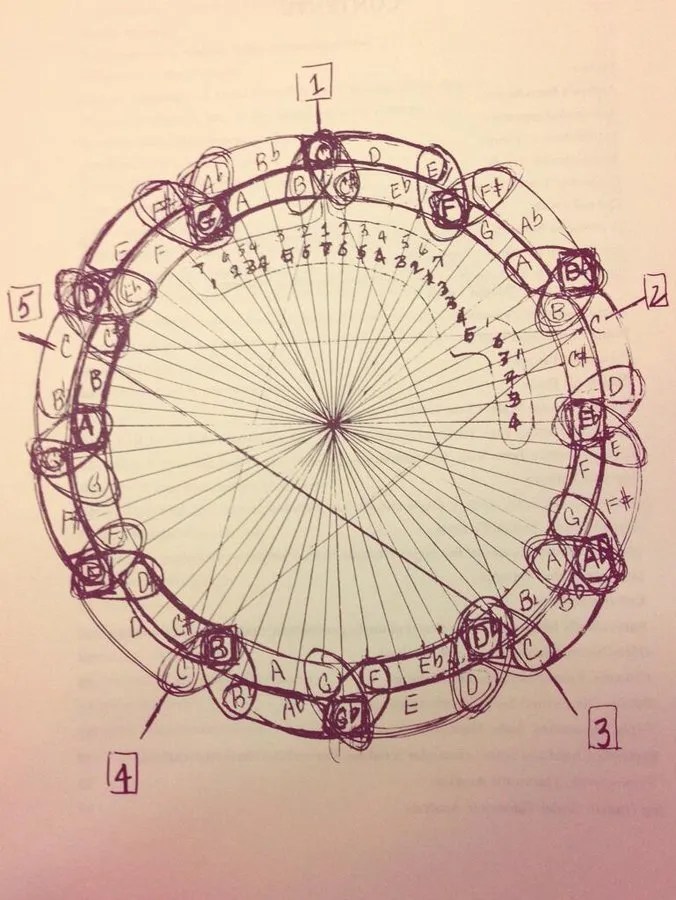
A while back, I posted the above picture onto Elon Musk’s X, and it got fairly popular, which was nice. It’s a sketch that John Coltrane made, and I had no idea what it was meant to demonstrate. Apparently, he gave it to fellow jazz musician Yusef Lateef in 1967, the same year he died (although I heard elsewhere he actually drew it in 1961), and he would pretty regularly produce these sorts of sketches to help himself reason through his music. A small handful of people started wondering about its mystical or occult implications, while others connected it to the “my coworker be losing his mind” meme. But what surprised me about it was the amount of people who got annoyed and immediately started yammering about how it isn’t really mystical; it’s just a boring circle of fifths, as though the fact that anyone might find this picture interesting for spiritual reasons was offensive on its face. One guy in particular, an account with 10k followers and a furry avatar, used it as the basis of a thread in which he saw a dichotomy between the real music theorists, the serious guys who are simply working out their ideas visually, and the woo-woo mystics who have no idea what they’re talking about but desperately want to see magic things everywhere. I’d link the post, but X doesn’t allow me to go through view most of the quote-tweets for some reason. In any case, you can imagine the kind of person who made it: the classic fedora-wearing, Reddit-using atheist that has become a cliché by this point.
There are a few problems with this interpretation, though, that are worth discussing. First, the picture isn’t just a typical circle of fifths. A circle of fifths is usually drawn by laying out the notes of a major scale in one circle and its relative minor notes in another, whereas this picture demonstrates a chromatic scale distributed along two concentric circles, with each circle arranged by whole tones. The likely reason Coltrane drew the picture, as I think this YouTube video lecture convincingly argues, was to think through what you can do with tritones during improvisation. And although it’s unclear what the pentangle might be doing besides linking the C octaves, it’s not at all unreasonable to guess that Coltrane was interested in its esoteric significance and wanted to incorporate it into his music somehow. After all, people have discussed this exact sort of influence when interpreting how he devised his Coltrane changes, which use major third interval chord substitutions that form an equilateral triangle on the circle of fifths. And he was clearly into pan-religious mysticism, which should be obvious by the content of his late albums.
But the more important problem with this distinction between the “Real Music Theorists” and the “woo-woo mystics” is that music has always been grounded in woo-woo mysticism. Bizarre philosophical ideas and supernatural notions have always accompanied the formal development of music theory, and composers themselves have often embedded religious and theological ideas into their compositional approach. I’d like to spend a bit of time here discussing exactly that topic…
There follows a fascinating history and analysis of the Pythagorean origins of Western music theory: “Yes, Music Is Mystical (and woo-woo),” from @zermatist.
See also Ted Gioia‘s broader survey of much the same turf: “Music to Raise the Dead: The Secret Origins of Musicology” @tedgioia
* Jack Kerouac
###
As we contemplate the key to keys, we might recall that it was on this date in 1969 that David Bowie’s “Space Oddity” was released as a single in the U.K. The tale of a fictional astronaut, it was hurried out to precede the Apollo moon landing– and became Bowie’s first commercial hit, reaching the UK top five.

“The real art of conducting consists in transitions”*…
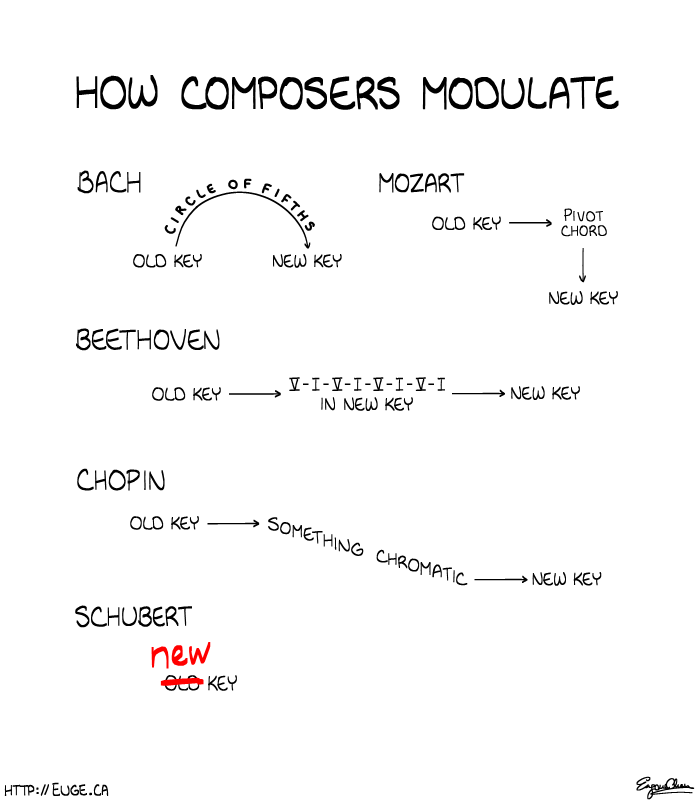

More in Eugene Chan‘s wonderful series Don’t Shoot the Piano Player. [TotH to friend SS.]
* Gustav Mahler
###
As we marvel at music, we might send well-composed birthday greetings to Henry Lawes; he was born on this date in 1596. The leading English songwriter of the mid-17th century (and brother of composer William Lawes), Henry worked both for Charles I and (roundhead) John Milton (for whom he composed Arcades and arranged for Milton to write the masque Comus). At the Restoration Lawes was reinstated in his old positions in the King’s Musick; he was buried in the cloisters of Westminster Abbey after his death in 1662.
“I was obliged to be industrious”*…

There’s an old joke that goes something like this: Mozart, on dying too young, finds himself in Heaven. He’s approached by God, who suggests that Mozart might become the conductor of Heaven’s orchestra. Mozart, taken aback, exclaims, “I’m flattered Lord, but surely Kapellmeister Bach is here and would be a more appropriate choice.” to which God responds, “I am Bach.”
Tyler Cowan with an argument that the joke isn’t so far off…
I’ve been reading and rereading biographies of Bach lately (for some podcast prep), and it strikes me he might count as the greatest achiever of all time. That is distinct from say regarding him as your favorite composer or artist of all time. I would include the following metrics as relevant for that designation:
1. Quality of work.
2. How much better he was than his contemporaries.
3. How much he stayed the very best in subsequent centuries.
4. Quantity of work.
5. Peaks.
6. Consistency of work and achievement.
I see Bach as ranking very, very high in all these categories. Who else might even be a contender for greatest achiever of all time? Shakespeare? Maybe, but Bach seems to beat him for relentlessness and quantity (at a very high quality level). Beethoven would be high on the list, but he doesn’t seem to quite match up to Bach in all of these categories. Homer seems relevant, but we are not even sure who or what he was. Archimedes? Plato or Aristotle? Who else?…
In any case, a reminder that we should all be listening to more Bach: “Is Bach the greatest achiever of all time?“, from @tylercowen.
* Johann Sebastian Bach
###
As we muse on magnificence, we might send melodic birthday greetings to Girolamo Frescobaldi; he was born on this date in 1583. A composer and keyboard virtuoso, he created some of the most influential music of the 17th century. His work influenced Bach, Johann Pachelbel, Henry Purcell, and other major composers.
Indeed, Bach is known to have owned a number of Frescobaldi’s works, including a manuscript copy of Frescobaldi’s Fiori musicali (Venice, 1635), which Bach signed and dated 1714 and performed in Weimar the same year.

,_engraving_by_Claude_Mellan_(1619).jpg)
You must be logged in to post a comment.