Posts Tagged ‘Space Oddity’
“The only truth is music”*…
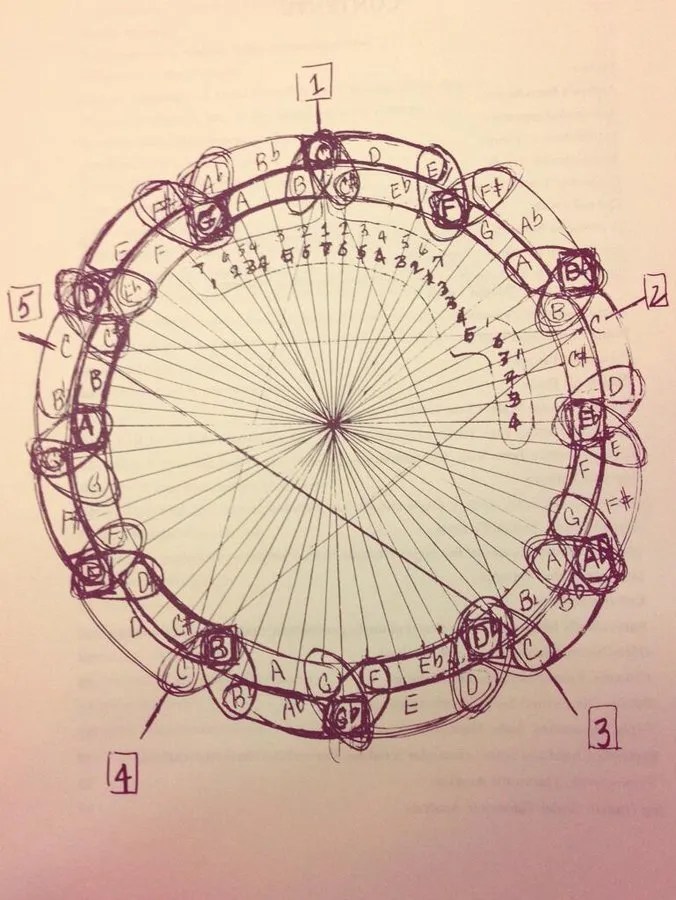
The pseudonymous Kerwin Fjøl on music theory and its origins…
A while back, I posted the above picture onto Elon Musk’s X, and it got fairly popular, which was nice. It’s a sketch that John Coltrane made, and I had no idea what it was meant to demonstrate. Apparently, he gave it to fellow jazz musician Yusef Lateef in 1967, the same year he died (although I heard elsewhere he actually drew it in 1961), and he would pretty regularly produce these sorts of sketches to help himself reason through his music. A small handful of people started wondering about its mystical or occult implications, while others connected it to the “my coworker be losing his mind” meme. But what surprised me about it was the amount of people who got annoyed and immediately started yammering about how it isn’t really mystical; it’s just a boring circle of fifths, as though the fact that anyone might find this picture interesting for spiritual reasons was offensive on its face. One guy in particular, an account with 10k followers and a furry avatar, used it as the basis of a thread in which he saw a dichotomy between the real music theorists, the serious guys who are simply working out their ideas visually, and the woo-woo mystics who have no idea what they’re talking about but desperately want to see magic things everywhere. I’d link the post, but X doesn’t allow me to go through view most of the quote-tweets for some reason. In any case, you can imagine the kind of person who made it: the classic fedora-wearing, Reddit-using atheist that has become a cliché by this point.
There are a few problems with this interpretation, though, that are worth discussing. First, the picture isn’t just a typical circle of fifths. A circle of fifths is usually drawn by laying out the notes of a major scale in one circle and its relative minor notes in another, whereas this picture demonstrates a chromatic scale distributed along two concentric circles, with each circle arranged by whole tones. The likely reason Coltrane drew the picture, as I think this YouTube video lecture convincingly argues, was to think through what you can do with tritones during improvisation. And although it’s unclear what the pentangle might be doing besides linking the C octaves, it’s not at all unreasonable to guess that Coltrane was interested in its esoteric significance and wanted to incorporate it into his music somehow. After all, people have discussed this exact sort of influence when interpreting how he devised his Coltrane changes, which use major third interval chord substitutions that form an equilateral triangle on the circle of fifths. And he was clearly into pan-religious mysticism, which should be obvious by the content of his late albums.
But the more important problem with this distinction between the “Real Music Theorists” and the “woo-woo mystics” is that music has always been grounded in woo-woo mysticism. Bizarre philosophical ideas and supernatural notions have always accompanied the formal development of music theory, and composers themselves have often embedded religious and theological ideas into their compositional approach. I’d like to spend a bit of time here discussing exactly that topic…
There follows a fascinating history and analysis of the Pythagorean origins of Western music theory: “Yes, Music Is Mystical (and woo-woo),” from @zermatist.
See also Ted Gioia‘s broader survey of much the same turf: “Music to Raise the Dead: The Secret Origins of Musicology” @tedgioia
* Jack Kerouac
###
As we contemplate the key to keys, we might recall that it was on this date in 1969 that David Bowie’s “Space Oddity” was released as a single in the U.K. The tale of a fictional astronaut, it was hurried out to precede the Apollo moon landing– and became Bowie’s first commercial hit, reaching the UK top five.

Doing unto others…
 source: Foundations Magazine
George Washington was only 16 when he finished copying out by hand all 110 “Rules of Civility & Decent Behavior in Company and Conversation,” a translation of a set of French Jesuit “injunctions to gentlemen” that dated from the late 16th century. Their dated diction (and the odd passe circumstance) notwithstanding, the Rules are an instructive read in these times of aggression and screed.
As we wax wistful, we might share a courteous smile with the nearest gin-soaked bar room queen– it was on this date in 1969 that the Rolling Stones released “Honky Tonk Women” in the U.S. (the very same day, as it happens, that David Bowie released “Space Oddity”).
 B-side: “You Can’t Always Get What You Want”
You must be logged in to post a comment.