Posts Tagged ‘rhythm’
“The real art of conducting consists in transitions”*…
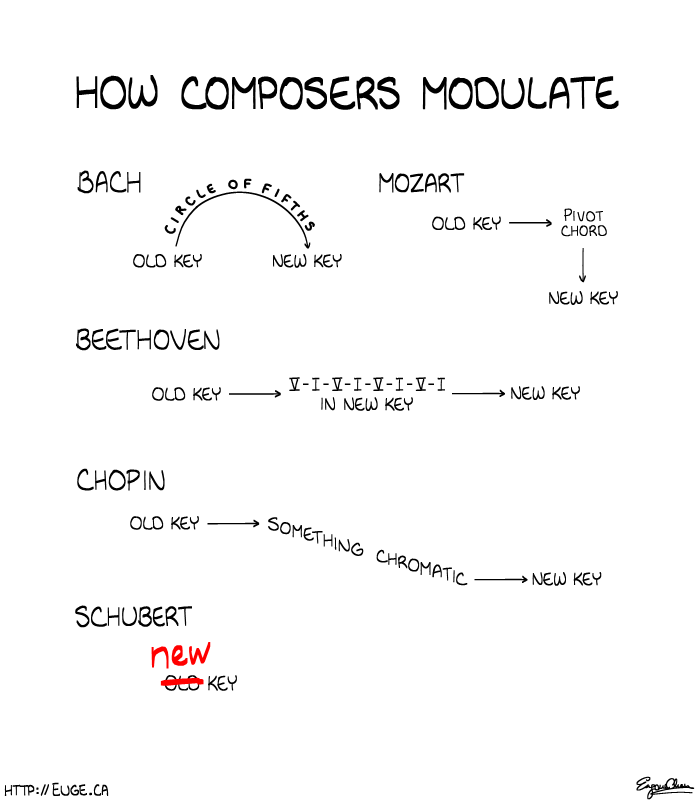

More in Eugene Chan‘s wonderful series Don’t Shoot the Piano Player. [TotH to friend SS.]
* Gustav Mahler
###
As we marvel at music, we might send well-composed birthday greetings to Henry Lawes; he was born on this date in 1596. The leading English songwriter of the mid-17th century (and brother of composer William Lawes), Henry worked both for Charles I and (roundhead) John Milton (for whom he composed Arcades and arranged for Milton to write the masque Comus). At the Restoration Lawes was reinstated in his old positions in the King’s Musick; he was buried in the cloisters of Westminster Abbey after his death in 1662.
“I Got Rhythm”*…

… indeed, as Nina Kraus explains, we all do…
Why do we care about rhythm? It connects us to the world. It plays a role in listening, in language, in understanding speech in noisy places, in walking, and even in our feelings toward one another.
Rhythm is much more than a component of music. Nevertheless, music is probably what first comes to mind when we hear the word rhythm: drumming, jazz, rock and roll, marching bands, street performers with wooden spoons and five-gallon buckets, drum circles, time signatures, stomp-stomp-clap — we will, we will rock you — adventures on the dance floor, beatboxing, incantations, mantras, and prayers. Beyond music, we experience the rhythmic changes of the seasons. Some of us have menstrual cycles. We have circadian rhythms — daily cycles of mental and physical peaks and troughs. Frogs croak rhythmically to attract mates and change their rhythm to signal aggression. Tides, 17-year cicadas, lunar phases, perigees, and apogees are other naturally occurring rhythms. Human-made rhythms include the built world — street grids, traffic lights, crop fields, mowed designs in baseball diamond outfields, the backsplash behind the kitchen counter, spatial patterns in geometric visual art forms.
Maintaining rhythm is almost a biological imperative for some of us…
An exploration of the many ways in which temporal patterns plays an important role in how we perceive — and connect with — the world: “The Extraordinary Ways Rhythm Shapes Our Lives,” at @mitpress.
And for an astounding application of rhythm, the story of Niko Tosa: “The Gambler Who Beat Roulette,” (with no electronic or other help). Via @nextdraft.
* George and Ira Gershwin (The piece [performed by Gershwin here] has become a jazz standard– and gave the world a chord progression– the “rhythm changes“– that provide the foundation for many other popular jazz tunes, including Charlie Parker’s and Dizzy Gillespie’s bebop standard “Anthropology (Thrivin’ on a Riff).”)
###
As we contemplate cadence, we might recall that it was on this date in 1965 that the Beatles recorded “Help!” The title song of their 1965 film and its soundtrack album, it was released as a single in July of that year, and was number one for three weeks in the United States and the United Kingdom.
The group recorded “Help!” in 12 takes using four-track equipment. The first nine takes concentrated on the instrumental backing. The descending lead guitar riff that precedes each verse proved to be difficult, so by take 4 it was decided to postpone it for an overdub. To guide that later overdub by George, John thumped the beat on his acoustic guitar body, which can be heard in the final stereo mix.
“Let there be bass”*…

Sometimes, it really is all about that bass…
A recent study in the journal Current Biology found that people danced 12% more when very low frequency bass was played.
The study was done by scientists at the LIVElab at McMaster University in Ontario, Canada, who wanted to see what musical ingredients make us want to dance.
“We look at things like what kinds of rhythms most pull people into that steady beat that we groove along with, and what kinds of interesting, syncopated, complex rhythms make us really drawn in and want to move more,” said Daniel Cameron, a neuroscientist and the lead author of the study.
Now, the lab for this experiment wasn’t the classic fluorescent lights, white coats and goggles setup. Instead, the LIVElab space was converted into an electronic dance music concert, and EDM duo Orphx performed live for volunteers adorned with headbands that had a motion capture sensor.
The lab was equipped with special special speakers that can play a very low frequency bass, undetectable to the human ear. The set lasted about an hour, and researchers introduced that very low bass every 2.5 minutes, and found that the concertgoers moved more when the speakers were on – even though they couldn’t hear it.
“It’s the inner-ear structures that give us a sense of where our head is in space,” he said. “That system is sensitive to low-frequency stimulation, especially if it’s loud.”
“We also know that our tactile system, that’s our sense of touch … is also sensitive to low-frequency stimulation, low-frequency sound.”…
“And that’s feeding into our motor system in the brain, the movement control system in our brain,” Cameron said. “So it’s adding a little bit of gain. It’s giving a little more energy … from that stimulation through those systems.”…
“What makes us dance? It really is all about that bass,” from @NPR.
For more on ultra-low frequency sounds and their effects, see “How low can you go?“; and lest we think this phenomenon restricted to humans, “Watch These Rats ‘Dance’ to the Rhythms of Mozart, Lady Gaga, and Queen.”
###
As we go low, we might recall that it was on this date in 1792, during George Washington’s first term as president, that the first edition of The Farmer’s Almanac was published. (It became The Old Farmer’s Almanac in 1832 to distinguish itself from similarly-titled competitors.) Still going strong, it is the oldest continuously-published periodical in the U.S.

You must be logged in to post a comment.