AI doesn’t really “think.” Rather, it remembers how we thought together. Are we’re about to stop giving it anything worth remembering? Bright Simons with a provocative analysis…
We are on the verge of the age of human redundancy. In 2023, IBM’s chief executive told Bloomberg that soon some 7,800 roles might be replaced by AI. The following year, Duolingo cut a tenth of its contractor workforce; it needed to free up desks for AI. Atlassian followed. Klarna announced that its AI assistant was performing work equivalent to 700 customer-service employees and that reducing the size of its workforce to under 2000 is now its North Star. And Jack Dorsey has been forthright about wanting to hold Block’s headcount flat while AI shoulders the growth.
The trajectory has a compelling internal logic. Routine cognitive work gets automated; junior roles thin out; productivity gains compound year on year. For boards reviewing cost structures, it is the cleanest investment proposition since the internal combustion engine retired the horse, topped up with a kind of moral momentum. Hesitate, the thinking goes, and fall behind.
But the research results of a team in the UK should give us pause. In the spring of 2024, they asked around 300 writers to produce short fiction. Some were aided by GPT-4 and others worked alone. Which stories, the researchers wanted to know, would be more creative? On average, the writers with AI help produced stories that independent judges rated as more creative than those written without it.
So far, so on message: a familiar story about the inevitable takeover by intelligent machines. But when the researchers examined the full body of stories rather than individual ones, the picture became murky. The AI-assisted stories were more similar to each other. Each writer had been individually elevated; collectively, they had converged. Anil R Doshi and Oliver Hauser, who published the study in Science Advances, reached for a phrase from ecology to explain this: a tragedy of the commons.
Hold that result in mind: individual gain, collective loss. It describes something far more consequential than a writing experiment—it describes the hidden logic of our entire relationship with artificial intelligence. And it suggests that the most successful organizations of the coming decade will be the ones that do something profoundly counterintuitive: instead of using AI to eliminate human interaction by firing droves of workers, they will use it to create more human interaction. IBM has reversed course on its earlier human redundancy fantasies. I bet more will in due course…
[Simons sketches the history of humans’ intertwined development of both social/organizational and utile technologies, concluding…]
… What the chain reveals is a dependency the AI industry has largely declined to examine. The underlying intelligence of a large language model isn’t a function of its architecture, its parameter count, or the volume of compute thrown at its training. It is not even about the training data. It is a function of the social complexity of the civilization whose language it digested.
Each epoch advanced the cognitive frontier through something far richer and more complex than the isolated genius of an individual guru or machine. It did so through new forms of collective problem-solving. Think new institutions (the Greek agora, the Roman lex, the medieval university, the scientific society, the modern corporation, and the social internet) that demanded and rewarded ever more sophisticated uses of language.
The cognitive anthropologist Edwin Hutchins studied how Navy navigation teams actually think. In his 1995 book Cognition in the Wild, he wrote something that reads today like an accidental prophecy. The physical symbol system, he observed, is “a model of the operation of the sociocultural system from which the human actor has been removed.”
That is, with eerie precision, a description of what a large language model (LLM) really is, stripped of all the unapproachable jargon and mathematical wizardry. An LLM like ChatGPT is a model of human social reasoning with the human wrangled out. And the question nobody in Silicon Valley is asking with sufficient urgency is: What happens to the model when the social reasoning that produced its training data begins to thin?…
[Simons explores evidence that this may already be materially underway, then explores what that “atrophy” might mean …]
… If AI capability depends on the social complexity of human language production—and if AI deployment systematically reduces that complexity through cognitive offloading, homogenization of creative output, and the elimination of interaction-dense work—then the technology is gradually undermining the conditions for its own advancement. Its successes, rather than failures, create a spiral: a slow attenuation of the very substrate it feeds on, spelling doom.
This is the Social Edge Paradox, and the intellectual tradition it draws from is older and more interdisciplinary than most AI commentary acknowledges…
[Simons unpacks that heritage, and puts it into dialogues with recent thoughts from Dario Amodei, Leopold Aschenbrenner, and Sam Altman, concluding…]
… The Social Edge Framework outlined here is a direct counterpoint to Amodei, Aschenbrenner, and Altman. It is a program of action to counter the human redundancy fantasy. It challenges the self-fulfilling doom-spirals created by the premature reallocation of material resources to a vision of AI. I speak of the philosophy that underestimates the sheer amount of human priming needed to support the Great Recode of legacy infrastructure before our current civilization can even benefit substantially from AI advances.
By “Great Recode,” I am paying homage to the simple but widely ignored fact that the overwhelming number of tools and services that advanced AI models still need to produce useful outputs for users are not themselves AI-like and most were built before the high-intensity computing era began with AI. In the unsexy but critical field of PDF parsing—one of the ways in which AI consumes large amounts of historical data to get smart—studies show that only a very small proportion of tools were created using techniques like deep learning that characterize the AI age. And in some important cases, the older tools remain indispensable. Vast investments are thus required to upgrade all or most of these tools—from PDF parsers to database schemas—to align with the pace of high-intensity computing driven by the power-thirst of AI. Yet, we are not at the point where AI can simply create its own dependencies.
Indeed, the so-called “legacy tech debt” supposedly hampering the faster adoption of AI has in many instances been revealed as a problem of mediation and translation. AI companies are learning that they need to hire people who deeply understand legacy systems to guide this Recoding effort. A whole new “digital archaeology” field is emerging where cutting-edge tools like ArgonSense are deployed to try to excavate the latent intelligence in legacy systems and code often after rushed modernization efforts have failed. In many cases, swashbuckling new-age AI adventurers have found that mainframe specialists of a bygone age remain critical, and multidisciplinary dialogues and contentions are essential to progress on the frontier. Hence the strange phenomenon of the COBOL hiring boom. New knowledge must keep feeding on old.
The Social Edge Framework says: yes, scaling matters, architecture matters, and compute matters. But none of these will continue to deliver if the social substrate—the complex, argumentative, institutionally diverse, perspectivally rich fabric of human interaction—is allowed to thin. And thinning is very possible…
… The Social Edge prescription is that organizations that hire more people to work in AI-enriched, high-interaction, and transmediary roles—where AI scaffolds learning rather than substituting it—will derive greater long-term advantage than those that treat the technology as a headcount-reduction device. In a world where raw cognitive throughput has been commodified, the value arc shifts to something considerably harder to replicate: the capacity to coordinate human intent with precision, speed, and genuine depth. That edge lies in trans-mediation and high human interactionism.
The AI industry is telling a story about the future of work that goes roughly like this: automate what can be automated, augment what remains, and trust that the productivity gains will compound into a wealthier, more efficient world.
The Social Edge Framework tells a different story. It says: the intelligence we are automating was never ours alone. It was forged in conversation, argument, institutional friction, and collaborative struggle. It lives in the spaces between people, and it shows up in AI capabilities only because those spaces were rich enough to leave linguistic traces worth learning from.
Every time a company automates an entry-level role, it saves a salary and loses a learning curve, unless it compensates. Every time a knowledge worker delegates a draft to an AI without engaging critically, the statistical thinning of the organizational record advances by an imperceptible increment. Every time an organization mistakes polished output for strategic progress, it consumes cognitive surplus without generating new knowledge.
None of these individual acts is catastrophic. However, their compound effect may be.
The organizations that will thrive in the next decade are not those with the highest AI utilization rates. They are those that understand something the epoch-chaining thought experiment makes vivid: that AI’s capabilities are an inheritance from the complexity of human social life. And inheritances, if consumed without reinvestment, eventually run out. This is particularly critical as AI becomes heavily customized for our organizational culture.
Making the right strategic choices about AI is going to become a defining trait in leadership. Bloom et al. cross-country research has long established that management quality explains a substantial share of productivity variance between teams and organizations, and even countries.
In the AI age, small differences in leadership quality can generate large differences in outcomes—a non-linear payoff I call convex leadership. The term is borrowed from options mathematics, where a convex payoff is one whose upside accelerates faster than the downside decelerates. Convex leaders convert cognitive abundance into structural ambition and thus avoid turning their creative and discovery pipelines into stagnant pools of polished busywork. Conversely, in organizations led by what we might call concave leaders—cautious, procedurally anchored, optimizing for error-avoidance—AI would tend to produce more noise than signal. Because leadership is such a major shaper of all our lives, it is in our interest to pay serious attention to its evolution in this new age.
The Social Edge is more than a metaphor. It is the literal boundary between what AI can do well and what it will keep struggling with due to fundamental internal contradictions. Furthermore, the framework asks us all to pay attention to how the very investment thesis behind AI also contains the seeds of its own failure. And it reminds leaders that AI’s frontier today is set by the richness of the social world that produced the data it learned from…
As we take the long view, we might recall that today is the anniverary of a techological advance that both fed the social edge and encouraged the build out of the technostructure from which today’s AI hatched: on this date in 1993 Version 1.0 of the web browser Mosaic was released by the National Center for Supercomputing Applications. It was the first software to provide a graphical user interface for the emerging World Wide Web, including the ability to display inline graphics.
From yesterday’s post on the possible (and promising, but also potentially painful) future of computing to a pressing predicament we face today. The estimable Anil Dash on the threats to the open web…
You must imagine Sam Altman holding a knife to Tim Berners-Lee’s throat.
It’s not a pleasant image. Sir Tim is, rightly, revered as the genial father of the World Wide Web. But, all the signs are pointing to the fact that we might be in endgame for “open” as we’ve known it on the Internet over the last few decades.
The open web is something extraordinary: anybody can use whatever tools they have, to create content following publicly documented specifications, published using completely free and open platforms, and then share that work with anyone, anywhere in the world, without asking for permission from anyone. Think about how radical that is.
Now, from content to code, communities to culture, we can see example after example of that open web under attack. Every single aspect of the radical architecture I just described is threatened, by those who have profited most from that exact system.
Today, the good people who act as thoughtful stewards of the web infrastructure are still showing the same generosity of spirit that has created opportunity for billions of people and connected society in ways too vast to count while —not incidentally— also creating trillions of dollars of value and countless jobs around the world. But the increasingly-extremist tycoons of Big Tech have decided that that’s not good enough.
Now, the hectobillionaires have begun their final assault on the last, best parts of what’s still open, and likely won’t rest until they’ve either brought all of the independent and noncommercial parts of the Internet under their control, or destroyed them. Whether or not they succeed is going to be decided by decisions that we all make as a community in the coming months. Even though there have always been threats to openness on the web, the stakes have never been higher than they are this time.
Right now, too many of the players in the open ecosystem are still carrying on with business as usual, even though those tactics have been failing to stop big tech for years. I don’t say this lightly: it looks to me like 2026 is the year that decides whether the open web as we know it will survive at all, and we have to fight like the threat is existential. Because it is…
[Dash details the treats– largely, but not entirely driven by AI and its purveyors. He concludes…]
… The threat to the open web is far more profound than just some platforms that are under siege. The most egregious harm is the way that the generosity and grace of the people who keep the web open is being abused and exploited. Those people who maintain open source software? They’re hardly getting rich — that’s thankless, costly work, which they often choose instead of cashing in at some startup. Similarly, volunteering for Wikipedia is hardly profitable. Defining super-technical open standards takes time and patience, sometimes over a period of years, and there’s no fortune or fame in it.
Creators who fight hard to stay independent are often choosing to make less money, to go without winning awards or the other trappings of big media, just in order to maintain control and authority over their content, and because they think it’s the right way to connect with an audience. Publishers who’ve survived through year after year of attacks from tech platforms get rewarded by… getting to do it again the next year. Tim Berners-Lee is no billionaire, but none of those guys with the hundreds of billions of dollars would have all of their riches without him. And the thanks he gets from them is that they’re trying to kill the beautiful gift that he gave to the world, and replace it with a tedious, extortive slop mall.
So, we’re in endgame now. They see their chance to run the playbook again, and do to Wikipedians what Uber did to cab drivers, to get users addicted to closed apps like they are to social media, to force podcasters to chase an algorithm like kids on TikTok. If everyone across the open internet can gather together, and see that we’re all in one fight together, and push back with the same ferocity with which we’re being attacked, then we do have a shot at stopping them.
At one time, it was considered impossibly unlikely that anybody would ever create open technologies that would ever succeed in being useful for people, let alone that they would become a daily part of enabling billions of people to connect and communicate and make their lives better. So I don’t think it’s any more unlikely that the same communities can summon that kind of spirit again, and beat back the wealthiest people in the world, to ensure that the next generation gets to have these same amazing resources to rely on for decades to come.
Alright, if it’s not hopeless, what are the concrete things we can do? The first thing is to directly support organizations in the fight. Either those that are at risk, or those that are protecting those at risk. You can give directly to support the Internet Archive, or volunteer to help them out. Wikipedia welcomes your donation or your community participation. The Electronic Frontier Foundation is fighting for better policy and to defend your rights on virtually all of these issues, and could use your support or provides a list of ways to volunteer or take action. The Mozilla Foundation can also use your donations and is driving change. (And full disclosure — I’m involved in pretty much all of these organizations in some capacity, ranging from volunteer to advisor to board member.) That’s because I’m trying to make sure my deeds match my words! These are the people whom I’ve seen, with my own eyes, stay the hand of those who would hold the knife to the necks of the open web’s defenders. [Further full disclosure: so is your correpondent, and so have I.]
Beyond just what these organizations do, though, we can remember how much the open web matters. I know from my time on the board of Stack Overflow that we got to see the rise of an incredibly generous community built around sharing information openly, under open licenses. There are very few platforms in history that helped more people have more economic mobility than the number of people who got good-paying jobs as coders as a result of the information on that site. And then we got to see the toll that extractive LLMs had when they took advantage of that community without any consideration for the impact it would have when they trained models on the generosity of that site’s members without reciprocating in kind.
The good of the web only exists because of the openness of the web. They can’t just keep on taking and taking without expecting people to finally draw a line and saying “enough”. And interestingly, opportunities might exist where the tycoons least expect it. I saw Mike Masnick’s recent piece where he argued that one of the things that might enable a resurgence of the open web might be… AI. It would seem counterintuitive to anyone who’s read everything I’ve shared here to imagine that anything good could come of these same technologies that have caused so much harm.
But ultimately what matters is power. It is precisely because technologies like LLMs have powers that the authoritarians have rushed to try to take them over and wield them as effectively as they can. I don’t think that platforms owned and operated by those bad actors can be the tools that disrupt their agenda. I do think it might be possible that the creative communities that built the web in the first place could use their same innovative spirit to build what could be, for lack of a better term, called “good AI“. It’s going to take better policy, which may be impossible in the short term at the federal level in the U.S., but can certainly happen at more local levels and in the rest of the world. Though I’m skeptical about putting too much of the burden on individual users, we can certainly change culture and educate people so that more people feel empowered and motivated to choose alternatives to the big tech and big AI platforms that got us into this situation. And we can encourage harm reduction approaches for the people and institutions that are already locked into using these tools, because as we’ve seen, even small individual actions can get institutions to change course.
Ultimately I think, if given the choice, people will pick home-cooked, locally-grown, heart-felt digital meals over factory-farmed fast food technology every time…
As we protect what’s precious, we might send carefully-calculated birthday greetings to a man whose work helped lay the foundation for both the promise and the peril unpacked in the article linked above above: J. Presper Eckert; he was born on this day in 1919. An electrical engineer, he co-designed (with John Mauchly) the first widely-known general purpose computer, the ENIAC (see here and here) for the U.S. Army’s Ballistic Research Laboratory. He and Mauchy went on to found the Eckert–Mauchly Computer Corporation, at which they designed and built the first commercial computer in the U.S., the UNIVAC.
Eckert (standing and gesturing) and Mauchy (at the console), demonstrating the UNIVAC to Walter Cronkite (source)
The enshittification of the major social media platforms has become impossible to ignore… and has led many to predict a more decentralized future for the web. But as William Gibson famously observed, “the future is already here, it’s just not evenly distributed.”
Case in point: Ben Smith‘s blockbuster Semafor post on the flourishing ecology of private chat groups that has emerged, starting with…
Chatham House, a giant and raucous Signal group that forms part of the sprawling network of influential private chats that began during the fervid early days of the COVID-19 pandemic, and which have fueled a new alliance of tech and the US right. That same week in Chatham House, Lonsdale and the Democratic billionaire Mark Cuban sparred over affirmative action, and Cuban and Daily Wire founder Ben Shapiro discussed questions of culture and work ethic.
This constellation of rolling elite political conversations revolve primarily around the venture capitalist Marc Andreessen and a circle of Silicon Valley figures. None of their participants was surprised to see Trump administration officials firing off secrets and emojis on the platform last month. I did not have the good fortune to be accidentally added to one of the chats, which can be set to make messages disappear after just 30 seconds.
But their influence flows through X, Substack, and podcasts, and constitutes a kind of dark matter of American politics and media. The group chats aren’t always primarily a political space, but they are the single most important place in which a stunning realignment toward Donald Trump was shaped and negotiated, and an alliance between Silicon Valley and the new right formed. The group chats are “the memetic upstream of mainstream opinion,” wrote one of their key organizers, Sriram Krishnan, a former partner in the venture capital firm Andreessen Horowitz (typically styled a16z) who is now the White House senior policy adviser for AI.
Of course, these are hardly the only power group chats. Anti-Trump liberals are now coordinating their responses on Signal. There are group chats for Black political elites and morning show producers. A vast and influential parallel set of tech conversations take place on WhatsApp. There’s a big China-friendly group over on WeChat. Elite podcasters have one…
… Many of the [Chatham House] chatters celebrate their success in driving the ascendant politics of the Trump era, which they hope will bring back patriotic industry and traditional cultural norms. Some who have left or lurk consider it a sinister phenomenon in which Andreessen exerted unspoken gravitational pull, as one participant put it: “You’d see that the writers were bending toward the billionaires, and even the ones who prided themselves on being iconoclastic were bending to the tastes and the centers of gravity of power.”…
… You should therefore be very suspicious of anyone who claims to be in the Genuine Ideas business but who is afraid to fully speak their mind in public. For the past half decade at least, America has been bombarded with the grumblings of influential people griping that they are not “allowed” to say what they really think, these days. Because of wokeness, and witch hunts, and things like that. What do they mean when they argue that they are not “allowed” to say something? Do they mean that they might be snatched by government agents and deported for writing a humanitarian op-ed in a student newspaper? No. What they mean, usually, is that they hold opinions that many people would find objectionable and if they say those opinions out loud people will get mad at them. In many cases, they also hold prestigious positions at media or business or academic institutions that claim to have some anodyne progressive values, and because their objectionable ideas are objectionable in the specific sense of “being some variety of bigotry,” their colleagues at those institutions would be mad at them, making their lives unpleasant. (It is darkly funny that, in the years that all of these people have been complaining about the woke censorship they are suffering, the people who have actually suffered the most professional retaliation for voicing their beliefs have been those who spoke out for the human rights of Palestinians. That has proven to be far more dangerous to one’s livelihood than being a bigot.)
It is important to notice the fact that, in truth, all of these whining people very much are allowed to say what they think. They sure can. No one is stopping them. What they are really objecting to is not censorship, but rather the honest reactions that their honest ideas will elicit. In other words, they cannot handle The Discourse. They are not equipped to participate in the Ideas industry. They are unable to carry the burden of telling the truth as they see it. This is fine, if you’re a regular person; no one is obligated to get yelled at for their beliefs. But it is not fine if you are someone—a writer, a leader, an intellectual influencer of the public—who is supposed to be pushing ideas. Those people must either say what they believe, change what they believe, or accept the fact that they are intellectual cowards.
These are the things that I thought last night when I read Ben Smith’s Semafor story about the many exclusive group chats, full of pundits and quasi-journalists and Substack writers and Silicon Valley business titans and political activists, that have served as private petri dishes of reactionary thinking since the start of the pandemic. It is a juicy story, replete with tales of the wounded signatories of the infamous Harper’s Letter forming and reforming little Signal chat groups where they could hold masturbatory agreement sessions with Marc Andreesen and Mark Cuban and similar tech gurus who fancy themselves masters of the nation’s future. Over and over again, participants in these chats explain that they were places where they could speak more openly than they would in public. “People during 2020 felt that there was a monoculture on social media,” goes one typical comment from an entrepreneur, “and if they didn’t agree with something, group chats became a safe space to debate that, share that, build consensus, feel that you’re not alone.” It’s not just the businessmen— “Group chats are now where everything important and interesting happens,” agrees one popular blog thinkfluencer, who presumably is not giving his public readers his important or interesting stuff…
… Sometimes you say what you think, and guess what happens? People get mad. People yell at you. Yes. That goes with the territory. I will put the = hate mail and death threats and angry internet comments that I received during my Gawker years up against anyone’s. And, hey: that’s the fucking job. Whether you write for Gawker or Substack or the New York Times or Harper’s—or whether you are a CEO or tech visionary or a venture capitalist who goes to the Aspen Ideas festival and has a bazillion Twitter followers—the only requirement of the job is to speak your mind honestly. Because, because, by asking the public to listen to you, you are telling the public that they will be getting, as best as you can manage it, your truest ideas. We ask people to give us their attention, and their time, and in turn we give them our honest thoughts. When you are operating in this world and you stop giving people your honest thoughts, you begin ripping people off.
Feel free to hide your honest thoughts in private group chats if you like. Rather than speaking forthrightly, retreat into a little hole where you can stage manage and coordinate the rollout of soft versions of your unpopular ideas in friendly forums. But if you do, don’t pretend that you are a member in good standing of the (absurd, enraging, pompous, but ultimately socially valuable) Ideas industry. Say what you think, cowards! Or stop pretending that your beliefs are important enough for other people to care about in the first place…
… it’s worth pointing out that the dynamics of these group chats only makes sense when you keep in mind that these people are doing something literally everyone on Earth does — post in a group chat — but think they literally invented the future of media. Peak rich guy brain at work here. They, also, spent the lead up to Semafor publishing their piece freaking out about it, which hilariously hyped the shit out of it.
The interesting thing here, though — well, beyond the fact that we now have hard evidence that a secret network of the country’s richest men have been using Signal groups to coordinate a soft coup and inadvertently crashed the global economy in the process — is the timing. According to Semafor, the big digital rats nest of middle-life-crisis-havers started forming after Andreessen published the “It’s Time To Build” blog post, one of the many manifestos he would publish during his manic post-COVID era. The essay went viral on Clubhouse (lol) and led to the earliest versions of these group chats forming on, first, WhatsApp, and, then, Signal.
I was particularly vicious about Clubhouse when it launched, a site I’ve often referred to as a dinner party simulation app. And I was especially angry that the social network was being astroturfed into a “thing” by men like Andreessen. To me, Clubhouse stands as the moment Silicon Valley fully lost the plot, effusively hyping up an app that literally just let them hear their own voices. The snake finally eating its own tail. As I wrote back in 2021, “Clubhouse, by the very fact both its initial user base and its subsequent hype was basically dreamt up by Silicon Valley insiders, was, in my opinion, a test of whether or not venture capitalists had enough influence to dream up a new — honestly, very bad — social network and force it upon the rest of the internet.”
Well, it turns out Clubhouse’s hilariously fast crashout did not deter these guys from continuing to try and make fetch happen and they’ve spent the last four years coordinating behind the scenes to remake the country in their own image. Well, at least until President Donald Trump’s tariff announcement last month, which seems to have really broken the right-wing tech coalition that’s been flourishing on Signal since COVID.
And according to Semafor, these group chats did have a profound impact on how we’ve understood the world for the last four years. These groups coordinated harassment campaigns — they especially hate journalist Taylor Lorenz, apparently — and affected how narratives were shaped online and in the media.
Networked oligarchy, but, also, the most typical radicalization story you could ever tell. Men, isolated by the pandemic, found each other on a public network, Clubhouse, and moved to a dark social platform, Signal, to speak more freely and openly and then spent years radicalizing each other. This is as true for the Silicon Valley dorks as it is for QAnon as it is incels as it is for ISIS. And it’s darkly funny that some of the men who built the internet as we currently use it were not immune from the indoctrinating social pathways they funded or built. Or to put it more simply: Silicon Valley has secretly getting very high on their own supply for years.
But the ultimate takeaway is that, yes, the intellectual dark web is real. The right wing are working together closely. They are texting each other constantly and sharing resources and tactics and if we have any shot at getting ourselves out from under their thumb, we have to have the same level of coordination…
The future of the web- not so “public” (nor “civil”) discourse?
* Michel Foucault, The Archaeology of Knowledge and The Discourse on Language
###
As we ponder pontificators, we might recall that it was on this date in 2015 that a baseball game between the Chicago White Sox and the Baltimore Orioles at Camden Yards in Baltimore set the all-time low attendance mark for Major League Baseball: zero fans were in attendance for the game, as the stadium was officially closed to the public due to the 2015 Baltimore protests over police brutality to Freddie Gray.
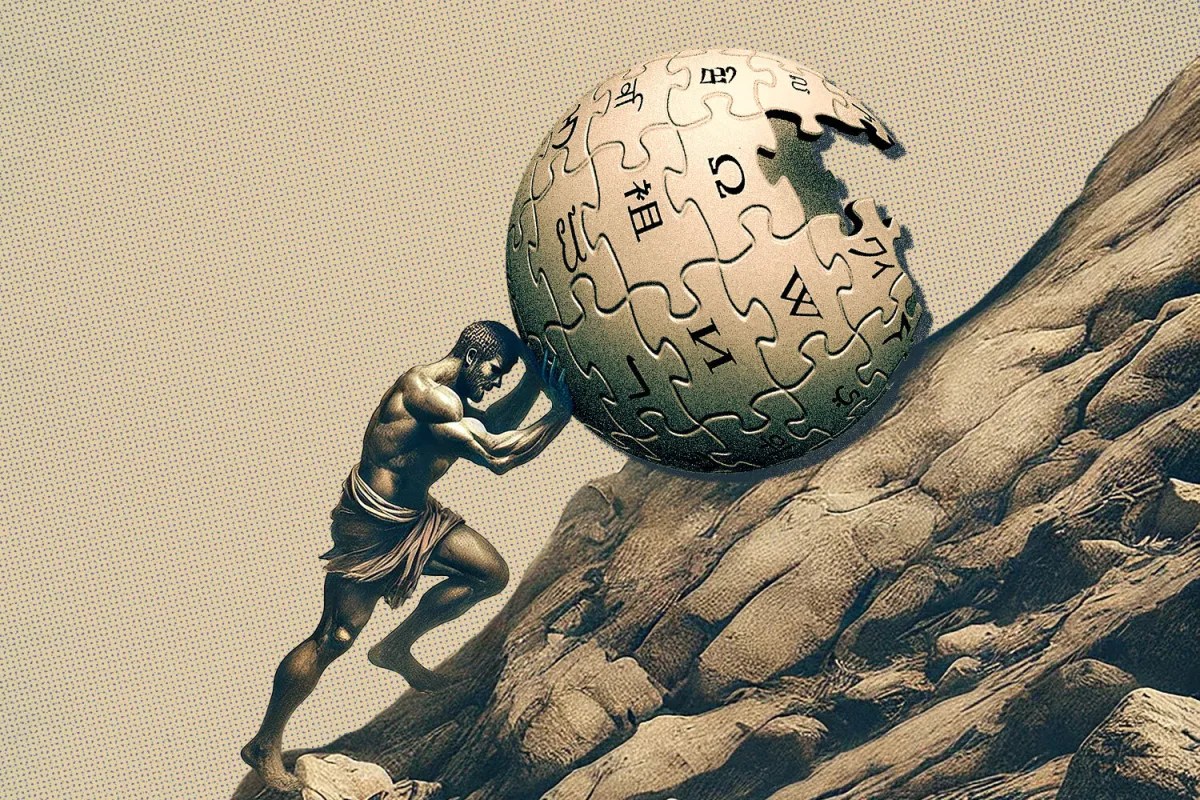
Since it was launched in 2001, Wikipedia has gone from curiosity to “bane of teachers” to cherished resource– the largest and most-read reference work in history, consistently among the top ten websites visited globally. Free and run by a network of volunteers (it’s hosted by the Wikimedia Foundation, an American nonprofit funded mainly by donations from readers), it has always been an anomaly– and has always been under some kind of threat.
Tobias Carroll of Inside Hook interviewed author, tech lawyer, and long-time student of Wikipedia Stephen Harrison on what the future might hold– is a tipping point coming?…
Has there ever been a time when Wikipedia wasn’t controversial? The long-running online encyclopedia has sparked plenty of debates since its founding in 2001, and has at various points been the subject of critiques from all across the political spectrum. It’s also an invaluable resource to millions around the world, host to a wealth of knowledge about everything from military battles to defunct sports teams.
Over the years, Stephen Harrison has written extensively about Wikipedia, including in a series of articles at Slate and his newsletter Source Notes. He’s also the author of a recent thriller, The Editors, about the international intrigue surrounding a Wikipedia-like website in the months leading up to the 2020 pandemic.
Harrison spoke with InsideHook about Wikipedia’s shifting place in internet culture, the many threats to it (including those from Elon Musk) and where he sees the encyclopedia going in the years to come…
… [Carroll] We’re now seeing people like Elon Musk targeting Wikipedia with existential criticism. What do you see as the biggest threats to Wikipedia — do you think it’s AI? Is it powerful people looking to make radical changes to how it works?
[Harrison] To some extent, it’s all of the above. I think it’s always under threat; even at the beginning they wondered if it would last and if people would keep contributing to it. There have been alternatives to it, like Conservapedia and RationalWiki and things like that, but they haven’t gotten the same traction. It’s a question of Joan Didion’s point about whether the center will hold. Hopefully Wikipedia will.
Now we have Elon Musk, who’s taken a pretty negative stance against Wikipedia. Of course, that’s very self-serving on his end because he wants people to go to his platform X, right? And he doesn’t like some of the content on his Wikipedia page, even the content that’s true about him being primarily an investor in a lot of these companies. He just doesn’t want to be couched or described as an investor because he has a certain narrative that he’s trying to put out there.
I think that there was always tension in the site. I think that to some extent people wanted to attack Wikipedia for something else, but it was very convenient to say, “Oh no, it’s all about women and minorities and underrepresented groups.” On the other hand, I want to say it does challenge some notions of what is encyclopedic. Wikipedia has kind of a small-c conservative view on topics that are notable.
The definition of notability has been repeat coverage and mainstream reliable sources, which a lot of people in underrepresented groups didn’t have for a long time. There’ll be people on Wikipedia, old-school editors, who’ll take issue with that. Editors aren’t just young guys in Silicon Valley. There are a lot of people — like the character Ed in The Editors — that have just been with the project for a long time, and they have their own views, too. They’ll say, “We’re an encyclopedia. We’re not here to try to right history’s wrongs.”
I’m not saying that it needs to get to 50-50 in terms of male and female articles. But for a long time, it was less than 10% [biographical articles about] women. Now it’s like climbing up to 20%, so it’s getting a little bit closer…
… I think the issue is that I’m increasingly finding myself asking AI applications questions that I might have initially gone to Wikipedia for. That pushes Wikipedia further into the background. Are humans going to keep contributing to Wikipedia if it’s perceived that all the information is going to ChatGPT or Perplexity or Grok?
I’ll be interested to see how Wikipedia editors overcome that. Maybe if there’s a silver lining it’s that Wikipedia editors have never been that egotistical. They’re always a little bit behind the scenes. So maybe they won’t mind their information going out to other sources as it does with Google knowledge panels or Alexa or Siri or something like that.
On the other hand, I don’t think they like the idea of it just doing free labor for tech companies. It gets to be a really tough problem: should Google or OpenAI donate more money to the Wikimedia Foundation? But you don’t want there to be any editorial control or any undue influence by Big Tech. So It’s a little bit of a mess. I think that part of it will involve requiring that these LLMs start citing or stating that this information comes from Wikipedia to give some sort of provenance to Wikipedia….
… I’ve been concerned that Wikipedia isn’t recruiting the younger generation. But then every time I’ve expressed worry about that, I find new contributors joining. I think that there’s a certain personality dimension that’s attracted to editing Wikipedia. And those people, hopefully, always find the site.
I think that there’s this political-industrial complex right now where everything is being politicized, right? And the right wing has an interest in portraying Wikipedia as left-wing and a kind of liberal media. What I would hope is that Wikipedia can withstand some of those criticisms. I don’t want only half of the readership to think about Wikipedia as a resource that can be used. But if I had to guess, I think it’s going to get worse before it gets better in terms of partisan rhetoric about Wikipedia…
As we look it up, we might recall that it was on this date in 1991 that Tim Berners-Lee showed the world the first web browser (and first WYSIWYGHTML editor), “WorldWideWeb” (the name of which was changed to “Nexus” after the debut of the World Wide Web later that year to avoid confusion between the brower and the network it was browsing).
Just over 30 years ago, my GBN partner Stewart Brand and I were discussing the then-new web affordance Pointcast, an active screensaver that displayed news and other information tailored to a user’s expressed interests and delivered live over the Internet. It was big news at the time; and while it failed, it prefigured the emergence of the algorithms that today feed “preferences” that we don’t even need (nor for that matter have the opportunity) to articlulate.
The problem, we mused, is that a system like that becomes a trap, one that (by simply satisfying expressed desires) impicitly works against discovery of the altogether new, of the thing we didn’t yet know might interest (or benefit) us. A system like that pulls us more deeply into holes instead of helping us explore broader horizons– it is biased against discovery, against learning (in its broadest sense). Our most important discoveries are often the books somewhere on the library shelp near the one we were seeking, the article in the (old print) newpaper next to the one to which we were intially drawn.
The answer, we imagined, wasn’t to skip such systems altogether; they can play a useful role; rather, it was to introduce a complementary “dial-up randomness”– to create ways to feed ourselves a stream of surprises.
[Recently] a New York-based app developer named Isaac Gemal [here] debuted a new site called WikiTok, where users can vertically swipe through an endless stream of Wikipedia article stubs in a manner similar to the interface for video-sharing app TikTok.
It’s a neat way to stumble upon interesting information randomly, learn new things, and spend spare moments of boredom without reaching for an algorithmically addictive social media app. Although to be fair, WikiTok is addictive in its own way, but without an invasive algorithm tracking you and pushing you toward the lowest-common-denominator content. It’s also thrilling because you never know what’s going to pop up next.
WikiTok, which works through mobile and desktop browsers, feeds visitors a random list of Wikipedia articles—culled from the Wikipedia API—into a vertically scrolling interface. Despite the name that hearkens to TikTok, there are currently no videos involved. Each entry is accompanied by an image pulled from the corresponding article. If you see something you like, you can tap “Read More,” and the full Wikipedia page on the topic will open in your browser.
For now, the feed is truly random, and Gemal is currently resisting calls to automatically tailor the stream of articles to the user’s interests based on what they express interest in.
“I have had plenty of people message me and even make issues on my GitHub asking for some insane crazy WikiTok algorithm,” Gemal told Ars. “And I had to put my foot down and say something along the lines that we’re already ruled by ruthless, opaque algorithms in our everyday life; why can’t we just have one little corner in the world without them?”
The breadth of topics you’ll encounter on WikiTok is staggering, owing to the wide range of knowledge that Wikipedia covers…
… Gemal posted the code for WikiTok on GitHub, so anyone can modify or contribute to the project. Right now, the web app supports 14 languages, article previews, and article sharing on both desktop and mobile browsers. New features may arrive as contributors add them. It’s based on a tech stack that includes React 18, TypeScript, Tailwind CSS, and Vite.
And so far, he is sticking to his vision of a free way to enjoy Wikipedia without being tracked and targeted. “I have no grand plans for some sort of insane monetized hyper-calculating TikTok algorithm,” Gemal told us. “It is anti-algorithmic, if anything.”
As we supersize serendipity, we might recall that it was on this date in 1967 that a remarkably warm and open new neighbor moved into the neighborhood: Misteroger’s Neighborhood premeired nationally on public television stations.
Fred McFeely Rogers was born in Latrobe, Pennsylvania on March 20, 1928. After earning his bachelor’s degree in music from Rollins College in 1951, he began working for NBC for a short time in New York. In 1953, he began working at the new public television station WQED for the show, The Children’s Corner where he learned that wearing sneakers were a lot quieter on the set than his dress shoes.
In 1961, Rogers moved to Toronto, Ontario to work on a new 15-minute show called Misterogers for CBC Television. In 1966, Rogers went back to WQED to create Misteroger’s Neighborhood.
In 1970, the show was renamed Mister Rogers’ Neighborhood. The series ended again in 1976 but was picked up three years later when Rogers felt as if his work speaking to children wasn’t done. The show continued from 1979 through 2001. Mr. Rogers passed away on February 27, 2003.
In 2011, PBS created an animated “spinoff” of the show called Daniel Tiger’s Neighborhood featuring the characters Rogers had created in his “land of make-believe”; and in 2019, Tom Hanks portrayed Rogers in the film, A Beautiful Day in the Neighborhood,” a role that earned him an Oscar nomination.







You must be logged in to post a comment.