Posts Tagged ‘threat’
“We have lived in this world where little things are done for love and big things for money. Now we have Wikipedia. Suddenly big things can be done for love.”*…
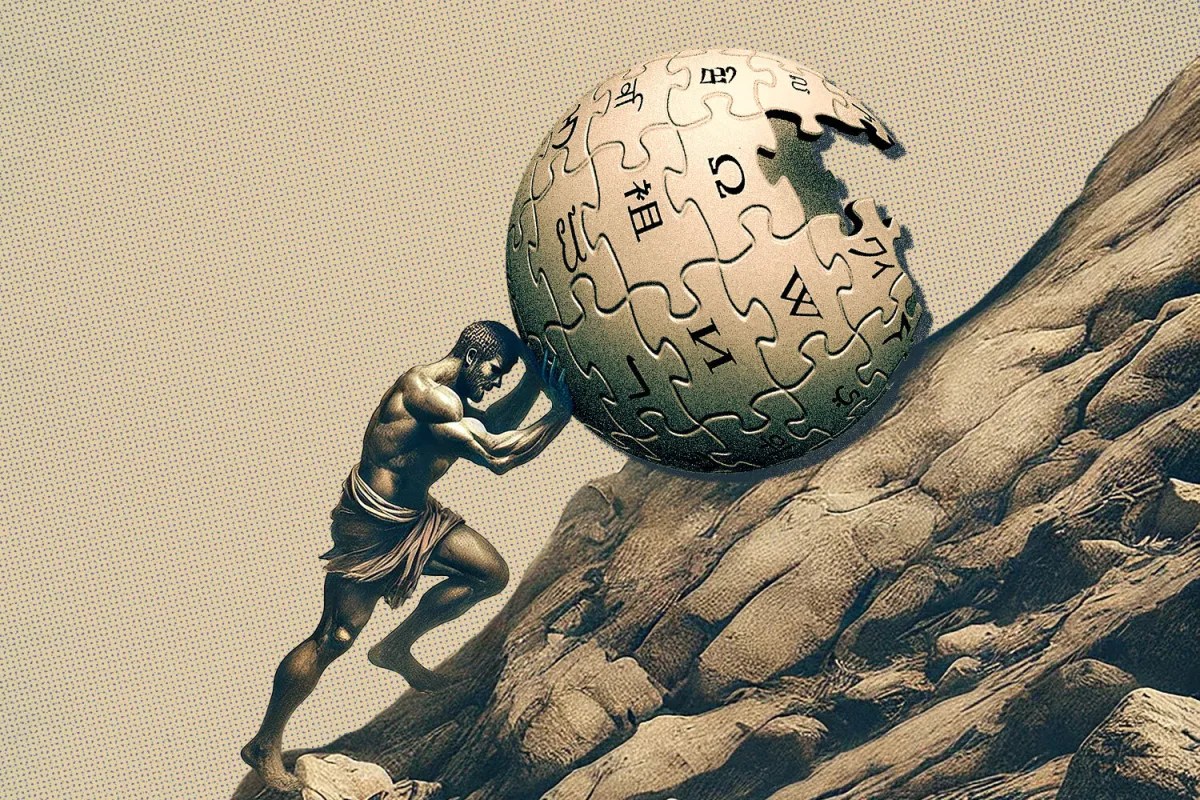
Since it was launched in 2001, Wikipedia has gone from curiosity to “bane of teachers” to cherished resource– the largest and most-read reference work in history, consistently among the top ten websites visited globally. Free and run by a network of volunteers (it’s hosted by the Wikimedia Foundation, an American nonprofit funded mainly by donations from readers), it has always been an anomaly– and has always been under some kind of threat.
Tobias Carroll of Inside Hook interviewed author, tech lawyer, and long-time student of Wikipedia Stephen Harrison on what the future might hold– is a tipping point coming?…
Has there ever been a time when Wikipedia wasn’t controversial? The long-running online encyclopedia has sparked plenty of debates since its founding in 2001, and has at various points been the subject of critiques from all across the political spectrum. It’s also an invaluable resource to millions around the world, host to a wealth of knowledge about everything from military battles to defunct sports teams.
Over the years, Stephen Harrison has written extensively about Wikipedia, including in a series of articles at Slate and his newsletter Source Notes. He’s also the author of a recent thriller, The Editors, about the international intrigue surrounding a Wikipedia-like website in the months leading up to the 2020 pandemic.
Harrison spoke with InsideHook about Wikipedia’s shifting place in internet culture, the many threats to it (including those from Elon Musk) and where he sees the encyclopedia going in the years to come…
… [Carroll] We’re now seeing people like Elon Musk targeting Wikipedia with existential criticism. What do you see as the biggest threats to Wikipedia — do you think it’s AI? Is it powerful people looking to make radical changes to how it works?
[Harrison] To some extent, it’s all of the above. I think it’s always under threat; even at the beginning they wondered if it would last and if people would keep contributing to it. There have been alternatives to it, like Conservapedia and RationalWiki and things like that, but they haven’t gotten the same traction. It’s a question of Joan Didion’s point about whether the center will hold. Hopefully Wikipedia will.
Now we have Elon Musk, who’s taken a pretty negative stance against Wikipedia. Of course, that’s very self-serving on his end because he wants people to go to his platform X, right? And he doesn’t like some of the content on his Wikipedia page, even the content that’s true about him being primarily an investor in a lot of these companies. He just doesn’t want to be couched or described as an investor because he has a certain narrative that he’s trying to put out there.
I think that there was always tension in the site. I think that to some extent people wanted to attack Wikipedia for something else, but it was very convenient to say, “Oh no, it’s all about women and minorities and underrepresented groups.” On the other hand, I want to say it does challenge some notions of what is encyclopedic. Wikipedia has kind of a small-c conservative view on topics that are notable.
The definition of notability has been repeat coverage and mainstream reliable sources, which a lot of people in underrepresented groups didn’t have for a long time. There’ll be people on Wikipedia, old-school editors, who’ll take issue with that. Editors aren’t just young guys in Silicon Valley. There are a lot of people — like the character Ed in The Editors — that have just been with the project for a long time, and they have their own views, too. They’ll say, “We’re an encyclopedia. We’re not here to try to right history’s wrongs.”I’m not saying that it needs to get to 50-50 in terms of male and female articles. But for a long time, it was less than 10% [biographical articles about] women. Now it’s like climbing up to 20%, so it’s getting a little bit closer…
… I think the issue is that I’m increasingly finding myself asking AI applications questions that I might have initially gone to Wikipedia for. That pushes Wikipedia further into the background. Are humans going to keep contributing to Wikipedia if it’s perceived that all the information is going to ChatGPT or Perplexity or Grok?
I’ll be interested to see how Wikipedia editors overcome that. Maybe if there’s a silver lining it’s that Wikipedia editors have never been that egotistical. They’re always a little bit behind the scenes. So maybe they won’t mind their information going out to other sources as it does with Google knowledge panels or Alexa or Siri or something like that.
On the other hand, I don’t think they like the idea of it just doing free labor for tech companies. It gets to be a really tough problem: should Google or OpenAI donate more money to the Wikimedia Foundation? But you don’t want there to be any editorial control or any undue influence by Big Tech. So It’s a little bit of a mess. I think that part of it will involve requiring that these LLMs start citing or stating that this information comes from Wikipedia to give some sort of provenance to Wikipedia….
… I’ve been concerned that Wikipedia isn’t recruiting the younger generation. But then every time I’ve expressed worry about that, I find new contributors joining. I think that there’s a certain personality dimension that’s attracted to editing Wikipedia. And those people, hopefully, always find the site.
I think that there’s this political-industrial complex right now where everything is being politicized, right? And the right wing has an interest in portraying Wikipedia as left-wing and a kind of liberal media. What I would hope is that Wikipedia can withstand some of those criticisms. I don’t want only half of the readership to think about Wikipedia as a resource that can be used. But if I had to guess, I think it’s going to get worse before it gets better in terms of partisan rhetoric about Wikipedia…
“How Long Can Wikipedia Hold On?” @tobiascarroll.bsky.social and @stephenharrison.com.
* Clay Shirky
###
As we look it up, we might recall that it was on this date in 1991 that Tim Berners-Lee showed the world the first web browser (and first WYSIWYG HTML editor), “WorldWideWeb” (the name of which was changed to “Nexus” after the debut of the World Wide Web later that year to avoid confusion between the brower and the network it was browsing).

“Human history seems to me to be one long story of people sweeping down—or up, I suppose—replacing other people in the process”*…

Max Roser argues that, if we keep each other safe – and protect ourselves from the risks that nature and we ourselves pose – we are only at the beginning of human history…
… The development of powerful technology gives us the chance to survive for much longer than a typical mammalian species.
Our planet might remain habitable for roughly a billion years. If we survive as long as the Earth stays habitable, and based on the scenario above, this would be a future in which 125 quadrillion children will be born. A quadrillion is a 1 followed by 15 zeros: 1,000,000,000,000,000.

A billion years is a thousand times longer than the million years depicted in this chart. Even very slow moving changes will entirely transform our planet over such a long stretch of time: a billion years is a timespan in which the world will go through several supercontinent cycles – the world’s continents will collide and drift apart repeatedly; new mountain ranges will form and then erode, the oceans we are familiar with will disappear and new ones open up…
… the future is big. If we keep each other safe the huge majority of humans who will ever live will live in the future.
And this requires us to be more careful and considerate than we currently are. Just as we look back to the heroes who achieved what we enjoy today, those who come after us will remember what we did for them. We will be the ancestors of a very large number of people. Let’s make sure we are good ancestors…
If we manage to avoid a large catastrophe, we are living at the early beginnings of human history: “The Future is Vast,” from @MaxCRoser @OurWorldInData.
* Alexander McCall Smith
###
As we take the long view, we might recall that it was on this date in 1915 that Mary Mallon, “Typhoid Mary,” was put in quarantine on North Brother Island, in New York City, where she was isolated until she died in 1938. She was the first person in the United States identified as an asymptomatic carrier of the pathogen associated with typhoid fever… before which, she first inadvertently, then knowingly spread typhoid for years while working as a cook in the New York area.
Mallon had previously been identified as a carrier (in 1905) and quarantined for three years, after which she was set free on the condition she changed her occupation and embraced good hygiene habits. But after working a lower paying job as a laundress, Mary changed her last name to Brown and returned to cooking… and over the next five years the infectious cycle returned, until she was identified and put back into quarantine.

“There will come a time when it isn’t ‘They’re spying on me through my phone’ anymore. Eventually, it will be ‘My phone is spying on me’.”*…

When to breathe easy– and when to worry…
When people worry about the impact of a new technology, often they worry it’ll set us on a path to ruin.
Sometimes they’re freaking out for no good reason. New technologies — particularly ones that affect communication, or give young people new abilities — unsettle people all the time, but don’t wreck the world. In the past, people worried that the telephone would destroy face-to-face conversation, that the portable camera would destroy all public privacy, and that pinball would turn kids into delinquents.
In each case, critics worried that the new technology would make people’s behavior a bit worse, and then that change would cause even more bad results, and on and on. We’d be on a “slippery slope” to ruin! (Indeed, cities like New York actually banned pinball for forty years — from the mid-30s to the mid-70s.)
This is why, in the worlds of philosophy and technology, “slippery slope” arguments are often regarded as kind of flimsy. Often, critics are just personally miffed by the new behaviors midwived by technology. But no social ruin is at hand.
Sometimes, though, a slippery slope is real. In the early days of the automobile, some critics feared cars would take over city streets — and that we’d get so addicted to car travel that we’d rebuild the whole country around cars. Those critics nailed it. That really did happen. The same thing goes with Facebook or other social media; some early critics (like the philosopher Ian Bogost) predicted they’d poison social and civic life. Again: Nailed it.
But how do you tell the difference? How do you know when you’re facing a technology that might lead us down a real slippery slope — versus a tech that you’re just annoyed by?…
Does a new technology pose serious dangers — or are we just overreacting? Clive Thompson (@pomeranian99) talks to philosopher Evan Selinger (@EvanSelinger) about how to tell: “How To Recognize When Tech Is Leading Us Down a ‘Slippery Slope’“
For a current warning from the aforementioned Ian Bogost (@ibogost), see “The Metaverse Is Bad.”
* the prescient Philip K. Dick
###
As we practice prudence, we might recall that it was on this date in 1861 that the first transcontinental telegram was sent from Stephen J. Field, the Chief Justice of California, to President Abraham Lincoln in Washington, DC.
In the temporary absence of the Governor of the State I am requested to send you the first message which will be transmitted over the wires of the telegraph Line which Connect the Pacific with the Atlantic States the People of California desire to Congratulate you upon the Completion of the great work.
They believe that it will be the means of strengthening the attachment which bind both the East & West to the Union & they desire in this the first message across the continent to express their loyalty to that Union & their determination to stand by the Government in this its day of trial They regard that Government with affection & will adhere to it under all fortunes

“Fortune sides with him who dares”*…

… or not:
Does hot weather actually make us hot-headed? Does a warming planet induce us to take more risks? According to new research, there is indeed a correlation: When it comes to rational decision-making, changes in climate shape how individuals think about loss and risk—even if it takes centuries for that evolution to occur…
New research finds that people living in climatically turbulent regions tend to make riskier decisions than those in relatively more stable environments. The full story at “How volatile climate shapes the way people think.”
* Virgil
###
As we feel the heat, we might recall that it was on this date in 1945 that Volume 1, Number 1 of the Bulletin of the Atomic Scientists was published. Concerned with scientific and global security issues resulting from accelerating technological advances that might have negative consequences for humanity, the group created “The Doomsday Clock” which has featured on its cover since its introduction in 1947, reflecting “basic changes in the level of continuous danger in which mankind lives in the nuclear age.”
The current “setting” is 2 minutes to midnight, reflecting the failure of world leaders to deal with looming threats of nuclear war and climate change. This is the clock’s closest approach to midnight, matching that of 1953,

The cover of the Bulletin of the Atomic Scientists has featured the famous Doomsday Clock since it debuted in 1947, when it was set at seven minutes to midnight.
“History is a vast early warning system”*…
… Still, the hazards we face at any point in time have altogether-contemporary characteristics. Happily, Anders Sandberg has ridden to the rescue a new collection of warning signs…

See them all at “Warning Signs for Tomorrow.”
* Norman Cousins
###
As we duck and cover, we might spare a thought for René Descartes, the French philosopher and mathematician who thought and therefore was; he died on this date in 1650.
Many contemporaries (perhaps most notably, Pascal) rejected his famous conclusion, the dualist separation of mind and body; more (Voltaire, et al.), since. But Descartes’ emphasis on method and analysis, his disciplined integration of philosophy and physical science, his insistence on the importance of consciousness in epistemology, and perhaps most fundamentally, his the questioning of tradition and authority had a transformative– and lasting– effect on Western thought, and has earned him the “title” of Father of Modern Philosophy.
“In order to improve the mind, we ought less to learn than to contemplate.”
– Rene Descartes

Frans Hals’ portrait of Descartes, c. 1649
You must be logged in to post a comment.