“The first to arrive is the first to succeed”*…
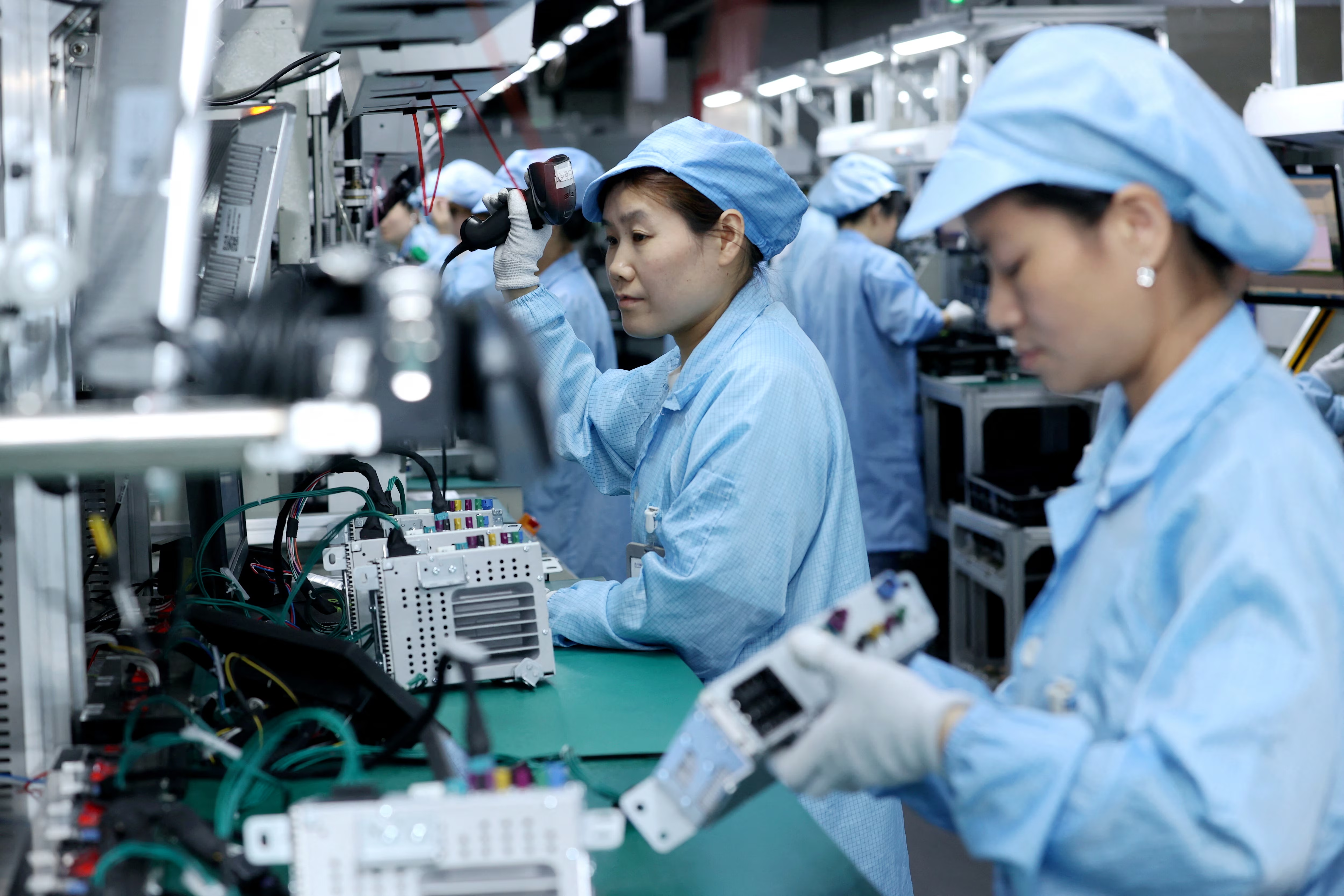
Is China “pulling up the ladder”? In his valuable newsletter, Ben Evans puts two recent news items on high-tech manufacturing into context…
… First, the FT argues that after the ‘China shock’ of cheap low-value manufacturing, there’s now a growing second China shock of high-value, high-tech manufacturing, where the same model of ferocious, Darwinian competition, backed by subsidies and cheap energy, produces a handful of very efficient and capable winners in each space, plus a lot of overcapacity, that then moves to exports. Second, Bloomberg says that Chinese export controls in those high-tech industries are crippling India’s attempt to build its own tech manufacturing base…
Gift article from the FT: “China shock 2.0: the flood of high-tech goods that will change the world“
Gift article from Bloomberg: “China’s Control Over Tech Is Threatening India’s Manufacturing Dreams“
* (先到先得) Chinese proverb
###
As we dissect the dynamics of dominance, we might recall that it was on this date in 1981 that the computer mouse became a practical, operating part of the personal computing world, when Xerox released its 1010 (Star) personal computer. The trackball, a related pointing device, had been invented in 1946 by Ralph Benjamin as part of a post-World War II-era fire-control radar plotting system called the Comprehensive Display System (CDS). Then, in the 1960s, Doug Engelbart and Bill English developed the first mouse prototype. They christened the device the mouse as early models had a cord attached to the rear part of the hand-held unit; the cord looked like a tail and made the device resemble a common mouse. (According to Roger Bates, a hardware designer under English, another reason for choosing this name was because the cursor on the screen was also referred to as “CAT” at this time.) In 1968, Engelbart premiered the pointer at what has come to be known as “The Mother of All Demos.” There followed, through the 70’s, a pair of personal computers that used a mouse (the Xerox Alto and the Lilith); but while they served as proof-of-concept, they sold only in the hundreds of units over the next several years. It was the Star that effectively brought the mouse to market… soon to be followed by Steve Jobs’ Apple Lisa, which forshadowed the Mac and the user interface that we’ve all come to know.
Apropos the articles above, computer mice are still a $2 billion business. But while they were invented and originally largely manufactured in the U.S., they are (as of 2025) mostly manufactured in Asia (68%, the lion’s share– 54%– in China); only 8% are made in the U.S.

You must be logged in to post a comment.