Posts Tagged ‘Vietnam War’
“The greatest danger in times of turbulence is not the turbulence – it is to act with yesterday’s logic”*…

Jennifer Pahlka— the founder and long-time leader of Code for America, the former US Deputy Chief Technology Officer, the author of Recoding America, and the cofounder and board chair of the Recoding America Fund— has dedicated her life to improving governance and government services. Here, she reflects on a core lesson that she has learned…
I got into government reform sixteen years ago, though I didn’t think of it as reform at the time. I thought of it as just trying to make a few specific things work better. Since then I’ve worked at the local, state, and federal levels, on benefit delivery, on national defense, on a handful of things in between. I’ve worked alongside a lot of people whose own paths in this work have run the gamut. Collectively we’ve seen a lot. I think we’ve learned a lot about what we often call the operating model of government.
But the government we have — the operating model it runs on, the rules and structures and assumptions that shape how it hires, procures, and delivers — was built for a world that no longer exists, and the distance between that world and this one is growing. We are approaching the kind of moment when that gap stops being a management problem and becomes a true legitimacy crisis. (Many will say that moment has already come.) It’s time to start asking whether the theory of change most of us have been operating under — incremental improvements off a pretty poor baseline — was ever going to get us to a government capable of meeting fast-changing needs. It hasn’t yet, and if we don’t do something differently, it won’t.
Kelly Born at the Packard Foundation recently shared with me a framework called the Three Horizons, originally developed by Anthony Hodgson and adapted widely in systems-change work. In it, Horizon 1 is the currently dominant system. It’s functional enough to persist but failing in critical ways, especially for people with less power. Horizon 3 is the future system you’re working toward, already visible in patches of practice that embody different values and different ways of working, but far from the norm. Horizon 2 is the turbulent middle where change agents work.
But the key insight is that not all Horizon 2 work is the same. Some H2 innovations genuinely create the conditions for the new system to emerge. Call those transforming H2, or H2+. Others, however inadvertently, extend the lifespan of the failing system by relieving the pressure that might otherwise force structural change. Call those sustaining H2, or H2-. Both feel like reform, but they have very different long-term implications.
H2- work is attractive because it usually produces real value in the short run. H2+ work can take a long time to pay off, and the path is rarely clear. In a stable environment, you can get away with a lot of H2-. In an environment where the underlying system has become truly untenable, the difference between the two starts to matter a great deal. I think that’s where we are now…
[Jen describes a few projects that illustrate patterns that play out over and over in the category of H2-, the work that sustains the status quo…]
… The H2- work I’m describing has been done in good faith by people. I am one of those people. Code for America, which I founded and where I spent more than a decade, is in important respects capacity substitution. USDR, which I also helped start, is as well. The healthcare.gov rescue (which I didn’t actually work on but tried to provide moral support for) was the rescue-and-rebuild cycle. For much of the past fifteen years, the H2- path was arguably the right call. When there was no political space for structural change, demonstrations were a good way to build the evidence base and develop the field.
I think we are in a different moment now. This moment is defined by disruption. I count three kinds.
Contingent disruption — pandemics, climate events, geopolitical shocks, financial crises — is unpredictable in its specifics but very predictable in its category: large, fast-moving, high-stakes demands that fall disproportionately on government. COVID was not an anomaly. The next version won’t look the same.
The most recent disruption to federal government, however, was political. Whatever the cost of its methods, DOGE made the brittleness of the current operating model impossible to ignore and created political openings for structural arguments that previously had no traction. The reform field did not create this moment. But it can shape what comes out of it.
AI brings structural disruption. This is a transformation already underway in the material conditions of work, economy, and administration. AI creates dramatic change in both the needs and conditions government must respond to and the ways in which it can respond at the same time. Yes, I certainly mean a social safety net not nearly fit to handle the levels of unemployment that are likely coming our way, and yes, I mean possible upsets in the balance of power between agencies and the vendors they rely on, but that’s barely scratching the surface.
AI is not only an exogenous shock that government will have to absorb. It is also moving the bar on what counts as acceptable service in the first place. People are already using AI to understand their medical bills, navigate insurance denials, and draft appeals for benefits they were wrongly denied. Soon they will expect to apply for SNAP or file their taxes by uploading a paystub and answering a few plain-language questions, not by filling out even the best-designed web form. The forty-page PDF used to feel intolerable. The well-designed web form will start to feel that way too, and faster than the last transition did.
And service delivery is only the most visible piece. The same expectation shift is going to hit regulation, permitting, enforcement, how quickly an agency can respond to a new problem, how a legislature decides whether a law is working. If a small team with the right tools can map a regulatory regime in a week, the timelines we have now, in which rulemaking takes several years–or even multiple presidential terms–become indefensible. If an advocate can stress-test a policy against thousands of edge cases before it gets enacted, the standard for what counts as due diligence in lawmaking starts to move. The bar is rising on the whole surface of what government does, not just on the forms people fill out.
Not everyone wants this shift to happen. Public sector unions have secured laws in several states forbidding the use of AI in service delivery, won contracts requiring union consent before autonomous vehicles can operate, and pushed legislation mandating staffing levels that the work no longer requires — as my colleagues Robert Gordon and Nick Bagley have documented. The concern for workers caught in this transition is legitimate. But blocking government’s transformation while the world around it moves on is not a strategy for protecting those workers. It exacerbates public frustration with government, weakens the case for investing in it, and leaves the people who most depend on public services with a system increasingly unfit to serve them.
So the gap we have been measuring, between what government delivers and what the public considers a basic level of competence, is widening from both ends at once. The system is straining to clear the old bar at the same moment the bar is rising.
In this environment, the benefits systems that struggled to scale during COVID will be asked to scale again. The regulatory processes that can’t move quickly will be asked to respond to developments they weren’t designed to anticipate. The civil service system that can’t attract the people it needs now will need to attract people with skills that didn’t exist a decade ago.
If I had to pick, it’s AI that drives this disruptive moment. But I don’t have to pick. You could just as easily imagine climate shocks, or the next pandemic, or an escalation of the current war. Truly, some combination of all the above is not that unlikely. Reasonable people may disagree about the size and shape of the disruption AI will bring, but betting against disruption generally seems deeply unwise at the moment.
If you buy that argument, then we must acknowledge that a reform field largely dedicated to H2- work is not what the moment calls for. In a stable environment, H2- work that buys time for a failing system might be much-needed, and might be a missed opportunity for transformation. In an environment where disruptions of all kinds are accelerating, it becomes a compounding liability. Extending the lifespan of a brittle system just means the system eventually fails more spectacularly. More people get hurt. More people look for alternatives to democracy.
That doesn’t mean we need to throw everything out and start over. For the reform ecosystem, it means existing actors need incentives to align their work toward structural transformation, new actors with adjacent expertise need to be welcomed into the fold (especially advocates and lobbyists, given how little influence muscle the field has today), and connections need to be made both upstream and downstream of where we’ve been focused. It means articulating competing H3 visions from a wide range of ideological and practical perspectives and debating them among, including the project that sparked this line of thinking, which Kelly funded and FAI and New America are currently working on. It means designing funding and partnership structures that reward structural ambition while staying grounded in meaningful near-term progress. Funders and grantees share responsibility for creating the conditions under which a diverse set of actors can aim higher by working together, and connecting the dots upstream.
For this to work, it can’t be a zero sum game. Government capacity is wildly neglected in philanthropy despite its high leverage. (Good luck naming an issue philanthropists care about that doesn’t benefit from increased government capacity.) Could the field stop doing some H2- work? Sure. That would free up some existing resources for more H2+ work, which has been too little of the field’s mindshare and resources to date. But that is not the path forward — it wouldn’t get us where we need to be. We need more resources, full stop. We need to make the case to philanthropy for greater investment in the entire field (that’s part of what Recoding America Fund is trying to do) and make the case to government leaders, including electeds, to invest in better plumbing, so that the investment in H2+ work isn’t coming at the expense of the essential life support…
[Jen outlines some of the key principles that animate H2+ efforts, then ponders “doing different things differently”…]
… I realized early last year that while I’d spent the bulk of my career trying to drag government into the Internet Era, that work has to change now. We are entering a new era, and if those of us who fought the last fight don’t adapt to the conditions and expectations of this one, we’ll make exactly the mistake the people who resisted internet-era ways of working made. We’ll become the blockers — the ones holding on to old ways of working because that is what we are used to and that is what we are good at.
None of which means rescue work should stop, or that demonstrations are worthless, or that capacity substitution isn’t helpful and needed. Some H2- work, done deliberately and named honestly, is best understood as experimentation: we’re running it inside the failing system precisely because that’s where we’ll learn what a new operating model has to do. That’s a different kind of work from rescue that produces learning incidentally, but both can be valuable.
But the field needs a shared frame clear-eyed enough to ask, with each investment: does this move the system toward H3, or does it prolong H1? That question should be driving how resources, talent, and attention get allocated now, not because the prior work was mistaken but because the moment is different and the cost of extending the status quo is too high. There will have to be work that sustains the status quo, but what tradeoffs are we willing to make?
But insisting we ask the question does not mean that answering it is easy: there is no objective set of criteria that distinguishes one from the other. What may look like H2+ to some may seem like H2- to others, and part of that depends on your particular vision of that third horizon (more on that in the coming weeks.) Some may see work as contributing to a transformation, and therefore H2+, but towards an undesired H3 state. Grappling with how to answer this question is work we all need to be doing…
… Some things haven’t changed. The community is still full of good, smart people with enormous insight into a very difficult problem. We’ve just run out of time to do it the way we’ve been doing it. A brittle system that gets propped up through manageable shocks will eventually meet a shock it can’t survive, and we are moving into a period where the shocks are neither manageable nor hypothetical. Every H2- intervention that returns the system to “good enough” is now a bet that good enough will hold. It’s a bet I no longer think we can afford to make.
The window for H2+ work has not been open like this before. It will not stay open indefinitely.
Eminently worth reading in full.
What DOGE coulda, shoulda been: “A Three Horizons Framework for Government Reform,” from @pahlkadot.bsky.social.
* Peter Drucker
###
As we face forward, we might recall that it was on this date in 1970 that President Richard Nixon formally authorized the commitment of U.S. combat troops, in cooperation with South Vietnamese units, against North Vietnamese troop sanctuaries in Cambodia.
Secretary of State William Rogers and Secretary of Defense Melvin Laird, who had continually argued for a downsizing of the U.S. effort in Vietnam, were excluded from the decision to use U.S. troops in Cambodia. Gen. Earle Wheeler, Chairman of the Joint Chiefs of Staff, cabled Gen. Creighton Abrams, senior U.S. commander in Saigon, informing him of the decision that a “higher authority has authorized certain military actions to protect U.S. forces operating in South Vietnam.” Nixon believed that the operation was necessary as a pre-emptive strike to forestall North Vietnamese attacks from Cambodia into South Vietnam as the U.S. forces withdrew and the South Vietnamese assumed more responsibility for the fighting. Nevertheless, three National Security Council staff members and key aides to presidential assistant Henry Kissinger resigned in protest over what amounted to an invasion of Cambodia.
When Nixon publicly announced the Cambodian incursion on April 30, it set off a wave of antiwar demonstrations. A May 4, protest at Kent State University resulted in the killing of four students by Army National Guard troops. Another student rally at Jackson State College in Mississippi resulted in the death of two students and 12 wounded when police opened fire on a women’s dormitory. The incursion angered many in Congress, who felt that Nixon was illegally widening the war; this resulted in a series of congressional resolutions and legislative initiatives that would severely limit the executive power of the president.
– source

“I still believe that if your aim is to change the world, journalism is a more immediate short-term weapon”*…

In the most recent issue of his “No Mercy/No Malice” newsletter, “The Podcast Election,” Scott Galloway makes the case that “in each election the victor is likely to be whoever best weaponizes an emerging medium.” John Grinspan (curator of political history at the Smithsonian Institution) offers a timely historical example: Long before anyone was accused of being “woke,” the Wide Awakes used new news technology to rapidly construct a national movement…
… when I discuss the deep history of political division in our country, someone in the audience always asserts that we can’t possibly compare past divisions to the present, because our media landscape is doing unprecedented harm, unlike anything seen in the past.
I’m always struck by people’s belief in a placid media landscape in the past, a time of calm before the internet blew everything up. In fact, the most divided period in the history of U.S. democracy — the mid-1800s — coincided with a sudden boom in new communications technologies, confrontational political influencers, widespread disinformation, and nasty fights over free speech. This media landscape helped bring about the Civil War.
The point is not that 21st century media is like the 19th century’s, but that the past was hardly full of the upstanding, rational, nonpartisan journalists many like to believe it was. And at this era’s center, in the campaign that actually led to the war, was a huge, strange, forgotten movement — the Wide Awakes — born from this media landscape and fought out in the newspapers, polling places and, ultimately, battlefields of the nation.
Newspapers had been around for centuries by the 1800s, but as American rates of literacy rose, millions of ordinary citizens became daily news junkies. The number of papers jumped from a few publications in 1800 to 4,000 brawling rags by 1860, collectively printing hundreds of millions of pages each year. They ranged from the snarky, immensely popular New York Herald and the blood-drenched true crime reports in the National Police Gazette to the high-minded abolitionism of The Liberator.
Nearly everyone literate devoured them — from wealthy elites to schoolgirls to enslaved people technically banned from reading. Newspapers published scandals and rumors, riling mobs and sparking frequent attacks on editors — often by other editors. Well into the 20th century, communities were still pulling newspaper presses out of local rivers, having been hurled there by angry mobs.
Ninety-five percent of American newspapers had explicit political affiliations. Many were directly bankrolled by political parties. There was no concept of journalistic independence and nonpartisanship until the turn of the 20th century.
These partisan presses, not the government, even printed the election ballots. Readers voted by cutting ballots from their pages and bringing them to the polls. (Imagine if TikTok influencers or podcasters were responsible for administering elections.)
The telegraph may seem old-timey today, but with its introduction in the 1840s, Americans could suddenly disseminate breaking news across huge territories along electrical wires. It allowed people to argue the issues nationwide, long before the internet, television, or even radio.
Americans became a people by arguing politics in the press. When politics was local, the major parties had avoided discussing slavery, taking what Abraham Lincoln mocked as a “don’t care” attitude. But now that Maine could debate with Texas, the topic shot to the forefront. By the 1850s, Northerners were digesting its evils daily.
The National Era — an abolitionist paper in Washington — first printed Harriet Beecher Stowe’s hair-raising Uncle Tom’s Cabin, by far the most influential antislavery novel in history. Meanwhile, the radical pro-slavery magazine De Bow’s Review, based in New Orleans, spread a maximalist vision of expanding slavery far and wide. Americans living thousands of miles from each other could argue about the issue, and the only gatekeepers were editors who profited from spreading often legitimate outrage.
It’s fitting, then, that the Northern pushback to slavery’s expansion came from the 19th-century equivalent of “very online” young newspaper readers. Early in the 1860 election, a core of young clerks in Connecticut formed a club to help campaign for the antislavery Republican Party. They happened to live in the state with the highest literacy rates and huge newspaper circulations. So when a local editor wrote that the Republicans seemed “wide awake” in the campaign, the boys named their club the Wide Awakes.
Adding militaristic uniforms, torch-lit midnight rallies, and an open eye as their all-seeing symbol, a new movement was born, which I chronicle in my recent book, Wide Awake: The Forgotten Force that Elected Lincoln and Spurred the Civil War. Often, their chief issue was not the knotty specifics of what to do about slavery, but the fight for a “Free Press” — unsuppressed by supporters of slavery, South or North.
The Wide Awakes exploded across the national newspaper network. Within months of their founding, young Republicans were forming clubs from Connecticut to California. Most learned how to organize their companies through the papers. They built a reciprocal relationship with America’s press: cheering friendly newspaper offices and harassing pro-slavery Democratic papers’ headquarters. Friendly editors returned the favor, marching with the Wide Awakes and pushing their readers to form more clubs, like the Indiana newspaperman who nudged: “Cannot such an organization be gotten up in this town?”
None of this could be described as independent journalism, but it sure spread a movement. It only took a few months to turn the Wide Awakes into one of the largest partisan movements America had ever seen, believed to have 500,000 members — the equivalent of 5 million today, proportionally speaking.
The same network of newspapers spread fear as well. Readers in much of the South saw the clubs as a partisan paramilitary organization. Wild accounts shared accidental misinformation and deliberate disinformation, pushing the false notion that the Wide Awakes were preparing for a war, not an election. The presence of a few hundred African American Wide Awakes in Boston morphed into claims in Mississippi that “the Wide Awakes are composed mainly of Negroes” who were plotting a race war. A dispersed, partisan media exaggerated such falsehoods like a national game of telephone.
By the time Lincoln won election in November 1860, hysterical editors predicted a Wide Awake attack on the South. Secessionist newspapers used fears of Wide Awakes to help push states out of the Union…
… What began in ink was spiraling into lead and steel. It took 16 years to develop from the introduction of the telegraph to the Civil War. Undoubtedly, the fight over slavery caused that conflict, but the newspapers fed it, amplified it, exaggerated it.
Mid-19th-century Americans lived with an odd combination: an unprecedented ability to spread information, but also a siloed and partisan system of interpreting it. It helped the nation finally reckon with the crimes of slavery, but also spread bad faith, irrational panic, and outright lies. This history can add a needed perspective to today’s political conflicts, so often magnified by social media. In both eras, new technologies supercharged existing political tensions. Yet we can also see from this heated history that political media is less like an unstoppable, unreformable force that will consume democracy, and more like another in a succession of breathtaking, catastrophic, wild new landscapes that must be tamed…
Perspective from our past: “How a 19th-century news revolution sparked activists, influencers, disinformation, and the Civil War,” from @NiemanLab.
Apposite: the Galloway piece referenced above and “The TikTok Electorate” from Max Read… and more fundamentally, “Are Americans too ignorant and gullible to self-govern?” a consideration of a century-old debate between Walter Lippmann and John Dewey, from the estimable Howard Rheingold.
* Tom Stoppard
###
As we muse on media, we might recall that it was on this date in 1969 that journalist Seymour Hersh submitted the story that (the following day) broke the news of the My Lai massacre to the American public. At least 347 (up to 504) Vietnamese civilians, almost all women, children, and elderly men, were murdered by U.S. soldiers, the largest massacre of civilians by U.S. forces in the 20th century.
Hersh had tried the day before to place a cautious and conservative piece but was initially rejected by Life and Look magazines. He turned to his friend David Obst, who ran the anti-war Dispatch News Service and who placed a more candid version in 35 papers (including the Washington Post and the Boston Globe); it ran in those papers the following day. Initial reaction was muted, as the press was focused on a massive anti-war demonstration in Washington scheduled for November 15. But the story spread, prompting global outrage and fueling domestic opposition to U.S. involvement in the Vietnam War. Hersh’s coverage of the atrocity earned him the 1970 Pulitzer Prize for International Reporting.

“If all else fails, there’s always print or web zines”*…

Gabriela Riccardi, with a history of– and an homage to– the zine…
After Martin Luther furiously (supposedly) hammered his 95 Theses to a local church door in the 16th century, chroniclers of history saw his act as plenty of things: a righteous rally against Catholic excess, a call to arms for renewed values, a firing shot for one ripper of a Reformation.
Others, though, saw it as the world’s first zine.
The zine — that unruly riff on the glossy magazine, often handmade and always self-published — has long been associated with revolution. DIY dabblers and political thought guerrillas, superfan scenesters and couriers of counterculture have all found a home in the humble zine.
Maybe that’s because a zine’s proposition — permission self-granted, gates unkept — is a boon companion to those who operate outside of the mainstream. Or maybe it’s just because they’re a lot of fun to make.
In any case, these exuberant little publications have something big to say: Small presses, indeed, can turn over heavy pages of history….
An appreciation of handcrafted publishing: “Zines: Scan and release,” from @griccardi_ in @qz.
See also: “Zines, the Punks of Print Media: A Creative Rebellion in Branding and Design” (source of the image above)
* Rudy Rucker
###
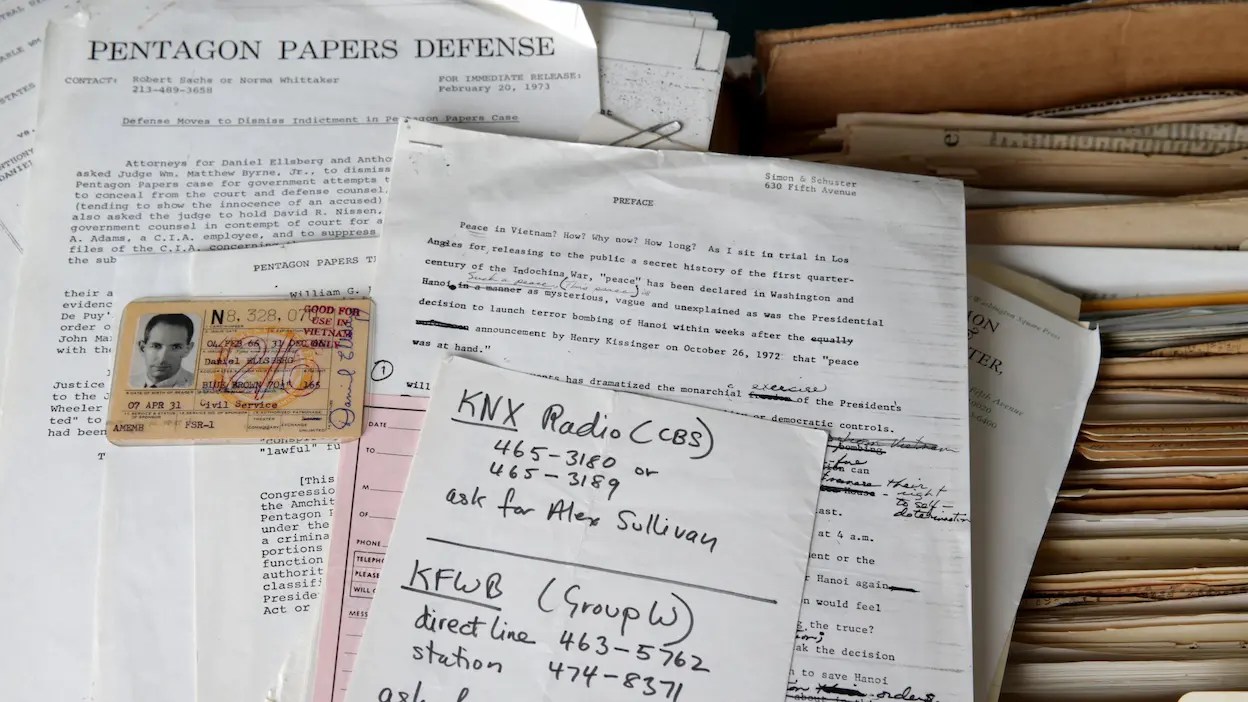
As we do it ourselves, we might recall that this date in 1972 was a milestone in (a different kind of) guerilla publishing: the New York Times begin publishing the “Pentagon Papers”…
… the 47-volume Pentagon analysis of how the U.S. commitment in Southeast Asia grew over a period of three decades. Daniel Ellsberg, a former Defense Department analyst who had become an antiwar activist, had stolen the documents. After unsuccessfully offering the documents to prominent opponents of the war in the U.S. Senate, Ellsberg gave them to the Times.
Officially called The History of the U.S. Decision Making Process on Vietnam, the “Pentagon Papers” disclosed closely guarded communiques, recommendations, and decisions concerning the U.S. military role in Vietnam during the Kennedy and Johnson administrations, along with the diplomatic phase in the Eisenhower years. The publication of the papers created a nationwide furor, with congressional and diplomatic reverberations as all branches of the government debated over what constituted “classified” material and how much should be made public.
The publication of the documents precipitated a crucial legal battle over “the people’s right to know,” and led to an extraordinary session of the U.S. Supreme Court to settle the issue. Although the documents were from the Kennedy and Johnson administrations, President Richard Nixon opposed their publication, both to protect the sources in highly classified appendices, and to prevent further erosion of public support for the war. On June 30, the Supreme Court ruled that the Times had the right to publish the material.
The publication of the “Pentagon Papers,” along with previous suspected disclosures of classified information to the press, led to the creation of a White House unit to plug information leaks to journalists. The illegal activities of the unit, known as the “Plumbers,” and their subsequent cover-up, became known collectively as the Watergate scandal, which resulted in President Nixon’s resignation in August 1974…
“Just as none of us is outside or beyond geography, none of us is completely free from the struggle over geography”*…

There are lessons to be learned from history. Noah Smith cautions us to be sure that we’re learning the right ones…
… 2022 saw authoritarian powers suddenly on the back foot. Russia’s invasion of Ukraine was a military and geopolitical disaster, and Xi’s economic mismanagement brought China’s growth to a momentary halt. Meanwhile, the U.S. started looking a bit more politically stable and started to take action to preserve its remaining industrial advantages, Asian democracies like Japan and the fast-growing India continued to flex their muscle, and Europe seemed more united than it had in…well, ever. All of this naturally had some people in the West optimistic that Cold War 2 would ultimately end much like World War 2 and the first Cold War.
Unfortunately, early optimism can easily give way to complacency and cockiness. We’re still in the opening moves of Cold War 2, and the minor victories of 2022 are likely to revert to the mean. 2023 is already shaping up to be a year in which the authoritarian powers recalibrate their strategy and find their footing.
…
Americans need to realize that Cold War 2 is fundamentally unlike Cold War 1 or World War 2. Those 20th century contests were ideological battles, where people fought and died for communism, fascism, and liberal democracy. But China is not an ideological, proselytizing power; its ideology, basically, is just “China.” Xi Jinping doesn’t care whether you have elections and protect civil rights or send minorities to the death camps, as long as you support Chinese hegemony abroad.
Cold War 2 is therefore a bit more like World War 1 — a naked contest of national power and interests. And if the U.S. tries to turn it into an ideological battle, it could backfire…
A provocative argument that we shouldn’t make too much of what are only the opening moves in “Cold War 2”: “2023 is when the empires strike back,” from @Noahpinion.
* Edward Said
###
As we grapple with geopolitics, we might recall that it was on this date in 1975 that South Vietnamese forces withdrew from the town of Xuan Loc in the last major battle of the Vietnam War. The North Vietnamese victory there occasioned the resignation of South Vietnamese President Nguyễn Văn Thiệu, who was replaced by Trần Văn Hương, who was ordered by the National Assembly to seek a negotiated peace with North Vietnam at any cost.

“Those who are easily shocked should be shocked more often”*…

Interior of the Bodleian Library in Oxford, by David Loggan, 1675. Rijksmuseum.
In the nineteenth century some librarians became preoccupied with the morality or lack thereof displayed in some of their texts. Consequently a number of libraries created special shelf marks or locations for restricted books to ensure that only readers with a proper academic purpose might access them…
Take a tour of the restricted collections in remarkable libraries: “Do Not Read.”
* Mae West
###
As we cover our eyes, we might consider censorship’s close cousin, misinformation: it was on this date in 1964 that Congress passed the Gulf of Tonkin Resolution. A response to a reported attack by the North Vietnamese Navy on the destroyer USS Maddox in the Gulf of Tonkin, the Resolution gave President Lyndon B. Johnson authorization, without a formal declaration of war by Congress, for the use of conventional military force in Southeast Asia– a right that Johnson exercised vigorously.
In 1967, A senate Foreign Relations Committee investigation determined that the incident had not unfolded as earlier reported, and repealed the Resolution. An NSA study of the incident, declassified in 2005, put it bluntly: “It is not simply that there is a different story as to what happened; it is that no attack happened that night.”

You must be logged in to post a comment.