Posts Tagged ‘authoritarian’
“…When fascism comes to the United States it will be wrapped in the American flag and will claim the name of 100-percent Americanism”*…
Sinclair Lewis sent up a warning flare in 1935. 90 years later, Richard Ovenden (Oxford’s librarian and author of the important– and terrific— Burning the Books: A History of Knowledge Under Attack) smells smoke…
In the space of three short months, the Archivist of the United States, Colleen Shogan, and the Librarian of Congress, Carla Hayden, have both been fired by the Trump administration. Both of these institutions have suffered setbacks before, and have come back stronger. One of the most severe attacks came at the hands of the British. In 1814 a British expeditionary force besieged Washington and set fire to the Capitol building. Officials had already recognised the threat and commandeered every cart they could find to move the National Archives outside the city.
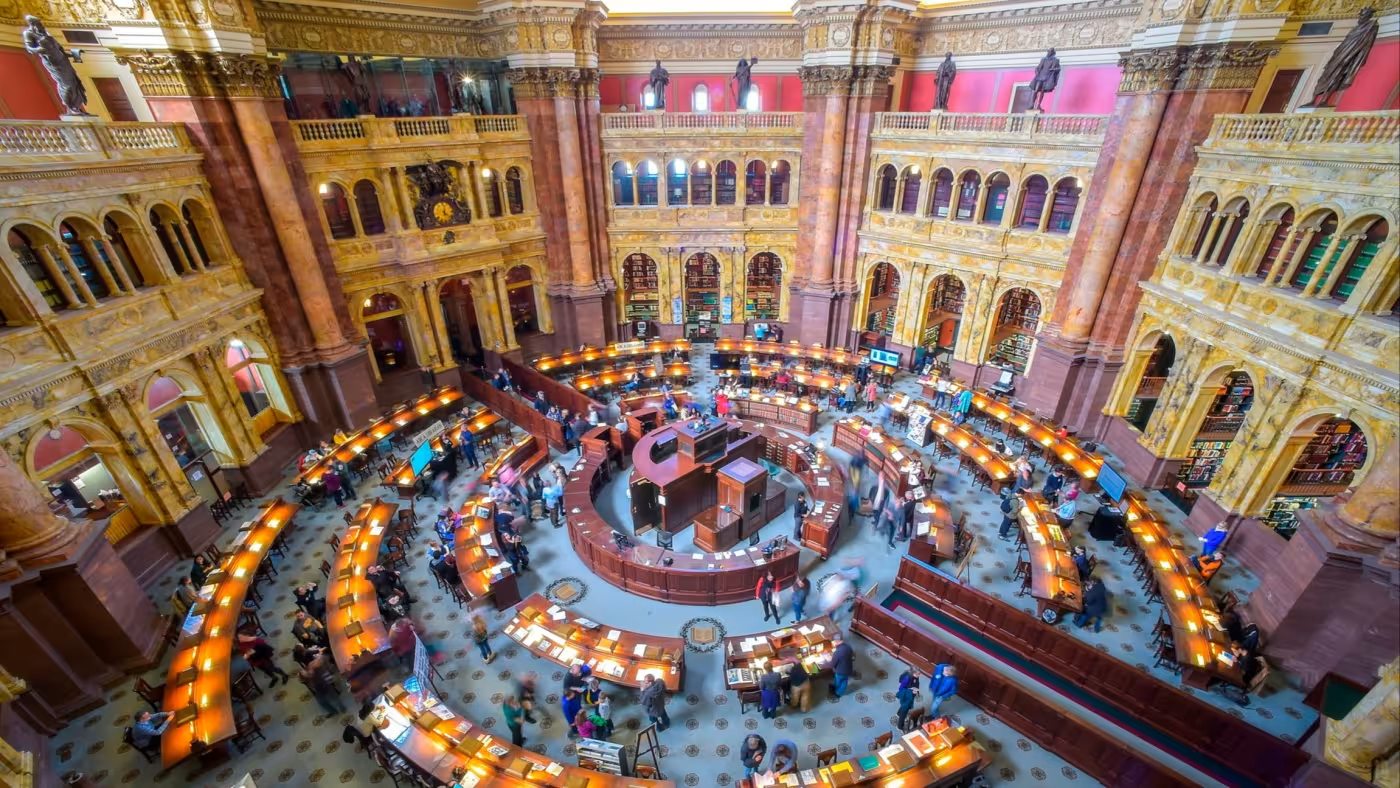
The Capitol building also housed the Library of Congress, and its 3,000 volumes of highly combustible material could not be moved so quickly. The volumes were ignited by British troops. The whole building, and much of the city, was consumed by flames.
News of the destruction of the library reached Thomas Jefferson, whose presidency had ended five years before. In a letter published in a Washington newspaper, he expressed his outrage at the “barbarism” of the British, and offered to make good the losses from his own private library. Congress purchased 7,000 volumes from the former president; with Jefferson’s books, the Library was reborn.
The Library of Congress serves two functions simultaneously. It is both the national library and the library of the legislature. It is as if the British Library was the same organisation as the libraries of the House of Commons and the House of Lords. The irony of course is that unlike its predecessor in 1814, the 119th US Congress has done nothing to protect its own library.
Trump’s press secretary, Karoline Leavitt, stated in a press briefing that Hayden had been dismissed because the Library had been providing “inappropriate books for children”. It was another senior Trump aide, Kellyanne Conway, who in 2017 introduced the world to the notion that there could be “alternative facts”. This reason for firing Hayden — who has, since 2016, greatly strengthened the institution she inherited — is another “alternative fact”.
The Library of Congress is a reference-only research library and has no lending library for children or adults, its collections being built through legal deposit legislation, passed by Congress in 1909 and updated as recently as 2016.
Shogan was dismissed as Archivist of the United States and replaced by Marco Rubio — who clearly has so much free time alongside his dual role as Secretary of State and national security adviser that he can also run the world’s largest National Archives.
One role that archives play is to preserve documents for legal and evidential reasons. After his last presidency, Trump’s illegal removal of classified documents, stored in a guest bathroom at Mar-a-Lago, resulted in their eventual retrieval by the National Archives under the provisions of the Presidential Records Act.
The removal of Hayden and Shogan demonstrates the exercise of arbitrary power, asserting control over knowledge. Both are the first women to lead their respective institutions, and both committed to reaching all parts of the nation they were appointed to serve. If the ideologically motivated censorship of collections and the recent mass deletion of government websites is anything to go by, the Trump administration is intent on removing swaths of knowledge from public circulation.
In a famous letter of 1813, Thomas Jefferson compared the spread of ideas to the way one candle is lit from another: “He who receives an idea from me”, he wrote, “receives instruction without lessening mine; as he who lights his taper at mine, receives light without darkening me”. Instead of Trump lighting the candles of knowledge in the US today, they are being systematically snuffed out…
An institution that survived British torching in 1814 is now facing a new onslaught: “The US Library of Congress is under attack,” from @richove.bsky.social in @financialtimes.com.
For more on why the attack on the LoC (and the Archive): “Trump Is Trying to Take Control of Congress Through Its Library“- “admin is trying to take over the Library of Congress, ‘a major component of the legislative branch” that confidentially advises lawmakers’.”
And related: “Chaos At The Copyright Office: Trump’s Firing Of Register Shira Perlmutter Came After AI Report’s Release, Leaving Industry Wondering What’s Next“- “speculation about the role that a long-awaited report on [on the use of copyrighted materials to train generative AI models] may have played in his action.”
Apposite, Human Smoke by Nicholson Baker: as Hamilton Nolan explains:
… a history of the years leading up to World War 2. The entire book takes the form of short, stylized, factual items of a few paragraphs or less, presented in chronological order, which taken together tell the story of societies sliding—often unwittingly—into very dark places.
While reading the book, I found over and over again that certain entries would vividly remind me of things happening today. The experience was so vivid that I decided to present a few of them to you here—first, Baker’s entry in his book, and then the modern thing that it made me think of. I make no sweeping claims that one thing is just like the other, or that this time is equivalent to that time. I’m only a curious reader, not a professional historian. I make no sweeping claims at all. It’s just interesting. “History doesn’t repeat itself,” Mark Twain said, “but it often rhymes.”…
And per William Faulkner (“”The past is never dead. It’s not even past”)…

* Sinclair Lewis
###
As we listen carfully for echoes, we might celebrate International Museum Day.

“Just as none of us is outside or beyond geography, none of us is completely free from the struggle over geography”*…

There are lessons to be learned from history. Noah Smith cautions us to be sure that we’re learning the right ones…
… 2022 saw authoritarian powers suddenly on the back foot. Russia’s invasion of Ukraine was a military and geopolitical disaster, and Xi’s economic mismanagement brought China’s growth to a momentary halt. Meanwhile, the U.S. started looking a bit more politically stable and started to take action to preserve its remaining industrial advantages, Asian democracies like Japan and the fast-growing India continued to flex their muscle, and Europe seemed more united than it had in…well, ever. All of this naturally had some people in the West optimistic that Cold War 2 would ultimately end much like World War 2 and the first Cold War.
Unfortunately, early optimism can easily give way to complacency and cockiness. We’re still in the opening moves of Cold War 2, and the minor victories of 2022 are likely to revert to the mean. 2023 is already shaping up to be a year in which the authoritarian powers recalibrate their strategy and find their footing.
…
Americans need to realize that Cold War 2 is fundamentally unlike Cold War 1 or World War 2. Those 20th century contests were ideological battles, where people fought and died for communism, fascism, and liberal democracy. But China is not an ideological, proselytizing power; its ideology, basically, is just “China.” Xi Jinping doesn’t care whether you have elections and protect civil rights or send minorities to the death camps, as long as you support Chinese hegemony abroad.
Cold War 2 is therefore a bit more like World War 1 — a naked contest of national power and interests. And if the U.S. tries to turn it into an ideological battle, it could backfire…
A provocative argument that we shouldn’t make too much of what are only the opening moves in “Cold War 2”: “2023 is when the empires strike back,” from @Noahpinion.
* Edward Said
###
As we grapple with geopolitics, we might recall that it was on this date in 1975 that South Vietnamese forces withdrew from the town of Xuan Loc in the last major battle of the Vietnam War. The North Vietnamese victory there occasioned the resignation of South Vietnamese President Nguyễn Văn Thiệu, who was replaced by Trần Văn Hương, who was ordered by the National Assembly to seek a negotiated peace with North Vietnam at any cost.

“Darkness cannot drive out darkness, only light can do that”*…

Noah Smith‘s sobering reflection on the rise of authoritarianism and illiberalism…
[This week] is the 20-year anniversary of the U.S. invasion of Iraq — a multi-decade debacle that would see hundreds of thousands of innocents killed, trillions of dollars flushed down the drain, America’s image in the Middle East destroyed, and the acceleration of the end of U.S. hegemony.
[This week] is also the [time] of the summit between Xi Jinping and Vladimir Putin, in which the leaders of the two authoritarian great powers reiterate their de facto alliance. With one of those powers actively engaged in a war of conquest against a peaceful neighbor, and the other threatening to do the same, the world is in danger of plunging back into the horrors of the early 20th century.
So this is the perfect [time] to repost a fairly melodramatic post that I wrote two years ago, about the rise of authoritarianism and illiberalism. I don’t apologize for the over-the-top language, since I think it’s difficult to overstate the danger; we humans have a strong tendency to stick our heads in the sand until it’s too late, and we need to wake up.
But we also need to remember a crucial piece of this story: It was American folly that began this baleful trend. Our victories in World War 2 and Cold War 1 gave the U.S. the unique opportunity to build a world where countries don’t invade other countries; when we invaded Iraq without cause or provocation, we threw away that opportunity. We brought back the principle of “the strong do what they can, and the weak suffer what they must”. We opened the gates, and allowed the Darkness back into our world. Now it’s our responsibility to help fix what we broke…
Illiberalism is on the march, all over the world- thoughts on what’s happening, why, and what we can do about it: “The Darkness,” from @Noahpinion. Eminently worth reading in full.
* Martin Luther King Jr.
###
As we face the future, we might recall that it was on this date in 1933 that Germany opened its first concentration camp, Dachau. Initially intended to intern Hitler’s political opponents (communists, social democrats, and other dissidents), it’s “mission” was enlarged to include forced labor, and, eventually, the imprisonment of Jews, Romani, German and Austrian criminals, and, finally, foreign nationals from countries that Germany occupied or invaded. There were 32,000 documented deaths at the camp, and thousands that are undocumented. Approximately 10,000 of the 30,000 prisoners were sick at the time of liberation by U.S. forces in April of 1945.

“Two and two makes five”*…

Boots are stamping on faces, but the trains are not running on time. The estimable Noah Smith brings the receipts…
The selling point of authoritarian rule has always been that dictators, oligarchs, and strongmen are competent and purposeful — that democracies dither while authoritarians act. When people tell you that “Mussolini made the trains run on time”, this is what they mean.
I’m not prepared to render a verdict on whether and when democracies or autocracies are more effective at governance (there is a very long academic literature on this, but few solid conclusions). I would certainly never claim that only democracies can govern effectively — Park Chung-hee, Deng Xiaoping, and Lee Kuan Yew certainly put that notion to rest. But I want to push back on the notion of authoritarian effectiveness in two concrete ways…
The authoritarians of the world are making a pretty good case for liberal democracy simply by being incredibly incompetent: “Authoritarians are not governing effectively,” from @Noahpinion.
* George Orwell, 1984
###
As we contemplate competency, we might recall that it was on this date in 1970 that Richard Nixon’s Vice President, Spiro T. Agnew, gave in to the Nattering Nabobs of Negativism (and to charges of extortion, tax fraud, bribery and conspiracy) and resigned.

You must be logged in to post a comment.