Posts Tagged ‘historians’
“…When fascism comes to the United States it will be wrapped in the American flag and will claim the name of 100-percent Americanism”*…
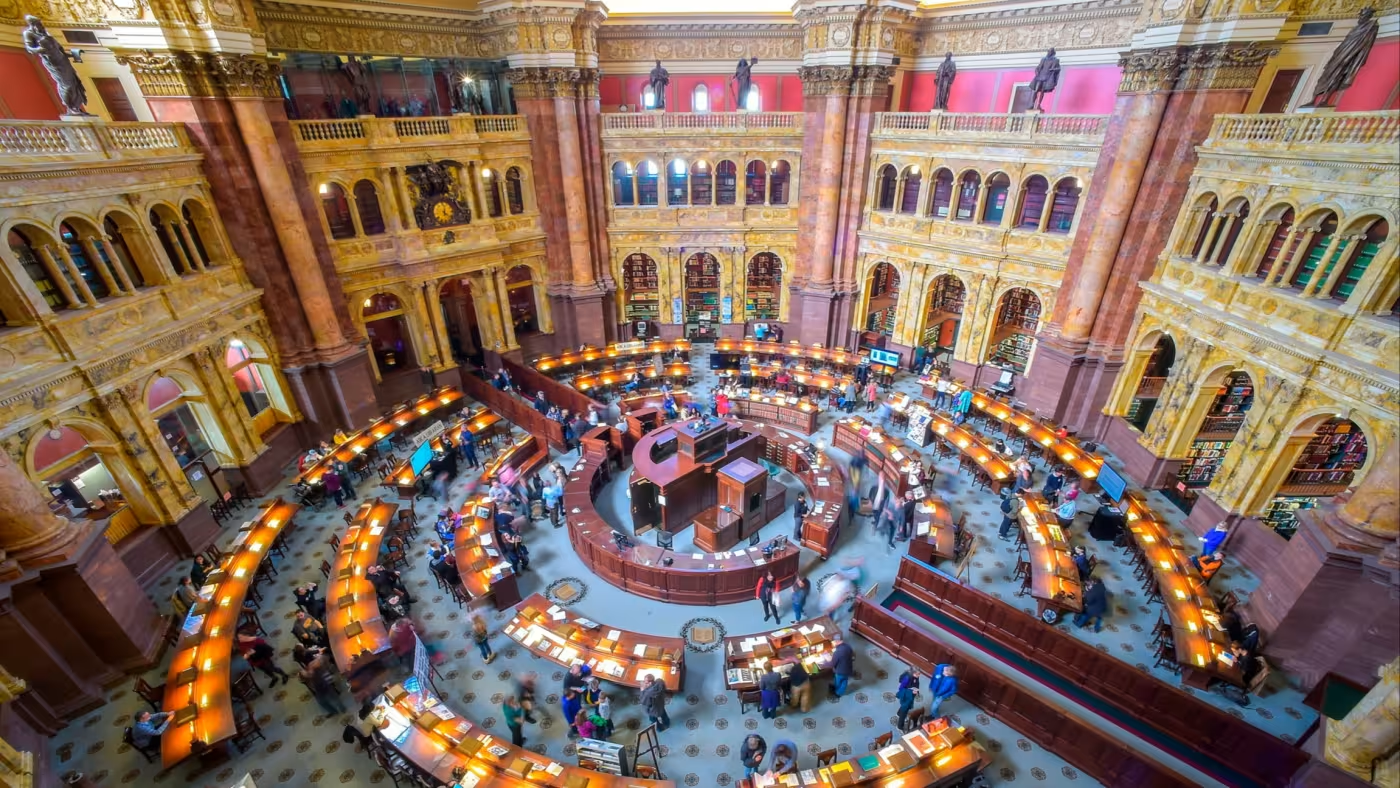
Sinclair Lewis sent up a warning flare in 1935. 90 years later, Richard Ovenden (Oxford’s librarian and author of the important– and terrific— Burning the Books: A History of Knowledge Under Attack) smells smoke…
In the space of three short months, the Archivist of the United States, Colleen Shogan, and the Librarian of Congress, Carla Hayden, have both been fired by the Trump administration. Both of these institutions have suffered setbacks before, and have come back stronger. One of the most severe attacks came at the hands of the British. In 1814 a British expeditionary force besieged Washington and set fire to the Capitol building. Officials had already recognised the threat and commandeered every cart they could find to move the National Archives outside the city.
The Capitol building also housed the Library of Congress, and its 3,000 volumes of highly combustible material could not be moved so quickly. The volumes were ignited by British troops. The whole building, and much of the city, was consumed by flames.
News of the destruction of the library reached Thomas Jefferson, whose presidency had ended five years before. In a letter published in a Washington newspaper, he expressed his outrage at the “barbarism” of the British, and offered to make good the losses from his own private library. Congress purchased 7,000 volumes from the former president; with Jefferson’s books, the Library was reborn.
The Library of Congress serves two functions simultaneously. It is both the national library and the library of the legislature. It is as if the British Library was the same organisation as the libraries of the House of Commons and the House of Lords. The irony of course is that unlike its predecessor in 1814, the 119th US Congress has done nothing to protect its own library.
Trump’s press secretary, Karoline Leavitt, stated in a press briefing that Hayden had been dismissed because the Library had been providing “inappropriate books for children”. It was another senior Trump aide, Kellyanne Conway, who in 2017 introduced the world to the notion that there could be “alternative facts”. This reason for firing Hayden — who has, since 2016, greatly strengthened the institution she inherited — is another “alternative fact”.
The Library of Congress is a reference-only research library and has no lending library for children or adults, its collections being built through legal deposit legislation, passed by Congress in 1909 and updated as recently as 2016.
Shogan was dismissed as Archivist of the United States and replaced by Marco Rubio — who clearly has so much free time alongside his dual role as Secretary of State and national security adviser that he can also run the world’s largest National Archives.
One role that archives play is to preserve documents for legal and evidential reasons. After his last presidency, Trump’s illegal removal of classified documents, stored in a guest bathroom at Mar-a-Lago, resulted in their eventual retrieval by the National Archives under the provisions of the Presidential Records Act.
The removal of Hayden and Shogan demonstrates the exercise of arbitrary power, asserting control over knowledge. Both are the first women to lead their respective institutions, and both committed to reaching all parts of the nation they were appointed to serve. If the ideologically motivated censorship of collections and the recent mass deletion of government websites is anything to go by, the Trump administration is intent on removing swaths of knowledge from public circulation.
In a famous letter of 1813, Thomas Jefferson compared the spread of ideas to the way one candle is lit from another: “He who receives an idea from me”, he wrote, “receives instruction without lessening mine; as he who lights his taper at mine, receives light without darkening me”. Instead of Trump lighting the candles of knowledge in the US today, they are being systematically snuffed out…
An institution that survived British torching in 1814 is now facing a new onslaught: “The US Library of Congress is under attack,” from @richove.bsky.social in @financialtimes.com.
For more on why the attack on the LoC (and the Archive): “Trump Is Trying to Take Control of Congress Through Its Library“- “admin is trying to take over the Library of Congress, ‘a major component of the legislative branch” that confidentially advises lawmakers’.”
And related: “Chaos At The Copyright Office: Trump’s Firing Of Register Shira Perlmutter Came After AI Report’s Release, Leaving Industry Wondering What’s Next“- “speculation about the role that a long-awaited report on [on the use of copyrighted materials to train generative AI models] may have played in his action.”
Apposite, Human Smoke by Nicholson Baker: as Hamilton Nolan explains:
… a history of the years leading up to World War 2. The entire book takes the form of short, stylized, factual items of a few paragraphs or less, presented in chronological order, which taken together tell the story of societies sliding—often unwittingly—into very dark places.
While reading the book, I found over and over again that certain entries would vividly remind me of things happening today. The experience was so vivid that I decided to present a few of them to you here—first, Baker’s entry in his book, and then the modern thing that it made me think of. I make no sweeping claims that one thing is just like the other, or that this time is equivalent to that time. I’m only a curious reader, not a professional historian. I make no sweeping claims at all. It’s just interesting. “History doesn’t repeat itself,” Mark Twain said, “but it often rhymes.”…
And per William Faulkner (“”The past is never dead. It’s not even past”)…

* Sinclair Lewis
###
As we listen carfully for echoes, we might celebrate International Museum Day.

“History is past politics and politics present history”*…

A recent study confirms a disturbing trend: American college students are abandoning the study of history. Since 2008, the number of students majoring in history in U.S. universities has dropped 30 percent, and history now accounts for a smaller share of all U.S. bachelor’s degrees than at any time since 1950. Although all humanities disciplines have suffered declining enrollments since 2008, none has fallen as far as history. And this decline in majors has been even steeper at elite, private universities — the very institutions that act as standard bearers and gate-keepers for the discipline. The study of history, it seems, is itself becoming a relic of the past.
It is tempting to blame this decline on relatively recent factors from outside the historical profession. There are more majors to choose from than in the past. As a broader segment of American society has pursued higher education, promising job prospects offered by other fields, from engineering to business, has no doubt played a role in history’s decline. Women have moved in disproportionate numbers away from the humanities and towards the social sciences. The lingering consequences of the Great Recession and the growing emphasis on STEM education have had their effects, as well.
Yet a deeper dive into the statistics reveals that history’s fortunes have worsened not over a period of years, but over decades. In the late 1960s, over six percent of male undergraduates and almost five percent of female undergraduates majored in history. Today, those numbers are less than 2 percent and 1 percent. History’s collapse began well before the financial crash.
This fact underscores the sad truth of history’s predicament: The discipline mostly has itself to blame for its current woes. In recent decades, the academic historical profession has become steadily less accessible to students and the general public — and steadily less relevant to addressing critical matters of politics, diplomacy, and war and peace. It is not surprising that students are fleeing history, for the historical discipline has long been fleeing its twin responsibilities to interact with the outside world and engage some of the most fundamental issues confronting the United States…
Hal Brands and Francis J. Gavin suggest that “The historical profession is committing slow-motion suicide.”
[Image above: source]
* The motto of the Johns Hopkins History Department (attributed to 19th century Oxford historian Edward Augutus Freeman by some scholars, and to 19th century Cambridge historian Sir John Robert Seeley by others)
###
As we look to the past, we might recall that it was on this date in 1803 that the Louisiana Purchase was consummated, when the U.S. took formal possession of 828,000 square miles of territory from France (an area that includes all or part of 15 current U.S. states and 2 Canadian provinces). Americans had originally sought to purchase only the port city of New Orleans and its adjacent coastal lands; but Napoleon, cash-strapped by his war with England, offered a (much) larger parcel– and the U.S. quickly agreed.

The modern continental United States, with the Louisiana Purchase overlaid
You must be logged in to post a comment.