“Research is formalized curiosity. It is poking and prying with a purpose.”*…
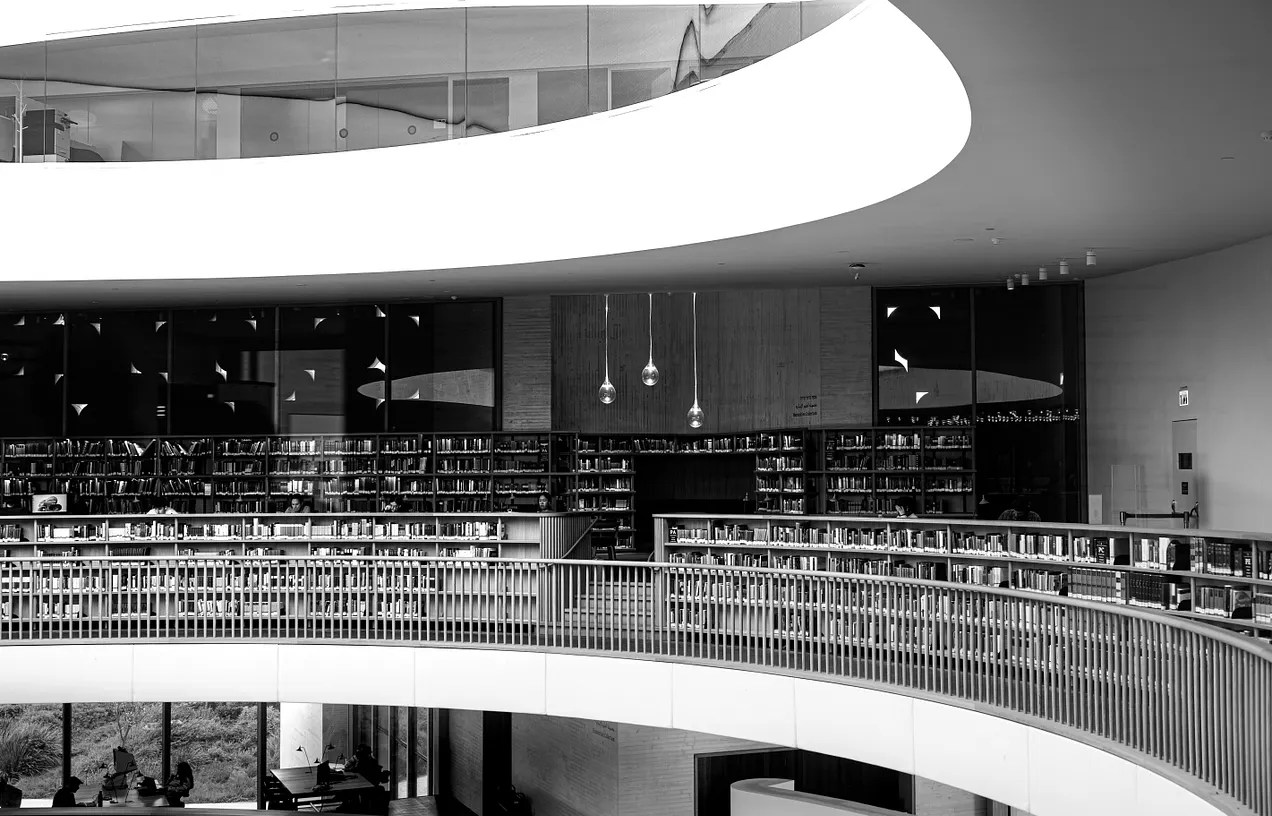
First, internet search, then AI– we live in an age of ever-easier answers. But, of course, that bounty comes with two issues; most obviously, can we trust the answers we get? But as important as that is, it’s secondary to the other issue: what do we lose when we “outsource” the research? As Ben Franklin is reputed to have said (though it seems likelier to be a quote from he Xunzi, the works of Xun Kuang, a Chinese Confucian philosopher who lived the 4th century BC), “Tell me and I forget. Teach me and I remember. Involve me and I learn.”
Librarian Hana Lee Goldin is here to help, with an approach to building a map of where knowledge lives, and advice on how to find our way through it…
Suppose we want to understand why a freeway was built through a particular neighborhood and what happened to the people who lived there afterward. A search engine can surface articles about the project, while a chatbot can summarize those articles into one response. Neither interface necessarily reveals the full range of places where information about that history may exist. City planning records may explain how officials chose the route, while census tables can show how the neighborhood changed. A local archive may preserve residents’ letters or photographs from before construction, while later scholarship can connect that history to broader patterns of transportation policy and displacement.
Finding those materials involves more than searching for the right words because different kinds of information are organized and made discoverable in different ways. A library catalog contains structured records for books, journals, media, digital resources, and other materials, and it may also link to or include records for archival collections. An archive may organize thousands of records according to the person or institution that created or accumulated them, then describe groups of records rather than every individual document. A government data portal organizes measurements according to categories such as geography or reporting period, while a scholarly database helps us find research distributed across many publications. Each system is designed around different kinds of information and discovery, which means we may need to search each one differently.
That difference becomes easy to miss when many of these systems can be reached through the same general interfaces. A search engine can return a library record next to a government report, while an AI tool can synthesize information drawn from several kinds of sources into a single response. The access feels flattened even though the underlying information is still organized according to very different rules. When a search produces weak results, we may keep changing the keywords even though the larger problem is that we’re looking in the wrong place.
Before deciding what to search, then, we need to know what we’re trying to find. If we want to understand how the freeway route was approved, we need records of the decision-making process. If we want to know how the neighborhood’s population changed, we need measurements that allow us to compare the neighborhood before and after construction. Once we know what kind of information could answer each part of the question, we can ask who would have created or preserved that information and which research system is designed to help us find it.
What we need, then, is a way to see that larger research environment as a whole: the different kinds of places it contains, the roles those places play, and the paths that can carry a question from one to another. An atlas offers a model for doing that. An atlas can bring together different maps of the same territory, allowing us to see features and relationships that no single map can represent on its own.
From that model comes the Atlas of Learning, a framework for mapping the research environment itself. Instead of geographic territory, it maps where different kinds of information can be found, how those places and systems organize what they contain, and how we can move among them as a question develops. One part of the Atlas might show where original records are preserved, while another shows the systems through which published research can be discovered. Other parts can include places for structured learning or people whose expertise helps us find our way through systems we don’t yet know.
The routes among those parts are part of the Atlas too. A planning document may give us the formal name of an agency, while a scholarly article may give us a citation to an earlier source. An archival record may introduce the name of an organization whose records are preserved somewhere else. Those names, citations, institutions, and other clues allow one source to generate the next search.
The framework isn’t meant to contain every research resource that exists. It gives us a way to recognize different kinds of resources, understand what each can help us find, and see how one can lead toward another. As we discover new places and learn how to navigate them, we can add those destinations and routes to the Atlas ourselves.
Before so much of research converged onto a common screen, the form and setting of a resource often revealed what kind of knowledge we were entering: a card catalog described and located materials, a statistical yearbook gathered institutional measurements, and an archival collection placed us among the records of a person or organization. Those distinctions can become harder to see when a government report, library record, and generated response arrive through the same interface. Many parts of the research world can now be reached from the same screen, but that ease of access can make those parts look more interchangeable than they are.
The Atlas restores that larger view. Instead of presenting every resource as another result arriving through the same interface, it makes the different parts of the research environment visible in relation to one another. We can see which places are built for which kinds of questions and how a discovery in one part of the Atlas can open a route into another. As more of our information environment is encountered through common interfaces or generated responses, that layered view gives us back a sense of the terrain we’re moving through…
[Goldin unpacks the Atlas; explains how to find “routes” within it (and what to “pack” for the different “terrains” we will traverse); and offers a strategy for those occasions on which one finds oneself “stuck.” She concludes by explaining that, in fact, there is no one “master,” but rather a multiplicity of use-specific atlases…]
… An Atlas of Learning can begin whenever there is something we want to understand beyond a quick factual lookup. Each inquiry creates its own terrain because the places we need to visit depend on the question. A health question may take us through medical literature and public health agencies, while a historical question may lead toward archives, newspapers, or census records. The Atlas gives that particular inquiry a visible research environment of its own.
Because the Atlas is organized around a question, that question becomes the compass. It gives the research direction as new possibilities appear, helping us decide whether a newly discovered resource is relevant to what we’re trying to understand and what it might contribute to an answer. And it becomes the point we return to whenever the terrain grows more complicated, helping us recover our bearing and decide what to pursue next.
The working Atlas can be extremely lightweight. A spreadsheet, Notion page, mind map, document, or another information-management tool can all serve the same purpose. At minimum, we need the question, the research destinations that become relevant to answering it, and a brief note about what each can contribute. The form matters less than being able to look at the Atlas and see, at a glance, where this particular inquiry can go.
The Atlas represents the research terrain for a single question. It keeps the destinations connected to that question visible together, giving us a way to see the terrain as it develops and maintain our orientation within it. Something becomes part of the Atlas when it materially advances the inquiry, either by helping us answer the question or by opening a direction we may need to follow next. The result is a record of the sources and destinations that have become consequential to the research, rather than everything we happened to encounter along the way.
Building an Atlas gives us practice locating a question within a larger information environment and recognizing how different parts of that environment can help answer it. We also learn to follow connections as new territory appears and to find our bearings when the direction becomes uncertain. Taken together, those abilities form a kind of information literacy we can apply when we enter subjects we have never explored before.
With that practice, entering an unfamiliar subject becomes an act of orientation as much as discovery. We may begin with little sense of how knowledge about that subject is organized or where its records, research, and expertise reside, but we know that those structures are there to be found. As they come into view, the subject begins to acquire a geography of its own, one that we can learn to read even though we have never traveled through it before.
The Atlas of Learning is something we draw as each question opens a new research terrain around us. The destinations will change from one subject to the next, and the route will develop differently each time. What remains is the ability to look beyond the interface in front of us and see a larger world of places we can learn to navigate…
Mapping where knowledge lives: “The Atlas of Learning.”
And because we will continue to use online search in our research, this earlier piece from Goldin: “Google Has a Secret Reference Desk. Here’s How to Use It.“
* Zora Neale Hurston
###
As we do the work, we might take caution from the story of Paul Kammerer; he was born on this date in 1880. A biologist, he claimed to have produced experimental evidence that acquired traits could be inherited. Almost all of Kammerer’s experiments involved forcing various amphibians to breed in environments that were radically different from their native habitat to demonstrate Lamarkian inheritance. (This is the idea that learning one acquires during one’s lifetime is passed on to that person’s offspring: e,g, if you play guitar, your children will have nimble fingers; each generation builds upon the past and continues to improve.)
Several scientists tried– and failed– to replicate the results of his most famous (and striking) findings, from his experiments with the mid-wife toad; and Kammerer was accused of fraud. Suffering depression at the time, he shot himself. Arthur Koestler’s 1971 book The Case of the Midwife Toad, argued that while Kammerer’s results were incorrect, he had been the victim of Nazi sympathizers at the University of Vienna, who’d tampered with his results. But most biologists believe that Kammerer was a fraud and even the others, that he misinterpreted the results of his experiments.
(That said, it is worth noting that, while Kammerer’s results remain tainted, the notion of heritable learning has (re-)gained some steam, through the work of geneticists like Barbara McClintock and epigeneticists.)

You must be logged in to post a comment.