Posts Tagged ‘museums’
“A room hung with pictures is a room hung with thoughts”*…

Nearly $1 trillion of art is expected to change hands in the coming decade, as boomers’ art collections get passed down. There won’t be enough buyers or museums to absorb it all. Felix Salmon on what inter-generational transfer may mean for the art world…
… The baby boomers spent money at an astonishing rate. In the single year of 2005, US boomers spent $7 trillion in 2026 dollars, per McKinsey. Twenty years earlier, in 1985, their predecessors in the Silent Generation had spent just $3 trillion in today’s dollars. Spending on art accelerated as the rich got richer, moved into ever-larger houses and became eager to splash out on discretionary purchases.
That unprecedented demand for art created an unprecedented supply of it too. “The art world became professionalized during the lifetime of the boomers,” notes Michael Darling, a co-founder of Museum Exchange, a company that tries to find museums willing to accept donors’ art. The number of artists making a living from their work reached previously unthinkable levels, with a concomitant increase in the number of galleries. There were about 150 art galleries in New York in 1946, per a 2005 Rand report. That doubled by 1961 and then doubled again by the early 2000s. In Los Angeles, the number of galleries went from almost zero in 1957 to more than 400 in 2005.
When patrons were limited to a few royal courts and religious institutions, the number of people who could make a living by producing art was relatively low. The boomers, blessed with vastly greater numbers, turned their money into battalions of collectable artists. In 1988 the Artnet Price Database, which tracks artists sold at auction, included 8,300 artists, including substantially all the Old Masters. By 2012 there were 90,275.
When you inherit art that was expensive when acquired, it’s difficult to think of it as “stuff” that could be thrown away or given to a thrift store. At the same time, storing and figuring out what to do with it can be enormously challenging. One way of making sure someone appreciates the art is to sell it. But finding buyers can be extraordinarily difficult. Most artists get forgotten over time. Even living artists have a hard time selling their work. A dead artist… needs a dealer who’s committed to resuscitating interest in them — and those dealers are few and far between, since it’s nearly always easier to sell the work of a living artist than a dead one.
Just looking at items that can be sold for cash on the secondary market, which is a tiny minority of all the art out there, roughly $1 trillion of art is expected to change hands just in the next 10 years, per Deloitte. No one is ready. The great wealth transfer includes a vast quantity of paintings and sculptures. A small proportion of it will have some sentimental value and be kept for that reason, but most of it is going to get moved out one way or another — sold, donated or even trashed…
[Salmon explores the options: continued stewardship by the heirs, sale (through auction houses or galleries), or donation (to museums)– all of which are, as he explains, fraught. But perhaps the biggest problem is the evolution of taste…]
… An even bigger barrier for inheritors looking to pass on a collection is the way tastes change over time. Boomers grew up looking at artists like Carl Andre or Balthus, congratulating themselves on how daringly receptive they were to the shattering of historical norms; as those norms get rebuilt, younger art lovers are much more likely to find reasons to avoid showing them entirely. Instead, their collections feature more women artists and tend to be more diverse in many other ways too.
The art world doesn’t fixate on the ultra-new in the way Hollywood or pop music does, where most consumption is of products produced and released in the past year or less. All the same, galleries overwhelmingly show new work by living artists, so that’s what most art collectors end up buying. That means heirs often end up inheriting work that used to be new and exciting but today is often little more than a faint memory.
The rise and fall of artists and artistic reputations is the subject of the emerging discipline of cultural evolution. Just as Darwinian evolution selects for species that do the best at surviving, artistic evolution selects for works that continue to attract our attention. Oleg Sobchuk, a researcher at the Max Planck Institute for Evolutionary Anthropology in Germany, explains that art disappears from our collective memory first quickly and then slowly, in a process known as bi-exponential decay. “Sometimes we think about art as speaking to something that makes us human, that it’s general and timeless,” he says. “But in most cases, art is about something that is happening at that period of time.” The further we get away from the moment an artwork is made, the less of our attention it can generally command.
In paleontology there’s the concept of the “turnover pulse,” where the rate of extinction rises sharply; it’s not dissimilar to the theory of the paradigm shift in the history of science. In art, it’s been more than a century since the modernist revolution that started with impressionism and continued through Picasso and Duchamp. Now, for the first time, the dominant collectors and curators — not to mention artists — will be people who grew up in the age of the internet.
“Every new media, when it appears, creates some kind of rupture,” Sobchuk says. “Usually it functions as a revolution. The culture was in the hands of a small number of powerful individuals, and then from time to time, you have a technological revolution.” That doesn’t mean digital art will displace painting and sculpture. But it probably means there’s less appetite and reverence for modernism. Which doesn’t bode well for those inheriting a lot of it…
[Salmon explains why, though this transfer is essentially inevitable, it will unfold more slowly than we might think (TLDR: “Because there will still be many boomer buyers for every collector planning ahead and unwinding a collection, there won’t be nearly as much of a supply-and-demand mismatch over the next decade as the broader generational shift might imply…”) He concludes…]
… The great art transfer is a much bigger deal than “what are we going to do with all this stuff.” The art we keep will stay in the canon; the art we discard will be lost to history. All the same, the stuff question is becoming urgent, and its answer is sad, if simple: A tiny proportion of the art we inherit will be treasured and valued, and a little bit more will find a good home elsewhere, perhaps slowly accumulating historical value even if it continues to lose cultural cachet. But most of it will probably acquire signs of physical deterioration and neglect — bumps and scratches and sunbleaching… All artists are mortal, after all, and only a minuscule fraction of them achieves immortality through their work. The rest are bound to fade away, sooner or later.
Ars longa? “Boomers Are Leaving Behind More Art Than Anyone Wants,” (or here), from @felixsalmon.com in @bloomberg.com.
Also worth following: the series in e-flux on the relationship between contemporary art, real estate, housing, gentrification, and the material conditions of artists’ lives. Revisiting earlier pieces, it begins with “Art, Creativity, Urbanism, Part I,” from Martha Rossler.
###
As we contemplate the canon, we might send birthday greetings to two artists whose places in the firmament seem, at least so far, secure:
Diego Velázquez was baptized on this date in 1599. A Baroque master of the Spanish Golden Age and leading artist in the court of King Philip IV of Spain and Portugal, he is generally considered one of the greatest artists in the history of Western art.

Andrew Warhola was born on this date in 1928 in Pittsburgh, PA. Better known as Andy Warhol, he was a leading figure in the Pop art movement; his work (painting, filmmaking, photography, publishing, and performance art) challenged traditional boundaries between high and low culture and provoked us to think more clearly about the relationship of reference and referent. Widely considered the most important artist of the second half of the 20th century, he was a role model for a generation of post-modernist artists.

“The pieces I chose were based on one thing only — a gasp of delight. Isn’t that the only way to curate a life?”*…

The Louvre has the Mona Lisa. In his nifty newsetter Ironic Sans, David Friedman reviews the “most treasured” holding of other museums…
Did you know that there is only one painting by Leonardo da Vinci on view in America? It’s a portrait of a teenage girl named Ginevra de’ Benci, a Florentine aristocrat, possibly commissioned for her wedding. And it’s one of only four portraits Leonardo painted of women. The most famous one, of course, is the Mona Lisa.The portrait of Ginevra is on display at the National Gallery of Art in Washington, DC, which acquired the painting in 1967. There’s an interesting story of how the painting was brought from Liechtenstein Castle to Washington in carry-on luggage.
[I haven’t told you this yet, but for the past year I’ve been working full-time as Senior Video Producer at the National Gallery of Art. I love it. Working in a museum surrounded by some of the world’s best art and telling stories about how art makes a difference in people’s lives, every day is a good day. Another time, I’ll share some of the work we’re doing. But for now, I just need to make clear that this newsletter is in no way formally connected to the museum or my work there.]
Here is Ginevra, painted by Leonardo around 30 years before Mona Lisa:

I once heard someone refer to Ginevra as “America’s Mona Lisa.” Obviously that’s in part because they’re both by the same artist. But sometimes people refer to something as their Mona Lisa to mean it’s their prize possession, or an incredible work, or the draw that people come to see.
And that got me wondering: What do other museums and institutions refer to as their Mona Lisa?
So I did some digging and I’ve gathered 17 works of art and other surprising things where someone from the institution has gone on record calling it their Mona Lisa…
From Duccio and Matisse to Sow and Warhol: “It’s Their Mona Lisa,” from @ironicsans.com.
* Maira Kalman, My Favorite Things
###
As we hit the highlights, we might spare a thought for a man whose works were often the “Mona Lisas” of the halls they graced: Giovanni Battista Tiepolo (AKA, Giambattista or Gianbattista Tiepolo): he died on this date in 1770. A painter and printmaker from the Republic of Venice, his luminous, poetic frescoes, while extending the tradition of Baroque ceiling decoration, epitomized the lightness and elegance of the Rococo period. Indeed, he was described by National Gallery head Michael Levey as “the greatest decorative painter of eighteenth-century Europe, as well as its most able craftsman.” He is considered– with Giambattista Pittoni, Canaletto, Giovan Battista Piazzetta, Giuseppe Maria Crespi, and Francesco Guardi— one of the traditional Old Masters of that period.


“To-day I think / Only with scents”*…

We’ve considered before smell, the unsung hero of the senses. Today, Kaja Šeruga explains how scientists using chemistry, archival records, and AI are reviving the aromas of old libraries, mummies and battlefields…
We often learn about the past visually — through oil paintings and sepia photographs, books and buildings, artifacts displayed behind glass. And sometimes we get to touch historical objects or listen to recordings. But rarely do we use our sense of smell — our oldest, most primal way of learning about the environment — to experience the distant past.
Without access to odor, “you lose that intimacy that smell brings to the interaction between us and objects,” saysanalytical chemist Matija Strlič. As lead scientist of the Heritage Science Laboratory at the University of Ljubljana in Slovenia and previously deputy director of the Institute for Sustainable Heritage at University College London, Strlič has devoted his career to interdisciplinary research in the field of heritage science. Much of his work focused on the preservation and reconstruction of culturally significant scents.
Reconstructed scents can enhance museum and gallery exhibits, says Inger Leemans, a cultural historian at the Royal Netherlands Academy of Arts and Sciences. Smell can provide a more inviting entry point, especially for uninitiated visitors, because there’s far less formalized language for describing smell than for interpreting visual art or displays. Since there’s no “right way” of talking about scent, she says, “your own knowledge is as good as the others’.”
Despite their potential to enrich our understanding of history and art, smells are rarely conserved with the same care as buildings or archaeological artifacts. But a small group of researchers, including Strlič and Leemans, is trying to change that — combining chemistry, ethnography, history and other disciplines to document and preserve olfactory heritage…
Read on for the fascinating details: “Recreating the smells of history,” from @knowablemag.bsky.social.
* Edward Thomas, “Digging“
###
As we take a whiff, we might recall that it was on this date in 1924 that Coco Chanel agreed with the Wertheimer brothers Pierre and Paul, directors of the perfume house Bourjois, to create a new corporate entity, Parfums Chanel, Its signature product was Chanel No. 5. She had been selling small quanitites of the scent in her boutique since 1921.
Traditionally, fragrances worn by women had fallen into two basic categories. Respectable women favored the essence of a single garden flower while sexually provocative indolic perfumes heavy with animal musk or jasmine were associated with women of the demi-monde. Chanel sought a new scent that would appeal to the flapper and celebrate the seemingly liberated feminine spirit of the 1920s. Her scent was formulated by chemist and perfumer Ernest Beaux, who designed an unprecedented olfactory architecture, a bouquet of 80 scents whose precious notes were blended with high proportions of aldehydes, organic compounds that carry a crisp, soapy, and floral citrusy scent. In late 1920, when presented with small glass vials containing sample scents numbered 1 to 5 and 20 to 24 for her assessment, she chose the fifth vial. Chanel told Beaux, “I present my dress collections on the fifth of May, the fifth month of the year and so we will let this sample number five keep the name it has already, it will bring good luck.”
The first promotion for Chanel No. 5 appeared in The New York Times on December 16, 1924– a small ad for Parfums Chanel announcing the Chanel line of fragrances available at Bonwit Teller, an upscale department store. The fragrance, of course, become a fave. An Andy Warhol subject and worn by everyone from Marilyn Monroe and Catherine Deneuve to Mad Men’s Peggy Olson, the perfume, is a foundational part of fragrance history… and still sells a bottle every 30 seconds.

“If you can make it here, you can make it anywhere.”*…

Hannah Frishberg, in Gothamist, on a labor of love…
Reno may be “the biggest little city in the world,” but it’s got some serious competition from the miniature New York City that hobbyist Joseph Macken built in his upstate New York basement over two decades.
“I sat down in my basement, turned the camera on on my phone and just started talking about my first section, which was Downtown Manhattan,” the Clifton Park resident said on a recent Thursday about his viral TikToks on his roughly 50-by-30-foot scale model of the city. “It just took off.”
The intricate model features what Macken says are hundreds of thousands buildings, landmarks and geographic elements across the five boroughs and their surroundings, including bridges, airports, the Hudson and East rivers, New York Harbor, Central Park, One World Trade Center and the original World Trade Center, the Statue of Liberty and Empire State Building. The work consists of 350 handmade sections that are pieced together and can be taken apart and moved…
… Macken, a 63-year-old truck driver who grew up in Middle Village and has no formal carpentry or engineering training, said he dreamed of replicating the Queens Museum’s famous “Panorama” after an elementary school trip when he was a kid. He embarked on the endeavor in 2004, armed with little more than balsa wood, Elmer’s glue and Styrofoam. His first building was “the RCA building at Rockefeller Center,” he said, referring to 30 Rock, which was formerly named for its longtime tenant, the Radio Corporation of America.
Macken said it took him about 10 years to build Manhattan alone and 11 years for the rest of the boroughs. He completed his opus in April, and said he’s confident every building in the city is represented. (Gothamist could not independently verify this claim; the city has more than 1 million buildings, according to the Department of Buildings.)…
… Macken is now working on a mini Minneapolis: “‘Mary Tyler Moore’ was one of my favorite shows growing up,” he said, adding that he plans to eventually do Los Angeles, Las Vegas and Chicago as well.
Macken said he’s still figuring out what he’ll do next with the model, but he’s in talks with the Museum of the City of New York in Manhattan about an exhibit there. A museum spokesperson confirmed this, praising his “ingenuity, creativity and skill.”
“ I don’t wanna put it back in storage,” Macken said. “That’s for damn sure.”…
More– and more photos– at: “This trucker built a scale model of NYC over 21 years. It’s drawing museums’ attention” from @gothamist.com.
* “Theme from New York, New York” composed by John Kander, with lyrics by Fred Ebb; performed in the film by Liza Minnelli and famously covered by Frank Sinatra
###
As we get small, we might recall that on this date in 1776– in the early days of the military occupation of the city by British forces during the Revolutionary War– the “Great Fire of New York” raged on the West Side of what then constituted New York City at the southern end of the island of Manhattan.
The fire destroyed from 10 to 25 percent of the buildings in the city, and some unaffected parts of the city were plundered. Many believed or assumed that the fire was deliberately set; British leaders accused revolutionaries– and used the pretext to declare martial law, to confiscate surviving uninhabited homes of known Patriots and assign them to British officers; to convert chuches (other than Church of England sanctuaries), into prisons, infirmaries, or barracks; and to billet regular soldiers with civilian families… all of which continued until the British evacuated the city on November 25, 1783.

“…When fascism comes to the United States it will be wrapped in the American flag and will claim the name of 100-percent Americanism”*…
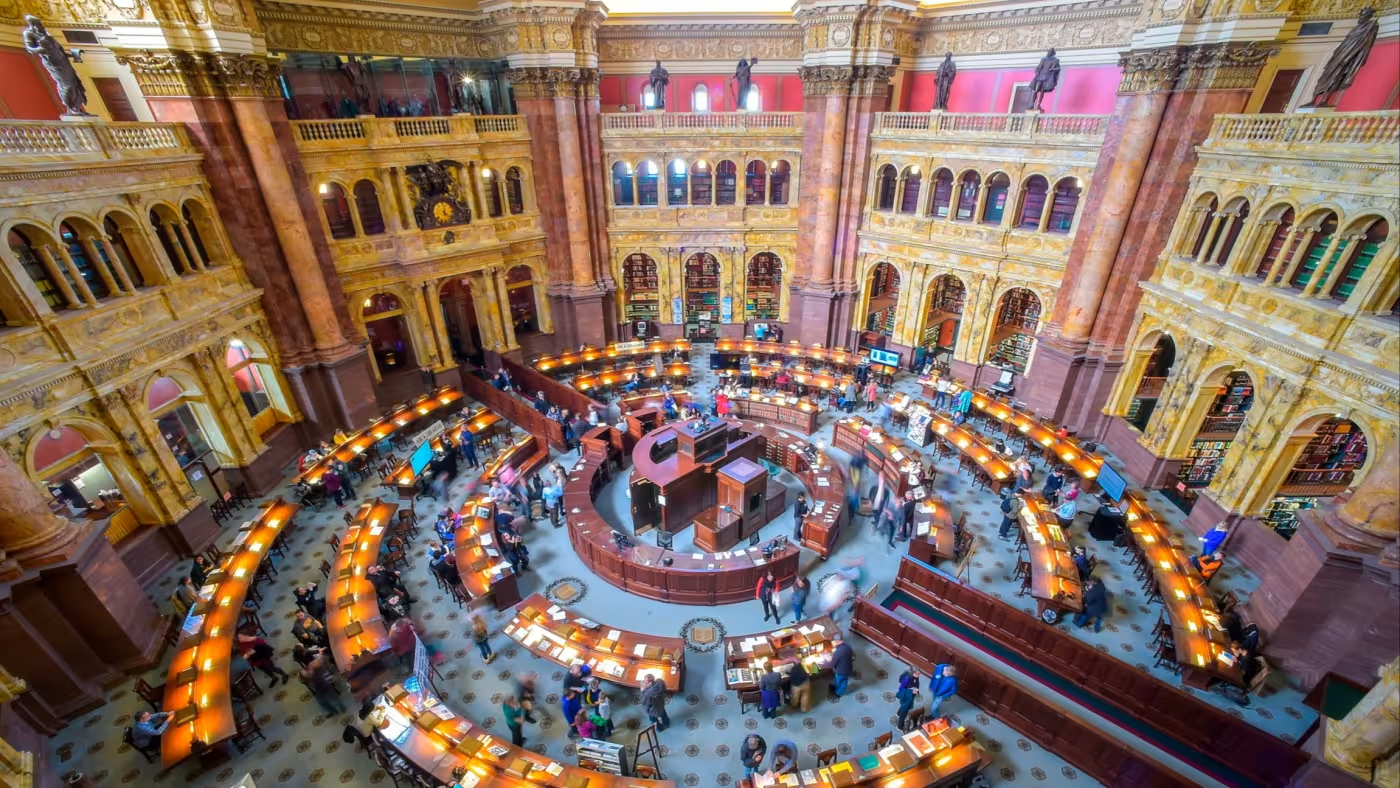
Sinclair Lewis sent up a warning flare in 1935. 90 years later, Richard Ovenden (Oxford’s librarian and author of the important– and terrific— Burning the Books: A History of Knowledge Under Attack) smells smoke…
In the space of three short months, the Archivist of the United States, Colleen Shogan, and the Librarian of Congress, Carla Hayden, have both been fired by the Trump administration. Both of these institutions have suffered setbacks before, and have come back stronger. One of the most severe attacks came at the hands of the British. In 1814 a British expeditionary force besieged Washington and set fire to the Capitol building. Officials had already recognised the threat and commandeered every cart they could find to move the National Archives outside the city.
The Capitol building also housed the Library of Congress, and its 3,000 volumes of highly combustible material could not be moved so quickly. The volumes were ignited by British troops. The whole building, and much of the city, was consumed by flames.
News of the destruction of the library reached Thomas Jefferson, whose presidency had ended five years before. In a letter published in a Washington newspaper, he expressed his outrage at the “barbarism” of the British, and offered to make good the losses from his own private library. Congress purchased 7,000 volumes from the former president; with Jefferson’s books, the Library was reborn.
The Library of Congress serves two functions simultaneously. It is both the national library and the library of the legislature. It is as if the British Library was the same organisation as the libraries of the House of Commons and the House of Lords. The irony of course is that unlike its predecessor in 1814, the 119th US Congress has done nothing to protect its own library.
Trump’s press secretary, Karoline Leavitt, stated in a press briefing that Hayden had been dismissed because the Library had been providing “inappropriate books for children”. It was another senior Trump aide, Kellyanne Conway, who in 2017 introduced the world to the notion that there could be “alternative facts”. This reason for firing Hayden — who has, since 2016, greatly strengthened the institution she inherited — is another “alternative fact”.
The Library of Congress is a reference-only research library and has no lending library for children or adults, its collections being built through legal deposit legislation, passed by Congress in 1909 and updated as recently as 2016.
Shogan was dismissed as Archivist of the United States and replaced by Marco Rubio — who clearly has so much free time alongside his dual role as Secretary of State and national security adviser that he can also run the world’s largest National Archives.
One role that archives play is to preserve documents for legal and evidential reasons. After his last presidency, Trump’s illegal removal of classified documents, stored in a guest bathroom at Mar-a-Lago, resulted in their eventual retrieval by the National Archives under the provisions of the Presidential Records Act.
The removal of Hayden and Shogan demonstrates the exercise of arbitrary power, asserting control over knowledge. Both are the first women to lead their respective institutions, and both committed to reaching all parts of the nation they were appointed to serve. If the ideologically motivated censorship of collections and the recent mass deletion of government websites is anything to go by, the Trump administration is intent on removing swaths of knowledge from public circulation.
In a famous letter of 1813, Thomas Jefferson compared the spread of ideas to the way one candle is lit from another: “He who receives an idea from me”, he wrote, “receives instruction without lessening mine; as he who lights his taper at mine, receives light without darkening me”. Instead of Trump lighting the candles of knowledge in the US today, they are being systematically snuffed out…
An institution that survived British torching in 1814 is now facing a new onslaught: “The US Library of Congress is under attack,” from @richove.bsky.social in @financialtimes.com.
For more on why the attack on the LoC (and the Archive): “Trump Is Trying to Take Control of Congress Through Its Library“- “admin is trying to take over the Library of Congress, ‘a major component of the legislative branch” that confidentially advises lawmakers’.”
And related: “Chaos At The Copyright Office: Trump’s Firing Of Register Shira Perlmutter Came After AI Report’s Release, Leaving Industry Wondering What’s Next“- “speculation about the role that a long-awaited report on [on the use of copyrighted materials to train generative AI models] may have played in his action.”
Apposite, Human Smoke by Nicholson Baker: as Hamilton Nolan explains:
… a history of the years leading up to World War 2. The entire book takes the form of short, stylized, factual items of a few paragraphs or less, presented in chronological order, which taken together tell the story of societies sliding—often unwittingly—into very dark places.
While reading the book, I found over and over again that certain entries would vividly remind me of things happening today. The experience was so vivid that I decided to present a few of them to you here—first, Baker’s entry in his book, and then the modern thing that it made me think of. I make no sweeping claims that one thing is just like the other, or that this time is equivalent to that time. I’m only a curious reader, not a professional historian. I make no sweeping claims at all. It’s just interesting. “History doesn’t repeat itself,” Mark Twain said, “but it often rhymes.”…
And per William Faulkner (“”The past is never dead. It’s not even past”)…

* Sinclair Lewis
###
As we listen carfully for echoes, we might celebrate International Museum Day.

You must be logged in to post a comment.