Posts Tagged ‘chemistry’
“A chair is a very difficult object. A skyscraper is almost easier.”*…
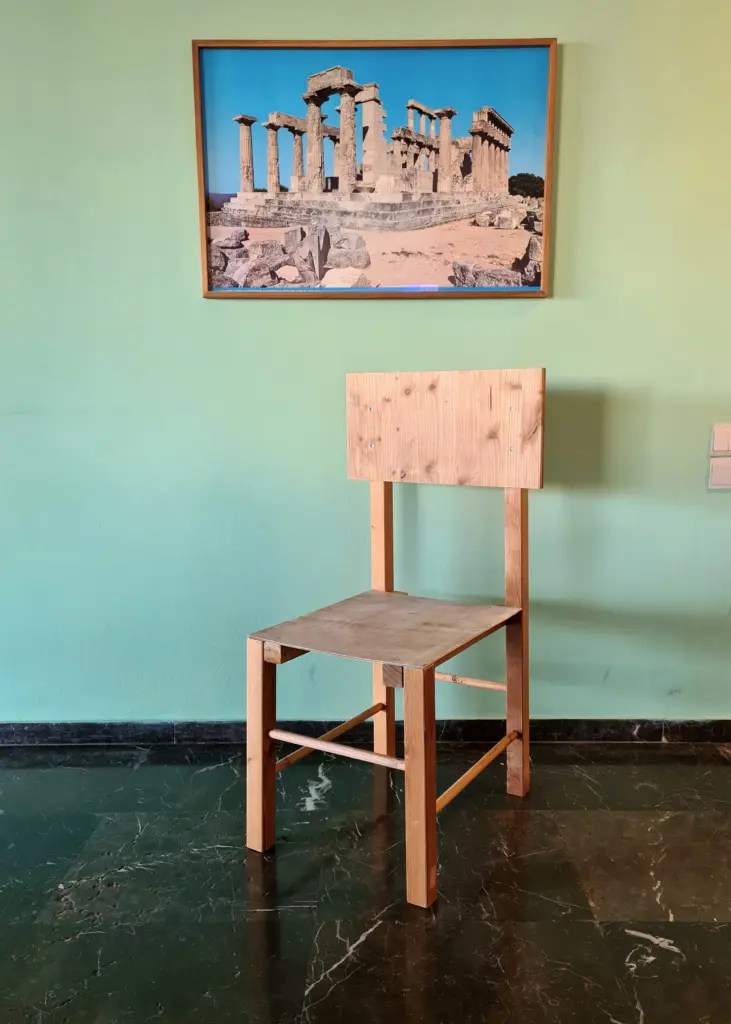
What happens when one combines practical carpentry skills with the the abundant theoretical knowledge of AI to build a chair? James Bridle recounts his experience…
In 1840, a surveyor took a chisel to one of the outer walls of St. John’s Church, on Old Haymarket in Liverpool, England. They carved a horizontal line into the stone, a couple of inches long, and below this, three radiating lines, getting wider at the base: a broad arrow. The broad arrow had been used in England since the fourteenth century, and later across Britain and its colonies, to mark government property, but the horizontal line was a relatively new addition. Into this crevice the surveyor would have placed an angle iron, or “bench,” used to support a leveling rod, from which elevations could be taken. Thus, the broad arrow and the line were known as a “benchmark.”
The benchmark on St. John’s Church, recorded in the records of the government’s Ordnance Survey, its official mapping agency, marked one hundred feet above sea level. Chiseling it into the stone meant that someone else could come along later and set up a leveling rod in exactly the same position and take their own reading, transforming it into a datum line: a reference point for further, and repeatable, surveying.
For a few years, the benchmark on St. John’s was the reference datum for the whole country, until it was realized that more accurate measurements should begin at the mean tide level. A pole was set up in the Victoria Docks, also in Liverpool, and the fluctuations of the tide observed for nine days. The resulting mark was used as the fundamental reference until the 1920s, when it was shifted again, to Newlyn, in Cornwall. Benchmarks continued to be carved into churches, civic buildings, milestones, and country walls across the country, all referencing the tidal datum at Newlyn.
“Sea level” is actually different everywhere, but in Britain, it remains a function, plus or minus, of ODN: Ordnance Datum Newlyn. This is the level measured within the town’s tidal observatory, constructed on the South Pier in 1915. The observatory takes the form of a hollow tower in which several floats are suspended, connected to a recording device. An inlet pipe allows the tower’s well to fill and empty with the Atlantic tides. Between 1915 and 2015 the mean sea level at Newlyn increased by 1.83 mm/year—and by 3.8 mm/year between 1993 and 2014. Each change in sea level is reflected in an incremental adjustment to elevations across the land.
The last official benchmark was carved on a milestone located outside a pub in Loughton, Essex, in 1993, before satellite-based systems took over the datum (today, a GPS antenna sprouts from the top of the tide tower in Newlyn). The Ordnance Survey still maintains a record of over half a million benchmarks, although many more have disappeared. Hiking clubs lead expeditions to find them, and hobbyist benchmarkers check them off their lists. When you start looking for them, you see them everywhere.
“Benchmarking” remains in use today as a term for establishing a baseline against which other data can be measured and judged: software performance, product quality, profitability, growth; quality, time, cost. But it’s worth remembering its origins not as a tool for establishing hierarchies, but for leveling; for connecting, rather than separating; and for understanding the whole earth, and everything that happens upon it, as a continuous, indivisible field, stretched across cities, forests, and mountains, and ever susceptible to the rhythm of the tides.A couple of years ago, I found myself stuck in an apartment in Athens, and in desperate need of distraction. I’d been living with my family on a Greek island, where we had space, and time, and had started to build a house; but at the end of 2023 my partner, Navine, became severely ill, and we had to return to the city we’d lived in for five years previously. She spent nine months in hospital; I visited every day, while also looking after our three-year-old son between nursery school and sleep and school again. I had less space, and a lot more stress, but I also had time to fill, and was itching to use my nascent carpentry skills. I needed to make something, with the limited tools and materials I had to hand—anything would do, it just needed to keep my body, and my mind, busy.
It was around this time that the current wave of what we’re calling artificial intelligence started to excite, and demand, attention. I actually studied AI at university, twenty years ago: exactly the wrong time, it turned out, to be studying it. The history of AI is one of booms and busts: “AI winters,” they were called, when the field seemed to sputter out after a series of advancements, and twenty years ago it was decidedly chilly. We learned about expert systems and neural networks from aging professors, but all the sensible students were learning about classical logic and statistics as preparation for careers in digital finance. It was another decade before the field would regain its energy, and—this is a controversial take—it would have little to do with conceptual breakthroughs. Rather, the growth of the internet, with its accompanying boom in processing capacity and data storage, would allow those same ideas—primarily neural networks—to be supercharged by graphics cards, digitized text and artworks, surveillance and social media, and the wholesale transference of everyday life to the online world. The AI “revolution,” if that’s what it is, is not a technological breakthrough, but the overwhelming accumulation of power and data in the hands of a few companies: power and data which rightfully belong to, and have been stolen from, everyone. But I digress.
I’d been noodling with this idea for some time: What if we used AI for something actually useful? It feels like we’re applying this new tool to all the wrong things: beating us at the games we enjoy, supercharging predatory capitalism, extracting and burning fossil fuels, depleting the planet’s resources, conflating images with art, encouraging extremism, suppressing rights, hallucinating, and so on and so forth. Wouldn’t it be infinitely more interesting if AI helped us do useful things in new and better ways, ways which we could not have imagined alone? Intelligences which we engaged with more like colleagues and collaborators than slaves and masters.
The one thing computers have always been really good at, one of the few qualities which genuinely impress me, is optimization. They can take a human-designed thing, an object or an algorithm, and ruthlessly strip it to the bare essentials while maintaining its functionality. Give a clever machine some widget, like a structural bracket or a complex workflow, and it will produce some alien-looking thing, a third of the weight and twice as efficient, which a human mind would not have conceived. That’s cool, that’s interesting. Of course, applied to culture, society, and the wider environment, such an idea of efficiency is a disaster, but it’s pretty neat for objects, as long as a human is keeping an eye on things.
I thought I might be able to make use of this particular skill to create something with what I had to hand: By combining my rudimentary carpentry abilities with the machine’s knack for efficiency and strangeness, something interesting might happen. Specifically, I didn’t want to design a process which would ultimately replace me, or take over the rewarding bits of work, but something more like a smart carpenter’s mate, that could do some of the sums and make useful suggestions and leave me to do the fiddling and the sanding. A collaborator, not a boss…[Bridle recounts the first iteration of his collaboration of his collaboration with ChatGPT…]
… There are two qualities of the chair that ChatGPT and I built that stand out. The first is that it looks flimsier than it is, but it works. The AI told me to use a sheet of very thin ply for the seat, so thin that I considered laminating two sheets of it together. It gives a little when you sit on it—but it holds. That’s exactly the kind of optimization I was looking for: a decision I wouldn’t have had the confidence to make, but, again, it works. It might even be slightly comfier that way—although I have no way of knowing if the machine actually intended it, structurally or comfort-wise; it might have been going on dimensions alone. Still, the chair stands.
The second quality of the chair is that it is unnervingly big. Not too big—it’s actually pretty comfortable for a six-footer like me—but it’s definitely bigger than you’d expect, verging on the uncanny. This I find to be absolutely fascinating.
What we have here is, quite literally, a chair designed by someone who has read a lot about chairs but never actually sat in one. They know what a chair should look like, what it should do, the mechanics of how one is put together, the physics of holding you up. But they have no embodied experience of the world, no history with chairs or any other object, no physical memory. They don’t know how it feels, not merely to sit in a chair, but to encounter one in the world, to place it among other things in a home, to live with it, to be around it every day as one goes about the mundane business of life. This is the idea of a chair brought to life; but things—objects, beings, relationships—are not mere ideas, and you certainly can’t get every aspect of them from books. The chair is low stakes, but, once again, you wouldn’t want to run a society, or a culture, or a planet this way.
Since building that first chair, others have been created. This is where the benchmarking bit comes in. A few weeks after the ChatGPT chair, I made another one, this time with an AI model called Mistral. Mistral is a French company which made a lot of claims to be more ethical than ChatGPT (whatever that really means), and I’d been told it was more accurate and precise when it came to technical matters. Once again, I described my request, and we went back and forth a bit, and then I tried to do what it told me.
Mistral’s chair didn’t stand up at all without some serious modifications: I had to add a bunch of cleats and bracing around the legs to make it stable enough to sit on, which eliminated any purported gains in efficiency. It was definitely more interesting than ChatGPT’s doll’s-house effort, with a short back and slanted armrests. It was also waaaayyy too high. My feet didn’t even touch the floor. So much for Mistral’s accuracy and precision—but points for making something a daring European chair designer might actually have come up with.
AI is unfortunately very hot right now. At a time when we could be attending to decarbonizing our societies and building more robust communities to help us through the turbulent years ahead, we seem to be giving most of our attention to a technology which not only burns through energy and other resources, but actively works to make our relationships less secure and our information environment less coherent. The art world is not immune to this tendency, and so when I received requests for AI-themed work for events and exhibitions, I turned the chair-making process into a set of instructions which anyone could follow, and sent it over.
The first iteration took place in Tokyo at an exhibition called “AI is Not Magic” in June of 2025. The curators followed my instructions, inviting Anthropic’s Claude AI to make them a chair from a selection of materials in the studio. It turned out a pretty nice chair, but the quality of the finish made me suspect that an experienced carpenter was involved at their end. Conversely, when a conference called ThingsCon in Amsterdam asked Elon Musk’s Grok AI to have a go, the system told them to build a lounge chair and gave very precise cutting instructions, but none of it fit together at all. As the ThingsCon team noted, “The system could produce—confidently, fluently, at length. But it couldn’t understand what it had made.” The chair they eventually ended up with, after much modification, was “grammatically coherent and practically useless. […] It’s a strange object—part furniture, part evidence.”
Each chair is indeed a piece of evidence—a benchmark, in the truest sense. Each iteration of the work produces a different outcome, which we can judge and compare. Each AI model reveals its own tendencies, biases, and limits, in physical form, easily appraised by a layperson. We are benchmarking; we are benchmaking; we are literally making a bench (fine, a chair, whatever). I appreciate processes where you learn to do a thing, a thing that you didn’t know how to do before, and at the end of that process you have not only done it, but you can see the results. And, in this case, sit on them.
This benchmarking has a deeper meaning as well. Carving a broad arrow into a church wall doesn’t reduce or isolate anything. Rather, it reminds us that every action is made in context; each benchmark refers to every other one, in a continuous, connected line through space and time. When we build, when we think, when we act, we do so in honor of every object, thought, and action which has preceded this one, and we are changed by the process. AI wants us to forget this, by making every output its own miraculous creation. But we owe the world more than that…[Bridle reflects on the experience…]
… Building the AI chairs taught me something about AI, but it didn’t teach me much about making chairs. Ultimately, I was the teacher, taking what I’d learned elsewhere to make the “practically useless” suggestions into something stable and self-supporting. The AI undoubtedly learned more than me from these interactions: how to speak, what interests (some) humans, how to flatter, how to slant and tailor its responses to my demands.
The anarchist anthropologist David Graeber, may he rest in peace, had a good bit on authority. He said that anarchists don’t oppose authority per se, but they study and critique it, and appraise its legitimacy. What he liked, he said, was self-subverting authority, authority which undermines its own basis. He gave the example of a teacher: A teacher knows something useful to their student, and so they have a natural authority; but if they do their job well, at the end of the process the student knows what the teacher knows, and their authority is spent. The hierarchy is flattened, and no further unequal power can accrue. The student is changed, and so is the world.
Of course it’s possible to learn things from AI, but, for me, real intelligence resides not in an ability to extract and dominate, but in the capacity to share, co-exist, and thrive together. There are many ways of being intelligent, as many as there are living beings, each one unique and valuable. The real challenge of AI is not in building ever more powerful systems—this is difficult, but inevitable—the challenge is to find what relationships between different intelligences benefit us all. The challenge is to choose the kind of world we all want to inhabit. Benchmarking—the practical, embodied work of exploration and mediation—is an attempt to find our way towards such a world…
On finding a healthy relationship with AI: “Benchma(r)king” from @jamesbridle.bsky.social in @emergencemagazine.bsky.social.
###
As we measure twice before cutting, we might recall that it was on this date in 1985 that the first discovery of a fullerene was published in the journal Nature. In September of 1985, the American chemists Robert F. Curl, Jr. and Richard E. Smalley, colleagues at Rice, met with Sir Harold W. Kroto of the University of Sussex, England. In 11 days of research, they discovered the first fullerene, C60, a spherical cluster of carbon atoms. The discovery of this new structure (AKA “buckminsterfullerene” or “buckyball”) opened a new branch of chemistry, and all three men were awarded the 1996 Nobel Prize for Chemistry for their work.

“Counterfactual reasoning, which deals with what-ifs, might strike some readers as unscientific. Indeed, empirical observation can never confirm or refute the answers to such questions.”*..

… still, we ask of our history, our reality “what if?”… The estimable Colin McGinn ponders why…
In a world with less gravity, the birds would be huge. In a world with more gravity, only insects would fly. In a world with more light and plant predators, plants would have consciousness and advanced intelligence. In a world with greater water resistance, whales would be small. In a colder world, there would be no cold-blooded animals. In a hotter world, all animals would be cold-blooded. In a wetter world, we would have gills. In a drier world, life would begin on the land, if it begins at all. In a world without tool-forming materials, we would still be walking on four legs. In a world with only predators, there would be no life. In a world without predators, life would be simple and boring. In a world without a sun, life would be primitive, unless there was another power source. In a world with available nuclear power, life would be much more abundant than now. In a world without consciousness, there would be no war. In a world without emotion, there would be no suicide. In a world with no psychology, there would be no madness. In a world without motion, there world be no progress and no death. In a world without causation, there would be only chaos. In a world without necessity, there would be only randomness. In a world without events, everything would be eternal. In a world without the infinite, there would be no finite. In a world without relations, there would be no facts. In a world without facts, there would be nothing. In a world without reality, there would be no unreality. In a world without nothingness, there would be no being.
Counterfactuals are inherently surprising, which is why we are fascinated by them. They tell us how different things could be under small changes. There are many kinds of counterfactual. We live in their shadow. They are always controversial, sometimes paradoxical. They give us a sense of intellectual freedom. They scare us. They are also funny. We wouldn’t know what to do without them. In a world without counterfactuals, there would be no thought worthy of the name…
On the utility– the necessity– of contemplating the unreal: “Counterfactuals.”
See also: “What is counterfactual thinking and why should you care about it?” (source of the image above)
###
As we analyze alternatives, we might recall that it was on this date in 1898 that chemist Morris Travers discovered Krypton– the element (Kr), not the counterfactual planet.

“What is really amazing, and frustrating, is mankind’s habit of refusing to see the obvious and inevitable until it is there, and then muttering about unforeseen catastrophes”*…

One of the effectively-secret ingredients in the world’s economic growth over the last couple of centuries has been insurance. The ability to insure against catastrophic loss has underwritten (pun intended) the trillions and trillions of dollars of loans that have funded the construction and acquisition that has enabled the growth of both commercial endeavor and the the accumulation of personal wealth (directly through home ownership and indirectly through equity ownership in those commercial endeavors or participation in pension schemes that own that equity).
But in a way that was enitrely predictable, climate change is rendering a growing portion of the world uninsurable. Gavin Evans ponders what that might mean…
The Florida peninsula looks like a sore thumb. It juts into the Gulf of Mexico and the Atlantic, where the water is getting warmer year on year, prompting fiercer hurricanes that can blow down houses like collapsing decks of cards. Climate scientists are convinced all hell will break loose sooner or later when a monster-sized, property-destroying storm makes a direct hit on Miami or Tampa-St Petersburg. Given three near-misses in the recent past, the experts view such a calamity as inevitable. It’s a huge risk for anyone living there – they stand to lose everything – but also for those bearing the financial side of this risk, the insurance companies. Some in the industry are seeing this as a portent for their future – an impending existential threat with profound implications for the economic system.
There are no easy solutions for people still paying off mortgages and those who want to buy property along the Florida coast, because the potential payout on the back of a mammoth storm is so high that the reinsurers (who insure the insurers against catastrophe) are refusing to underwrite their clients and, with no reinsurance, there’s no insurance; and with no insurance, no mortgages; and with no mortgages, no property market. Insurance protects investments against loss and is therefore a pillar of the economic system. If it goes, economies are destabilised.
Many panicked homeowners have rushed to make their houses less risky for insurance companies by reinforcing their roofs with hurricane clips, installing impact-resistant windows, doors and shutters, and strengthening their foundations. But it’s not just storms and higher, warmer seas that concern insurers. Rising temperatures mean that the frequency, range and ferocity of wildfires are also on the rise.
So far this year, 3,374 wildfires have burned an area of Florida totalling 231,172 acres (at the time of writing), and it is even worse in California where 7,855 blazes have killed at least 31 people, destroyed more than 17,000 houses and devoured 525,208 acres of land, at an estimated cost of more than $250 billion. Here, too, homeowners rushed to make their properties more palatable to cold-footed insurers – clearing their surroundings of anything flammable, covering yards with gravel, sheathing houses with fire-resistant stucco, and replacing wooden roofs with steel.
But, even for the most diligent, insurance companies have turned tail, dumping existing clients and abandoning fire-prone and storm-prone areas altogether. On the Californian fire front, 2024 was a turning point as several insurers ceased issuing new policies because of fire-associated risks, including the United States’ biggest property insurer, State Farm, which cancelled policies in parts of Los Angeles. It is all too easy to view this cynically, but it’s happening because property insurers have been reporting year-on-year losses from climate change-related payouts.
Insurance companies survive by making more money from covering risk than they lose from these risks, which is why they prefer clients less likely to claim (insofar as they can predict the risk involved) and require them to pay substantial excess to discourage claims. When payouts rise above the premium intake, insurance companies either hike up these premiums or withdraw. But when that risk is considered catastrophic, potentially affecting many thousands of clients, as with Floridian storms and Californian fires, it is the reinsurers who are the first to retreat because they will ultimately bear most of the cost.
Reinsurers aggregate payout patterns to establish the likelihood of having to make huge payouts from future natural catastrophes. They do this by gathering exposure data from existing insurers in a geographical area, and by examining catastrophe models (computer simulations that estimate potential losses from natural perils). When they put all this together with detailed analysis of conditions within the area, they come up with a figure for their total potential loss if a catastrophic event strikes.
This is why reinsurers focus so intensely on climate change. Take a glance at the websites of big ones like Swiss Re and Munich Re and you get a sense of how central this is to their calculations – a concern that has spread to property insurers who are starting to hire climate consultants. Even more than market volatility, climate is their biggest headache. ‘You won’t meet a single insurance or reinsurance CEO who doesn’t believe in climate change,’ the insurance investor and former Lombard Insurance CEO James Orford told me. ‘They see it in the numbers – a combination of more extreme, less predictable events, combined with big losses of sums insured. All the modelling suggests these are uninsurable risks.’…
[Evans recaps the history of insurance, starting in Genoa, in the mid-14th century, with the insuring of maritime expeditions; examines the current state of play; examines the efforts (and gauges the weaknesses) of state’s efforts to step up with coverage when insurers step away; then considers another role for states…]
If states do withdraw from insurance and reinsurance, some of the most lucrative areas of the US, Canada, Europe, Asia, Africa and Australia will be devastated: no mortgages and no banks, leading to more ghost towns and villages. ‘It ends with depopulation and abandonment,’ said Agarwala. ‘Climate change reduces the operating space for humanity.’ In the UK, rising sea levels and coastal erosion could literally reduce operating space, putting 200,000 British homes at risk by 2050. There’s no coastal-erosion insurance, which puts more burden on the state, mainly to pay for new defences, but also to help people move.
Governments can take action in other ways, by investing greater sums in risk-prevention and management. There are signs of this happening such as the ‘fire-hardening’ and storm-prevention efforts in Florida, and improved flood defences in the UK; meanwhile, the EU’s Recovery and Resilience Facility is being used in several countries to build and renovate operations centres to cope with wildfires, and to buy firefighting helicopters.
In future, it is likely that voters will demand that their state and national governments do far more, regardless of the cost. They will want tougher building codes, including limitations on building in risky areas; expensive fire-prevention and fire-fighting schemes; better flood and storm defences; improved early catastrophe management, involving relocating people from risky areas and, when disaster strikes, rapid life-saving interventions such as large-scale emergency evacuations. If the insurance industry is forced to retreat by the climate crisis, all of this infrastructural investment will require vast chunks of taxpayers’ money. It is hard to avoid the feeling that this is part of our destiny, and that the sore thumb of the Florida peninsula is pointing us to the future…
Whole regions of the world are now uninsurable, bringing radical uncertainty to the economy: “The insurance catastrophe,” from @aeon.co.
See also: “An Uninsurable Country” (a report form NRDC), “The Insurance Crisis Is So Desperate People Are Turning Socialist” (a gift article from Bloomberg), and “The Uninsurable Future: The Climate Threat to Property Insurance, and How to Stop It” (from Yale Law Review)
* Isaac Asimov
###
As we cover up, we might send highly-charged birthday greetings to a man who made foundational contributions both to the detection of climatic conditions and to a technology that may help allieviate climate change: John Frederic Daniell was born on this date in 1790. Named the first professor of chemistry at the newly founded King’s College London in 1831, he was an avid meteorologist. He invented the dew-point hygrometer known by his name and a register pyrometer; in 1830 he erected a water-barometer in the hall of the Royal Society.
But Daniell is better remembered as a chemist (and physicist), especially for his invention of the Daniell cell, an element of an electric battery much better than voltaic cells, the standard before him. Indeed, the Daniell cell is the historical basis for the contemporary definition of the volt (the unit of electromotive force in the International System of Units). All advances in battery technology since then were “from” the base that Daniell laid.

“To-day I think / Only with scents”*…

We’ve considered before smell, the unsung hero of the senses. Today, Kaja Šeruga explains how scientists using chemistry, archival records, and AI are reviving the aromas of old libraries, mummies and battlefields…
We often learn about the past visually — through oil paintings and sepia photographs, books and buildings, artifacts displayed behind glass. And sometimes we get to touch historical objects or listen to recordings. But rarely do we use our sense of smell — our oldest, most primal way of learning about the environment — to experience the distant past.
Without access to odor, “you lose that intimacy that smell brings to the interaction between us and objects,” saysanalytical chemist Matija Strlič. As lead scientist of the Heritage Science Laboratory at the University of Ljubljana in Slovenia and previously deputy director of the Institute for Sustainable Heritage at University College London, Strlič has devoted his career to interdisciplinary research in the field of heritage science. Much of his work focused on the preservation and reconstruction of culturally significant scents.
Reconstructed scents can enhance museum and gallery exhibits, says Inger Leemans, a cultural historian at the Royal Netherlands Academy of Arts and Sciences. Smell can provide a more inviting entry point, especially for uninitiated visitors, because there’s far less formalized language for describing smell than for interpreting visual art or displays. Since there’s no “right way” of talking about scent, she says, “your own knowledge is as good as the others’.”
Despite their potential to enrich our understanding of history and art, smells are rarely conserved with the same care as buildings or archaeological artifacts. But a small group of researchers, including Strlič and Leemans, is trying to change that — combining chemistry, ethnography, history and other disciplines to document and preserve olfactory heritage…
Read on for the fascinating details: “Recreating the smells of history,” from @knowablemag.bsky.social.
* Edward Thomas, “Digging“
###
As we take a whiff, we might recall that it was on this date in 1924 that Coco Chanel agreed with the Wertheimer brothers Pierre and Paul, directors of the perfume house Bourjois, to create a new corporate entity, Parfums Chanel, Its signature product was Chanel No. 5. She had been selling small quanitites of the scent in her boutique since 1921.
Traditionally, fragrances worn by women had fallen into two basic categories. Respectable women favored the essence of a single garden flower while sexually provocative indolic perfumes heavy with animal musk or jasmine were associated with women of the demi-monde. Chanel sought a new scent that would appeal to the flapper and celebrate the seemingly liberated feminine spirit of the 1920s. Her scent was formulated by chemist and perfumer Ernest Beaux, who designed an unprecedented olfactory architecture, a bouquet of 80 scents whose precious notes were blended with high proportions of aldehydes, organic compounds that carry a crisp, soapy, and floral citrusy scent. In late 1920, when presented with small glass vials containing sample scents numbered 1 to 5 and 20 to 24 for her assessment, she chose the fifth vial. Chanel told Beaux, “I present my dress collections on the fifth of May, the fifth month of the year and so we will let this sample number five keep the name it has already, it will bring good luck.”
The first promotion for Chanel No. 5 appeared in The New York Times on December 16, 1924– a small ad for Parfums Chanel announcing the Chanel line of fragrances available at Bonwit Teller, an upscale department store. The fragrance, of course, become a fave. An Andy Warhol subject and worn by everyone from Marilyn Monroe and Catherine Deneuve to Mad Men’s Peggy Olson, the perfume, is a foundational part of fragrance history… and still sells a bottle every 30 seconds.

“Money is a servant to politicians and the country. But, if the politicians and the country become the servant of the money, the politicians have failed.”*…

Given all that’s going on in the current adminsitration, it’s hard to keep track of the havoc. Here, an update on a drama playing out in the legislature (with heavy White House involvement).
Crypto interests came after the local banker last week in a bitter Congressional fight. As Matt Stoller explains, they didn’t win, but it’s not over…
… [Last] Thursday, the Senate Banking Committee abruptly canceled its meeting, known as a mark-up, to write little-noticed legislation to deregulate the financial system. And the reason is that two of the more powerful forces in D.C. – the banking lobby and the new MAGA-powered crypto world – came into conflict. The result, so far, is a stalemate.
I haven’t written about crypto for a few years, because there’s not much to say beyond “they did a lot of bribes in a bribe-prone system.” But depending on what happens next, we could be looking at the end of an iconic American figure, the local banker, and his or her replacement with something very different. The context of the legislative fight is, as you see in lots of other areas, the decline of the productive institutional fabric of America.
Culturally speaking, banks have a weird place in America, as they are the institutions that control permission to use resources. The endless number of bank heist movies, often with plucky burglars as heroic figures telling bank customers they needn’t worry because it’s not their money at risk, suggests that there’s a lot of skepticism of financial power in general. But there are two types of bankers, the generous local elite and the extractive beancounter. These represent a traditional populist vs oligarch framework.
Take the holiday classic film It’s a Wonderful Life. It’s about a small town banker named George Bailey, played by Jimmy Stewart. Bailey’s help financing useful things in Bedford Falls, like houses and businesses, contrasts with the avaricious Harry Potter, who is a stand-in for Wall Street.
There’s a reason for these cultural totems. Americans have always understood that distant control of credit is dangerous, the theme of movies such as Wall Street, Margin Call, and The Big Short. They also see that local control of credit and payments is key to self-sufficiency. Local banks uses to be, and to some extent still are, the powerhouse of American cities and towns.
That said, there have always been a variety of financial institutions to serve different kinds of customers, including large corporations. There are three kinds of banks in America, the small bank, the regional bank spanning a few states, and a few dozen national mega-banks. Local banks, a la George Bailey, are more efficient with better service and more commercial lending. According to the Institute for Local Self-Reliance, roughly half of U.S. assets were held in small banks, which did most of the productive lending. In 2020, small and regionals held just 17% of industry assets, but offered 46% of bank lending to new and growing businesses.
In the post-war era, this mix of banking was relatively stable, with roughly fourteen thousand local banks and thrifts serving as mortgage and commercial lenders, and check clearing institutions. But in the early 1980s, policymakers sought to consolidate the sector, enacting a series of deregulatory laws to encourage bank failures and mergers. The result is that today we have fewer than four thousand banks, and by the end of the Trump administration, we may have fewer than a thousand.
Of course, the world isn’t the same as it was forty five years ago. Since the 1980s, finance has changed. We are a capital markets driven economy, not a bank-driven one, and we use credit cards not checks, apps and ATMs more than branches. Bailouts have replaced proactive regulation, and we now have four giant Too Big to Fail banks that span multiple lines of business from investment banking to brokerage services. But local economies still depend on local banks, and there are fewer and fewer of them…
… Banking is a great business, because mostly you pay customers a small amount for the use of their money, and get the government to guarantee you a profit. You can make more if you actually do the work to lend money, but you don’t have to.
In return for this easy profit via a government safety net, bankers accept regulation. As the brilliant scholar Saule Omarova notes, the best way to understand banks is as franchises from the government. Bankers safeguard the nation’s money and payments system, and are well-paid for it, but it’s fundamentally a public and not a private duty. That’s why there are banking charters from the state.
The rise of crypto parallels the consolidation and corruption of banking. From the 1980s onward, small town bankers, like everyone else during the neoliberal era, became heavily oriented around removing rules against speculation and froth. The low interest rate environment of the New Deal gave way to a high interest rate world, and that put enormous pressure on the balance sheets of bankers who had lent money more cheaply. That, plus the turn of the Democrats away from protecting small towns in favor of consumer rights, led to a sharp anti-government sentiment among local bankers…
[Stoller unpacks the history of banking the last few decades and then turns to crypto…]
… While anti-monopolists argued for a renewal of public institutions to tamp down on concentrations of wealth and power, the crypto world went the opposite way, arguing that it was the very existence and power of public institutions that led to the crisis in the first place.
Crypto was ideological, at first framed around utopian rhetoric and the blockchain. Unfortunately, there were no actual real use cases for productive ends, it was entirely a way of scamming or speculating without rules. During the 2010s, when the Federal Reserve kept interest rates at zero and engineered a set of bubbles, crypto was one of the more prominent ones. In 2021, I wrote an article titled “Cryptocurrencies: A Necessary Scam” describing the ideological goal of crypto.
Fortunately, regulators kept crypto hived off from the real economy, so as the bubble blew up, it didn’t much matter. In 2022, when Sam Bankman-Fried and a host of crypto institutions collapsed in an orgy of fraud and leverage and money laundering and sanctions evasions, crypto seemed to be over. But it wasn’t, because of the power of the banking lobby, the weakness of Joe Biden’s administration, and the general pro-deregulation consensus in Congress…
… After Biden, the crypto industry had immense political leverage over a supine Congress and a friendly administration. Concerns over things like consumer protection ended, of course, but even more “serious” things like worries over national security and sanctions evaporated. Trump pardoned the Binance CEO Changpeng Zhao, and no one cared any longer that crypto was used to funnel money to Hamas and Venezuela.
The narrative around crypto changed, as crypto proponents dropped their naive ideological arguments. Industry proponents no longer argued there’s anything innovative, or that crypto is important for payments or any other purpose. It’s purely a mechanism to speculate. And the industry ended its commitment to a stateless approach. The trading side of crypto attacked stock market regulations, while the banking side demanded access to the banking franchise, including bank charters, access to the Federal Reserve safety net, and so forth. They started claiming they are bank-like, only better, and that the current banking order is lazy and protected by regulation.
And that brings us to the legislative fight last week. A few months ago, Congress did its first set of favors for the crypto industry, passing the Genius Act, which allowed for companies to issue “stablecoins,” which is to say, they can take dollar deposits as long as they back those deposits with actual dollars. However, they were mostly barred from paying interest on stablecoins. And the payment of interest on deposits is really key, because that’s what would allow stablecoin issuers and crypto exchanges to compete with banks over those cheap customer deposits that enable profits. It is an existential problem, not for the JP Morgan’s of the world, as they are so big it doesn’t matter, but for the rest of the banking sector, the local and community guys.
The most aggressive crypto firm, Coinbase, sort of offers interest on deposits, with what are called “rewards.” By calling them rewards instead of interest, Coinbase is trying to create a loophole in the Genius Act. But it’s a grey area, at best, and regulators could crack down.
The next piece of legislation pushed by the crypto world was called the Clarity Act, which has a number of elements, some of them involving rules around speculation. If it passes, we can expect very little regulation of the stock market, anti-money laundering, or insider trading going forward. But the fight that led to the cancelation of the markup of the Clarity Act is whether “rewards,” aka interest on deposits, are legal. Enter the banking lobby.
Community and regional bankers are not used to fighting with conservatives, because they haven’t had to. They did block liberal lawyer Omarova from becoming the bank regulator at the Office of Comptroller of the Currency. But they certainly aren’t used to dealing with feral and weird crypto MAGA online influencers with billions of dollars. That doesn’t make sense to them. And it should have been obvious that they were in the crosshairs of the crypto industry; the Federal Reserve just launched a rulemaking to give crypto a mini bank charter, which should scare the hell out of the local banks.
But they finally have started to get in gear, pointing to a Treasury report saying that $6.6 trillion of deposits might leave the banking system if crypto companies could pay interest on stablecoins. The Independent Community Bankers Association, the trade group for local bankers, mobilized its members against stablecoin rewards.
Much of the crypto world doesn’t care about stablecoins or banking; they are interested in removing the rules regulating speculation and gambling. For them, it’s a securities law matter. But for Coinbase, which makes roughly a billion dollars in revenue with stablecoins, that part of the bill does matter. And so Brian Armstrong pulled his support for the bill on the eve of the markup. There’s something a bit odd about Coinbase’s opposition, since they got 95% of what they wanted, and everyone else is fine with the legislation. But I don’t want to speculate too much on motivations, the point is Armstrong was unhappy with the final bill.
It’s not clear what happens now. The Senate Banking Committee has put enormous time and effort into this legislation, at the behest of crypto donors. But it really is an zero sum fight. If crypto exchanges can pay interest or rewards on stablecoins, then local banks lose their deposit base. If crypto exchanges can’t, then they won’t get access to cheap deposits. While Senators are desperate for some sort of compromise, it doesn’t look like there is one. Someone has to win and someone has to lose.
This battle is one where there is no good guy, but if there’s someone who is less bad, it would be the local bankers. They at least do lend into communities, and are subject to real regulation. Crypto is a disaster, and if we integrate crypto into the real economy, they will eventually demand their own bailout. But the critique that banks don’t pay much in interest on accounts is accurate. Furthermore, the credit card business is a bloated monopolistic mess. Still, those problems are largely about the Too Big to Fail banks, not the local guys, and the TBTF banks will be fine regardless.
Honestly, I’m exhausted by the question that we are forced to answer in this fight. Should credit allocation and payments be controlled by a set of lazy right-wing bankers who hate government, or a hungrier and deeply corrupt group of crypto scammers? It would be nice to have an alternative to those two interest groups. And eventually, we will, since it’s becoming clear that the state will have to take a much bigger role in credit allocation. But for now, the fact that crypto finally got stopped, at least temporarily, by the banking lobby, well at least it’s funny. And it does show how checks and balances are useful even when everyone involved is deeply flawed.
At this moment, I’ll take what I can get…
The end of an era? “The Slow Death of Banking in America,” from @mattstoller.skystack.xyz.
Pair with Molly White‘s “They’ve bought themselves a Congress” (“Coinbase calls the shots in the Senate…”) and from Matt Levine: “Stablecoin Narrow Banking” (“one solution here is to allow stablecoins to pay interest (like banks) but also impose capital requirements (like banks). I would not bet on that happening though…”) “Memecoin Venture Capital,” (“… today I want to talk about the fourth category, tokens promising no rights…”)
* Oliver Kemper
###
As we hollow out our mattresses, we might send painless birthday greetings to Felix Hoffman; he was born on this date in 1868. A chemist for the German chemical and pharmaceutical company Bayer, he sythesized both acetylsalicylic acid (ASA), which Bayer marketed as “aspirin,” and diamorphine, which was popularized under the Bayer trade name “heroin.”

You must be logged in to post a comment.