Posts Tagged ‘chemistry’
“It’s peculiar. It’s special. There’s very little of it, but it has this pivotal role in the universe.”*…

One of the oldest, scarcest elements in the universe has given us treatments for mental illness, ovenproof casserole dishes, and electric cars. Increasingly, our response to climate change seems to depend on it. But how much do we really know about lithium? Jacob Baynham explains…
The universe was born small, unimaginably dense and furiously hot. At first, it was all energy contained in a volume of space that exploded in size by a factor of 100 septillion in a fraction of a second. Imagine it as a single cell ballooning to the size of the Milky Way almost instantaneously. Elementary particles like quarks, photons and electrons were smashing into each other with such violence that no other matter could exist. The primordial cosmos was a white-hot smoothie in a blender.
One second after the Big Bang, the expanding universe was 10 billion degrees Kelvin. Quarks and gluons had congealed to make the first protons and neutrons, which collided over the course of a few minutes and stuck in different configurations, forming the nuclei of the first three elements: two gases and one light metal. For the next 100 million years or so, these would be the only elements in the vast, unblemished fabric of space before the first stars ignited like furnaces in the dark to forge all other matter.
Almost 14 billion years later, on the third rocky planet orbiting a young star in a distal arm of a spiral galaxy, intelligent lifeforms would give names to those first three elements. The two gases: hydrogen and helium. The metal: lithium.
This is the story of that metal, a powerful, promising and somehow still mysterious element on which those intelligent lifeforms — still alone in the universe, as far as they know — have pinned their hopes for survival on a planet warmed by their excesses…
[Baynham tells the story of this remarkable element, the development of it many uses (in psychopharmacology, in materials science, and of course in electronics– especially batteries), the rigors of extracting it for those purposes, and the challenges that its scarcity– and its potency– present…]
… Long before cell phones and climate anxiety and the Tesla Model Y, long before dinosaurs and the first creatures that climbed out of the ocean to walk on land, long before the Earth formed from swirling masses of cosmic matter heavy enough to coalesce, back, way back, to the infant universe, to the dawn of matter itself, there were just three types of atoms — three elements in the blank canvas of space. One of them was lithium. It was light, fragile and extremely reactive, its one outer electron tenuously held in place.
Everything we have done with lithium, all its wondrous applications in energy, industry and psychiatry, somehow hinges on this basic structure, a sort of magic around which we’re increasingly engineering our future. Lightness is usually associated with abundance on the periodic table — almost 99% of the mass of the universe is just the lightest two elements. Lithium, however, is the third lightest element and still mysteriously scarce…
That most elemental of elements: “The Secret, Magical Life of Lithium,” from @JacobBaynham in @noemamag.com.
###
As we muse on materials, we might send densely-packed birthday greetings to Philip W. Anderson; he was born on this date in 1923. A theoretical physicist, he shared (with John H. Van Vleck and Sir Nevill F. Mott) the 1977 Nobel Prize for Physics for his research on semiconductors, superconductivity, and magnetism. Anderson made contributions to the theories of localization, antiferromagnetism, symmetry breaking including a paper in 1962 discussing symmetry breaking in particle physics, leading to the development of the Standard Model around 10 years later), and high-temperature superconductivity, and to the philosophy of science through his writings on emergent phenomena. He was a pioneer in the field that he named: condensed matter physics, which has found applications in semiconductor and laserr technology, magnetic storage, liquid crystals, optical fibers, nanotechnology, quantum computing, and biomedicine.

“You can swim (uncomfortably) in water at a temperature slightly above freezing; a tiny drop in temperature—or a miracle—allows you to walk on water.”*…

As Elise Cutts explains, making ice requires more than subzero temperatures. The unpredictable process takes microscopic scaffolding, random jiggling and often a little bit of bacteria…
We learn in grade school that water freezes at zero degrees Celsius, but that’s seldom true. In clouds, scientists have found supercooled water droplets as chilly as minus 40 C, and in a lab in 2014, they cooled water to a staggering minus 46 C before it froze. You can supercool water at home: Throw a bottle of distilled water in your freezer, and it’s unlikely to crystallize until you shake it.
Freezing usually doesn’t happen right at zero degrees for much the same reason that backyard wood piles don’t spontaneously combust. To get started, fire needs a spark. And ice needs a nucleus — a seed of ice around which more and more water molecules arrange themselves into a crystal structure.
The formation of these seeds is called ice nucleation. Nucleation is so slow for pure water at zero degrees that it might as well not happen at all. But in nature, impurities provide surfaces for nucleation, and these impurities can drastically change how quickly and at what temperature ice forms.
For a process that’s anything but exotic, ice nucleation remains surprisingly mysterious. Chemists can’t reliably predict the effect of a given impurity or surface, let alone design one to hinder or promote ice formation. But they’re chipping away at the problem. They’re building computer models that can accurately simulate water’s behavior, and they’re looking to nature for clues — proteins made by bacteria and fungi are the best ice makers scientists know of.
Understanding how ice forms is more than an academic exercise. Motes of material create ice seeds in clouds, which lead to most of the precipitation that falls to Earth as snow and rain. Several dry Western states use ice-nucleating materials to promote precipitation, and U.S. government agencies including the National Oceanic and Atmospheric Administration and the Air Force have experimented with ice nucleation for drought relief or as a war tactic. (Perhaps snowstorms could waylay the enemy.) And in some countries, hail-fighting planes dust clouds with silver iodide, a substance that helps small droplets to freeze, hindering the growth of large hailstones.
But there’s still much to learn. “Everyone agrees that ice forms,” said Valeria Molinero, a physical chemist at the University of Utah who builds computer simulations of water. “After that, there are questions.”…
More at: “The Enduring Mystery of How Water Freezes,” from @elisecutts in @QuantaMagazine.
Even more at “Cold, colder and coldest ice” (source of the image above)
* Meteorologist Craig Bohren
###
As we contemplate crystallization, we might send chilly birthday greetings to a man fascinated by ice and its crystalline structure, Walther Hermann Nernst; he was born on this date in 1864. A physicist and physical chemist, he made material contributions to thermodynamics, physical chemistry, electrochemistry, and solid-state physics. But he is best remembered for the Nernst heat theorem, which stated that the entropy (a thermodynamic measure of disorder) in a system approaches zero as the temperature goes towards absolute zero… which led to the development of what Nernst himself called “the third law of thermodynamics,” and to Nernst’s receiving the 1920 Nobel Prize in Chemistry.

“Food is simply sunlight in cold storage”*…

Increasingly, as Patrick Sisson explains, that’s literally true…
If you had to identify a specific type of real estate that has seen its value increase because of changing consumer eating habits, global demographic shifts, worldwide pandemic preparedness, and US export policy — while its importance to reducing global carbon emissions and adapting to climate change rise in tandem — refrigerated warehouses may not be your first pick.
But there’s a strong case to be made that the expansion and evolution of the cold-storage industry — often called the “cold chain” — will play a significant role in energy, environmental, and economic news in the 21st century. Cold storage facilities aren’t fun places to visit; some are kept so frigid, at minus 50 degrees Fahrenheit, that the workers who toil in these windowless spaces rotate in 15-minute shifts, despite their heavy protective gear…
… refrigerated warehouses are great to build and own. Investors and developers expect 8 to 10% annual growth in this specialized real estate, according to Adam Thocher, SVP of Global Programs and Insights at the Global Cold Chain Alliance (GCCA). That’s made it a profitable real-estate niche…
The ability to more easily cool and freeze food for storage, preparation, and distribution has revolutionized grocery shelves, home cooking, and restaurants for decades, and will continue to do so for years because it taps into every trend all at once. Growing fast-casual restaurant chains, last-mile delivery, a surging global middle class seeking more protein, and the explosion in healthy, organic produce and industrialized frozen food, all need cold storage…
The pandemic accelerated these trends, spiking frozen-food sales in the US to over $74 billion in 2023, a $10 billion increase in just three years, and leading to a wave of refrigerator purchases by Chinese consumers. The need to refrigerate Covid vaccines underscored how important these sites are to global health. Even Ozempic and similar blockbuster anti-obesity drugs need to be stored at 46 degrees F. And the rest of the world is increasingly asking why, if you can always get a Granny Smith apple in New York, can’t you get one in Beijing or London?…
The GCCA estimates there is at least 7.4 billion cubic feet of cold storage worldwide, and 3.7 billion in the US alone, but that’s a vast understatement, Thocher said. The alliance only looks at partial data from 92 countries (not including China) and governments tend to be cagey about sharing his kind of data because of economic and food-security concerns, since these sites are crucial parts of food infrastructure and can reveal levels of economic activity…
Food security has become a global challenge with a growing population, Peters said, especially since roughly 30% of global food production is lost, making increasing supply and reducing food waste imperative. That’s extremely tricky when the critical loss of arable land and desertification, due to climate change, strengthens the case for cold-storage warehouses, which, because of their vast energy use, contribute to that very problem. A 2023 Columbia University study found the sector responsible for 3.5% of total global emissions. The cold-storage industry has responded with more energy-efficient designs and less harmful ammonia-based refrigerants, but it adds an additional challenge to efforts to ramp up sustainable energy production.
“This is a real system-level challenge, a wicked problem,” [Toby Peters, professor of the cold economy at the UK’s Birmingham Energy Institute] said. “My exam question is, how do we feed 9 billion people while economically empowering 400 million small farmers, all without using diesel?”…
Diets, demographics, desertification are all fueling “The Hot Business of Cold Storage,” by @patrickcsisson in @sherwood_news.
* John Harvey Kellogg
###
As we chill, we might recall that it was on this date in 1903 that Carl von Linde received two U.S. patents for his Linde oxygen process and associated equipment (Nos. 728,173 and 727,650). Linde had already invented the first industrial-scale air separation and gas liquefaction processes, which led to the first reliable and efficient compressed-ammonia refrigerator (in 1876).
In 1901, Linde had began work on a technique to obtain pure oxygen and nitrogen based on the fractional distillation of liquefied air. His 1903 patents were steps in that direction.
Linde founded a company to commercialize access to these pure gases. Now known as Linde plc (but formerly known variously as the Linde division of Union Carbide, Linde, Linde Air Products, and Praxair), it has become the world’s largest producer of industrial gases– and ushered in the creation of the global supply chain for industrial gases that serves the global cold chain.

“Some say the world will end in fire, some say in ice.”*…

Ethan Siegel reminds us that the world– the living world– almost did end in ice…
… one event came closer than any other to bringing an end to life on Earth: a catastrophe known as either the Great Oxidation Event or the Great Oxygenation Event. Oxygen, one of the hallmark characteristics of our living Earth, was a tremendous destructive force when it first arrived in any sort of meaningful abundance some ~2 billion years after Earth first took shape. The slow alteration of our atmosphere by the gradual addition of oxygen proved to be fatal to the most common types of organism that were present on Earth at the time. For several hundred million years, the Earth entered a horrific ice age which froze the entire surface: known today as a Snowball Earth scenario. This disaster almost ended life on Earth entirely. Here’s the story of our planet’s near-death, culminating in life’s ultimate survival story…
For roughly 300 million years, the Earth was frozen: “What was it like when oxygen killed almost all life on Earth?” from @StartsWithABang in @bigthink. Eminently worth reading in full.
* Robert Frost, “Fire and Ice“
###
As we contemplate change, we might send chilly birthday greetings to Raoul Pictet; he was born on this date in 1846. Remembered as a pioneer in cryogenics, Pictet was a Swiss chemist who spent much of his career trying to produce very low temperatures (in order to produce ice for refrigeration)– which led him to the creation of liquid oxygen in 1877 (for which he’s credited as co-discoverer, as French scientist Louis-Paul Cailletet, working completely separately, also produced liquid oxygen that year).

“A lot of people were opposed to it. A lot of people were for it. I myself think about it as little as possible.”
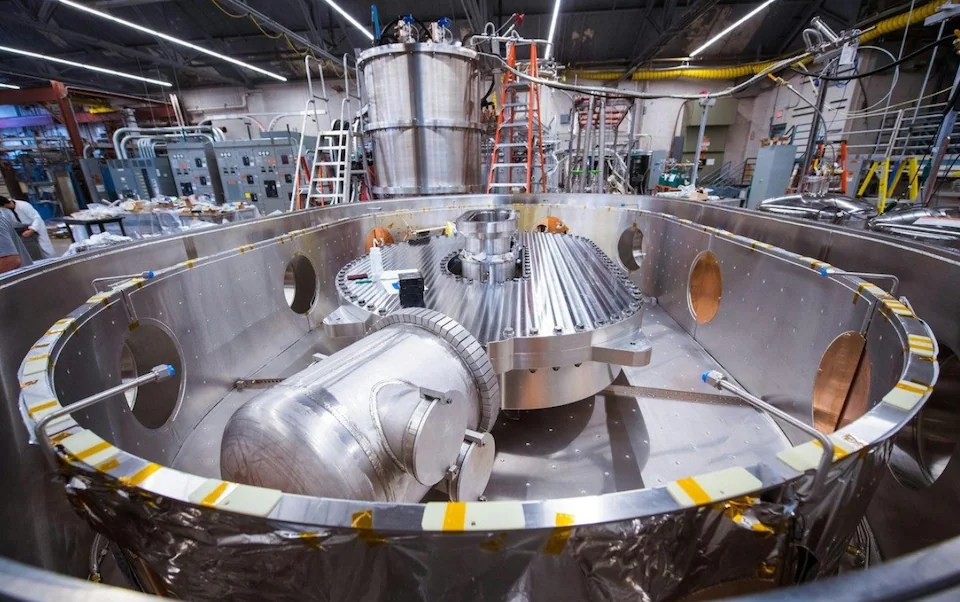
As AI, clean tech, climate response, and other uses grow, concerns are rising that the U.S. and the world are going to run out of electricity (and here). As John Ellis reports, there’s a controversial potential answer closer to hand than many had thought…
Commercial nuclear fusion has gone from science fiction to science fact in less than a decade.
Britain’s First Light Fusion announced last week that it had broken the world record for pressure at the Sandia National Laboratories in the US, pushing the boundary to 1.85 terapascal, five times the pressure at the core of the Earth.
Days earlier, a clutch of peer-reviewed papers confirmed that Commonwealth Fusion Systems near Boston had broken the world record for a large-scale magnet with a field strength of 20 tesla using the latest high-temperature super-conducting technology. This exceeds the threshold necessary for producing net energy, or a “Q factor”, above 1.0.
“Overnight, it basically changed the cost per watt of a fusion reactor by a factor of almost 40,” said Professor Dennis Whyte, plasma doyen at the Massachusetts Institute of Technology (MIT). The March edition of the IEEE Transactions on Applied Superconductivity published six papers ratifying different aspects of the technology.
A poll at the International Atomic Energy Agency’s forum in London found that 65 percent of insiders think fusion will generate electricity for the grid at viable cost by 2035, and 90 percent by 2040.
The Washington-based Fusion Industry Association says four of its members think they can do it by 2030. If the industry is anywhere close to being right, we need to rethink all our energy assumptions…
firstlightfusion.com, cfs.energy, telegraph.co.uk, web.mit.edu, ieeexplore.ieee.org/stamp
From New Items (@EllisItems)
For a series of less-optimistic takes on the prospect of power from fusion: “Why are nuclear fusion reactors difficult?
* Kurt Vonnegut, God Bless You, Mr. Rosewater
###
As we ponder power, we might spare a thought for Irène Joliot-Curie; she died on this date in 1956. A chemist and physicist, she followed in the footsteps of her mother (Marie Curie), sharing the Nobel prize in Chemistry (in 1935, with her husband Frédéric Joliot-Curie) for their discovery of induced radioactivity, making them the second-ever married couple (after her parents) to win the Nobel Prize, and making her and her mother the first (and so far only) mother–daughter pair to have won Nobels.
Sadly, Irène also shared her mother’s fate: she died of leukemia resulting from radiation exposure during research.

You must be logged in to post a comment.