Posts Tagged ‘cold chain’
“The ice was here, the ice was there, The ice was all around”*…
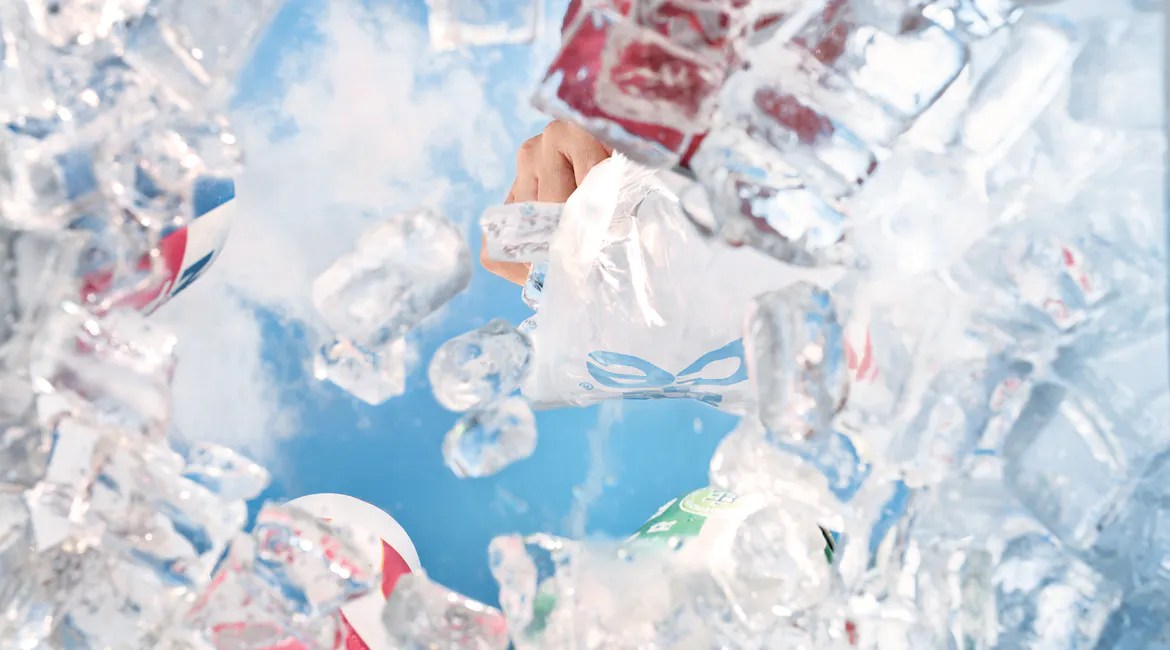
Your correspondent will on the road for the next several days, so (R)D will be on hiatus until on or around September 3. Meantime, a seasonally-appropriate post…
Writing for Texas Monthly, Lauren Larson visits Reddy Ice, the largest producer of packaged ice in North America and it’s CEO, Lonny Warner, to explore a billion-dollar industry that’s essential to us all, but that few of us stop to ponder…
… Warner joins a long procession of icemen who have bemoaned the lack of interest in their trade. “We are so familiar with water in its liquid and its solid form, that we seldom think of it as a mineral, and still less as a mineral product of any considerable industrial importance,” wrote W. P. Blake, an American geologist and mining consultant, in an 1883 report on the country’s ice trade. And yet, he wrote, “the industry is peculiarly American, and in no other country has the business of cutting and storing ice been so well systematized and perfected.”
By the time of Blake’s findings, people had been experimenting with making and keeping ice for centuries. In India, possibly as early as three thousand years ago, people used clay pots to cool water: The water’s evaporation through the clay removed heat, leaving chilled water or even ice under the right conditions. The technique is still used, especially as the country experiences record heat waves.
Americans in the nineteenth century, the dawn of the modern ice industry, had it easier. “The natural supply of ice in the United States is almost beyond calculation,” wrote a U.S. census agent named Henry Hall in a report submitted in 1883. Since at least 1805 so-called natural ice had been harvested from northern lakes, rivers, and ponds in a process accurately and musically depicted in the opening scene of Frozen, a rare cinematic nod to the ice industry. (In Eugene O’Neill’s 1946 play, The Iceman Cometh, a salesman has told his alcoholic friends that his wife is at home with the iceman. The iceman in question is meant to evoke death—the woman has been killed—but anxieties around swole deliverymen entering homes and seducing wives seem to have been prevalent in the twentieth century.) Using long handsaws and a variety of improvised plows, Northerners would cut grids in the ice and remove blocks, which were then stored or sent to warmer locales by ship or rail in insulated containers.
Thanks to a man named Frederic Tudor, some of these destinations were quite far-flung. Tudor was a merchant from Boston, more mutton chop than man in his later years. He would ship natural ice from Thoreau’s Walden Pond, which is startlingly Whole Foods–y branding for the nineteenth century.
Tudor envisioned a global ice industry. Perhaps he was motivated by the limited market for his Gläce-priced ice blocks in the U.S. or by the prevalence elsewhere of tropical fevers such as yellow fever, as the symptoms of these were often soothed by cold water. (In 1851 a doctor named John Gorrie experimented with creating a cold sickroom for malaria patients’ high fevers, effectively inventing air-conditioning.) In 1806, Tudor attempted to ship blocks of ice to the island of Martinique, a speculation that is detailed by Jonathan Rees, a history professor at Colorado State University Pueblo, in Refrigeration Nation, one of three books he’s written about refrigeration. First, the owner of a boat Tudor had chartered got cold feet, convinced, as many shipowners were, that the ice would melt and sink the ship. Tudor chartered another ship and successfully delivered his wares to the island, but Martinique had no icehouse in which to store it, and it began to melt, as ice does. Customers also had no idea how to transport it from his hold to their homes or keep it cold once they did; Tudor advised them to wrap their purchases in cloth. “He still got complaints, since it melted anyway,” writes Rees.
Tudor could very well have gone down in history as the father of the modern Potemkin start-up rather than the father of the modern ice industry, but he persevered. He saw that in order to create the worldwide ice trade he envisioned, he would have to build a global network of icehouses. Eventually his empire grew vast, and historians call Tudor by the absolutely sick moniker the Ice King…
… By the mid to late nineteenth century, artificial ice makers were being invented across the globe. Texans—perhaps shaken by the Civil War, which hindered the shipment of ice, and also likely motivated by the state’s growing beef industry—were aggressive in the ice race. By 1867, notes Rees, when the United States had only eight ice plants, three existed in San Antonio. Some early refrigeration machines used compressed ammonia, which is still widely used as a coolant. In the coming decades, ice plants bloomed across the state like frost on a window.
In the late 1920s, Southland Ice Company had eight plants and 21 retail locations in Texas, from which it provided ice for the iceboxes of residents in surrounding areas. (Widespread adoption of refrigerators was still several decades away and was driven, Rees tells me, by the lure of ice in the home. “The argument was always, ‘Get rid of the iceman. Buy a refrigerator.’ ”) Southland eventually became Southland Ice Corporation, and its icehouses, which had grown into convenience stores called Tote’ms, were rechristened 7-Elevens. In 1972, as 7-Eleven was growing into the brand that would stain the lips of countless middle schoolers with its neon Slurpees, Southland rebranded its large ice operation, calling it Reddy Ice Division.
Reddy was not yet the acquisitive ice empire it is today. For most of the twentieth century, regional producers thrived. But then, in the early nineties, the packaged-ice industry encountered an innovation: the in-store bagger. Refrigerator ice makers already existed but were not a particularly virile threat, as it would take a long time for a refrigerator-door ice maker to fill a cooler. In-store ice baggers were a different story.
The machines had been perfected by a young man named Jim Stuart, a former accountant who had consulted for a company called Automatic Ice Machine, or A.I.M. Inspired by that work, he began selling what he called the Ice Factory, a machine that automatically made and packaged ice at grocery stores and other retailers that had previously bought their ice from local businesses. Stuart began acquiring these flailing producers. His Houston-based company, Packaged Ice, quickly achieved ice supremacy, and in 1998, Stuart bought Reddy. (It still makes the Ice Factory.) A 2001 New Yorker profile christened Stuart the Emperor of Ice…
[Larson reviews the uses to which we put ice– the social (American’s prefer their beverages chilled), but also the more industral: ice is critical to everything from construction (e.g., in high temps it’s used to keep concrete from setting too quickly and becoming brittle) to medical treatment and research…]
… Not far from Reddy’s headquarters is a storage facility with twelve thousand pounds of ice that’s kept on reserve—kept on ice!—for emergencies. When natural disasters level our critical systems, as ritually occurs in Texas, ice is suddenly even more crucial. “When a hurricane hits and power goes out, we’re a lifeline,” Warner says. “It’s not for drinks at that point. It’s ‘how do I keep my food cold?’ ” In the event of a crisis, Reddy works with H-E-B, Walmart, and the Federal Emergency Management Agency to distribute ice, often thousands of pounds of it. He vividly remembers when Hurricane Beryl tore through Houston soon after the Fourth of July in 2024. Celebrations had cleared out Reddy and its distributors’ reserves, leading them to scramble to get ice from across the country to Houston. “We had H-E-B calling us for ice, and we were just trying to get it anywhere we could,” Horton, of Polar Ice, recalls.
The moments when ice is needed but unavailable are as irritating and unsettling to us as the breakdown of any utility, even in much lower-stakes contexts than a hurricane’s aftermath. “Ice is actually a very high-passion business,” says Juan Estrada, who directs Reddy plants in the Metroplex and across the state. Customers might stop at a convenience store on the way to a party, gather some snacks, and then ask for a bag of ice at the checkout. If there is no ice available, Estrada says, they’ll likely abandon all their other purchases and walk out. For most of us, these small but searing disappointments are the only times we think about the role of ice in our lives.
But for many Texans, ice can be the only thing keeping us from succumbing to our surroundings. In 2024, Harris County Public Health reported that heat-related illnesses had increased by 329 percent between 2019 and 2023. Texans who are exposed to heat as part of their work in industries including agriculture, construction, and delivery—as is the case for more than 35 percent of Americans—are disproportionately vulnerable, as are older adults and children.
Those of us outside those groups are not immune. As early as March of this year, a ranger at Big Bend National Park tells me, she and her colleagues were responding to between four and six heat-related incidents each week. Rangers bring ice on almost every medical response; it’s crucial for stabilizing patients during what can be an hours-long journey from the park to a hospital. In the summer, says San Antonio Fire Department medic Ashley Long, everyone is vulnerable to the heat, even those who have been hydrating all day. Much like the ice distributors, Long responds to ten times as many emergencies when it’s hot. “The hospitals are just slammed. Every single bed is taken,” she says. “Every disease and debilitation that people have is magnified by the heat.”
Perhaps we don’t think much about ice because doing so requires us to consider how implausible it is that we’re able to live comfortably in such heat. How lucky we are to enjoy a snow cone on a one-hundred-degree day.
An invisible essential: “Inside the Billion-Dollar Industry That’s Keeping Your Beer Cold—and Saving Lives,” from @lonlozzin.bsky.social in @texasmonthly.bsky.social.
For a look at the even larger, even more infrastructurally-central, but equally opaque– ‘cold chain’: “Food is simply sunlight in cold storage.”
* Samuel Taylor Coleridge, The Rime of the Ancient Mariner
###
As we stay cool, we might note that there’s still time to check in on World Water Week; today is its final day. While its in-person events are happening in Stockholm, much of the program is available online.
Why we should care (UK-centered, but all-too-relevant across the globe).

“It may be said in truth that man is always susceptible of improvement”*…

… a (possibly surprising) observation from Thomas Robert Malthus, a man whose dire predictions of paucity and doom have informed political philosophy and economics since the late 18th century… and given rise to the adjective “Malthusian.” In a review of Deborah Valenze‘s The Invention of Scarcity: Malthus and the Margins of History, Oliver Cussen explores his (also possibly surprising) lasting impact…
For the late French historian Emmanuel Le Roy Ladurie, Thomas Robert Malthus was an indispensable guide to the agrarian past. Le Roy Ladurie applied Malthus’s argument that population grows faster than subsistence to the archives of Languedoc, where, in the empirical detail of parish registers, cadastral surveys, tax rolls and price series, he perceived ‘the immense respiration of a social structure’ over the course of three centuries. In the 15th century, after the Black Death, the region’s population was at a historic low. Land was left fallow, and villagers complained about the encroachment of wild animals and forests on crops and pasture. Nature was taking its revenge for the great land colonisation movement of the Middle Ages. Civilisation recovered, but growth in a world of limits was ultimately self-defeating. The prosperity of the 16th century soon gave way to famine, drought, war and plague. It was only after modern technology unlocked the productive capacities of the earth that society was able to escape this cycle of expansion, crisis and renewal. Acknowledging his intellectual debt, Le Roy Ladurie pointed out the irony that the ‘Malthusian curse’ should lift just as it was being discovered in England in 1798. ‘Malthus was a clear-headed theoretician of traditional societies,’ he conceded, ‘but he was a prophet of the past; he was born too late in a world too new.’
Yet the spectre of Malthus continued to haunt industrial modernity. No sooner had the Great Exhibition of 1851 encouraged Victorians to embrace material gratification without guilt than William Stanley Jevons began to warn of the imminent exhaustion of the nation’s coal supply. Drawing explicitly on Malthus, Jevons argued that the increased demand on resources from a growing population was forcing mines into deeper and more inaccessible seams. ‘We shall begin as it were to see the further shore of our Black Indies,’ he warned. ‘The wave of population will break upon that shore, and roll back upon itself.’ John Maynard Keynes, who made no secret of his admiration for Malthus, attributed the First World War and the Russian Revolution to overpopulation and global competition for food. The ‘great acceleration’ of the second half of the 20th century, a period of unprecedented energy consumption, economic prosperity and demographic growth, produced its own peculiar versions of Malthusian catastrophism, from the neoliberal to the cosmological (the American scientist Garrett Hardin seriously entertained ‘interstellar migration’ as a solution to ‘the population problem’). When the first edition of the Essay on the Principle of Population appeared in 1798 there were just over ten million people in Britain and life expectancy was under forty. We are a long way from Malthus’s Britain, and further still from Le Roy Ladurie’s Languedoc. Why does a theory of scarcity endure in an age of abundance?…
And at what cost? A fascinating– and all-too-relevant– story: “Prophet of the Past,” from @lrb.co.uk.
(Image above: source)
* Thomas Robert Malthus, An Essay on the Principle of Population
###
As we ponder the prospect of progress, we might might send chilly birthday greetings to a man who helped breach some of the limits about which Malthus worried: Carl von Linde; he was born on this date in 1842. A scientist, engineer, and businessman, he discovered the refrigeration cycle, invented the first industrial-scale air separation and gas liquefaction processes, and laid the foundation for the development of the refrigerator and ultimately the cold chain— the supply chain that uses refrigeration to maintain perishable goods (meat and produce, pharmaceuticals, and other heat-sensitive goods) in transit, often across the globe.

“Food is simply sunlight in cold storage”*…

Increasingly, as Patrick Sisson explains, that’s literally true…
If you had to identify a specific type of real estate that has seen its value increase because of changing consumer eating habits, global demographic shifts, worldwide pandemic preparedness, and US export policy — while its importance to reducing global carbon emissions and adapting to climate change rise in tandem — refrigerated warehouses may not be your first pick.
But there’s a strong case to be made that the expansion and evolution of the cold-storage industry — often called the “cold chain” — will play a significant role in energy, environmental, and economic news in the 21st century. Cold storage facilities aren’t fun places to visit; some are kept so frigid, at minus 50 degrees Fahrenheit, that the workers who toil in these windowless spaces rotate in 15-minute shifts, despite their heavy protective gear…
… refrigerated warehouses are great to build and own. Investors and developers expect 8 to 10% annual growth in this specialized real estate, according to Adam Thocher, SVP of Global Programs and Insights at the Global Cold Chain Alliance (GCCA). That’s made it a profitable real-estate niche…
The ability to more easily cool and freeze food for storage, preparation, and distribution has revolutionized grocery shelves, home cooking, and restaurants for decades, and will continue to do so for years because it taps into every trend all at once. Growing fast-casual restaurant chains, last-mile delivery, a surging global middle class seeking more protein, and the explosion in healthy, organic produce and industrialized frozen food, all need cold storage…
The pandemic accelerated these trends, spiking frozen-food sales in the US to over $74 billion in 2023, a $10 billion increase in just three years, and leading to a wave of refrigerator purchases by Chinese consumers. The need to refrigerate Covid vaccines underscored how important these sites are to global health. Even Ozempic and similar blockbuster anti-obesity drugs need to be stored at 46 degrees F. And the rest of the world is increasingly asking why, if you can always get a Granny Smith apple in New York, can’t you get one in Beijing or London?…
The GCCA estimates there is at least 7.4 billion cubic feet of cold storage worldwide, and 3.7 billion in the US alone, but that’s a vast understatement, Thocher said. The alliance only looks at partial data from 92 countries (not including China) and governments tend to be cagey about sharing his kind of data because of economic and food-security concerns, since these sites are crucial parts of food infrastructure and can reveal levels of economic activity…
Food security has become a global challenge with a growing population, Peters said, especially since roughly 30% of global food production is lost, making increasing supply and reducing food waste imperative. That’s extremely tricky when the critical loss of arable land and desertification, due to climate change, strengthens the case for cold-storage warehouses, which, because of their vast energy use, contribute to that very problem. A 2023 Columbia University study found the sector responsible for 3.5% of total global emissions. The cold-storage industry has responded with more energy-efficient designs and less harmful ammonia-based refrigerants, but it adds an additional challenge to efforts to ramp up sustainable energy production.
“This is a real system-level challenge, a wicked problem,” [Toby Peters, professor of the cold economy at the UK’s Birmingham Energy Institute] said. “My exam question is, how do we feed 9 billion people while economically empowering 400 million small farmers, all without using diesel?”…
Diets, demographics, desertification are all fueling “The Hot Business of Cold Storage,” by @patrickcsisson in @sherwood_news.
* John Harvey Kellogg
###
As we chill, we might recall that it was on this date in 1903 that Carl von Linde received two U.S. patents for his Linde oxygen process and associated equipment (Nos. 728,173 and 727,650). Linde had already invented the first industrial-scale air separation and gas liquefaction processes, which led to the first reliable and efficient compressed-ammonia refrigerator (in 1876).
In 1901, Linde had began work on a technique to obtain pure oxygen and nitrogen based on the fractional distillation of liquefied air. His 1903 patents were steps in that direction.
Linde founded a company to commercialize access to these pure gases. Now known as Linde plc (but formerly known variously as the Linde division of Union Carbide, Linde, Linde Air Products, and Praxair), it has become the world’s largest producer of industrial gases– and ushered in the creation of the global supply chain for industrial gases that serves the global cold chain.

You must be logged in to post a comment.