Posts Tagged ‘heat’
“The ice was here, the ice was there, The ice was all around”*…
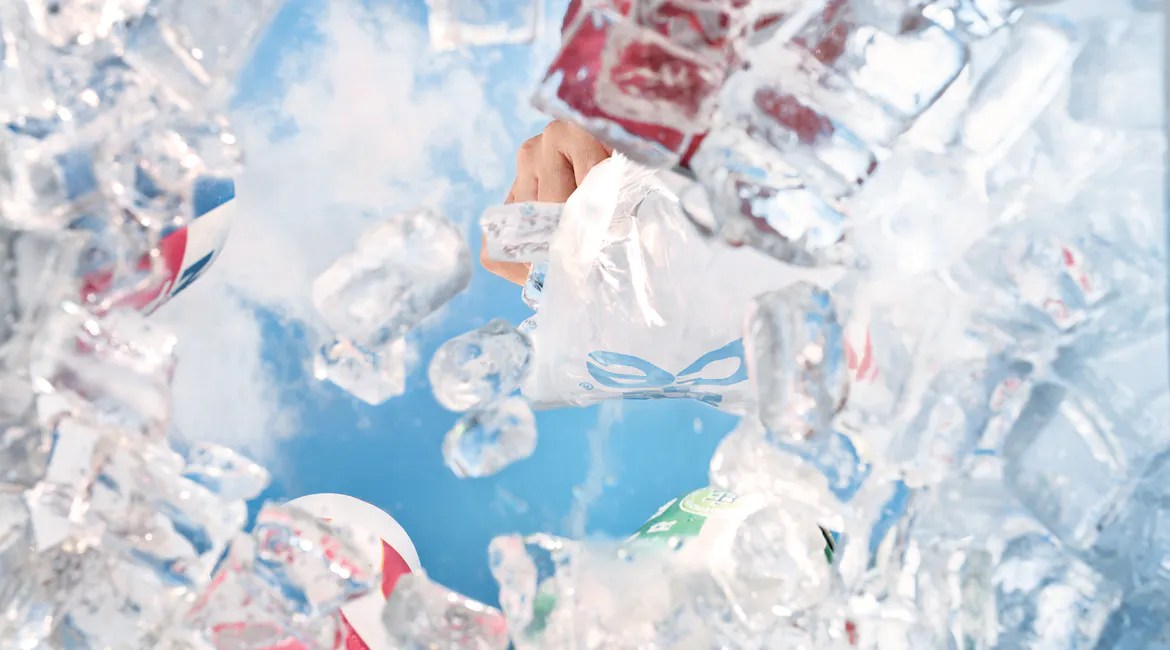
Your correspondent will on the road for the next several days, so (R)D will be on hiatus until on or around September 3. Meantime, a seasonally-appropriate post…
Writing for Texas Monthly, Lauren Larson visits Reddy Ice, the largest producer of packaged ice in North America and it’s CEO, Lonny Warner, to explore a billion-dollar industry that’s essential to us all, but that few of us stop to ponder…
… Warner joins a long procession of icemen who have bemoaned the lack of interest in their trade. “We are so familiar with water in its liquid and its solid form, that we seldom think of it as a mineral, and still less as a mineral product of any considerable industrial importance,” wrote W. P. Blake, an American geologist and mining consultant, in an 1883 report on the country’s ice trade. And yet, he wrote, “the industry is peculiarly American, and in no other country has the business of cutting and storing ice been so well systematized and perfected.”
By the time of Blake’s findings, people had been experimenting with making and keeping ice for centuries. In India, possibly as early as three thousand years ago, people used clay pots to cool water: The water’s evaporation through the clay removed heat, leaving chilled water or even ice under the right conditions. The technique is still used, especially as the country experiences record heat waves.
Americans in the nineteenth century, the dawn of the modern ice industry, had it easier. “The natural supply of ice in the United States is almost beyond calculation,” wrote a U.S. census agent named Henry Hall in a report submitted in 1883. Since at least 1805 so-called natural ice had been harvested from northern lakes, rivers, and ponds in a process accurately and musically depicted in the opening scene of Frozen, a rare cinematic nod to the ice industry. (In Eugene O’Neill’s 1946 play, The Iceman Cometh, a salesman has told his alcoholic friends that his wife is at home with the iceman. The iceman in question is meant to evoke death—the woman has been killed—but anxieties around swole deliverymen entering homes and seducing wives seem to have been prevalent in the twentieth century.) Using long handsaws and a variety of improvised plows, Northerners would cut grids in the ice and remove blocks, which were then stored or sent to warmer locales by ship or rail in insulated containers.
Thanks to a man named Frederic Tudor, some of these destinations were quite far-flung. Tudor was a merchant from Boston, more mutton chop than man in his later years. He would ship natural ice from Thoreau’s Walden Pond, which is startlingly Whole Foods–y branding for the nineteenth century.
Tudor envisioned a global ice industry. Perhaps he was motivated by the limited market for his Gläce-priced ice blocks in the U.S. or by the prevalence elsewhere of tropical fevers such as yellow fever, as the symptoms of these were often soothed by cold water. (In 1851 a doctor named John Gorrie experimented with creating a cold sickroom for malaria patients’ high fevers, effectively inventing air-conditioning.) In 1806, Tudor attempted to ship blocks of ice to the island of Martinique, a speculation that is detailed by Jonathan Rees, a history professor at Colorado State University Pueblo, in Refrigeration Nation, one of three books he’s written about refrigeration. First, the owner of a boat Tudor had chartered got cold feet, convinced, as many shipowners were, that the ice would melt and sink the ship. Tudor chartered another ship and successfully delivered his wares to the island, but Martinique had no icehouse in which to store it, and it began to melt, as ice does. Customers also had no idea how to transport it from his hold to their homes or keep it cold once they did; Tudor advised them to wrap their purchases in cloth. “He still got complaints, since it melted anyway,” writes Rees.
Tudor could very well have gone down in history as the father of the modern Potemkin start-up rather than the father of the modern ice industry, but he persevered. He saw that in order to create the worldwide ice trade he envisioned, he would have to build a global network of icehouses. Eventually his empire grew vast, and historians call Tudor by the absolutely sick moniker the Ice King…
… By the mid to late nineteenth century, artificial ice makers were being invented across the globe. Texans—perhaps shaken by the Civil War, which hindered the shipment of ice, and also likely motivated by the state’s growing beef industry—were aggressive in the ice race. By 1867, notes Rees, when the United States had only eight ice plants, three existed in San Antonio. Some early refrigeration machines used compressed ammonia, which is still widely used as a coolant. In the coming decades, ice plants bloomed across the state like frost on a window.
In the late 1920s, Southland Ice Company had eight plants and 21 retail locations in Texas, from which it provided ice for the iceboxes of residents in surrounding areas. (Widespread adoption of refrigerators was still several decades away and was driven, Rees tells me, by the lure of ice in the home. “The argument was always, ‘Get rid of the iceman. Buy a refrigerator.’ ”) Southland eventually became Southland Ice Corporation, and its icehouses, which had grown into convenience stores called Tote’ms, were rechristened 7-Elevens. In 1972, as 7-Eleven was growing into the brand that would stain the lips of countless middle schoolers with its neon Slurpees, Southland rebranded its large ice operation, calling it Reddy Ice Division.
Reddy was not yet the acquisitive ice empire it is today. For most of the twentieth century, regional producers thrived. But then, in the early nineties, the packaged-ice industry encountered an innovation: the in-store bagger. Refrigerator ice makers already existed but were not a particularly virile threat, as it would take a long time for a refrigerator-door ice maker to fill a cooler. In-store ice baggers were a different story.
The machines had been perfected by a young man named Jim Stuart, a former accountant who had consulted for a company called Automatic Ice Machine, or A.I.M. Inspired by that work, he began selling what he called the Ice Factory, a machine that automatically made and packaged ice at grocery stores and other retailers that had previously bought their ice from local businesses. Stuart began acquiring these flailing producers. His Houston-based company, Packaged Ice, quickly achieved ice supremacy, and in 1998, Stuart bought Reddy. (It still makes the Ice Factory.) A 2001 New Yorker profile christened Stuart the Emperor of Ice…
[Larson reviews the uses to which we put ice– the social (American’s prefer their beverages chilled), but also the more industral: ice is critical to everything from construction (e.g., in high temps it’s used to keep concrete from setting too quickly and becoming brittle) to medical treatment and research…]
… Not far from Reddy’s headquarters is a storage facility with twelve thousand pounds of ice that’s kept on reserve—kept on ice!—for emergencies. When natural disasters level our critical systems, as ritually occurs in Texas, ice is suddenly even more crucial. “When a hurricane hits and power goes out, we’re a lifeline,” Warner says. “It’s not for drinks at that point. It’s ‘how do I keep my food cold?’ ” In the event of a crisis, Reddy works with H-E-B, Walmart, and the Federal Emergency Management Agency to distribute ice, often thousands of pounds of it. He vividly remembers when Hurricane Beryl tore through Houston soon after the Fourth of July in 2024. Celebrations had cleared out Reddy and its distributors’ reserves, leading them to scramble to get ice from across the country to Houston. “We had H-E-B calling us for ice, and we were just trying to get it anywhere we could,” Horton, of Polar Ice, recalls.
The moments when ice is needed but unavailable are as irritating and unsettling to us as the breakdown of any utility, even in much lower-stakes contexts than a hurricane’s aftermath. “Ice is actually a very high-passion business,” says Juan Estrada, who directs Reddy plants in the Metroplex and across the state. Customers might stop at a convenience store on the way to a party, gather some snacks, and then ask for a bag of ice at the checkout. If there is no ice available, Estrada says, they’ll likely abandon all their other purchases and walk out. For most of us, these small but searing disappointments are the only times we think about the role of ice in our lives.
But for many Texans, ice can be the only thing keeping us from succumbing to our surroundings. In 2024, Harris County Public Health reported that heat-related illnesses had increased by 329 percent between 2019 and 2023. Texans who are exposed to heat as part of their work in industries including agriculture, construction, and delivery—as is the case for more than 35 percent of Americans—are disproportionately vulnerable, as are older adults and children.
Those of us outside those groups are not immune. As early as March of this year, a ranger at Big Bend National Park tells me, she and her colleagues were responding to between four and six heat-related incidents each week. Rangers bring ice on almost every medical response; it’s crucial for stabilizing patients during what can be an hours-long journey from the park to a hospital. In the summer, says San Antonio Fire Department medic Ashley Long, everyone is vulnerable to the heat, even those who have been hydrating all day. Much like the ice distributors, Long responds to ten times as many emergencies when it’s hot. “The hospitals are just slammed. Every single bed is taken,” she says. “Every disease and debilitation that people have is magnified by the heat.”
Perhaps we don’t think much about ice because doing so requires us to consider how implausible it is that we’re able to live comfortably in such heat. How lucky we are to enjoy a snow cone on a one-hundred-degree day.
An invisible essential: “Inside the Billion-Dollar Industry That’s Keeping Your Beer Cold—and Saving Lives,” from @lonlozzin.bsky.social in @texasmonthly.bsky.social.
For a look at the even larger, even more infrastructurally-central, but equally opaque– ‘cold chain’: “Food is simply sunlight in cold storage.”
* Samuel Taylor Coleridge, The Rime of the Ancient Mariner
###
As we stay cool, we might note that there’s still time to check in on World Water Week; today is its final day. While its in-person events are happening in Stockholm, much of the program is available online.
Why we should care (UK-centered, but all-too-relevant across the globe).

“What dreadful hot weather we have! It keeps one in a continual state of inelegance.”*…

Climatologist Zeke Hausfather on what’s turning out to be a scorching summer…
I’m generally pretty measured in how I discuss climate data. There has been only one time in recent years when I was truly shocked: when global temperatures came in for September 2023 at a full 0.5C warmer than any prior September on record. Once until today, that is. With the July runs now in from 667 ensemble members across 14 different seasonal forecast models, it looks like this year’s El Niño is not only very likely to be the strongest event since reliable records began – it may end up the strongest by a truly mind-blowing margin.
The multi-model median for the event’s peak (measured as detrended sea surface temperature anomalies in the Niño 3.4 region of the tropical Pacific) currently stands at 3.6C, roughly 0.8C hotter than the prior record of 2.75C set in 2015-16. For context, the gap between the strongest and the fifth strongest El Niño of the past 150 years is only about 0.5C. The models are forecasting something outside the envelope of anything we have ever observed [as the chart at the top illustrates].
A few things stand out in this figure. First, no event in a century and a half of observations has ever pushed meaningfully past 2.75C. The legendary 1877-78 event comes closest, in a statistical dead heat with 2015-16 (2.73C vs 2.75C, well within the uncertainty of 19th-century ship data). Second, the middle 80% of this year’s forecast ensemble sits entirely at or above that all-time record: even the low end of the plume (2.8C) grazes it. Around 91% of ensemble members exceed the 2015-16 record at their peak…
… What is remarkable here is not just the level but the trajectory. The 2026 event is developing faster than 1997-98, the previous gold standard for explosive El Niño onsets. And unlike 2015 which started its year already warm from a precursor event, this one launched from genuinely La Niña-ish conditions in January…
Read on the for the chilling-but-in-the-wrong-way details.
A ~90% chance of a record-setting event: “The Strongest El Niño Ever,” from @zekehausfather.com.
More detail– and opportunity to track the heat– at Zeke’s Climate Dashboard. And for related info, see also Climate.us— the volunteer-fielded “successor” to the now-suppressed Climate.gov.
* Jane Austen, in a 1796 letter to her elder sister, Casandra
###
As we sweat it, we might send scorching birthday greetings to the sublime Martha Reeves; she was born on this date in 1941. A singer, she is best known for her work in Martha and the Vandellas, which scored several major Hot 100 hits, including “Nowhere to Run,” “Jimmy Mack,” “Dancing in the Street,” and of course, “Heat Wave.” In 1995, the group was inducted into the Rock and Roll Hall of Fame; in 2023, Reeves was included on Rolling Stone‘s list of the 200 Greatest Singers of All Time.
“Men argue. Nature acts.”*…

Further to yesterday’s post, an elegant (albeit frightening) tool from our friends at The Pudding…
Climate scientists say that we’re headed for more than a two degree rise in earth’s temperatures. But for most of us, that’s not really helpful in providing a tangible vision of our future.
Perhaps that’s because we’re more familiar with weather: the daily, short-term forecasts that make you pack an extra sweater or wear your rain boots. Climate, on the other hand, describes average weather systems over long periods of time.
150 years ago, German scientist Wladimir Köppen attempted to bridge the gap between climate and weather by using vegetation growth, average temperature, and precipitation levels to classify the world into five distinct climate zones: Arid Tropical, Temperate, Cold, and Polar…
To distinguish the differences within these categories, the five climate zones are divided into subcategories.
For example, here you can see these European temperate climates broken up into four subcategories: Temperate – Dry summer, hot summer, Temperate – Dry summer, warm summer, Temperate – No dry season, warm summer, Temperate – No dry season, hot summer.
Overall, there are 30 unique subclassifications, and together they make up the Köppen Climate Classification (KCC). The KCC helps us not only differentiate between weather systems of neighboring countries, but also brings insights into cities oceans apart that on average will have similar weather throughout the year…
A 2018 study, led by climatologist Hylke Beck, used projected data from climate models along with the current Köppen Climate Classification to give a glimpse at what our world may look and feel like in 2070.
At a zoomed out level, some of these changes are hard to notice: Temperate climates shifting north Tropical and Arid climates growing Cold climates disappearing.
But what if we were to zoom into the city level to see how these changes affect the way each city feels?
This project looks at 70 global cities, and tracks their classification from present day to 2070.
And with climate change, your city isn’t just getting hotter: it will resemble the distinctive climate of completely different places…
Here we see our 70 global cities listed in their current climate classification. [With this tool], we can transport any city into its future classification…
Bracing: “Climate Zones- how will your city feel in the future?” from @puddingviz.
See also: “Conservation Imperatives: securing the last unprotected terrestrial sites harboring irreplaceable biodiversity,” a paper from two dozen climate scientists with a plan to protect Earth’s remain biodiversity by conserving a tiny percentage of the planet’s surface: “Our analysis estimated that protecting the Conservation Imperatives in the tropics would cost approximately $34 billion per year over the next five years. This represents less than 0.2% of the United States’ GDP, less than 9% of the annual subsidies benefiting the global fossil fuel industry, and a fraction of the revenue generated from the mining and agroforestry industries each year.”
* Voltaire
###
As we reconsider our customs, we might note that on this date last year, the Earth set a record for the hottest day every recorded… a record that lasted until the next day, Tuesday, July 4th. July 6, 2023 currently holds the record– but it is deemed likely to “fall” this summer…

“What dreadful hot weather we have! It keeps me in a continual state of inelegance.”*…

… and it’s likely, climate scientists Matthew Barlow and Jeffrey Basara suggest, to get more uncomfortable still…
… Although heat waves are a natural part of the climate, the severity and extent of the heat waves so far this year are not “just summer.”
A scientific assessment of the U.S. heat wave estimates that heat this severe and long-lasting was two to four times more likely to occur today because of human-caused climate change than it would have been without it. This conclusion is consistent with the rapid increase over the past several decades in the number of U.S. heat waves and their occurrence outside the peak of summer…
… Although heat waves are a natural part of the climate, the severity and extent of the heat waves so far this year are not “just summer.”
A scientific assessment of the U.S. heat wave estimates that heat this severe and long-lasting was two to four times more likely to occur today because of human-caused climate change than it would have been without it. This conclusion is consistent with the rapid increase over the past several decades in the number of U.S. heat waves and their occurrence outside the peak of summer…
At the peak of the last ice age, some 20,000 years ago, when the Northeast U.S. was under thousands of feet of ice, the globally averaged temperature was only 10.8 F (6 C) cooler than now. So, it is not surprising that 2.2 F (1.2 C) of warming so far is already rapidly changing the climate.
Countries promised in 2015 as part of the Paris Agreement to keep warming well under 2 C, but current government policies around the world won’t meet those goals. Temperatures are on pace to continue rising, with the increase likely to more than double again by the end of the century.
While this summer is likely be one of the hottest on record, it is important to realize that it may also be one of the coldest summers of the future…

Read on for more on: “How climate change is heating up the weather, and what we can do about it,” from @MathewABarlow and @OUWXDoc in @ConversationUS.
See also: “The rise of the truly cruel summer,” (gift article) from @TheEconomist.
* Jane Austen, in a letter to her sister dated 18th September, 1796
###
As we chill, we might recall that it was on this date in 1922, the day before his 19th birthday, that Ralph Samuelson invented water skiing. Samuelson had already mastered aquaplaning (riding on a sheet of wood while being pulled by a powerboat) but wanted a summer equivalent of snow skiing. He had unsuccessfully tried barrel staves and snow skis before succeeding with 8 foot long pine boards, the front tip of which he bent up (by boiling them in his mother’s kettle). His first successful outing, on a wide portion of the Mississippi River near Lake City, Minnesota, involved starting on an aquaplane, then stepping off onto the skis.
Samuelson didn’t patent his invention, nor was his work sufficiently publicized at the time to prevent U.S. Patent 1,559,390 for water skis from being subsequently issued, on October 27, 1925, to prolific inventor Fred Waller, who marketed his product as “Dolphin Akwa-Skees.” (Waller also invented Cinerama, which he used to publicize his skis…) Still, Samuelson, who became a turkey farmer, was a guest of honor at a water skiing 50th anniversary in 1972, and was inducted into the Water Ski Hall of Fame in 1977. His slightly-modified second pair (the first pair broke) still exists, and are on display at the Lake City Chamber of Commerce.

“I’m having a magenta day. Not just red, but magenta!”*…

Your correspondent is still on the road; regular service resumes on or around May 6. Meantime, a colorful update…
Forget about red hot. A new color-coded heat warning system relies on magenta to alert Americans to the most dangerous conditions they may see this summer.
The National Weather Service and the Centers for Disease Control and Prevention on Monday — Earth Day — presented a new online heat risk system that combines meteorological and medical risk factors with a seven-day forecast that’s simplified and color-coded for a warming world of worsening heat waves.
“For the first time we’ll be able to know how hot is too hot for health and not just for today but for coming weeks,” Dr. Ari Bernstein, director of the National Center for Environmental Health, said at a joint news conference by government health and weather agencies.
Magenta is the worst and deadliest of five heat threat categories, hitting everybody with what the agencies are calling “rare and/or long-duration extreme heat with little to no overnight relief.” It’s a step higher than red, considered a major risk, which hurts anyone without adequate cooling and hydration and has impacts reverberating through the health care system and some industries. Red is used when a day falls within the top 5% hottest in a particular location for a particular date; when other factors come into play, the alert level may bump even higher to magenta, weather service officials said.
On the other hand, pale green is little to no risk. Yellow is minor risk, mostly to the very young, old, sick and pregnant. Orange is moderate risk, mostly hurting people who are sensitive to heat, especially those without cooling, such as the homeless.
“When red-hot isn’t enough: New government heat risk tool sets magenta as most dangerous level,” from @AP.
* Stephen King, Needful Things
###
As we reassess risk, we might recall that it was on this date in 1986 that Russia announced the Chernobyl nuclear disaster, two days after it happened.

You must be logged in to post a comment.