Posts Tagged ‘cities’
“All the cities of the world are going to expand. We need to have a better understanding of what makes good urban habitat for home sapiens.”*…

“When did our vision of the future become so constrained, tired, and even dystopic?” Julien Crockett talks with Bruno Carvalho, the author of The Invention of the Future: A History of Cities in the Modern World, about the history of city planning and how urban design intertwines with a society’s prognostications and projections…
Cities have long been places of possibility—places where it seemed that we could break from the past and create an entirely new future. As Bruno Carvalho observes in his new book, The Invention of the Future: A History of Cities in the Modern World, this mindset is a key feature of what it means to be “modern”—a sensibility toward the present and the future as it relates to the past.
Yet, as Carvalho’s wide-ranging history details, a break from the past does not assume a positive vision of the future. In fact, Carvalho begins his book with the question “Where did the future go?”—the title of a debate between the venture capitalist Peter Thiel and anthropologist David Graeber. Both imagine that the only cities of tomorrow are on Mars. When did our vision of the future become so constrained, tired, and even dystopic?
Carvalho’s book returns to a recurring paradox we have faced since the Enlightenment: the better our capacity for creation and prediction, the more limited our ability to imagine a new future. He marvels, though, that “we know some of what is coming: urbanization and climate change, life and death. Between all that, there is a lot of space for reinvention.”
In our conversation, we look to the past to help us think through what reinvention might look like and discuss what it means to plan for a radically different future. We also discuss the legacies of Silicon Valley, the construction of New York City, urban futures moving from the West across the Pacific, and whether Carvalho is optimistic about what’s to come…
Eminently worth reading and pondering: “Where Did the Future Go?” from @lareviewofbooks.bsky.social.
* Jan Gehl
###
As we undertake to understand the urban, we might recall that it was on this date in 455 that the Vandals entered Rome, which they plundered for the next two weeks. It was, as sackings went (this was Rome’s third, of four altogether), relatively “light”: while the Vandals (who had destroyed all of Rome’s aqueducts on their approach) looted Roman treasure and sold many Romans into slavery, their leader Genseric acceded to the pleas of Pope Leo that the Vandals refrain from the wholesale slaughter of Rome’s population and the destruction of the Eternal City’s historic buildings.

“Bacteria represent the world’s greatest success story”*…

But as Stephen Jay Gould goes on to observe (in his 1996 book, Full House: The Spread of Excellence from Plato to Darwin), “They are today and have always been the modal organisms on earth; they cannot be nuked to oblivion and will outlive us all. This time is their time, not the ‘age of mammals’ as our textbooks chauvinistically proclaim. But their price for such success is permanent relegation to a microworld, and they cannot know the joy and pain of consciousness. We live in a universe of trade-offs; complexity and persistence do not work well as partners.”
Still, we (more complex) humans have recognized– and accommodated– bacteria for millennia. As We Make Money Not Art explains in a review of a recent book– We The Bacteria. Notes Toward Biotic Architecture by architectural historians Beatriz Colomina and Mark Wigley— that’s fascinatingly apparent in the history of architecture…
This “alternative history of architecture from the point of view of microbes” compiles the research that led to the exhibition We the Bacteria: Notes Toward Biotic Architecture at the 24th Milan Triennale last year. Curated by Colomina and Wigley, the show investigated how microbial ecosystems relate to spatial design and health inequality.
The book argues that microbes have not only built the whole planetary biosphere but they have also been the real architects of our homes and cities throughout the ages. Or rather, it’s the fear and diseases they cause that have shaped our spaces and the ways we move through them.
About ten thousand years ago, humans began retreating into spaces increasingly cut off from the exterior world. Plants, soil and insects could be left outside. But microbes, including pathogenic ones, followed humans inside their homes, where they adapted, mutated and generated new diseases. As our shelters expanded into villages, cities and sprawling empires, so too did the microbial ecosystems.
The authors narrate how buildings and bodies exist in a constant microbial exchange, co-evolving into a single, dynamic ecosystem. The microbiome of a home is highly specific to its inhabitants. Even the microbiome of a frequently cleaned hospital room resembles the microbiome of the previous patient, but starts to resemble that of a new occupant after twenty-four hours.
Architecture cannot exist without microbes, and, by extension, without disease. While scrubbing, spraying and disinfecting may eliminate most microorganisms, these practices also breed extremophiles, species so resistant that they can take over the space.
Throughout history, the book reveals, health crises have dictated architectural and urban design. From toilets to fumigation systems, from the plague hospitals, aka lazarettos, to the sanatoriums for tuberculosis patients; from sewage systems to urban parks, cities have been continually reshaped in response to the threats they sought to contain. Architecture became the first line of defence against microbes…
[More of the intertwined history of bacteria and our reponse to them, with lots of fascinating photos…]
… Given the important role that microbes play for our immune systems and the environments we inhabit, the authors call for a biotic architecture. Biotic architecture is less human-centric than traditional architecture. It learns from microbes rather than resists them. It does, of course, maintain some antimicrobial protocols against pathogens remain crucial. Water, sewage systems, toilets and food preparation areas still need to be cleansed, but cleaning routines should also embrace controlled exposure to microbial diversity. During COVID-19, for example, microbiologist Elisabetta Caselli and her colleagues replaced conventional disinfectants with probiotic-based sanitation in six Italian public hospitals. The result was a decrease in surface pathogens by up to 90% compared to conventional chemical cleaning and lower rates of healthcare-associated infections and antibiotic resistances… For once, here is a book that presents a vision where humans can actively contribute to microbial diversity, collaborate with the unseen world around us and build in ways that nurture rather than harm the environment…
More– and more fascinating images– at: “We The Bacteria. Notes Toward Biotic Architecture.”
###
As we coexist, we might recall that it was on this date in 2012 that Rebekah Speight of Dakota City, Nebraska sold a McDonald’s Chicken McNugget that resembled President George Washington for $8,100 on eBay (the third most expensive McNugget ever sold). She had kept the McNugget in her freezer for 3 years before deciding to sell it…. because bacteria.

“Walking is man’s best medicine”*…
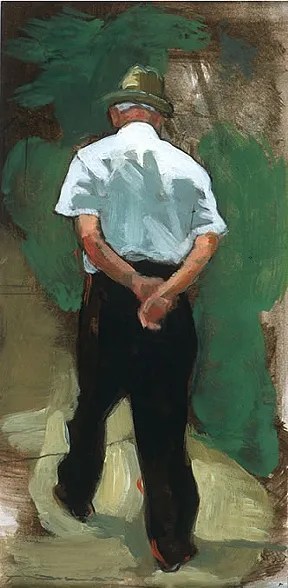
Thomas J. Bevin on the essential virtues of walking as inactivity…
… The vital thing to understand- and the point that I want to stress the most- is that walking is not an activity. Or rather, it should not be conceptualised as and reduced to being a mere activity. It is much more than that because it is much less than that. Walking is one of the great forms of inactivity and in a world of striving and consumerism and grasping and impatience it is one of only very few potential forms of inactivity left. It is that makes it precious.
You see, when you walk slowly and with no real destination in mind you are not doing, you are just being. Such walking, such contemplation is the beginning of freedom, it is the necessary pre-condition for having your own thoughts and as such for truly living your own life.
Which is why it is such a shame when people pollute their potentially edifying walks by turning to their ever-present phones. When I walk the streets and alleys of my city I constantly see people either shouting inanities into their phones or else using them to wirelessly pump music or podcasts into their eager ears. Walking thus becomes reduced to a mere mode of transportation for the carless and these reluctant pedestrians become- like so many other one-person-per-vehicle drivers- detached and isolated units moving through space. The audio and the journeying cancel each other out and it all bleeds into one, it becomes a blur that blots out the boredom of not being at your destination yet. Worse still is when this is combined with step counting apps or wristwatches which tragically instrumentalise the beautiful art of wandering around and turn walking into a metricated means of merely keeping the body alive and in some sort of working order. Such devices reduce us to machines, and one of the great tricks of Capitalism or The System or however you want to conceive it is that it not only turns us into machines for consumption and generating wealth for The Economy, but it also burdens us with the upkeep of the machinery that we have been reduced to becoming…
…
… When you start tracking your step count when you go for your daily constitutional you turn the walk into ‘free time’ in this sense. It becomes an Activity, something that is Good For You. And this only compounds if you listen to some manner of Educational Podcast as you do so. The thrillingly, daringly subversive non-activity of moseying around the neighbourhood for no reason other than the sheer pleasure of being alive, able to walk and out of doors degenerates into just another means of being visibly productive. Because eking out maximum amounts of productivity from every moment of our days has been working out so great for us thus far. All work and no play makes Jack a dull boy and we are all so play-deprived that many of us are becoming passive, disembodied viewers of our own on-screen lives…
…
… what does it say then when walking- something that is already complete and requires no thought or effort or expense- is polluted and diminished into just another opportunity to consume and document said consumption? What does it say when we so thoughtlessly desecrate our leisure like this? I would argue that to do these things is more than a little dehumanising.
Animals survive and act and react but only humans can opt out of this cycle and into the higher realm of inactivity. Just as silences make music more beautiful and pauses make conversations richer in meaning, it is inactivity- that is the moving beyond doing into being– that makes life human. Responding to stimuli alone, satisfying needs as they arise alone makes life nothing more than a cycle of biological survival.
The beauty is in the gaps. Art and culture arise from the blank spaces (which may be why these vital spheres in particular seem to be diminishing in this time of always on, always available activity). Uselessness and purposelessness are true luxury, true wealth. Look at any heart-stirring ceremony or custom or event- they are filled with detours and excesses, they are far from efficient. You could easily workshop a way of getting to the same basic endpoint much, much quicker and in doing so you would kill everything that made that ceremony unique and beautiful and, well, ceremonial.
The luxury of the aimless walk is one of the most accessible and readily available blank spaces we have. It is no coincidence that such a stroll will all of itself produce ideas and insights and new observations. In the absence of a task the mind will begin to play. It will be free. This is why walking and creativity go absolutely hand in hand. Insight comes to the contemplative and contemplation comes from inactivity, from not trying to generate insights, or indeed trying to do much of anything at all. In a try-hard world this is a difficult truth to convince people of. Because it asks for patience. It asks for more than mere effort. It asks for participation in the world as it is, which for the mind that has always trained itself to be busy is a big ask indeed. But it is the only way to be free…
Reclaiming our humanity: “Walking as Inactivity.”
And for a reminder that this wisdom has it place in the technical sphere of our lives: “Design for lingering.”
Sadly apposite: “More on Pedestrian Deaths.”
* Hippocrates
###
As we amble, we might send insightful birthday greetings to a man who walked both aimlessly and purposely, Lewis Mumford; he was born on this date in 1895. A historian, sociologist, philosopher of technology, and cultural critic, Mumford is probably best remembered for his writings on cities, perhaps especially for his award-winning book The City in History. (See also The City— the extraordinary film that Mumford made with Ralph Steiner and Wiilard Van Dyne, from an outline by the renowned documentarian Pare Lorentz, with a score by Aaron Copland.)
Mumford’s approaches to technology, its history, and its roles in society were acknowledged influences on writers like Jacques Ellul, Witold Rybczynski, Amory Lovins, E. F. Schumacher, Herbert Marcuse, Thomas Merton, and Marshall McLuhan. In a similar way, he was an inspiration for the organicist and environmentalist movements of today.
Unfortunately, once an economy is geared to expansion, the means rapidly turn into an end and “the going becomes the goal.” Even more unfortunately, the industries that are favored by such expansion must, to maintain their output, be devoted to goods that are readily consumable either by their nature, or because they are so shoddily fabricated that they must soon be replaced. By fashion and build-in obsolescence the economies of machine production, instead of producing leisure and durable wealth, are duly cancelled out by the mandatory consumption on an even larger scale….
Restore human legs as a means of travel. Pedestrians rely on food for fuel and need no special parking facilities…
– Lewis Mumford, The City in History

“The braid is always stronger than the strand”*…

From Grace Ebert, a novel look at the world’s densest “city”…
At its height in the 1990s, Kowloon Walled City in Hong Kong housed about 50,000 people. Its population is unremarkable for small cities, but what set Kowloon apart from others of its size was its density. Spanning only 2.6 hectares, the tiny enclave contained [the equivalent of] 1,255,000 people per square kilometer, making it the densest city in the world. For context, New York City boasts about 11,300 per square kilometer, while Manila, the most highly concentrated municipality today, tops out at about 42,000.
Kowloon was built as a small military fort around the turn of the 20th century. When the Chinese and English governments abandoned it after World War II, the area attracted refugees and people in search of affordable housing. With no single architect, the urban center continued to grow as people stacked buildings on top of one another and tucked new structures in between existing ones to accommodate the growing population without expanding beyond the original fort’s border.
With only a small pocket of community space at the center, Kowloon quickly morphed into a labyrinth of shops, services, and apartments connected by narrow stairs and passageways through the buildings. Rather than navigate the city through alleys and streets, residents traversed the structures using slim corridors that always seemed to morph, an experience that caused many to refer to Kowloon as “a living organism.”
The city devolved into a slum with crime and poor living conditions and was razed in 1994. Before demolition, though, a team of Japanese researchers meticulously documented the architectural marvel, which had become a sort of cyberpunk icon that even inspired a gritty arcade as tribute.
For a now out-of-print book titled Kowloon City: An Illustrated Guide, artist Hitomi Terasawa drew a meticulous cross-sectioned rendering of the urban phenomenon to preserve its memory. The massive panorama peers into the compact neighborhood, glimpsing narrow dance halls, laundry dangling from balconies, and entire factories tucked inside cramped quarters.
Thanks to psychologist Greg Jensen, we now have a stunning high-resolution scan of Terasawa’s illustration complete with annotations and diagramming. It’s worth viewing the full panorama in its entirety to zoom in on all the details of this infamous city [and here, animated]. And, for photos of Kowloon and its inhabitants, check out this incredibly informative video detailing its history…
A real-life human hive: “A Rare Cross-Section Illustration Reveals the Infamous Happenings of Kowloon Walled City,” from @Colossal.
* Ryan Graudin, The Walled City
###
As we pack it in, we might we might send the simplest of birthday greetings to a writer, philosopher, and naturalist who might not have gravitated naturally to Kowloon City, Henry David Thoreau; he was born on this date in 1817. From 1845 to 1847, Thoreau lived in a small cabin on the banks of Walden Pond, a small lake near Concord, Massachusetts. Striving to “simplify, simplify,” he strictly limited his expenditures, his possessions, and his contact with others, intending “to live deliberately, to front only the essential facts of life, and see if I could not learn what it had to teach.”
Thoreau became a pillar of New England Transcendentalism, embracing and exemplifying the movement’s belief in the universality of creation and the primacy of personal insight and experience. Perhaps best remembered for his advocacy of simple, principled living, his writings on the relationship between humans and the environment also helped define the nature essay.

“Men argue. Nature acts.”*…

Further to yesterday’s post, an elegant (albeit frightening) tool from our friends at The Pudding…
Climate scientists say that we’re headed for more than a two degree rise in earth’s temperatures. But for most of us, that’s not really helpful in providing a tangible vision of our future.
Perhaps that’s because we’re more familiar with weather: the daily, short-term forecasts that make you pack an extra sweater or wear your rain boots. Climate, on the other hand, describes average weather systems over long periods of time.
150 years ago, German scientist Wladimir Köppen attempted to bridge the gap between climate and weather by using vegetation growth, average temperature, and precipitation levels to classify the world into five distinct climate zones: Arid Tropical, Temperate, Cold, and Polar…
To distinguish the differences within these categories, the five climate zones are divided into subcategories.
For example, here you can see these European temperate climates broken up into four subcategories: Temperate – Dry summer, hot summer, Temperate – Dry summer, warm summer, Temperate – No dry season, warm summer, Temperate – No dry season, hot summer.
Overall, there are 30 unique subclassifications, and together they make up the Köppen Climate Classification (KCC). The KCC helps us not only differentiate between weather systems of neighboring countries, but also brings insights into cities oceans apart that on average will have similar weather throughout the year…
A 2018 study, led by climatologist Hylke Beck, used projected data from climate models along with the current Köppen Climate Classification to give a glimpse at what our world may look and feel like in 2070.
At a zoomed out level, some of these changes are hard to notice: Temperate climates shifting north Tropical and Arid climates growing Cold climates disappearing.
But what if we were to zoom into the city level to see how these changes affect the way each city feels?
This project looks at 70 global cities, and tracks their classification from present day to 2070.
And with climate change, your city isn’t just getting hotter: it will resemble the distinctive climate of completely different places…
Here we see our 70 global cities listed in their current climate classification. [With this tool], we can transport any city into its future classification…
Bracing: “Climate Zones- how will your city feel in the future?” from @puddingviz.
See also: “Conservation Imperatives: securing the last unprotected terrestrial sites harboring irreplaceable biodiversity,” a paper from two dozen climate scientists with a plan to protect Earth’s remain biodiversity by conserving a tiny percentage of the planet’s surface: “Our analysis estimated that protecting the Conservation Imperatives in the tropics would cost approximately $34 billion per year over the next five years. This represents less than 0.2% of the United States’ GDP, less than 9% of the annual subsidies benefiting the global fossil fuel industry, and a fraction of the revenue generated from the mining and agroforestry industries each year.”
* Voltaire
###
As we reconsider our customs, we might note that on this date last year, the Earth set a record for the hottest day every recorded… a record that lasted until the next day, Tuesday, July 4th. July 6, 2023 currently holds the record– but it is deemed likely to “fall” this summer…

You must be logged in to post a comment.