Posts Tagged ‘Sack of Rome’
“All the cities of the world are going to expand. We need to have a better understanding of what makes good urban habitat for home sapiens.”*…

“When did our vision of the future become so constrained, tired, and even dystopic?” Julien Crockett talks with Bruno Carvalho, the author of The Invention of the Future: A History of Cities in the Modern World, about the history of city planning and how urban design intertwines with a society’s prognostications and projections…
Cities have long been places of possibility—places where it seemed that we could break from the past and create an entirely new future. As Bruno Carvalho observes in his new book, The Invention of the Future: A History of Cities in the Modern World, this mindset is a key feature of what it means to be “modern”—a sensibility toward the present and the future as it relates to the past.
Yet, as Carvalho’s wide-ranging history details, a break from the past does not assume a positive vision of the future. In fact, Carvalho begins his book with the question “Where did the future go?”—the title of a debate between the venture capitalist Peter Thiel and anthropologist David Graeber. Both imagine that the only cities of tomorrow are on Mars. When did our vision of the future become so constrained, tired, and even dystopic?
Carvalho’s book returns to a recurring paradox we have faced since the Enlightenment: the better our capacity for creation and prediction, the more limited our ability to imagine a new future. He marvels, though, that “we know some of what is coming: urbanization and climate change, life and death. Between all that, there is a lot of space for reinvention.”
In our conversation, we look to the past to help us think through what reinvention might look like and discuss what it means to plan for a radically different future. We also discuss the legacies of Silicon Valley, the construction of New York City, urban futures moving from the West across the Pacific, and whether Carvalho is optimistic about what’s to come…
Eminently worth reading and pondering: “Where Did the Future Go?” from @lareviewofbooks.bsky.social.
* Jan Gehl
###
As we undertake to understand the urban, we might recall that it was on this date in 455 that the Vandals entered Rome, which they plundered for the next two weeks. It was, as sackings went (this was Rome’s third, of four altogether), relatively “light”: while the Vandals (who had destroyed all of Rome’s aqueducts on their approach) looted Roman treasure and sold many Romans into slavery, their leader Genseric acceded to the pleas of Pope Leo that the Vandals refrain from the wholesale slaughter of Rome’s population and the destruction of the Eternal City’s historic buildings.

“Knowledge without character”*…

Much has been written about AI and its possible consequences, both positive (e.g., productivity, innovation) and negative (e.g. resource consumption, job elimination, and economic inequality).
The estimable Nicholas Carr weighs in on AI’s potential impact on culture…
One day in 1953, a young and at the time little-known experimental artist named Robert Rauschenberg arrived at the studio of the great abstract expressionist Willem de Kooning bearing a bottle of Jack Daniels and a strange request. He wanted the famous artist to give him one of his drawings so he could erase it. De Kooning was taken aback. “I remember that the idea of destruction kept coming into the conversation,” Rauschenberg later recalled, “and I kept trying to show that it wouldn’t be destruction.”
Rauschenberg explained to de Kooning that he wanted to see if a work of art could be created not just through the inscription of marks but through their removal. Could art be erasive as well as inscriptive? After much back-and-forth, and several servings of brown liquor, de Kooning agreed. He chose a drawing he had recently completed — one he was fond of — and gave it to Rauschenberg.
Over the course of the next two months, Rauschenberg slowly, meticulously erased the drawing, taking off layers of grease pencil, charcoal, graphite, and ink. He went through forty erasers. All that remained in the end were a few faint traces of the original sketch. With the help of his friend Jasper Johns, he then carefully matted and framed the work, and Johns wrote a label for it, inscribing the title, artist, and date so precisely that they appeared to have been printed out by a machine:
ERASED de KOONING DRAWING
ROBERT RAUSCHENBERG
1953“The simple, gilded frame and understated inscription are integral parts of the finished artwork,” writes a curator at the San Francisco Museum of Modern Art, which acquired the work in 1998, “offering the sole indication of the psychologically loaded act central to its creation.” Even a work of erasure demands a frame, Rauschenberg understood, a boundary establishing its place in the world. Erasure cries out for inscription. We want to know the marks were there before they weren’t.
Erasive is an exceptionally uncommon word. It was coined in the seventeenth century but has rarely been used since. Word-processing and messaging spellcheckers underline it with suspicion. Its rarity testifies to our discomfort with, as the SFMOMA writer terms it, the “psychologically loaded act” of erasure. But, thanks to the rise of what tech companies have cheerfully branded “generative AI,” the word seems certain to be used more often in the years to come. Our condition demands it. Behind every act of AI generation lie many acts of erasure. We have entered the erasive age.
Although we assume that media is fundamentally inscriptive, a means of preserving and transmitting human-made marks of one sort or another, communication systems have always also entailed erasure. What they erase are the spatiotemporal boundaries that in nature fix speech to speaker. A person says something, and if there are others in earshot, they hear it. Otherwise it’s gone. But that same person writes those same words down on a sheet of paper, or enters them into a computer network, and the words can travel through space and persist through time. Much of the value of media, cultural and financial, has always stemmed from its power to erase the material world’s physical constraints on the flow of speech, the flow of information.
So long as erasure served our desire to transmit our own marks and receive the marks made by others, we didn’t worry about it. We celebrated it — the death of distance! the transcendence of time! — just as we celebrate other technologies that free us, or at least shield us, from the world’s frictions and constraints. We want our marks, and the marks of others, to flow freely through space and time. We want the speech of distant people to arrive in our mailbox, to issue forth from our radio and TV, to hang on the walls of a museum, to appear on the screen of our phone. Take away such freedom of movement, return us to the original communication system of mouth and ear, and you take away knowledge, culture, entertainment, pretty much the entirety of modernity.
Erasure is good for business. The more that media has erased the world, the more dependent society has become on the systems and services of media companies and the more profits those companies have earned. That’s why people like Mark Zuckerberg have been so eager to promote the benefits of “frictionlessness” in communication and social relations. What we failed to appreciate is that the pursuit of profit would lead the companies beyond the erasure of spatiotemporal boundaries. They would seek to erase the greatest source of friction in their operations: their reliance on human creativity and expression. They would seek to replace the human source of the information they transmit — speakers and their speech — with highly efficient machines capable of creating “content” cheaply and on demand.
In creating tradable derivatives of human speech, AI erases the human voice, the human hand. First, it turns the works of culture into numbers, then it compresses those numbers into a generalized statistical model. Of the originals only traces remain. If Rauschenberg sought to show that erasure can be a generative act, AI bots have the opposite goal: to show that generation can be an erasive act. Fulfilling de Kooning’s fears, generation turns destructive…
… The more we draw on AI to shape our perception and understanding of the world, to structure our thoughts and words, to express ourselves, the more complicit we become in erasing culture, the past, others, ourselves. Eventually, should we continue down the path, even the memory of what’s been erased will be erased. No frame, no matting, no inscription. Only the empty revelation of erasure…
Generation as destruction: “The Erasive Age,” and entry in Carr’s on-going series, Dead Speech, on the cultural and economic consequences of AI.
Pair with Rob Horning on AI’s commodification of language: “The reified mind.”
See also Henry Farrell‘s “Large language models are cultural technologies. What might that mean?” and “A.I. Is Coming for Culture“, from Joshua Rothman.
* “The Seven Social Sins are:
Wealth without work.
Pleasure without conscience.
Knowledge without character.
Commerce without morality.
Science without humanity.
Worship without sacrifice.
Politics without principle.”
– From a sermon given by Frederick Lewis Donaldson in Westminster Abbey, 1925
###
As we husband our humanity, we might recall that it was on this date in 410 that the three day Sack of Rome by the Barbarian Visigoths, led by Alaric, ended.
Rome was at the time no longer the capital of the Western Roman Empire (it had moved to Mediolanum and then to Ravenna); but it remained the Empire’s spiritual and cultural center, “the eternal city.” And it had not fallen to an enemy in almost 800 years (the Gauls sacked Rome in 387 BCE). As St. Jerome, living in Bethlehem at the time, wrote: “The City which had taken the whole world was itself taken.”

A 15th-century depiction of the Sack of Rome (with anachronistic details)
“Firmness, utility, and beauty”*…
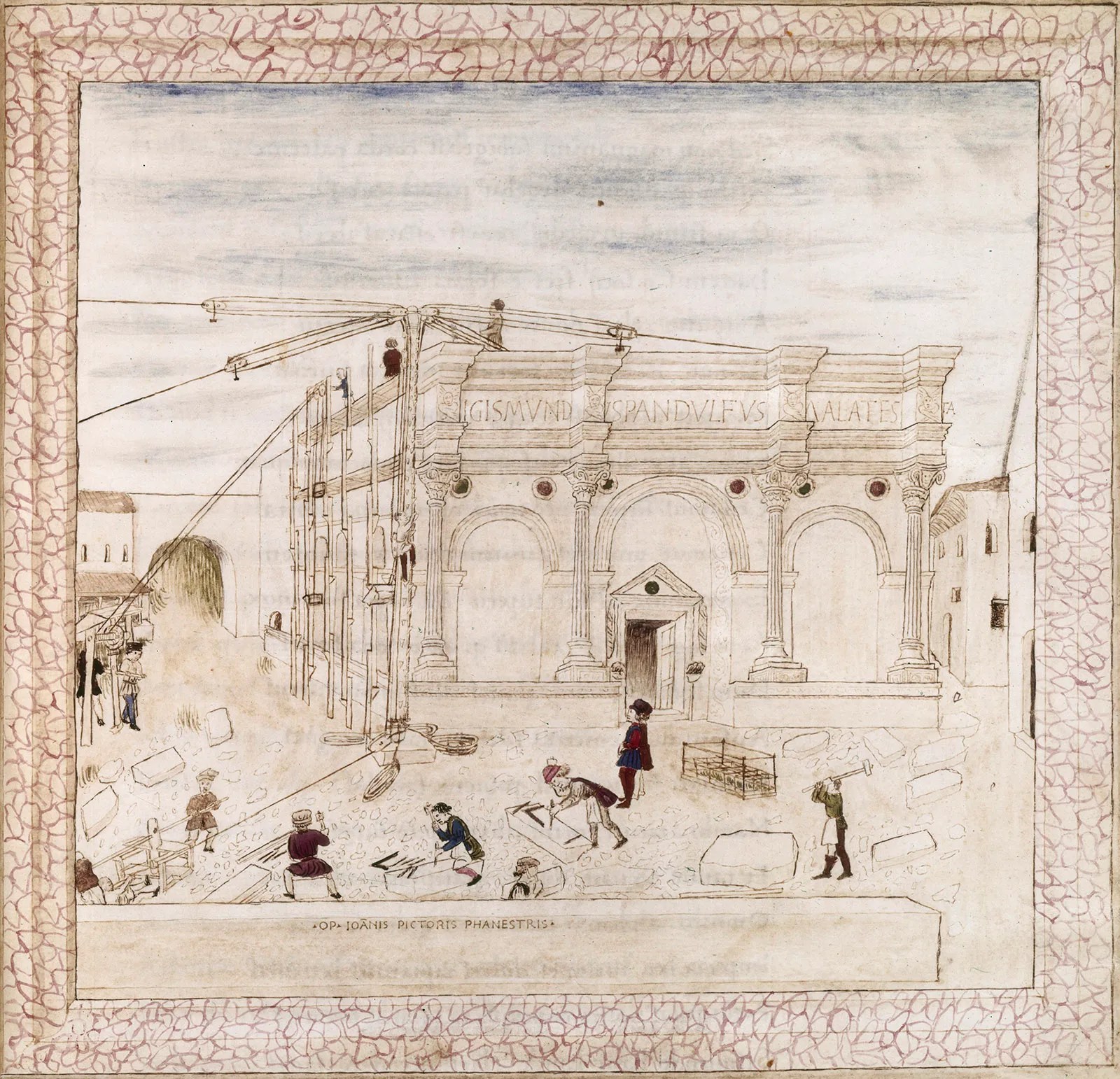
In a review of Indra Kagis McEwen‘s book All the King’s Horses- Vitruvius in an Age of Princes, Ingrid Rowland examines the ways in which Vitruvius’s Ten Books on Architecture [AKA De Architectura] was not only a manual of the building arts but a treatise on how to extend and consolidate the Roman Empire, and lent itself all too well to the autocratic ambitions of Renaissance princes…
As perennial best sellers go, the treatise known as Ten Books on Architecture by the Roman writer Vitruvius is not, perhaps, the most predictable. It includes some gripping stories, certainly, many of them military, like the the Carian queen Artemisia’s surprise naval attack on Rhodes aboard the Rhodians’ own ships or the thwarted siege of the same city by the Macedonian general Demetrius Poliorcetes, the proverbial “Sacker of Cities,” whose gigantic war machine, the “City-seizer” (Helepolis), churns to an ignominious halt in a pool of muck created overnight by the mass emptying of Rhodian chamber pots.
These vignettes, however, are little gems inserted to brighten long passages about what kind of wood to use for different parts of a building, the proportions of temples, and the marvels of waterproof concrete, as well as instructions on how to build, among many other wonders and amenities, sundials, aqueducts, water clocks, and catapults. Its storehouse of practical information helped to ensure that Vitruvius’s handbook, written around 25 BCE, was one of the few ancient Greek and Latin works to survive what the fifteenth-century pundit Leon Battista Alberti called the “shipwreck” of the Middle Ages, along with the poetry of Vergil and Ovid, the prose of Cicero, a Latin translation of Plato’s Timaeus, the Bible, and some other surprisingly durable texts. Ever since the papal printer Eucharius Silber brought out his edition in Rome in 1486, Ten Books on Architecture has never gone out of print.
One of the chief reasons for the enduring interest in On Architecture, aside from its treasury of practical instructions, is the ambitious educational program that Vitruvius puts forth in the first of his ten books (each of which originated as a single papyrus scroll, closer to the length of a modern chapter than an entire book, just as his chapters are approximately the size of a paragraph). Architects, he argues, can only complete their work properly (in his words, “perfect” it) if they are well informed about every one of the subjects that the art of building brings into play—if not as well informed as a specialist, then at least well enough to make the right decisions. A competent practitioner, therefore, must not only master drawing but also have a good grasp of literature, music, mathematics, and law…
… It seems likely that the connection between education, architecture, and empire inspired the creation of the earliest known manuscript of Vitruvius, copied on parchment in the ninth century, perhaps for Charlemagne, perhaps by the hand of his learned adviser Alcuin of York, almost certainly as part of the Frankish king’s project of resurrecting the glories of ancient Rome in a Christian spirit. It is through this same clever wedge, education, that Vitruvius has driven himself and his treatise into the very heart of the way the contemporary world still thinks about any number of things, from human scale to beauty to liberal education to the best methods of town planning. Whether you have read Vitruvius or not, his influence is still palpable in the fabric of modern urban life, and that is why he has been translated as recently as 2017 into Chinese…
… In All the King’s Horses: Vitruvius in an Age of Princes, Indra Kagis McEwen, a Canadian architect and historian, brings out a more chilling aspect of Vitruvius and his millennial tradition: his fatal attractiveness to despots. The “princes” of her title are the princes of whom Machiavelli wrote: strongmen who seized and maintained one-man rule over medieval and early modern Italian city-states by force of arms and charisma. Augustus served these princes as an inspiring model because his trajectory so closely resembled their own—except, of course, for its colossal scale. Like the Italian lords who revered him, the future Imperator rose to his august heights by doing whatever would ensure his own survival, eventually completing a process that Machiavelli attributes to Augustus’s adoptive father, Julius Caesar: supplanting the ancient Roman Republic with one-man rule…
Fascinating… and too timely: “Vitruvius & the Warlords” from @nybooks.com.
* “Firmitas, utilitas, venustas”– the three principles of good architecture, as described by Vitruvius in De Architectura
###
As we analyze the architecture of authoritarianism, we might recall that it was on thsi date in 1527, during the War of the League of Cognac (a dispute between the Holy Roman Empire and the Papacy), that Rome was captured and sacked by the mutinous troops of Charles V, Holy Roman Emperor. Charles V had intended only to threaten military action to make Pope Clement VII come to his terms. But most of Charles’ Imperial army (14,000 Germans, including Lutherans, 6,000 Spaniards, and some Italians) were unpaid, and took matters into their own hands. Despite being ordered not to storm Rome, they broke into the scarcely defended city and began looting, killing, and holding citizens for ransom. Clement VII took refuge in Castel Sant’Angelo after the Swiss Guard were annihilated in a delaying rear guard action; he remained there until a ransom was paid to the pillagers. Benvenuto Cellini witnessed the Sack and described the it in his works.
The Sack of Rome impacted the histories of Europe, Italy, and Christianity, creating lasting ripple effects throughout European culture and politics. Before the sack, Rome had been a center of Italian High Renaissance culture and patronage, and the main destination for any European artist eager for fame and wealth, thanks to the prestigious commissions of the papal court. In the sack, Rome suffered depopulation and economic collapse, sending artists and writers elsewhere.
The Sack of Rome also permanently shifted the balance of power between Church and State. Before the sack, Pope Clement VII opposed the ambitions of Emperor Charles V. Afterward, he no longer had the military or financial resources to do so. To avert more warfare, Clement adopted a conciliatory policy toward Charles. The power shift – away from the Pope, toward the Emperor – also produced lasting consequences for Catholicism.
And the Sack of Rome also contributed to making permanent the split between Catholics and Protestants. (After the sack, Clement acceded to Charles’ wishes, agreeing to call a Church Council to decide how to address the Protestant Reformation and naming the city of Trent, Italy as its site. In 1545, eleven years after Clement’s death, his successor Pope Paul III convened the Council of Trent. As Charles predicted, it reformed the corruption present in certain orders of the Catholic Church. But by 1545, the moment for reconciliation between Catholics and Protestants – arguably a possibility during the 1520s, given cooperation between the Pope and Emperor – had passed.)
The Sack of Rome is widely identified by historians as the the end of the Italian High Renaissance.

“Everyone should be able to do one card trick, tell two jokes, and recite three poems, in case they are ever trapped in an elevator”*…

Two things make tall buildings possible: the steel frame and the safety elevator. The elevator, underrated and overlooked, is to the city what paper is to reading and gunpowder is to war. Without the elevator, there would be no verticality, no density, and, without these, none of the urban advantages of energy efficiency, economic productivity, and cultural ferment. The population of the earth would ooze out over its surface, like an oil slick, and we would spend even more time stuck in traffic or on trains, traversing a vast carapace of concrete. And the elevator is energy-efficient—the counterweight does a great deal of the work, and the new systems these days regenerate electricity. The elevator is a hybrid, by design…
The history, design, economics, and psychology of the technology that made modern cities possible– the lives of elevators: “Up and Then Down.”
* Daniel Handler
###
As we press the button, we might recall that it was on this date in 1527, during the War of the League of Cognac, that an estimated 20,000 mutinous troops of Charles V, Holy Roman Emperor (angered over unpaid wages) carried out the Sack of Rome (which was then part of the papal States). For three days, they pillaged the city, grabbing valuables and demanding tributes. They overpowered (and killed most of) the Swiss Guard, and took Pope Clement VII hostage (in Castel Sant’Angelo); he was freed only after a hefty ransom was paid. Benvenuto Cellini, witnessed the Sack and described the it in his works.
In the aftermath, Rome– which had been the center of Italian High Renaissance culture– never recovered its momentum. Indeed, many historians consider the Sack of Rome the end of the Renaissance.

“Not everything that is faced can be changed, but nothing can be changed until it is faced”*…

Police advance through a cloud of tear gas on Aug. 17, 2014 in Ferguson, Mo.
Fifty years ago, President Lyndon B. Johnson called for a “War on Crime,” a declaration that ushered in a new era of American law enforcement. Johnson’s turn toward crime control as a federal priority remains his most enduring legacy—even more than the Great Society programs that scholars often herald as his greatest achievement—and continues to shape what is arguably the most important social crisis the United States now faces.
Until recently, the devastating outcomes of the War on Crime that Johnson began had gone relatively unnoticed. Then, last August, during the series of demonstrations in Ferguson, Mo., images of law-enforcement authorities drawing M-4 carbine rifles and dropping tear gas bombs on protestors and civilians alike shocked much of the American public. Ferguson looked like a war zone. Many commentators attributed this sight to the ongoing technology transfers from the defense sector to local law-enforcement authorities, which began during the War on Drugs and escalated in the climate of the War on Terror.
But the source of those armored cars is much older than that. It was the Law Enforcement Assistance Act that Johnson presented to Congress on March 8, 1965, that first established a direct role for the federal government in local police operations, court systems, and state prisons. Even though the Voting Rights Act is considered the major policy victory of that year, Johnson himself hoped that 1965 would be remembered not as the apex of American liberal reform, but rather as “the year when this country began a thorough, intelligent, and effective war against crime”…
As we witness (again) the deploying of martial materiel against citizens the vast majority of whom are peacefully exercising their constitutional rights to express all-too-understandable frustration and anger, we’d be wise to try to learn from our history and correct our mistakes: “Why We Should Reconsider the War on Crime.”
(TotH to EWW)
*
###
As we pray for ploughshares, we might recall that it was on this date in 455 that the Vandals entered Rome, which they plundered for the next two weeks. It was, as sackings went (this was Rome’s third, of four altogether), relatively “light”: while the Vandals (who had destroyed all of Rome’s aqueducts on their approach) looted Roman treasure and sold many Romans into slavery, their leader Genseric acceded to the pleas of Pope Leo that the Vandals refrain from the wholesale slaughter of Rome’s population and the destruction of the Eternal City’s historic buildings.

Genseric sacking Rome, by Karl Briullov
You must be logged in to post a comment.