“Firmness, utility, and beauty”*…
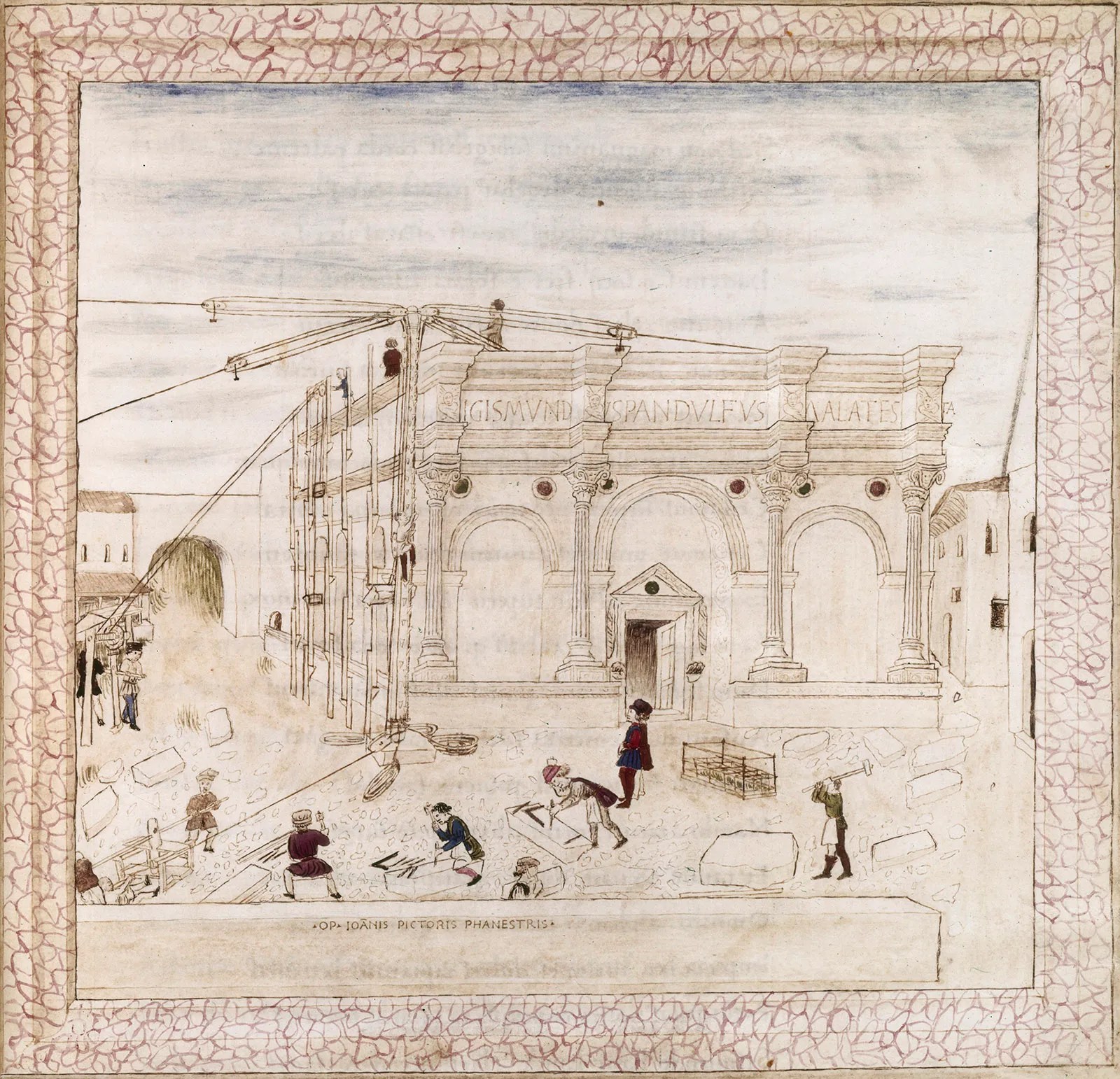
In a review of Indra Kagis McEwen‘s book All the King’s Horses- Vitruvius in an Age of Princes, Ingrid Rowland examines the ways in which Vitruvius’s Ten Books on Architecture [AKA De Architectura] was not only a manual of the building arts but a treatise on how to extend and consolidate the Roman Empire, and lent itself all too well to the autocratic ambitions of Renaissance princes…
As perennial best sellers go, the treatise known as Ten Books on Architecture by the Roman writer Vitruvius is not, perhaps, the most predictable. It includes some gripping stories, certainly, many of them military, like the the Carian queen Artemisia’s surprise naval attack on Rhodes aboard the Rhodians’ own ships or the thwarted siege of the same city by the Macedonian general Demetrius Poliorcetes, the proverbial “Sacker of Cities,” whose gigantic war machine, the “City-seizer” (Helepolis), churns to an ignominious halt in a pool of muck created overnight by the mass emptying of Rhodian chamber pots.
These vignettes, however, are little gems inserted to brighten long passages about what kind of wood to use for different parts of a building, the proportions of temples, and the marvels of waterproof concrete, as well as instructions on how to build, among many other wonders and amenities, sundials, aqueducts, water clocks, and catapults. Its storehouse of practical information helped to ensure that Vitruvius’s handbook, written around 25 BCE, was one of the few ancient Greek and Latin works to survive what the fifteenth-century pundit Leon Battista Alberti called the “shipwreck” of the Middle Ages, along with the poetry of Vergil and Ovid, the prose of Cicero, a Latin translation of Plato’s Timaeus, the Bible, and some other surprisingly durable texts. Ever since the papal printer Eucharius Silber brought out his edition in Rome in 1486, Ten Books on Architecture has never gone out of print.
One of the chief reasons for the enduring interest in On Architecture, aside from its treasury of practical instructions, is the ambitious educational program that Vitruvius puts forth in the first of his ten books (each of which originated as a single papyrus scroll, closer to the length of a modern chapter than an entire book, just as his chapters are approximately the size of a paragraph). Architects, he argues, can only complete their work properly (in his words, “perfect” it) if they are well informed about every one of the subjects that the art of building brings into play—if not as well informed as a specialist, then at least well enough to make the right decisions. A competent practitioner, therefore, must not only master drawing but also have a good grasp of literature, music, mathematics, and law…
… It seems likely that the connection between education, architecture, and empire inspired the creation of the earliest known manuscript of Vitruvius, copied on parchment in the ninth century, perhaps for Charlemagne, perhaps by the hand of his learned adviser Alcuin of York, almost certainly as part of the Frankish king’s project of resurrecting the glories of ancient Rome in a Christian spirit. It is through this same clever wedge, education, that Vitruvius has driven himself and his treatise into the very heart of the way the contemporary world still thinks about any number of things, from human scale to beauty to liberal education to the best methods of town planning. Whether you have read Vitruvius or not, his influence is still palpable in the fabric of modern urban life, and that is why he has been translated as recently as 2017 into Chinese…
… In All the King’s Horses: Vitruvius in an Age of Princes, Indra Kagis McEwen, a Canadian architect and historian, brings out a more chilling aspect of Vitruvius and his millennial tradition: his fatal attractiveness to despots. The “princes” of her title are the princes of whom Machiavelli wrote: strongmen who seized and maintained one-man rule over medieval and early modern Italian city-states by force of arms and charisma. Augustus served these princes as an inspiring model because his trajectory so closely resembled their own—except, of course, for its colossal scale. Like the Italian lords who revered him, the future Imperator rose to his august heights by doing whatever would ensure his own survival, eventually completing a process that Machiavelli attributes to Augustus’s adoptive father, Julius Caesar: supplanting the ancient Roman Republic with one-man rule…
Fascinating… and too timely: “Vitruvius & the Warlords” from @nybooks.com.
* “Firmitas, utilitas, venustas”– the three principles of good architecture, as described by Vitruvius in De Architectura
###
As we analyze the architecture of authoritarianism, we might recall that it was on thsi date in 1527, during the War of the League of Cognac (a dispute between the Holy Roman Empire and the Papacy), that Rome was captured and sacked by the mutinous troops of Charles V, Holy Roman Emperor. Charles V had intended only to threaten military action to make Pope Clement VII come to his terms. But most of Charles’ Imperial army (14,000 Germans, including Lutherans, 6,000 Spaniards, and some Italians) were unpaid, and took matters into their own hands. Despite being ordered not to storm Rome, they broke into the scarcely defended city and began looting, killing, and holding citizens for ransom. Clement VII took refuge in Castel Sant’Angelo after the Swiss Guard were annihilated in a delaying rear guard action; he remained there until a ransom was paid to the pillagers. Benvenuto Cellini witnessed the Sack and described the it in his works.
The Sack of Rome impacted the histories of Europe, Italy, and Christianity, creating lasting ripple effects throughout European culture and politics. Before the sack, Rome had been a center of Italian High Renaissance culture and patronage, and the main destination for any European artist eager for fame and wealth, thanks to the prestigious commissions of the papal court. In the sack, Rome suffered depopulation and economic collapse, sending artists and writers elsewhere.
The Sack of Rome also permanently shifted the balance of power between Church and State. Before the sack, Pope Clement VII opposed the ambitions of Emperor Charles V. Afterward, he no longer had the military or financial resources to do so. To avert more warfare, Clement adopted a conciliatory policy toward Charles. The power shift – away from the Pope, toward the Emperor – also produced lasting consequences for Catholicism.
And the Sack of Rome also contributed to making permanent the split between Catholics and Protestants. (After the sack, Clement acceded to Charles’ wishes, agreeing to call a Church Council to decide how to address the Protestant Reformation and naming the city of Trent, Italy as its site. In 1545, eleven years after Clement’s death, his successor Pope Paul III convened the Council of Trent. As Charles predicted, it reformed the corruption present in certain orders of the Catholic Church. But by 1545, the moment for reconciliation between Catholics and Protestants – arguably a possibility during the 1520s, given cooperation between the Pope and Emperor – had passed.)
The Sack of Rome is widely identified by historians as the the end of the Italian High Renaissance.

You must be logged in to post a comment.