Posts Tagged ‘unintended consequences’
“Most things are never meant”*…
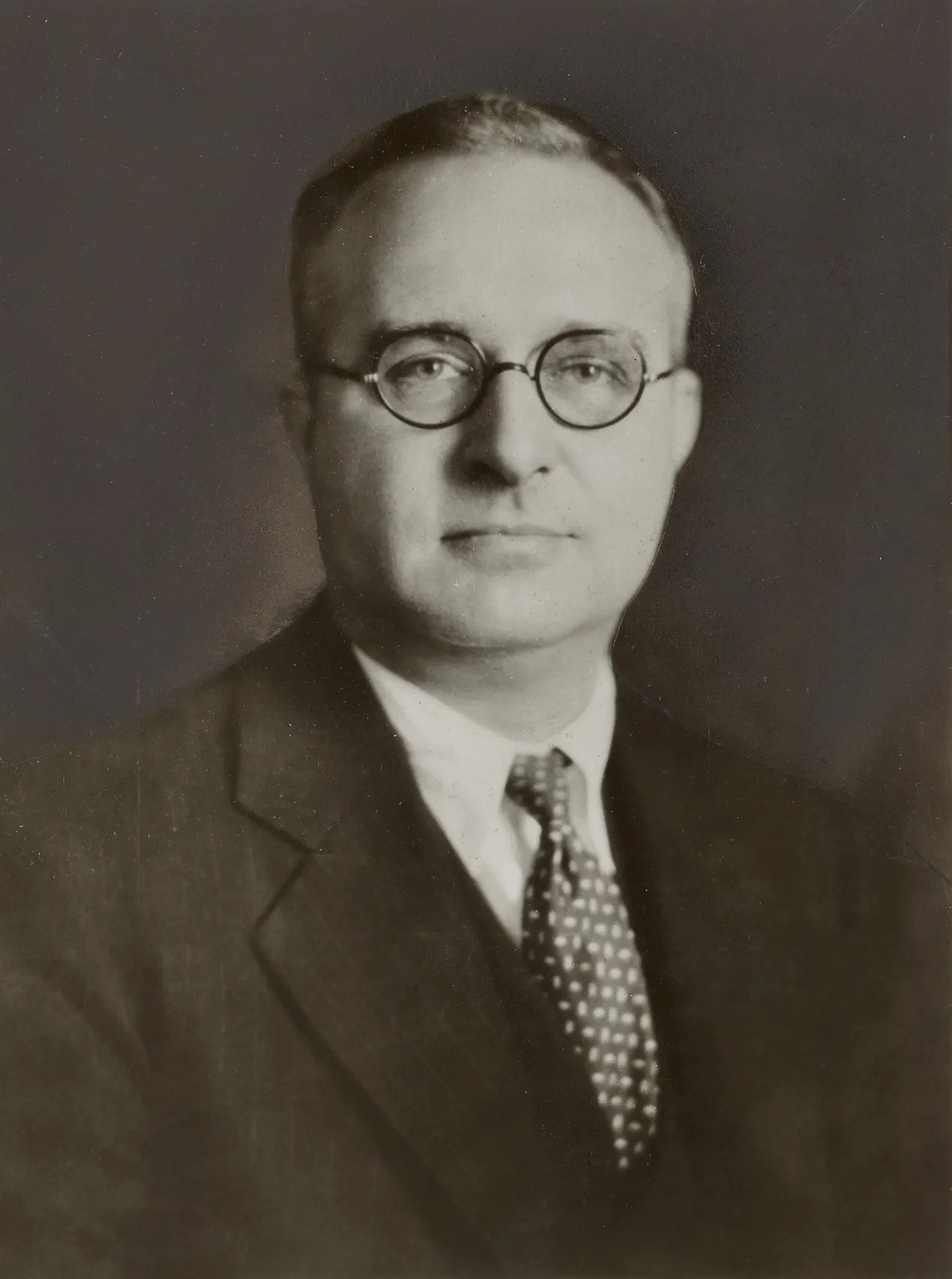
From Dan Russell‘s nifty (and in this instance, all-too-appropriately-named) newsletter, Unanticipated Consequences, an “appreciation” of a gentleman into whom (Roughly) Daily has run before (e. g, here)…
If you set out to design a supervillain to destroy the biosphere, create a jovial, optimistic mechanical engineer from Ohio who wanted to make the world a slightly more convenient place. Thomas Midgley Jr. was not a mad scientist plotting global ruin from a diabolical evil-genius lair, he was an enthusiastic tinkerer, and as a friend once commented, had “ten ideas a minute, nine of them screwy, but the tenth a lulu.” He wrote light verse, loved music, and held over a hundred patents. As a teenager, he used elm-tree juice instead of spit to throw unhittable curveballs. He was, by all accounts, a charming guy who merely sought practical solutions to the day’s pressing technological annoyances. What could go wrong?
Yet, by the time his career was over, Midgley had introduced two of the most globally destructive chemical compounds in human history. He became, as one historian aptly put it, a one-man environmental disaster. His legacy is the ultimate cautionary tale for the modern innovator: a masterclass in the massive, terrifying, and utterly unanticipated consequences of design choices…
[Russell tells the stories of Midgley’s pair of consequential inventions: the additive “lead” (tetraethyl lead, a neurotoxin) in gasoline and the refrigerant CFC (the use of which ripped a hole in the ozone layer). He recounts Midgley’s death (literally) in the grip of another of his inventions, then concludes…]
… What do we do with the ghost of Thomas Midgley? It is easy, with a century of hindsight, to look back at the millions of cardiovascular deaths, the plummeting IQs, and the shredded stratosphere, and label him a monster. But that ignores the fundamental mechanics of innovation. The Midgley story is a stark reminder of the massive delta between human intent and ecological reality.
When we invent, we are almost always trying to solve a local, immediate pain point. Engines rattle and refrigerators explode. Midgley looked at these problems and offered brilliant and simple solutions. But biology and atmosphere are deeply intertwined and heavily networked systems. The consequences of introducing synthetic compounds into these systems don’t spool out in days or weeks; they unfold across generations.
Midgley did not want to poison the world. He wrote poetry about human dominance over the Earth, genuinely believing that science could only make the future better. If forced to concede the environmental damage of his inventions, he likely would have plunged headlong into the lab to invent safe substitutes. But he lacked the conceptual tools, the time horizon, and the humility to imagine that the very things that made his inventions magical—the cheap and effective solution of lead and the unyielding stability of Freon—were exactly what made them apocalyptically awful for humanity.
The history of Thomas Midgley is a brilliantly clear, slightly horrifying reminder: sometimes, the most dangerous things in the world are brought to us by a friendly guy with a periodic table in his pocket, just trying to stop that really annoying noise in his car…
The bane of unintended consequences: “New Ways to Poison an Entire Planet: The Legacy of Thomas Midgley, Jr.”
* Philip Larkin, “Going, Going“
###
As we consider consequences, we might acknowledge that there are some consequences ourecall that on this date in 1908, at around 7:15 am, northwest of Lake Baikal, Russia, a huge fireball nearly as bright as the Sun was seen crossing the sky. Minutes later, there was a huge flash and a shock wave felt up to 400 miles away. Over Tunguska, a meteorite over 50-m diameter, travelling at over 60,000 mph penetrated Earth’s atmosphere, heated to about 10,000 ºC and detonated 6 to10 km above the ground. The blast released the energy of 10-50 Megatons of TNT, destroying 830 square miles of forest and leaving almost no trace of life. (As the area was essentially unpopulated, estimates are that only three people died.) The Tunguska rock came from the Taurid Meteor storm that crosses Earth’s orbit twice a year.
Midgley’s story is a reminder that we need to take all of the care we can to protect ourselves from unintended harms that we might inflict on oursleves. A meteor strike is, of course, not the product of a human choice– and in 1908, outside our control. But today, there is something we can do: check in with the B612 Foundation.

“History will be kind to me for I intend to write it”*…

The more that historians make their own experiences an explicit part of their work, David A. Bell argues, the harder it will become to let the sources speak clearly…
Although enrollments in college history courses have plunged in recent years, interest in the subject remains high, to judge from both the best-seller lists and history’s place in the gladiatorial combat known as American politics. We are, in many ways, saturated in history. But what purpose does it serve? Academic specialists and the general public alike seem more confused by this question than at any time in recent memory.
History has always had multiple purposes, of course. Among the oldest is moral education: providing examples of admirable character and conduct to emulate, and infamous character and conduct to shun. Equally venerable is the establishment of legitimate title, including, especially, to states: rulers have claimed the right to rule because of their descent from a line of predecessors stretching back into the mists of time. The great monotheistic religions, meanwhile, have looked to history to teach awe of God’s power and to reveal the unfolding of His plans for humanity.
But during the Enlightenment, a vision of history emerged that at least partially eclipsed these older ones: History with a capital H, history as a science. In this new vision, linked to the nascent social sciences, the study of history could reveal the regular, predictable laws that govern the development of all human societies, and therefore could help us understand not only the past but the present and future as well. During the French Revolution, the mathematician and philosopher Condorcet composed one of the great early works along these lines, Sketch for a Historical Picture of the Progress of the Human Mind. (Ironically, he wrote it while in hiding from the revolutionary Terror.) He began with hunter-gatherer societies, worked his way up through the eighteenth century, and pointed to a glorious future in which humanity’s “indefinite advancement” would lead to the eradication of poverty and an extension of the human life span. Hegel and Marx, in their turn, saw History following determined paths toward a discernible and desirable future condition.
But in his new book, Singular Pasts, the historian Enzo Traverso writes, “The past no longer announces the future; it no longer contains any promise of redemption.” Even Marxist scholars, for all their continued belief in the importance of class, no longer have any confidence that the history of class struggle points toward the ultimate victory of the proletariat and the establishment of a more just society. Liberals who, after communism’s collapse, read Francis Fukuyama and hoped that History had reached an end point of sorts, at least to the extent that societies around the world were embracing a Western model of capitalism as well as moderate social democracy, have seen their dreams turn to nightmares. Very few historians still try to deduce universal laws from their often fragmentary and difficult source material or to predict the future. If any group of contemporary academics is forecasting what is to come in a convincing manner it is climate scientists, and if a specter is haunting the world today, it is the all too real specter of ecological doom.
Where has the fall of scientific history left us?…
A consideration: “Ego-Histories,” from @DavidAvromBell in @nybooks.
For a more optimistic answer, pair with Michael S. Roth‘s appreciation of historian/historiographer Hayden White: “The Ironic Radical: On Hayden White’s The Ethics of Narrative.”
* Winston Churchill
###
As we think back, we might recall that it was on this date in 1215 that King John affixed his seal to the Magna Carta… an early example of unintended consequences: the “Great Charter” was meant as a fundamentally reactionary treaty between the king and his barons, guaranteeing nobles’ feudal rights and assuring that the King would respect the Church and national law. But over succeeding centuries, at the expense of royal and noble hegemony, it became a cornerstone of English democracy– and indeed, democracy as we know it in the West.

“Iteration, like friction, is likely to generate heat instead of progress”*…

A word of caution from the wondrous Randall Munroe (@xkcd): “Rotatation.”
* George Eliot, The Mill on the Floss
###
As we resist repetition, we might send perpetual birthday greetings to Jean Bernard Léon Foucault; he was born on this date in 1819. A physicist who made an early measurement of the speed of light, discovered eddy currents, and is credited with naming the gyroscope (although he did not invent it), Foucault is best remembered for the (eponymously-named) Foucault’s Pendulum– suspended from the roof of the Panthéon in Paris– demonstrating the effects of the Earth’s rotation. Using a long pendulum with a heavy bob, he showed its plane was not static, but rotated at a rate related to Earth’s angular velocity and the latitude of the site.
In fact, essentially the same experimental approach had been used by Vincenzo Viviani as early as 1661; but it was Foucault’s work that caught the public imagination: within years of his 1851 experiment, the were “Foucault’s Pendulums” hanging– and attracting crowds–in major cities across Europe and America.

“Virtue is more to be feared than vice, because its excesses are not subject to the regulation of conscience”*…

Regulation often addresses real public needs/concerns. But the costs of compliance often favor the largest players in a regulated market– which can lead to consolidation. From the Oxford Martin School, a current example…
Exploiting the timing and territorial scope of the European Union’s General Data Protection Regulation (GDPR), this paper examines how privacy regulation shaped firm performance in a large sample of companies across 61 countries and 34 industries. Controlling for firm and country-industry-year unobserved characteristics, we compare the outcomes of firms at different levels of exposure to EU markets, before and after the enforcement of the GDPR in 2018. We find that enhanced data protection had the unintended consequence of reducing the financial performance of companies targeting European consumers. Across our full sample, firms exposed to the regulation experienced a 8% decline in profits, and a 2% reduction in sales. An exception is large technology companies, which were relatively unaffected by the regulation on both performance measures. Meanwhile, we find the negative impact on profits among small technology companies to be almost double the average effect across our full sample. Following several robustness tests and placebo regressions, we conclude that the GDPR has had significant negative impacts on firm performance in general, and on small companies in particular…
“Privacy Regulation and Firm Performance: Estimating the GDPR Effect Globally,” from @oxmartinschool via @benedictevans
[Image above: source]
* Adam Smith
###
As we seek balance, we might recall that it was on this date in 1969 that the U.S. officially withdrew $500, $1,000, $5,000, and $10,000 bills from circulation, pursuant to an executive order by President Richard Nixon. The larger bills had been used by banks and the government for large financial transactions, but had been rendered obsolete by the electronic money transfer system.
Those large-denomination bills were last printed on December 27, 1945 and are still considered legal tender. Indeed, (a version of) the $500 is still used in the game of Monopoly.

“Any solution is all too likely to become the next problem”*…

One of today’s defining paradoxes is the contrast between the massive abundance of everything digital and the relative stasis, or even decline, of so much else. Software hasn’t meaningfully improved the world’s physical infrastructure even as it builds increasingly refined interfaces, networks, and marketplaces on top of that infrastructure. I currently have a thousand lifetimes worth of (effectively free) entertainment at my fingertips, but getting to the airport still takes as long as it would have thirty years ago.
Information seems infinite relative to more tangible resources, but it’s not. Digital scarcity is less visible than the physical kind, but no less real. James Bridle observes in his book New Dark Age that while computation contributes to climate change, on one hand—data centers consume a growing percentage of the world’s energy—computation itself is also constrained by a warming planet: The strength of wireless transmission will actually decline as atmospheric temperatures rise, while much of the internet’s supporting hardware—subterranean fiberoptic tubes and undersea cable landing sites—is vulnerable to damage from rising sea levels. In a way, exponential information growth is threatening its own future.
A century ago, driving felt as boundless as computation does now. As a result, we built the whole world around cars, and have since struggled to unwind that effort now that we know better. It’s possible we’re making a similar mistake today, unable to imagine a less abundant future, with digital traffic jams just around the corner…
Drew Austin, editor of the urban transportation newsletter Kneeling Bus. in a edition of another wonderful newsletter, The Prepared.
[image above: source]
* your correspondent
###
As we rein in our enthusiasms, we might recall that it was on this date in 455 that the Vandals entered Rome, which they plundered for the next two weeks. It was, as sackings went (this was Rome’s third, of four altogether), relatively “light”: while the Vandals (who had destroyed all of Rome’s aqueducts on their approach) looted Roman treasure and sold many Romans into slavery, their leader Genseric acceded to Pope Leo’s plea that he refrain from the wholesale slaughter of Rome’s population and destruction of the Eternal City’s historic buildings.

Genseric sacking Rome, by Karl Briullov
You must be logged in to post a comment.