“Walking is man’s best medicine”*…
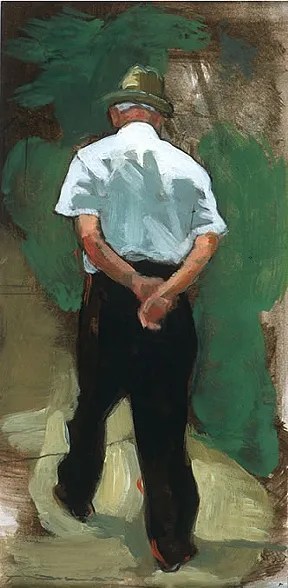
Thomas J. Bevin on the essential virtues of walking as inactivity…
… The vital thing to understand- and the point that I want to stress the most- is that walking is not an activity. Or rather, it should not be conceptualised as and reduced to being a mere activity. It is much more than that because it is much less than that. Walking is one of the great forms of inactivity and in a world of striving and consumerism and grasping and impatience it is one of only very few potential forms of inactivity left. It is that makes it precious.
You see, when you walk slowly and with no real destination in mind you are not doing, you are just being. Such walking, such contemplation is the beginning of freedom, it is the necessary pre-condition for having your own thoughts and as such for truly living your own life.
Which is why it is such a shame when people pollute their potentially edifying walks by turning to their ever-present phones. When I walk the streets and alleys of my city I constantly see people either shouting inanities into their phones or else using them to wirelessly pump music or podcasts into their eager ears. Walking thus becomes reduced to a mere mode of transportation for the carless and these reluctant pedestrians become- like so many other one-person-per-vehicle drivers- detached and isolated units moving through space. The audio and the journeying cancel each other out and it all bleeds into one, it becomes a blur that blots out the boredom of not being at your destination yet. Worse still is when this is combined with step counting apps or wristwatches which tragically instrumentalise the beautiful art of wandering around and turn walking into a metricated means of merely keeping the body alive and in some sort of working order. Such devices reduce us to machines, and one of the great tricks of Capitalism or The System or however you want to conceive it is that it not only turns us into machines for consumption and generating wealth for The Economy, but it also burdens us with the upkeep of the machinery that we have been reduced to becoming…
…
… When you start tracking your step count when you go for your daily constitutional you turn the walk into ‘free time’ in this sense. It becomes an Activity, something that is Good For You. And this only compounds if you listen to some manner of Educational Podcast as you do so. The thrillingly, daringly subversive non-activity of moseying around the neighbourhood for no reason other than the sheer pleasure of being alive, able to walk and out of doors degenerates into just another means of being visibly productive. Because eking out maximum amounts of productivity from every moment of our days has been working out so great for us thus far. All work and no play makes Jack a dull boy and we are all so play-deprived that many of us are becoming passive, disembodied viewers of our own on-screen lives…
…
… what does it say then when walking- something that is already complete and requires no thought or effort or expense- is polluted and diminished into just another opportunity to consume and document said consumption? What does it say when we so thoughtlessly desecrate our leisure like this? I would argue that to do these things is more than a little dehumanising.
Animals survive and act and react but only humans can opt out of this cycle and into the higher realm of inactivity. Just as silences make music more beautiful and pauses make conversations richer in meaning, it is inactivity- that is the moving beyond doing into being– that makes life human. Responding to stimuli alone, satisfying needs as they arise alone makes life nothing more than a cycle of biological survival.
The beauty is in the gaps. Art and culture arise from the blank spaces (which may be why these vital spheres in particular seem to be diminishing in this time of always on, always available activity). Uselessness and purposelessness are true luxury, true wealth. Look at any heart-stirring ceremony or custom or event- they are filled with detours and excesses, they are far from efficient. You could easily workshop a way of getting to the same basic endpoint much, much quicker and in doing so you would kill everything that made that ceremony unique and beautiful and, well, ceremonial.
The luxury of the aimless walk is one of the most accessible and readily available blank spaces we have. It is no coincidence that such a stroll will all of itself produce ideas and insights and new observations. In the absence of a task the mind will begin to play. It will be free. This is why walking and creativity go absolutely hand in hand. Insight comes to the contemplative and contemplation comes from inactivity, from not trying to generate insights, or indeed trying to do much of anything at all. In a try-hard world this is a difficult truth to convince people of. Because it asks for patience. It asks for more than mere effort. It asks for participation in the world as it is, which for the mind that has always trained itself to be busy is a big ask indeed. But it is the only way to be free…
Reclaiming our humanity: “Walking as Inactivity.”
And for a reminder that this wisdom has it place in the technical sphere of our lives: “Design for lingering.”
Sadly apposite: “More on Pedestrian Deaths.”
* Hippocrates
###
As we amble, we might send insightful birthday greetings to a man who walked both aimlessly and purposely, Lewis Mumford; he was born on this date in 1895. A historian, sociologist, philosopher of technology, and cultural critic, Mumford is probably best remembered for his writings on cities, perhaps especially for his award-winning book The City in History. (See also The City— the extraordinary film that Mumford made with Ralph Steiner and Wiilard Van Dyne, from an outline by the renowned documentarian Pare Lorentz, with a score by Aaron Copland.)
Mumford’s approaches to technology, its history, and its roles in society were acknowledged influences on writers like Jacques Ellul, Witold Rybczynski, Amory Lovins, E. F. Schumacher, Herbert Marcuse, Thomas Merton, and Marshall McLuhan. In a similar way, he was an inspiration for the organicist and environmentalist movements of today.
Unfortunately, once an economy is geared to expansion, the means rapidly turn into an end and “the going becomes the goal.” Even more unfortunately, the industries that are favored by such expansion must, to maintain their output, be devoted to goods that are readily consumable either by their nature, or because they are so shoddily fabricated that they must soon be replaced. By fashion and build-in obsolescence the economies of machine production, instead of producing leisure and durable wealth, are duly cancelled out by the mandatory consumption on an even larger scale….
Restore human legs as a means of travel. Pedestrians rely on food for fuel and need no special parking facilities…
– Lewis Mumford, The City in History

You must be logged in to post a comment.