Posts Tagged ‘Lewis Mumford’
“Walking is man’s best medicine”*…

Thomas J. Bevin on the essential virtues of walking as inactivity…
… The vital thing to understand- and the point that I want to stress the most- is that walking is not an activity. Or rather, it should not be conceptualised as and reduced to being a mere activity. It is much more than that because it is much less than that. Walking is one of the great forms of inactivity and in a world of striving and consumerism and grasping and impatience it is one of only very few potential forms of inactivity left. It is that makes it precious.
You see, when you walk slowly and with no real destination in mind you are not doing, you are just being. Such walking, such contemplation is the beginning of freedom, it is the necessary pre-condition for having your own thoughts and as such for truly living your own life.
Which is why it is such a shame when people pollute their potentially edifying walks by turning to their ever-present phones. When I walk the streets and alleys of my city I constantly see people either shouting inanities into their phones or else using them to wirelessly pump music or podcasts into their eager ears. Walking thus becomes reduced to a mere mode of transportation for the carless and these reluctant pedestrians become- like so many other one-person-per-vehicle drivers- detached and isolated units moving through space. The audio and the journeying cancel each other out and it all bleeds into one, it becomes a blur that blots out the boredom of not being at your destination yet. Worse still is when this is combined with step counting apps or wristwatches which tragically instrumentalise the beautiful art of wandering around and turn walking into a metricated means of merely keeping the body alive and in some sort of working order. Such devices reduce us to machines, and one of the great tricks of Capitalism or The System or however you want to conceive it is that it not only turns us into machines for consumption and generating wealth for The Economy, but it also burdens us with the upkeep of the machinery that we have been reduced to becoming…
…
… When you start tracking your step count when you go for your daily constitutional you turn the walk into ‘free time’ in this sense. It becomes an Activity, something that is Good For You. And this only compounds if you listen to some manner of Educational Podcast as you do so. The thrillingly, daringly subversive non-activity of moseying around the neighbourhood for no reason other than the sheer pleasure of being alive, able to walk and out of doors degenerates into just another means of being visibly productive. Because eking out maximum amounts of productivity from every moment of our days has been working out so great for us thus far. All work and no play makes Jack a dull boy and we are all so play-deprived that many of us are becoming passive, disembodied viewers of our own on-screen lives…
…
… what does it say then when walking- something that is already complete and requires no thought or effort or expense- is polluted and diminished into just another opportunity to consume and document said consumption? What does it say when we so thoughtlessly desecrate our leisure like this? I would argue that to do these things is more than a little dehumanising.
Animals survive and act and react but only humans can opt out of this cycle and into the higher realm of inactivity. Just as silences make music more beautiful and pauses make conversations richer in meaning, it is inactivity- that is the moving beyond doing into being– that makes life human. Responding to stimuli alone, satisfying needs as they arise alone makes life nothing more than a cycle of biological survival.
The beauty is in the gaps. Art and culture arise from the blank spaces (which may be why these vital spheres in particular seem to be diminishing in this time of always on, always available activity). Uselessness and purposelessness are true luxury, true wealth. Look at any heart-stirring ceremony or custom or event- they are filled with detours and excesses, they are far from efficient. You could easily workshop a way of getting to the same basic endpoint much, much quicker and in doing so you would kill everything that made that ceremony unique and beautiful and, well, ceremonial.
The luxury of the aimless walk is one of the most accessible and readily available blank spaces we have. It is no coincidence that such a stroll will all of itself produce ideas and insights and new observations. In the absence of a task the mind will begin to play. It will be free. This is why walking and creativity go absolutely hand in hand. Insight comes to the contemplative and contemplation comes from inactivity, from not trying to generate insights, or indeed trying to do much of anything at all. In a try-hard world this is a difficult truth to convince people of. Because it asks for patience. It asks for more than mere effort. It asks for participation in the world as it is, which for the mind that has always trained itself to be busy is a big ask indeed. But it is the only way to be free…
Reclaiming our humanity: “Walking as Inactivity.”
And for a reminder that this wisdom has it place in the technical sphere of our lives: “Design for lingering.”
Sadly apposite: “More on Pedestrian Deaths.”
* Hippocrates
###
As we amble, we might send insightful birthday greetings to a man who walked both aimlessly and purposely, Lewis Mumford; he was born on this date in 1895. A historian, sociologist, philosopher of technology, and cultural critic, Mumford is probably best remembered for his writings on cities, perhaps especially for his award-winning book The City in History. (See also The City— the extraordinary film that Mumford made with Ralph Steiner and Wiilard Van Dyne, from an outline by the renowned documentarian Pare Lorentz, with a score by Aaron Copland.)
Mumford’s approaches to technology, its history, and its roles in society were acknowledged influences on writers like Jacques Ellul, Witold Rybczynski, Amory Lovins, E. F. Schumacher, Herbert Marcuse, Thomas Merton, and Marshall McLuhan. In a similar way, he was an inspiration for the organicist and environmentalist movements of today.
Unfortunately, once an economy is geared to expansion, the means rapidly turn into an end and “the going becomes the goal.” Even more unfortunately, the industries that are favored by such expansion must, to maintain their output, be devoted to goods that are readily consumable either by their nature, or because they are so shoddily fabricated that they must soon be replaced. By fashion and build-in obsolescence the economies of machine production, instead of producing leisure and durable wealth, are duly cancelled out by the mandatory consumption on an even larger scale….
Restore human legs as a means of travel. Pedestrians rely on food for fuel and need no special parking facilities…
– Lewis Mumford, The City in History

“The purpose of a system is what it does”*…

Via Patrick Tanguay and his wonderful newsletter, Sentiers. Tanguay observes, “diagnosing what’s going on in society right now, how our multiple systems function and the issues that emerge from that, is not an easy task. It’s probably unfair then to also expect solutions from one article, but that’s what I was hoping for by the end of this one,” by Barath Raghavan and Bruce Schneier…
Technology was once simply a tool—and a small one at that—used to amplify human intent and capacity. That was the story of the industrial revolution: we could control nature and build large, complex human societies, and the more we employed and mastered technology, the better things got. We don’t live in that world anymore. Not only has technology become entangled with the structure of society, but we also can no longer see the world around us without it. The separation is gone, and the control we thought we once had has revealed itself as a mirage. We’re in a transitional period of history right now.
We tell ourselves stories about technology and society every day. Those stories shape how we use and develop new technologies as well as the new stories and uses that will come with it. They determine who’s in charge, who benefits, who’s to blame, and what it all means.
Some people are excited about the emerging technologies poised to remake society. Others are hoping for us to see this as folly and adopt simpler, less tech-centric ways of living. And many feel that they have little understanding of what is happening and even less say in the matter.
But we never had total control of technology in the first place, nor is there a pretechnological golden age to which we can return. The truth is that our data-centric way of seeing the world isn’t serving us well. We need to tease out a third option. To do so, we first need to understand how we got here.
When we describe something as being abstract, we mean it is removed from reality: conceptual and not material, distant and not close-up. What happens when we live in a world built entirely of the abstract? A world in which we no longer care for the messy, contingent, nebulous, raw, and ambiguous reality that has defined humanity for most of our species’ existence? We are about to find out, as we begin to see the world through the lens of data structures.
Two decades ago, in his book Seeing Like a State, anthropologist James C. Scott explored what happens when governments, or those with authority, attempt and fail to “improve the human condition.” Scott found that to understand societies and ecosystems, government functionaries and their private sector equivalents reduced messy reality to idealized, abstracted, and quantified simplifications that made the mess more “legible” to them. With this legibility came the ability to assess and then impose new social, economic, and ecological arrangements from the top down: communities of people became taxable citizens, a tangled and primeval forest became a monoculture timber operation, and a convoluted premodern town became a regimented industrial city.
This kind of abstraction was seemingly necessary to create the world around us today. It is difficult to manage a large organization, let alone an interconnected global society of eight billion people, without some sort of structure and means to abstract away details. Facility with abstraction, and abstract reasoning, has enabled all sorts of advancements in science, technology, engineering, and math—the very fields we are constantly being told are in highest demand.
The map is not the territory [quoth Alfred Korzybski], and no amount of intellectualization will make it so. Creating abstract representations by necessity leaves out important detail and context. Inevitably, as Scott cataloged, the use of large-scale abstractions fails, leaving leadership bewildered at the failure and ordinary people worse off.
But our desire to abstract never went away, and technology, as always, serves to amplify intent and capacity. Now, we manifest this abstraction with software. Computing supercharges the creative and practical use of abstraction. This is what life is like when we see the world the way a data structure sees the world. These are the same tricks Scott documented. What has changed is their speed and their ubiquity…
… Data structures dominate our world and are a byproduct of the rational, modern era, but they are ushering in an age of chaos. We need to embrace and tame, but not extinguish, this chaos for a better world…
…
As [Lewis] Mumford wrote in his classic history of technology, “The essential distinction between a machine and a tool lies in the degree of independence in the operation from the skill and motive power of the operator.” A tool is controlled by a human user, whereas a machine does what its designer wanted. As technologists, we can build tools, rather than machines, that flexibly allow people to make partial, contextual sense of the online and physical world around them. As citizens, we can create meaningful organizations that span our communities but without the permanence (and thus overhead) of old-school organizations.
Seeing like a data structure has been both a blessing and a curse. Increasingly, it feels like it is an avalanche, an out-of-control force that will reshape everything in its path. But it’s also a choice, and there is a different path we can take. The job of enabling a new society, one that accepts the complexity and messiness of our current world without being overwhelmed by it, is one all of us can take part it. There is a different future we can build, together…
A fascinating and important piece: “Seeing Like a Data Structure,” @schneierblog @BelferCenter. Eminently worth reading in full.
See also: “Empty Innovation“
###
As we reframe, we might send free birthday greetings to Matthias Ettrich; he was born on this date in 1972. A computer scientist interested in Linux and open source software, he Ettrich founded KDE in 1996 to create (as he put it on Usenet) “consistent, nice looking free desktop environment” for Unix-like systems using Qt as its widget toolkit– to which end, he has developed LyX. A German, operating in Berlin, Ettrich was awarded the Federal Cross of Merit for his contributions to free software.

“If we are to prevent megatechnics from further controlling and deforming every aspect of human culture, we shall be able to do so only with the aid of a radically different model derived directly, not from machines, but from living organisms and organic complexes (ecosystems)”*…

In a riff on Lewis Mumford, the redoubtable L. M. Sacasas addresses the unraveling of modernity…
The myth of the machine underlies a set of three related and interlocking presumptions which characterized modernity: objectivity, impartiality, and neutrality. More specifically, the presumptions that we could have objectively secured knowledge, impartial political and legal institutions, and technologies that were essentially neutral tools but which were ordinarily beneficent. The last of these appears to stand somewhat apart from the first two in that it refers to material culture rather than to what might be taken as more abstract intellectual or moral stances. In truth, however, they are closely related. The more abstract intellectual and institutional pursuits were always sustained by a material infrastructure, and, more importantly, the machine supplied a master template for the organization of human affairs.
…
Just as the modern story began with the quest for objectively secured knowledge, this ideal may have been the first to lose its implicit plausibility. Since the late 19th century onward, philosophers, physicists, sociologists, anthropologists, psychologists, and historians have, among others, proposed a more complex picture that emphasized the subjective, limited, contingent, situated, and even irrational dimensions of how humans come to know the world. The ideal of objectively secured knowledge became increasingly questionable throughout the 20th century. Some of these trends get folded under the label “postmodernism,” but I found the term unhelpful at best a decade ago—now find it altogether useless.
We can similarly trace a growing disillusionment with the ostensible impartiality of modern institutions. This takes at least two forms. On the one hand, we might consider the frustrating and demoralizing character of modern bureaucracies, which we can describe as rule-based machines designed to outsource judgement and enhance efficiency. On the other, we can note the heightened awareness of the actual failures of modern institutions to live up to the ideals of impartiality, which has been, in part, a function of the digital information ecosystem.
But while faith in the possibility of objectively secured knowledge and impartial institutions faltered, the myth of the machine persisted in the presumption that technology itself was fundamentally neutral. Until very recently, that is. Or so it seems. And my thesis (always for disputation) is that the collapse of this last manifestation of the myth brings the whole house down. This in part because of how much work the presumption of technological neutrality was doing all along to hold American society together. (International readers: as always read with a view to your own setting. I suspect there are some areas of broad overlap and other instances when my analysis won’t travel well). Already by the late 19th century, progress had become synonymous with technological advancements, as Leo Marx argued. If social, political, or moral progress stalled, then at least the advance of technology could be counted on…
But over the last several years, the plausibility of this last and also archetypal manifestation of the myth of the machine has also waned. Not altogether, to be sure, but in important and influential segments of society and throughout a wide cross-section of society, too. One can perhaps see the shift most clearly in the public discourse about social media and smart phones, but this may be a symptom of a larger disillusionment with technology. And not only technological artifacts and systems, but also with the technocratic ethos and the public role of expertise.
If the myth of the machine in these three manifestations, was, in fact, a critical element of the culture of modernity, underpinning its aspirations, then when each in turn becomes increasingly implausible the modern world order comes apart. I’d say that this is more or less where we’re at. You could usefully analyze any number of cultural fault lines through this lens. The center, which may not in fact hold, is where you find those who still operate as if the presumptions of objectivity, impartiality, and neutrality still compelled broad cultural assent, and they are now assailed from both the left and the right by those who have grown suspicious or altogether scornful of such presumptions. Indeed, the left/right distinction may be less helpful than the distinction between those who uphold some combination of the values of objectivity, impartiality, and neutrality and those who no longer find them compelling or desirable.
…
What happens when the systems and strategies deployed to channel often violent clashes within a population deeply, possibly intractably divided about substantive moral goods and now even about what Arendt characterized as the publicly accessible facts upon which competing opinions could be grounded—what happens when these systems and strategies fail?
It is possible to argue that they failed long ago, but the failure was veiled by an unevenly distributed wave of material abundance. Citizens became consumers and, by and large, made peace with the exchange. After all, if the machinery of government could run of its own accord, what was their left to do but enjoy the fruits of prosperity. But what if abundance was an unsustainable solution, either because it taxed the earth at too high a rate or because it was purchased at the cost of other values such as rootedness, meaningful work and involvement in civic life, abiding friendships, personal autonomy, and participation in rich communities of mutual care and support? Perhaps in the framing of that question, I’ve tipped my hand about what might be the path forward.
At the heart of technological modernity there was the desire—sometimes veiled, often explicit—to overcome the human condition. The myth of the machine concealed an anti-human logic: if the problem is the failure of the human to conform to the pattern of the machine, then bend the human to the shape of the machine or eliminate the human altogether. The slogan of the one of the high-modernist world’s fairs of the 1930s comes to mind: “Science Finds, Industry Applies, Man Conforms.” What is now being discovered in some quarters, however, is that the human is never quite eliminated, only diminished…
Eminently worth reading in full: “The Myth of the Machine, ” from @LMSacasas.
For a deep dive into similar waters, see John Ralston Saul‘s (@JohnRalstonSaul) Voltaire’s Bastards.
[Image above: source]
* Lewis Mumford, The Myth of the Machine
###
As we rethink rudiments, we might recall that it was on this date in 1919 that Arthur Eddington confirmed Einstein’s light-bending prediction– a part of The Theory of General Relativity– using photos of a solar eclipse. Eddington’s paper the following year was the “debut” of Einstein’s theoretical work in most of the English-speaking world (and occasioned an urban legend: when a reporter supposedly suggested that “only three people understand relativity,” Eddington was supposed to have jokingly replied “Oh, who’s the third?”)

“Why has our age surrendered so easily to the controllers, the manipulators, the conditioners of an authoritarian technics?”*…

Half a century ago, Lewis Mumford developed a concept that explains why we trade autonomy for convenience…
… Surveying the state of the high-tech life, it is tempting to ponder how it got so bad, while simultaneously forgetting what it was that initially convinced one to hastily click “I agree” on the terms of service. Before certain social media platforms became foul-smelling swamps of conspiratorial misinformation, many of us joined them for what seemed like good reasons; before sighing at the speed with which their batteries die, smartphone owners were once awed by these devices: before grumbling that there was nothing worth watching, viewers were astounded by how much streaming content was available at one’s fingertips. Overwhelmed by the way today’s tech seems to be burying us in the bad, it’s easy to forget the extent to which tech won us over by offering us a share in the good — or to be more precise, in “the goods.”
Nearly 50 years ago, long before smartphones and social media, the social critic Lewis Mumford put a name to the way that complex technological systems offer a share in their benefits in exchange for compliance. He called it a “bribe.” With this label, Mumford sought to acknowledge the genuine plentitude that technological systems make available to many people, while emphasizing that this is not an offer of a gift but of a deal. Surrender to the power of complex technological systems — allow them to oversee, track, quantify, guide, manipulate, grade, nudge, and surveil you — and the system will offer you back an appealing share in its spoils. What is good for the growth of the technological system is presented as also being good for the individual, and as proof of this, here is something new and shiny. Sure, that shiny new thing is keeping tabs on you (and feeding all of that information back to the larger technological system), but it also lets you do things you genuinely could not do before. For a bribe to be accepted it needs to promise something truly enticing, and Mumford, in his essay “Authoritarian and Democratic Technics,” acknowledged that “the bargain we are being asked to ratify takes the form of a magnificent bribe.” The danger, however, was that “once one opts for the system no further choice remains.”
For Mumford, the bribe was not primarily about getting people into the habit of buying new gadgets and machines. Rather it was about incorporating people into a world that complex technological systems were remaking in their own image. Anticipating resistance, the bribe meets people not with the boot heel, but with the gift subscription.
The bribe is a discomforting concept. It asks us to consider the ways the things we purchase wind up buying us off, it asks us to see how taking that first bribe makes it easier to take the next one, and, even as it pushes us to reflect on our own complicity, it reminds us of the ways technological systems eliminate their alternatives. Writing about the bribe decades ago, Mumford was trying to sound the alarm, as he put it: “This is not a prediction of what will happen, but a warning against what may happen.” As with all of his glum predictions, it was one that Mumford hoped to be proven wrong about. Yet as one scrolls between reviews of the latest smartphone, revelations about the latest misdeeds of some massive tech company, and commentary about the way we have become so reliant on these systems that we cannot seriously speak about simply turning them off — it seems clear that what Mumford warned “may happen” has indeed happened…
Eminently worth reading in full: “The Magnificent Bribe,” by Zachary Loeb in @_reallifemag.
As to (some of) the modern implications of that bargain, see also Shoshana Zuboff‘s: “You Are the Object of a Secret Extraction Operation.”
As we move into the third decade of the 21st century, surveillance capitalism is the dominant economic institution of our time. In the absence of countervailing law, this system successfully mediates nearly every aspect of human engagement with digital information. The promise of the surveillance dividend now draws surveillance economics into the “normal” economy, from insurance, retail, banking and finance to agriculture, automobiles, education, health care and more. Today all apps and software, no matter how benign they appear, are designed to maximize data collection.
Historically, great concentrations of corporate power were associated with economic harms. But when human data are the raw material and predictions of human behavior are the product, then the harms are social rather than economic. The difficulty is that these novel harms are typically understood as separate, even unrelated, problems, which makes them impossible to solve. Instead, each new stage of harm creates the conditions for the next stage…
And resonantly: “AI-tocracy” a working paper from NBER that links the development of artificial intelligence with the interests of autocracies: from the abstract:
Can frontier innovation be sustained under autocracy? We argue that innovation and autocracy can be mutually reinforcing when: (i) the new technology bolsters the autocrat’s power; and (ii) the autocrat’s demand for the technology stimulates further innovation in applications beyond those benefiting it directly. We test for such a mutually reinforcing relationship in the context of facial recognition AI in China. To do so, we gather comprehensive data on AI firms and government procurement contracts, as well as on social unrest across China during the last decade. We first show that autocrats benefit from AI: local unrest leads to greater government procurement of facial recognition AI, and increased AI procurement suppresses subsequent unrest. We then show that AI innovation benefits from autocrats’ suppression of unrest: the contracted AI firms innovate more both for the government and commercial markets. Taken together, these results suggest the possibility of sustained AI innovation under the Chinese regime: AI innovation entrenches the regime, and the regime’s investment in AI for political control stimulates further frontier innovation.
(And, Anne Applebaum warns, “The Bad Guys Are Winning.”)
* “Why has our age surrendered so easily to the controllers, the manipulators, the conditioners of an authoritarian technics? The answer to this question is both paradoxical and ironic. Present day technics differs from that of the overtly brutal, half-baked authoritarian systems of the past in one highly favorable particular: it has accepted the basic principle of democracy, that every member of society should have a share in its goods. By progressively fulfilling this part of the democratic promise, our system has achieved a hold over the whole community that threatens to wipe out every other vestige of democracy.
The bargain we are being asked to ratify takes the form of a magnificent bribe. Under the democratic-authoritarian social contract, each member of the community may claim every material advantage, every intellectual and emotional stimulus he may desire, in quantities hardly available hitherto even for a restricted minority: food, housing, swift transportation, instantaneous communication, medical care, entertainment, education. But on one condition: that one must not merely ask for nothing that the system does not provide, but likewise agree to take everything offered, duly processed and fabricated, homogenized and equalized, in the precise quantities that the system, rather than the person, requires. Once one opts for the system no further choice remains. In a word, if one surrenders one’s life at source, authoritarian technics will give back as much of it as can be mechanically graded, quantitatively multiplied, collectively manipulated and magnified.”
– Lewis Mumford in “Authoritarian and Democratic Technics,” via @LMSacasas
###
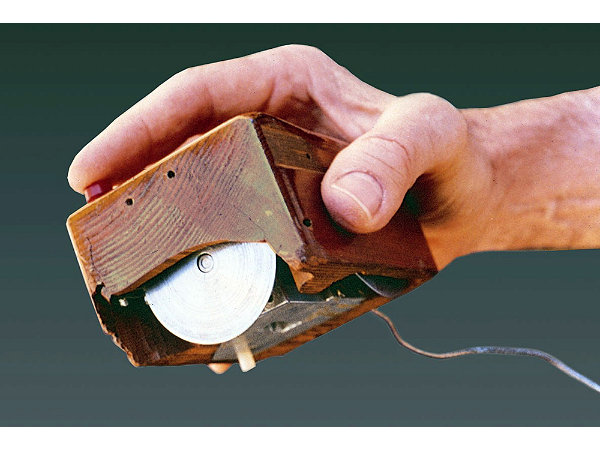
As we untangle user agreements, we might recall that it was on this date in 1970 that Douglas Engelbart (see here, here, and here) was granted a patent (US No. 3,541,541) on the “X-Y Position Indicator for a Display System,” the world’s first prototype computer mouse– a wooden block containing the tracking apparatus, with a single button attached.

“Machines. Inventions. Power. Black out the past.”*…

“The City” is a shape-shifting work of social criticism, radical in its rage, reactionary in its solutions. Financed largely by a $50,000 grant from the Carnegie Corporation and produced under the aegis of the American Institute of Planners, “The City” could be described as a propaganda film promoting the benefits and aims of city planning, but it was about more than that. Its scope encompassed a whole diseased society, its citizens divorced from their own identities and their own destinies—all on account of the march of unrestrained progress. “The City” was that rare thing—the prestige picture that tackled poverty and degradation, a sociological tract that aspired to poetry. It boasted the finest pedigree of any America documentary made up to that time: an outline from documentary master Pare Lorentz (“The Plow That Broke the Plains,” “The River”), commentary written by literary critic and prominent urbanist Lewis Mumford, and the first film score from composer Aaron Copland. Its directors, Ralph Steiner and Willard van Dyke, were both veterans of the American avant-garde…
Produced to be shown at the 1939 New York World’s Fair as part of the “City of Tomorrow” exhibit, “The City” was a passionate argument for innovative housing design and community planning– for restoring to modern city life a semblance of healthy living and social well-being rooted in community-based “garden cities.”
A pioneering documentary that makes a beguiling argument:
[Quote and image above: Library of Congress]
* “Machines. Inventions. Power. Black out the past. Forget the quiet cities. Bring in the steam and steel. The iron men. The giants. Open the throttle. All aboard, the promised land. Pillars of smoke by day. Pillars of fire by night. Pillars of progress. Machines to make machines. Production to expand production. There’s wood and wheat and kitchen sinks and calico all ready made in tonnes enough for tens, thousands, millions. Millions! Faster and faster, better and better!” — Lewis Mumford, The City
###
As we reconsider urbanism, we might recall that it was on this date (N.S.) in 1607 that the first permanent English settlement in the Americas was created, when the Virginia Company of London established “James Fort”– which became Jamestown– on the bank of the James (Powhatan) River, 2.5 miles from what is now the center of Williamsburg.

Colonial Jamestown About 1614
You must be logged in to post a comment.