Posts Tagged ‘history of computing’
“Do not fold, spindle, or mutilate”*…

Punched cards have a long history in machine control (dating back to Jacquard) and computing (starting with Babbage‘s Difference Engine), but it was Herman Hollerith who brought them into modern computation in the late 1880s… where punch cards remained for about 100 years. From the Smithsonian’s American History Museum…
In the late 1880s, American engineer Herman Hollerith saw a railroad punch card when he was trying to figure out new ways of compiling statistical information for the U.S. Census. His first punch card, like those used on railways, only had holes along the edges. The meaning of each hole was indicated on the card. By the time Hollerith tabulating equipment was used in the 1890 U.S. Census, holes were scattered across the cards, although their meaning was not indicated on it.
Hollerith and his employees at the Tabulating Machine Company in Washington, D.C. soon developed punched cards for use in compiling information for commercial enterprises such as railroads. They and staff of the U.S. Census Bureau prepared improved machines—these devices are shown in the object group on tabulating equipment. By the 1920s, the United States had two major manufacturers of punch card equipment, International Business Machines (the descendent of the Tabulating Machine Company) and Remington Rand (the descendent of Powers Accounting Machine Company established by Russian emigré and former Census Bureau employee James Powers). Each manufacturer developed a distinctive standard punch card. IBM cards had eighty columns of rectangular holes while those of Remington Rand had ninety columns of circular holes. Tabulating machines were widely used in both government and commerce, with cards designed to meet the needs of customers. For example, checks issued by the U.S. government often came on punch cards.
When IBM and Remington Rand began selling electronic computers in the years following World War II, punch cards became the preferred method of entering data and programs onto them. They also were used in later minicomputers and some early desktop calculators. Punch cards surviving in the Smithsonian collections reflect the widespread use of computers – they announced scores on standardized tests, served as a library cards, were part of the proof of mathematical theorems, and kept medical records. Some are printed with the names of users, from university computer centers and computer clubs to the Library of Congress to Bell Laboratories…
Browse the collection: “Punch Cards for Data Processing“
See also: here, here, and here.
* Ubiquitous warning on punch cards:
… in the 1950s, after the invention of the computer and its widespread business use, that everyone began to see punch cards. Companies sent punch cards out with bills: the telephone company, utility companies, and even department stores realized that they could save a step in their billing process, as well as making it easier for them to process the returned check, by using the cards themselves as the bills. By the 1960s, punch cards were familiar, everyday objects.
While company employees could be trusted to take care of the cards, the person in the street could not. Warnings were necessary. In the 1930s the University of Iowa used cards for student registration; on each card was printed “Do not fold or bend this card.” Cards reproduced in an IBM sales brochure of the 1930s read “Do not fold, tear, or mutilate this card” and “Do not fold tear or destroy.” I’m not sure when the canonical “Do not fold, spindle, or mutilate” first appeared; it’s one of those traditions whose author and origin is lost in the mists of time. Let’s consider the words one at a time, stop and take them seriously…
– “A Cultural History of the Punch Card” (from 1991; eminently worth reading in full)
###
As we contemplate chads (of which, punch cards produced a gracious plenty), we might spare a thought for Gerald Hawkins; he died on this date in 2003. An astronomer and author, he was best known for his work in archaeoastronomy— most of all, for his 1965 book, Stonehenge Decoded. In the early 1960s, Hawkins had used punch cards to load data modeling sun and moon movements onto magnetic tapes, then into an IBM 7090. The results led him to conclude, as the book argues, that the features at the monument were arranged in such a way as to predict a variety of astronomical events– that Stonehenge was a giant prehistoric observatory and computer. While some archaeologists are hesitant to accept Hawkins’ theories, many archaeoastronomers have built upon his work. More widely, scholars accept that the importance of astronomical alignment and large complexes being planned and constructed to fulfill cosmology has been demonstrated at other prehistoric sites, such as the Snake Mound and Cahokia in the U.S.

“Reality is frequently inaccurate”*…

Machine learning and what it may teach us about reality…
Our latest paradigmatic technology, machine learning, may be revealing the everyday world as more accidental than rule-governed. If so, it will be because machine learning gains its epistemological power from its freedom from the sort of generalisations that we humans can understand or apply.
The opacity of machine learning systems raises serious concerns about their trustworthiness and their tendency towards bias. But the brute fact that they work could be bringing us to a new understanding and experience of what the world is and our role in it…
The world is a black box full of extreme specificity: it might be predictable but that doesn’t mean it is understandable: “Learn from Machine Learning,” by David Weinberger (@dweinberger) in @aeonmag.
(image above: source)
* Douglas Adams, The Restaurant at the End of the Universe
###
As ruminate on the real, we might send carefully-computed birthday greetings to Grace Brewster Murray Hopper. A seminal computer scientist and Rear Admiral in the U.S. Navy, “Amazing Grace” (as she was known to many in her field) was one of the first programmers of the Harvard Mark I computer (in 1944), invented the first compiler for a computer programming language, and was one of the leaders in popularizing the concept of machine-independent programming languages– which led to the development of COBOL, one of the first high-level programming languages.
Hopper also found and documented the first computer “bug” (in 1947).
She has both a ship (the guided-missile destroyer USS Hopper) and a super-computer (the Cray XE6 “Hopper” at NERSC) named in her honor.

“Why has our age surrendered so easily to the controllers, the manipulators, the conditioners of an authoritarian technics?”*…

Half a century ago, Lewis Mumford developed a concept that explains why we trade autonomy for convenience…
… Surveying the state of the high-tech life, it is tempting to ponder how it got so bad, while simultaneously forgetting what it was that initially convinced one to hastily click “I agree” on the terms of service. Before certain social media platforms became foul-smelling swamps of conspiratorial misinformation, many of us joined them for what seemed like good reasons; before sighing at the speed with which their batteries die, smartphone owners were once awed by these devices: before grumbling that there was nothing worth watching, viewers were astounded by how much streaming content was available at one’s fingertips. Overwhelmed by the way today’s tech seems to be burying us in the bad, it’s easy to forget the extent to which tech won us over by offering us a share in the good — or to be more precise, in “the goods.”
Nearly 50 years ago, long before smartphones and social media, the social critic Lewis Mumford put a name to the way that complex technological systems offer a share in their benefits in exchange for compliance. He called it a “bribe.” With this label, Mumford sought to acknowledge the genuine plentitude that technological systems make available to many people, while emphasizing that this is not an offer of a gift but of a deal. Surrender to the power of complex technological systems — allow them to oversee, track, quantify, guide, manipulate, grade, nudge, and surveil you — and the system will offer you back an appealing share in its spoils. What is good for the growth of the technological system is presented as also being good for the individual, and as proof of this, here is something new and shiny. Sure, that shiny new thing is keeping tabs on you (and feeding all of that information back to the larger technological system), but it also lets you do things you genuinely could not do before. For a bribe to be accepted it needs to promise something truly enticing, and Mumford, in his essay “Authoritarian and Democratic Technics,” acknowledged that “the bargain we are being asked to ratify takes the form of a magnificent bribe.” The danger, however, was that “once one opts for the system no further choice remains.”
For Mumford, the bribe was not primarily about getting people into the habit of buying new gadgets and machines. Rather it was about incorporating people into a world that complex technological systems were remaking in their own image. Anticipating resistance, the bribe meets people not with the boot heel, but with the gift subscription.
The bribe is a discomforting concept. It asks us to consider the ways the things we purchase wind up buying us off, it asks us to see how taking that first bribe makes it easier to take the next one, and, even as it pushes us to reflect on our own complicity, it reminds us of the ways technological systems eliminate their alternatives. Writing about the bribe decades ago, Mumford was trying to sound the alarm, as he put it: “This is not a prediction of what will happen, but a warning against what may happen.” As with all of his glum predictions, it was one that Mumford hoped to be proven wrong about. Yet as one scrolls between reviews of the latest smartphone, revelations about the latest misdeeds of some massive tech company, and commentary about the way we have become so reliant on these systems that we cannot seriously speak about simply turning them off — it seems clear that what Mumford warned “may happen” has indeed happened…
Eminently worth reading in full: “The Magnificent Bribe,” by Zachary Loeb in @_reallifemag.
As to (some of) the modern implications of that bargain, see also Shoshana Zuboff‘s: “You Are the Object of a Secret Extraction Operation.”
As we move into the third decade of the 21st century, surveillance capitalism is the dominant economic institution of our time. In the absence of countervailing law, this system successfully mediates nearly every aspect of human engagement with digital information. The promise of the surveillance dividend now draws surveillance economics into the “normal” economy, from insurance, retail, banking and finance to agriculture, automobiles, education, health care and more. Today all apps and software, no matter how benign they appear, are designed to maximize data collection.
Historically, great concentrations of corporate power were associated with economic harms. But when human data are the raw material and predictions of human behavior are the product, then the harms are social rather than economic. The difficulty is that these novel harms are typically understood as separate, even unrelated, problems, which makes them impossible to solve. Instead, each new stage of harm creates the conditions for the next stage…
And resonantly: “AI-tocracy” a working paper from NBER that links the development of artificial intelligence with the interests of autocracies: from the abstract:
Can frontier innovation be sustained under autocracy? We argue that innovation and autocracy can be mutually reinforcing when: (i) the new technology bolsters the autocrat’s power; and (ii) the autocrat’s demand for the technology stimulates further innovation in applications beyond those benefiting it directly. We test for such a mutually reinforcing relationship in the context of facial recognition AI in China. To do so, we gather comprehensive data on AI firms and government procurement contracts, as well as on social unrest across China during the last decade. We first show that autocrats benefit from AI: local unrest leads to greater government procurement of facial recognition AI, and increased AI procurement suppresses subsequent unrest. We then show that AI innovation benefits from autocrats’ suppression of unrest: the contracted AI firms innovate more both for the government and commercial markets. Taken together, these results suggest the possibility of sustained AI innovation under the Chinese regime: AI innovation entrenches the regime, and the regime’s investment in AI for political control stimulates further frontier innovation.
(And, Anne Applebaum warns, “The Bad Guys Are Winning.”)
* “Why has our age surrendered so easily to the controllers, the manipulators, the conditioners of an authoritarian technics? The answer to this question is both paradoxical and ironic. Present day technics differs from that of the overtly brutal, half-baked authoritarian systems of the past in one highly favorable particular: it has accepted the basic principle of democracy, that every member of society should have a share in its goods. By progressively fulfilling this part of the democratic promise, our system has achieved a hold over the whole community that threatens to wipe out every other vestige of democracy.
The bargain we are being asked to ratify takes the form of a magnificent bribe. Under the democratic-authoritarian social contract, each member of the community may claim every material advantage, every intellectual and emotional stimulus he may desire, in quantities hardly available hitherto even for a restricted minority: food, housing, swift transportation, instantaneous communication, medical care, entertainment, education. But on one condition: that one must not merely ask for nothing that the system does not provide, but likewise agree to take everything offered, duly processed and fabricated, homogenized and equalized, in the precise quantities that the system, rather than the person, requires. Once one opts for the system no further choice remains. In a word, if one surrenders one’s life at source, authoritarian technics will give back as much of it as can be mechanically graded, quantitatively multiplied, collectively manipulated and magnified.”
– Lewis Mumford in “Authoritarian and Democratic Technics,” via @LMSacasas
###
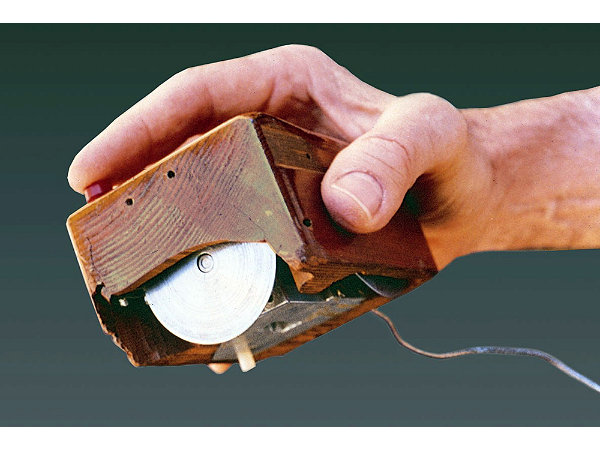
As we untangle user agreements, we might recall that it was on this date in 1970 that Douglas Engelbart (see here, here, and here) was granted a patent (US No. 3,541,541) on the “X-Y Position Indicator for a Display System,” the world’s first prototype computer mouse– a wooden block containing the tracking apparatus, with a single button attached.

“The future is already here – it’s just not evenly distributed”*…

Security, transportation, energy, personal “stuff”– the 2018 staff of Popular Mechanics, asked leading engineers and futurists for their visions of future cities, and built a handbook to navigate this new world: “The World of 2045.”
* William Gibson (in The Economist, December 4, 2003)
###
As we take the long view, we might spare a thought for Charles Babbage; he died on this date in 1871. A mathematician, philosopher, inventor, and mechanical engineer, Babbage is best remembered for originating the concept of a programmable computer. Anxious to eliminate inaccuracies in mathematical tables, he first built a small calculating machine able to compute squares. He then produced prototypes of portions of a larger Difference Engine. (Georg and Edvard Schuetz later constructed the first working devices to the same design, and found them successful in limited applications.) In 1833 he began his programmable Analytical Machine (AKA, the Analytical Engine), the forerunner of modern computers, with coding help from Ada Lovelace, who created an algorithm for the Analytical Machine to calculate a sequence of Bernoulli numbers— for which she is remembered as the first computer programmer.
Babbage’s other inventions include the cowcatcher, the dynamometer, the standard railroad gauge, uniform postal rates, occulting lights for lighthouses, Greenwich time signals, and the heliograph opthalmoscope. A true hacker, he was also passionate about cyphers and lock-picking.

Hello?… Hello?…

Quoth the always-amusing Tyler Hellard: “ConferenceCall.biz is a spectacular display of existential despair and the modern condition.”
And indeed it is.
###
As we remember that we can press “8” to mute at any time, we might email elegantly and creatively designed birthday greetings to Douglas Carl Engelbart; he was born on this date in 1925. An engineer and inventor who was a computing and internet pioneer, Doug (who passed away last year) is best remembered for his seminal work on human-computer interface issues, and for “the Mother of All Demos” in 1968, at which he demonstrated for the first time the computer mouse, hypertext, networked computers, and the earliest versions of graphical user interfaces… that’s to say, computing as we know it.

.jpg)
You must be logged in to post a comment.