Posts Tagged ‘reality’
“A physicist is just an atom’s way of looking at itself”*…
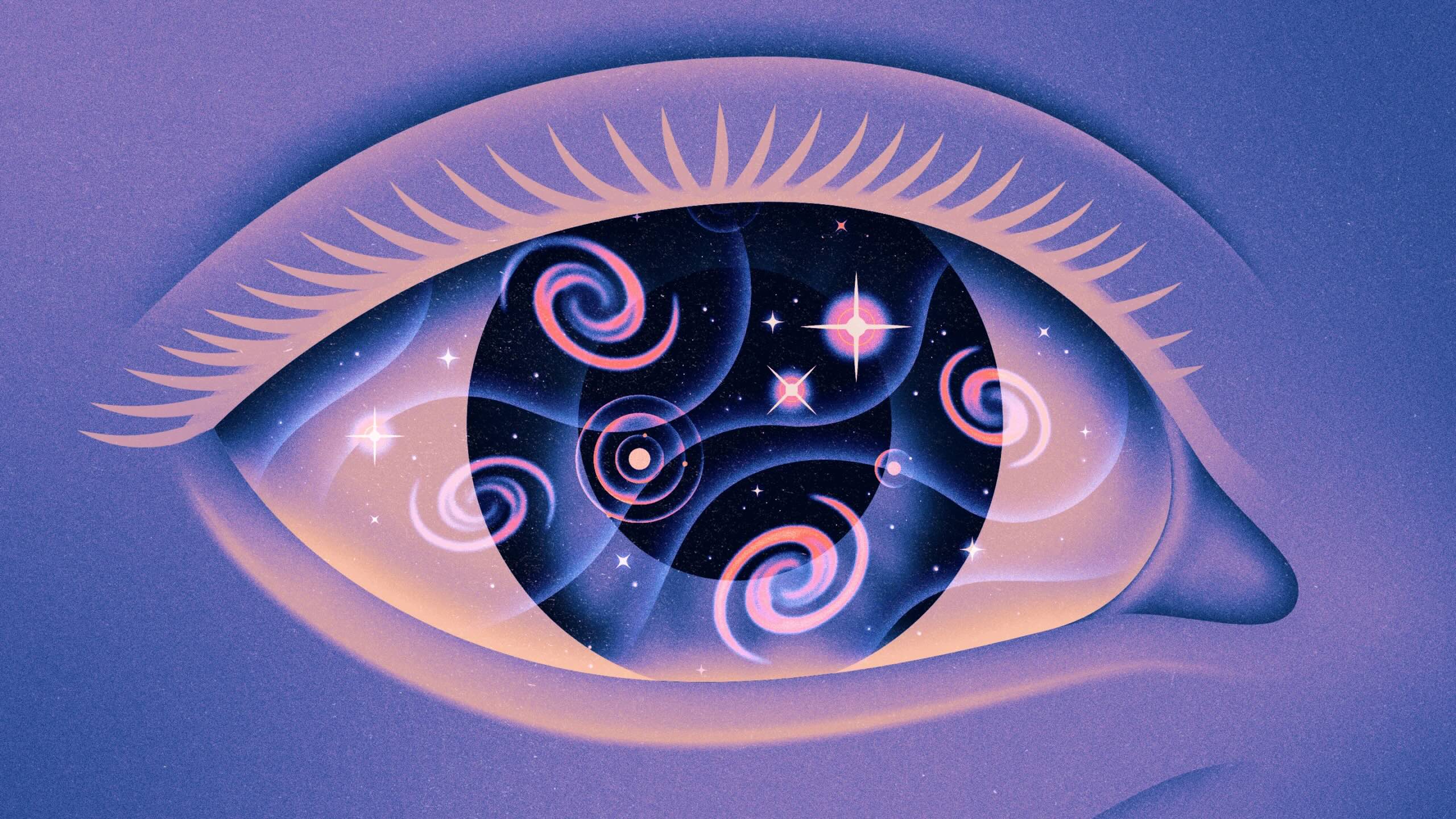
Encouraged by successes in understanding black holes, theoretical physicists are applying what they’ve learned to whole universes. As Matt von Hippel explains, what they’re finding has them questioning fundamental assumptions about how physics ought to be done…
Tinkering at their desks with the mathematics of quantum space and time, physicists have discovered a puzzling conundrum. The arcane rules of quantum theory and gravity let them imagine many different kinds of universes in precise detail, enabling powerful thought experiments that in recent years have addressed long-standing mysteries swirling around black holes.
But when a group of researchers examined a universe intriguingly like our own in 2019, they found a paradox: The theoretical universe seemed to admit only a single possible state. It appeared so simple that its contents could be described without conveying even a single bit of data, not even a choice of a zero or a one. This result clashed with the fact that this type of universe should be capable of hosting black holes, stars, planets — and people. Yet all those rich details were nowhere to be seen.
“We look around, and certainly the world seems more complex than that,” said Rob Myers, a theoretical physicist at the Perimeter Institute for Theoretical Physics in Waterloo, Canada, who has not been directly involved in this research.
Physicists have good reason to trust the calculation, which builds on fundamental physical ideas. The math implies a universe with only one state; our universe is clearly not like that. Now a team of theorists has floated a possible answer. The paradoxical result occurred when physicists sought an objective description of the state of an entire universe. But a description like that might not be possible, even in principle. It implicitly assumes a universe that exists without an observer to observe it. And perhaps without observers, the complexity of the universe loses its meaning…
[von Hippel unpacks the scientific thinking that led to this conundrum. He concludes with an account of recent work by Ying Zhao that hints at a resolution…]
… Quantum mechanics requires a distinction between an observer — such as the scientist carrying out an experiment — and the system they observe. The system tends to be something small and quantum, like an atom. The observer is big and far away, and thus well described by classical physics… Perhaps an observer could do the same to these closed, impossibly simple-seeming universes?
In 2024, Zhao moved to the Massachusetts Institute of Technology, where she began to work on the problem of how to put an observer into a closed universe. She and two colleagues —Daniel Harlow and Mykhaylo Usatyuk — thought of the observer as introducing a new kind of boundary: not the edge of the universe, but the boundary of the observer themself. When you consider a classical observer inside a closed universe, all the complexity of the world returns, Zhao and her collaborators showed.
The MIT team’s paper came out at the beginning of 2025, around the same time that another group came forward with a similar idea. Others chimed in to point out connections to earlier work.
At this stage, everyone involved emphasizes that they don’t know the full solution. The paradox itself may be a misunderstanding, one that evaporates with a new argument. But so far, adding an observer to the closed universe and trying to account for their presence may be the safest path.
“Am I really confident to say that it’s right, it’s the thing that solves the problem? I cannot say that. We try our best,” Zhao said…
“Cosmic Paradox Reveals the Awful Consequence of an Observer-Free Universe,” from @quantamagazine.org.
Apposite: “Biology Might Not Be Quantum, but Its Math Is Quantumlike“
###
As we keep an eye out, we might send cosmological birthday greetings to Enrico Fermi; he was born on this date in 1901. A physicist and Nobel Laureate (1938) for his discovery of nuclear reactions brought about by slow neutrons, he is best remembered for (literally) presiding over the birth of the Atomic Age. Fermi was perhaps especially remarkable as the last “double-threat” in his field: a genius at creating both important theories and elegant experiments. As observed before (and illustrated above :), the division of labor between theorists and experimentalists has since been pretty complete.
The novelist and historian of science C. P. Snow wrote that “if Fermi had been born a few years earlier, one could well imagine him discovering Rutherford’s atomic nucleus, and then developing Bohr’s theory of the hydrogen atom. If this sounds like hyperbole, anything about Fermi is likely to sound like hyperbole.”

“Reality is that which, when you stop believing in it, doesn’t go away”*…

Particles are nature’s smallest constituents, but that doesn’t mean they’re fundamental. So of what, physicist Felix Flicker asks, does the Universe consist?…
What is the world made of? For centuries, people have believed that matter is constructed from tiny, indivisible parts. Some of the earliest known references come from the Greek philosopher Democritus, who taught that the Universe was composed of atoms the size of dust motes floating in sunlight. Theravada Buddhism developed the concept of kalapas, indivisible bundles of properties fleeting into and out of existence. Alchemy’s description of fundamental ‘corpuscles’, expounded by Isaac Newton and others, derived from translations of Aristotle by mediaeval Islamic scholars. And Hideki Yukawa, winner of the 1949 Nobel Prize in Physics for his work developing the modern theory of elementary particles, took inspiration from a passage in the Zhuangzi, a Daoist text written during China’s warring states period, in which fast-moving entities puncture holes within formless chaos. Yukawa saw a parallel to particle collisions.
The concept of a particle, as we now refer to these indivisible parts, has therefore been repeatedly re-introduced in contradictory ways. The modern view continues this tradition. In late-19th-century physics, particles were tiny indivisible objects with well-defined positions and momenta. The advent of quantum mechanics led these clear waters to become muddied. But the basic idea persists: we are taught from a young age that matter is made of atoms, built from particles such as electrons, and electrons are not built from anything else. For this reason, these particles are sometimes said to be fundamental. But are they? Is the Universe really made from the smallest constituents, as a beach is made from sand?
The answer to this question, I will contest, is perhaps a surprising one: yes, the Universe is built from fundamental units – but fundamental need not mean smallest. This view is generally adopted by those physicists, such as myself, who work in the largest discipline within the subject: quantum matter. This is the study of quantum behaviours that manifest on everyday scales: the attraction of iron to a magnet, the flow of electricity along a wire, or the passage of sound through a crystal. In these settings, too, we find particles. But these particles are not elementary, like the electron: they are emergent.
The distinction can be pictured as follows. Imagine a lightbulb, its rays of light travelling to your eyes. We can ask what those rays are made of. Quantum mechanics has an answer: a ray of light is a stream of individual particles called photons. In turn, we can ask what the photons are made of. The answer this time is that they are not made of anything else: they are elementary. Now imagine that this lightbulb is of a vintage sort, and gives off a gentle hum. It emits waves of sound that travel to your ears. We can again ask what those waves are made of. And, once again, quantum mechanics has an answer: a wave of sound can be described by individual particles called phonons. Now, if you are familiar with the Standard Model of particle physics, you will know that it contains photons but not phonons. The reason is that phonons are not elementary. If you ask what a phonon is made of, there is an answer: it is a pattern of vibrations of the atoms in the air. In the study of quantum matter, however, we say it is an emergent particle.
So what are emergent particles? Are they as real as elementary particles? And, perhaps most importantly, can they tell us anything new about the nature of reality?…
[Flicker answers the first two of those questions, then turns to the third…]
… So, are elementary particles emergent? Even if we can ever answer this, we will be faced with the same question, whatever we find. In the end, whether you like the idea comes down to personal taste and, perhaps, a degree of cultural upbringing. The more widely publicised attempts at a ‘theory of everything’ always struck me as suspiciously similar to themes in the Old Testament: the Universe was once describable by a single mathematical formula, but that one, true quantum field spontaneously broke in a cataclysmic event that resulted in the messy collection of particles we find before us. I find that the quantum matter perspective, on the other hand, resonates with me in a similar manner to the Daoist texts such as the Zhuangzi. From this new perspective, it is our current world that is beautiful. It grew from a swamp of possible theories, each ugly in its arbitrariness: it doesn’t matter which way we followed, as they all lead here…
A physicist argues that our universe is more than the sum of its particles: “Reality Emerges,” from @aeon.co.
Resonant: “There Is No ‘Hard Problem Of Consciousness’,” from Carlo Rovelli
Also apposite (and fascinating): “Physicists just found a tiny flaw in time itself,” from ScienceDaily.
* Philip K. Dick
###
As we muse on materialization, we might send insightful birthday greetings to Jack Steinberger; he was born on this date in 1921. An experimental physicist, he worked on sub-atomic particles– the “elementary” constituents of matter discussed above– at Columbia, UC Berkeley, and CERN. He shared the 1988 Nobel Prize in Physics (with Leon M. Lederman and Melvin Schwartz) for the discovery of the muon neutrino.

“Reality is that which, when you stop believing in it, doesn’t go away”*…

Reality is tough. Everything eats and is eaten. Everything destroys and is destroyed.
In a way that challenges lots of our deeply-seated conceptions (your correspondent’s, anyway), philosopher (and self-proclaimed pessimist) Drew Dalton invokes the laws of thermodynamics to argue that it is our moral duty to strike back at the Universe…
Reality is not what you think it is. It is not the foundation of our joyful flourishing. It is not an eternally renewing resource, nor something that would, were it not for our excessive intervention and reckless consumption, continue to harmoniously expand into the future. The truth is that reality is not nearly so benevolent. Like everything else that exists – stars, microbes, oil, dolphins, shadows, dust and cities – we are nothing more than cups destined to shatter endlessly through time until there is nothing left to break. This, according to the conclusions of scientists over the past two centuries, is the quiet horror that structures existence itself.
We might think this realisation belongs to the past – a closed chapter of 19th-century science – but we are still living through the consequences of the thermodynamic revolution. Just as the full metaphysical implications of the Copernican revolution took centuries to unfold, we have yet to fully grasp the philosophical and existential consequences of entropic decay. We have yet to conceive of reality as it truly is. Instead, philosophers cling to an ancient idea of the Universe in which everything keeps growing and flourishing. According to this view, existence is good. Reality is good.
But what would our metaphysics and ethics look like if we learned that reality was against us?…
Read on for his provocative argument that philosphers must grapple with the meaning of thermodynamics: “Reality is evil,” from @dmdalton.bsky.social in @aeon.co.
Dalton further explores these ideas in his book The Matter of Evil: From Speculative Realism to Ethical Pessimism (2023)
* Philip K. Dick
###
As we wrestle with reality, we might send somewhat sunnier birthday greetings to Stephen William Hawking CH CBE FRS FRSA; he was born on this date in 1942. A theoretical physicist and cosmologist, he is probably best known in his professional circles for his work with Roger Penrose on gravitational singularity theorems in the framework of general relativity, for his theoretical prediction that black holes emit radiation (now called Hawking radiation), and for his support of the many-worlds interpretation of quantum mechanics.
But Hawking is more broadly known as a popularizer of science. His A Brief History of Time stayed on the British Sunday Times best-seller list for over four years (a record-breaking 237 weeks), and has sold over 10 million copies worldwide.
“We have this one life to appreciate the grand design of the universe, and for that, I am extremely grateful.”

“The world of reality has its limits; the world of imagination is boundless”*…

Still, it’s useful to know the difference… and as Yasemin Saplakoglu explains, that’s a complex process– one that science takes very seriously…
As I sit at my desk typing up this newsletter, I can see a plant to my left, a water bottle to my right and a gorilla sitting across from me. The plant and bottle are real, but the gorilla is a product of my mind — and I intuitively know that this is true. That’s because my brain, like most people’s, has the ability to distinguish reality from imagination. If it didn’t, or if I had a condition that disrupts this distinction, I’d constantly see gorillas and elephants where they don’t exist.
Imagination is sometimes described as perception in reverse. When we look at an object, electromagnetic waves enter the eyes, where they are translated into neural signals that are then sent to the visual cortex at the back of the brain. This process generates an image: “plant.” With imagination, we start with what we want to see, and the brain’s memory and semantic centers send signals to the same brain region: “gorilla.”
In both cases, the visual cortex is activated. Recalling memories can also activate some of the same regions. Yet the brain can clearly distinguish between imagination, perception and memory in most cases (though it is still possible to get confused). How does it keep everything straight?
By probing the differences between these processes, neuroscientists are untangling how the human brain creates our experience. They’re finding that even our perception of reality is in many ways imagined. “Underneath our skull, everything is made up,” Lars Muckli, a professor of visual and cognitive neurosciences at the University of Glasgow, told me. “We entirely construct the world in its richness and detail and color and sound and content and excitement. … It is created by our neurons.”
To distinguish reality and imagination, the brain might have some kind of “reality threshold,” according to one theory. Researchers recently tested this by asking people to imagine specific images against a backdrop — and then secretly projected faint outlines of those images there. Participants typically recognized when they saw a real projection versus their imagined one, and those who rated images as more vivid were also more likely to identify them as real. The study suggested that when processing images, the brain might make a judgment on reality based on signal strength. If the signal is weak, the brain takes it for imagination. If it’s strong, the brain deems it real. “The brain has this really careful balancing act that it has to perform,” Thomas Naselaris, a neuroscientist at the University of Minnesota, told me. “In some sense it is going to interpret mental imagery as literally as it does visual imagery.”
Although recalling memories is a creative and imaginative process, it activates the visual cortex as if we were seeing. “It started to raise the question of whether a memory representation is actually different from a perceptual representation at all,” Sam Ling, a neuroscientist at Boston University, told me. A recent study looked to identify how memories and perceptions are constructed differently at the neurobiological level. When we perceive something, visual cues undergo layers of processing in the visual cortex that increase in complexity. Neurons in earlier parts of this process fire more precisely than those that get involved later. In the study, researchers found that during memory recall, neurons fired in a much blurrier way through all the layers. That might explain why our memories aren’t often as crisp as what we’re seeing in front of us…
“How Do Brains Tell Reality From Imagination?” from @yaseminsaplakoglu.bsky.social in @quantamagazine.bsky.social.
* Jean-Jacques Rousseau
###
As we parse perception, we might send mindful birthday greetings to a man whose work figures into the history of science’s struggle on this issue, Franz Brentano; he was born on this date in 1838. A philosopher and psychologist, his 1874 Psychology from an Empirical Standpoint, considered his magnum opus and is credited with having reintroduced the medieval scholastic concept of intentionality into contemporary philosophy and psychology.
Brentano also studied perception, with conclusions that prefigure the discussion above…
He is also well known for claiming that Wahrnehmung ist Falschnehmung (‘perception is misconception’) that is to say perception is erroneous. In fact he maintained that external, sensory perception could not tell us anything about the de facto existence of the perceived world, which could simply be illusion. However, we can be absolutely sure of our internal perception. When I hear a tone, I cannot be completely sure that there is a tone in the real world, but I am absolutely certain that I do hear. This awareness, of the fact that I hear, is called internal perception. External perception, sensory perception, can only yield hypotheses about the perceived world, but not truth. Hence he and many of his pupils (in particular Carl Stumpf and Edmund Husserl) thought that the natural sciences could only yield hypotheses and never universal, absolute truths as in pure logic or mathematics.
However, in a reprinting of his Psychologie vom Empirischen Standpunkte (Psychology from an Empirical Standpoint), he recanted this previous view. He attempted to do so without reworking the previous arguments within that work, but it has been said that he was wholly unsuccessful. The new view states that when we hear a sound, we hear something from the external world; there are no physical phenomena of internal perception… – source

“Tennyson said that if we could understand a single flower we would know who we are and what the world is”*…

Reality feels “stable” enough to talk about it– though all logic seems to point away from that possibility. Marco Giancotti unpacks what he suggests is the only line of reasoning that resolves that paradox…
What is the source of what we call order? Why do many things look too complex, too perfectly organized to arise unintentionally from chaos? How can something as special as a star or a flower even happen? And, for that matter, why do some natural phenomena seem designed for a purpose?
We live in a universe of forces eternally straining to crush things together or tear them apart. There is no physical law for “forming shapes”, no law for being separated from other things, no law for staying still.
Boundaries are in the eye of the beholder, not in the world out there. Out there is only tumult, clashing, and shuffling of everything with everything else.
And yet, our familiar world is filled with things stable and consistent enough for us to give them names—and to live our whole lives with.
In this essay we’ll tackle these questions at the very root. We need good questions to get good answers, so we’ll begin by clarifying the problem. It has to do with probabilities—we’ll see why those natural objects seem so utterly unlikely to happen by chance, and we’ll find the fundamental process that solves the dilemma.
This will take us most of the way, but we’ll have one final obstacle to overcome, a cognitive Last Boss: living things still feel a little magical in some way, imbued with a mysterious substance called “purpose” that feels qualitatively different from how inanimate things work. This kind of confusion runs very deep in our culture. To remove it, I’ll give a name to something that, as far as I know, hasn’t been named before: phenomena that I’ll be calling—enigmatically, for now—“Water Lilies.”…
Applying systems dynamics, complexity, and emergence to understanding reality itself: “Recursion, Tidy Stars, and Water Lilies,” from @marco_giancotti (the second in a trilogy of essays: part one here; subscribe to his newsletter for Part Three when it drops).
* Jorge Luis Borges, “The Zahir“
###
As we explore existence, we might spare a thought for Francis Simpson; he died on this date in 2003. An English naturalist, conservationist, and chronicler of the countryside and wild flowers of his native Suffolk, he became a botanist at Ipswich Museum, where he worked until his retirement in 1977.
He published one of the most highly regarded county floras, simply entitled Simpson’s Flora of Suffolk, and in 1938 saved a small meadow, famous for its snakeshead fritillaries, from being drained and ploughed into farmland. Using donations amounting to £75, he was able to purchase the field, Mickfield Meadow, for the Society for the Promotion of Nature Reserves. Today, it is one of the oldest nature reserves in the country, protecting the meadow flowers now surrounded by farmland.

You must be logged in to post a comment.