Posts Tagged ‘Carlo Rovelli’
“Reality is a very subjective affair”*…

As Nathan Gardels reports, the Berggruen Institute recently gathered religious scholars, philosophers, quantum physicists, AI technologists, neuroscientists and science fiction novelists at Casa dei Tre Oci in Venice to ponder the nature of consciousness. Noting that “it is fascinating to see how their ideas correspond to the long-ago musings of Medieval mystics and even the “pagan masters” of antiquity'” Gardels observes that “the great question then, as now, and probably forever, is whether there is a metaphysical gap between the body and the soul, or if they are made of the same substance, symbiotic aspects of a singular reality that entail each other.” He concludes…
…The quantum physicist Carlo Rovelli argues that the much-discussed metaphysical gap between body and soul, subjective and objective, doesn’t exist.
As he has written in Noema, “We, subjects of knowledge and understanding, are not outside the world. We are part of it. Our theories and knowledge are embodied tools to help us navigate the real world, not disembodied views on reality from the outside. They are themselves aspects of the very world they describe. Our understanding, like our feelings, perceptions and experience, is a natural phenomenon.”
For Rovelli, the notion of a metaphysical gap “contradicts everything we have learned about nature in the last centuries. The mind is the behavior of the brain, properly described in a high-level language. Neither my own experience of myself nor an external experience of me is primary: They are two distinct perspectives on the same events. We do not need to assume that the circle between epistemology (how we get knowledge) and ontology (what exists) requires a starting point. There is nothing wrong with its circularity: The world I access is the information I have about it, and I am part of that world.
“Nor do we need to require that there is any ultimate or fundamental account of reality. Any account is approximate, has blind spots and is realized within reality, so it is embodied in a part of that same reality.
“If we do not fall into the error of dualism upfront, we can safely speak of soul and emotions just as we speak of a kitchen table, even if the table is also a collection of atoms. It is time to give up the pernicious dualism introduced by the debate on consciousness and embrace the reality that our soul, or our spiritual life, is consistent with our fundamental physics.
“Earth is not metaphysically different from the heavens, living beings are not metaphysically different from inanimate matter, humans are not metaphysically different from other animals. The soul is not metaphysically different from the body. We are all parts of nature.”
Rovelli’s scientific case that we humans are not outside the world of reality, but constitutive participants in it and constructors of it, tracks with the intuition of Medieval thinkers like the 14th-century Christian mystic Meister Eckhart.
For Eckhart, consciousness was being aware we are not apart from, but both inhabit and are inhabited by, the mind of God — that is, “objective reality.”
As stated in the New Testament’s Gospel of John, “In the beginning was the Word, and the Word was with God.” In biblical terms, the Word, or Logos, is divine reason. Eckhart interpreted this passage as meaning that the incarnation of the divine in man was not a one-time event of Christ’s birth in Bethlehem, but takes place through continuous human participation in the unfolding Logos of the Word, making us part of and conjoining with the mind of God; co-essences, so to speak.” If God is the pure thought of divine reason, then, as Sloterdijk has put it, ‘To think is to give birth to God.’”
That Medieval insight is another way of saying, in Rovelli’s words, that “objectivity without a subject is an abstract construct, of little relevance — it is the illusion of a science now belonging to the past.”
Consciousness, then, can be said to be the perspective of the aware self in a world where there is no outside. The “I” is not detached from some order of objective reality, but in all the diversity of personal experience, part of what makes it “everywhere whole.” Not only is “the universe disclosed by a knowing subject;” the knowing subject is its co-creator from within…
Eminently worth reading in full.
Striving to understand the nature of consciousness: “Subjective Perspective Makes Objective Reality ‘Everywhere Whole’,” from @noemamag.com.
Pair with: “Everything is not itself.”
* Vladimir Nabokov, Pale Fire
###
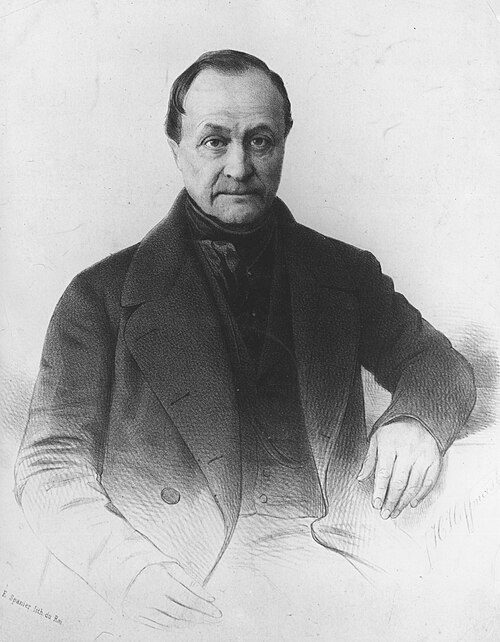
As we muse on our minds, we might spare a thought for a man who wrestled with these same issues, Auguste Comte; he died on this date in 1857. A philosopher (and mathematician), he is remembered as the father of the doctrine of positivism. He developed the Law of Three Stages to describe the historical evolution of human thought and consciousness, arguing that the human mind, in its search for understanding, progresses through three distinct intellectual phases (the theological, the metaphysical, and the positive (or scientific), each with a different method of explaining reality.
Comte is widely regarded as the first “philosopher of science” in the modern sense, and as the forebearer of sociology (the name of which he coined, as he did the word “altruism”). He had a major impact on 19th-century thought, influencing the work of social thinkers like John Stuart Mill and George Eliot. His concepts of “sociology” and social evolutionism set the tone for early social theorists and anthropologists including Harriet Martineau and Herbert Spencer, evolving into modern academic sociology (a la Émile Durkheim) as practical and objective social research.
“Reality is that which, when you stop believing in it, doesn’t go away”*…

Particles are nature’s smallest constituents, but that doesn’t mean they’re fundamental. So of what, physicist Felix Flicker asks, does the Universe consist?…
What is the world made of? For centuries, people have believed that matter is constructed from tiny, indivisible parts. Some of the earliest known references come from the Greek philosopher Democritus, who taught that the Universe was composed of atoms the size of dust motes floating in sunlight. Theravada Buddhism developed the concept of kalapas, indivisible bundles of properties fleeting into and out of existence. Alchemy’s description of fundamental ‘corpuscles’, expounded by Isaac Newton and others, derived from translations of Aristotle by mediaeval Islamic scholars. And Hideki Yukawa, winner of the 1949 Nobel Prize in Physics for his work developing the modern theory of elementary particles, took inspiration from a passage in the Zhuangzi, a Daoist text written during China’s warring states period, in which fast-moving entities puncture holes within formless chaos. Yukawa saw a parallel to particle collisions.
The concept of a particle, as we now refer to these indivisible parts, has therefore been repeatedly re-introduced in contradictory ways. The modern view continues this tradition. In late-19th-century physics, particles were tiny indivisible objects with well-defined positions and momenta. The advent of quantum mechanics led these clear waters to become muddied. But the basic idea persists: we are taught from a young age that matter is made of atoms, built from particles such as electrons, and electrons are not built from anything else. For this reason, these particles are sometimes said to be fundamental. But are they? Is the Universe really made from the smallest constituents, as a beach is made from sand?
The answer to this question, I will contest, is perhaps a surprising one: yes, the Universe is built from fundamental units – but fundamental need not mean smallest. This view is generally adopted by those physicists, such as myself, who work in the largest discipline within the subject: quantum matter. This is the study of quantum behaviours that manifest on everyday scales: the attraction of iron to a magnet, the flow of electricity along a wire, or the passage of sound through a crystal. In these settings, too, we find particles. But these particles are not elementary, like the electron: they are emergent.
The distinction can be pictured as follows. Imagine a lightbulb, its rays of light travelling to your eyes. We can ask what those rays are made of. Quantum mechanics has an answer: a ray of light is a stream of individual particles called photons. In turn, we can ask what the photons are made of. The answer this time is that they are not made of anything else: they are elementary. Now imagine that this lightbulb is of a vintage sort, and gives off a gentle hum. It emits waves of sound that travel to your ears. We can again ask what those waves are made of. And, once again, quantum mechanics has an answer: a wave of sound can be described by individual particles called phonons. Now, if you are familiar with the Standard Model of particle physics, you will know that it contains photons but not phonons. The reason is that phonons are not elementary. If you ask what a phonon is made of, there is an answer: it is a pattern of vibrations of the atoms in the air. In the study of quantum matter, however, we say it is an emergent particle.
So what are emergent particles? Are they as real as elementary particles? And, perhaps most importantly, can they tell us anything new about the nature of reality?…
[Flicker answers the first two of those questions, then turns to the third…]
… So, are elementary particles emergent? Even if we can ever answer this, we will be faced with the same question, whatever we find. In the end, whether you like the idea comes down to personal taste and, perhaps, a degree of cultural upbringing. The more widely publicised attempts at a ‘theory of everything’ always struck me as suspiciously similar to themes in the Old Testament: the Universe was once describable by a single mathematical formula, but that one, true quantum field spontaneously broke in a cataclysmic event that resulted in the messy collection of particles we find before us. I find that the quantum matter perspective, on the other hand, resonates with me in a similar manner to the Daoist texts such as the Zhuangzi. From this new perspective, it is our current world that is beautiful. It grew from a swamp of possible theories, each ugly in its arbitrariness: it doesn’t matter which way we followed, as they all lead here…
A physicist argues that our universe is more than the sum of its particles: “Reality Emerges,” from @aeon.co.
Resonant: “There Is No ‘Hard Problem Of Consciousness’,” from Carlo Rovelli
Also apposite (and fascinating): “Physicists just found a tiny flaw in time itself,” from ScienceDaily.
* Philip K. Dick
###
As we muse on materialization, we might send insightful birthday greetings to Jack Steinberger; he was born on this date in 1921. An experimental physicist, he worked on sub-atomic particles– the “elementary” constituents of matter discussed above– at Columbia, UC Berkeley, and CERN. He shared the 1988 Nobel Prize in Physics (with Leon M. Lederman and Melvin Schwartz) for the discovery of the muon neutrino.

You must be logged in to post a comment.