Posts Tagged ‘Auguste Comte’
“Reality is a very subjective affair”*…

As Nathan Gardels reports, the Berggruen Institute recently gathered religious scholars, philosophers, quantum physicists, AI technologists, neuroscientists and science fiction novelists at Casa dei Tre Oci in Venice to ponder the nature of consciousness. Noting that “it is fascinating to see how their ideas correspond to the long-ago musings of Medieval mystics and even the “pagan masters” of antiquity'” Gardels observes that “the great question then, as now, and probably forever, is whether there is a metaphysical gap between the body and the soul, or if they are made of the same substance, symbiotic aspects of a singular reality that entail each other.” He concludes…
…The quantum physicist Carlo Rovelli argues that the much-discussed metaphysical gap between body and soul, subjective and objective, doesn’t exist.
As he has written in Noema, “We, subjects of knowledge and understanding, are not outside the world. We are part of it. Our theories and knowledge are embodied tools to help us navigate the real world, not disembodied views on reality from the outside. They are themselves aspects of the very world they describe. Our understanding, like our feelings, perceptions and experience, is a natural phenomenon.”
For Rovelli, the notion of a metaphysical gap “contradicts everything we have learned about nature in the last centuries. The mind is the behavior of the brain, properly described in a high-level language. Neither my own experience of myself nor an external experience of me is primary: They are two distinct perspectives on the same events. We do not need to assume that the circle between epistemology (how we get knowledge) and ontology (what exists) requires a starting point. There is nothing wrong with its circularity: The world I access is the information I have about it, and I am part of that world.
“Nor do we need to require that there is any ultimate or fundamental account of reality. Any account is approximate, has blind spots and is realized within reality, so it is embodied in a part of that same reality.
“If we do not fall into the error of dualism upfront, we can safely speak of soul and emotions just as we speak of a kitchen table, even if the table is also a collection of atoms. It is time to give up the pernicious dualism introduced by the debate on consciousness and embrace the reality that our soul, or our spiritual life, is consistent with our fundamental physics.
“Earth is not metaphysically different from the heavens, living beings are not metaphysically different from inanimate matter, humans are not metaphysically different from other animals. The soul is not metaphysically different from the body. We are all parts of nature.”
Rovelli’s scientific case that we humans are not outside the world of reality, but constitutive participants in it and constructors of it, tracks with the intuition of Medieval thinkers like the 14th-century Christian mystic Meister Eckhart.
For Eckhart, consciousness was being aware we are not apart from, but both inhabit and are inhabited by, the mind of God — that is, “objective reality.”
As stated in the New Testament’s Gospel of John, “In the beginning was the Word, and the Word was with God.” In biblical terms, the Word, or Logos, is divine reason. Eckhart interpreted this passage as meaning that the incarnation of the divine in man was not a one-time event of Christ’s birth in Bethlehem, but takes place through continuous human participation in the unfolding Logos of the Word, making us part of and conjoining with the mind of God; co-essences, so to speak.” If God is the pure thought of divine reason, then, as Sloterdijk has put it, ‘To think is to give birth to God.’”
That Medieval insight is another way of saying, in Rovelli’s words, that “objectivity without a subject is an abstract construct, of little relevance — it is the illusion of a science now belonging to the past.”
Consciousness, then, can be said to be the perspective of the aware self in a world where there is no outside. The “I” is not detached from some order of objective reality, but in all the diversity of personal experience, part of what makes it “everywhere whole.” Not only is “the universe disclosed by a knowing subject;” the knowing subject is its co-creator from within…
Eminently worth reading in full.
Striving to understand the nature of consciousness: “Subjective Perspective Makes Objective Reality ‘Everywhere Whole’,” from @noemamag.com.
Pair with: “Everything is not itself.”
* Vladimir Nabokov, Pale Fire
###
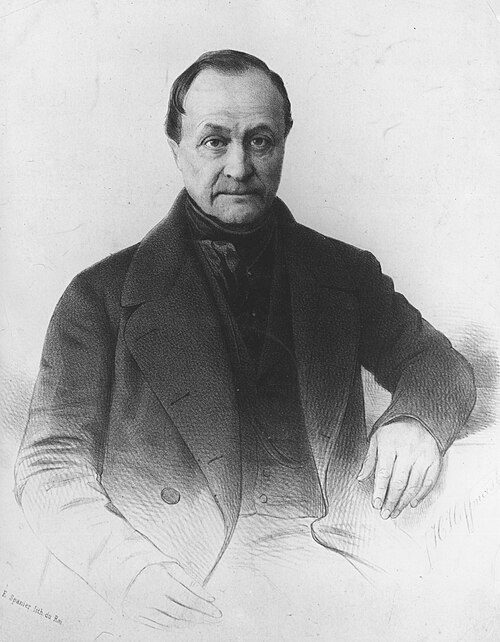
As we muse on our minds, we might spare a thought for a man who wrestled with these same issues, Auguste Comte; he died on this date in 1857. A philosopher (and mathematician), he is remembered as the father of the doctrine of positivism. He developed the Law of Three Stages to describe the historical evolution of human thought and consciousness, arguing that the human mind, in its search for understanding, progresses through three distinct intellectual phases (the theological, the metaphysical, and the positive (or scientific), each with a different method of explaining reality.
Comte is widely regarded as the first “philosopher of science” in the modern sense, and as the forebearer of sociology (the name of which he coined, as he did the word “altruism”). He had a major impact on 19th-century thought, influencing the work of social thinkers like John Stuart Mill and George Eliot. His concepts of “sociology” and social evolutionism set the tone for early social theorists and anthropologists including Harriet Martineau and Herbert Spencer, evolving into modern academic sociology (a la Émile Durkheim) as practical and objective social research.
“I think it would be a very good idea”*…

As we discuss global culture(s) or geo-politics, we often talk about “The West” (and the rest). In a review of Georgios Varouxakis‘ new book The West: The History of an Idea, Andrew Kaufmann reminds us that it’s important to interrogate that defining concept…
What is the West? Many take the idea for granted, but few can define it. In this meticulously researched, engaging, and sometimes bewildering new book, The West: The History of an Idea, intellectual historian Georgios Varouxakis takes readers on a two-centuries-long tour of the many uses, definitions, and redefinitions of the term. Along the way, readers may find their own long-held assumptions and stereotypes challenged and even undermined.
The book makes a number of arguments, but for the purposes of this review, it’s worth focusing on just a few major ones. The first and most innovative argument of the book is this: The idea of the West as a transnational sociopolitical community distinct from the rest of the world is more recent than we think. This idea received its first sophisticated and coherent articulation in the 1820s from French philosopher Auguste Comte.
While historians and other academics had long looked to past societies like ancient Athens or medieval Europe as representing the “West” against some “other,” Comte was the first to coherently put together a future-oriented political program to be adopted and followed. Most scholars locate the future-focused version of the West’s inauguration in the 1890s, when the idea was used to justify imperial and colonial expansion. By contrast, Varouxakis argues that Comte and his followers wanted to build a West that was anti-imperialist, committed to science and reason, liberated from dogmatic Christianity, and fueled by altruism and sympathy.
As a progressive positivist, Comte saw the “Western Republic” as a via media between a hyper nationalism (of the French variety) and an overly abstract universalism. He imagined a way station that transcended the parochialism of family and nation and would one day be realized and embraced all over the world, even if it would take a full seven centuries from his own writing to come to fruition (that was Comte’s timeline). Neither tied to a particular nation like France (although Paris would be the center of this Republic until Constantinople would replace it), nor embodied by an abstract and universal cosmopolitanism, the Western Republic (or l’Occident) would be set off against its Other—in particular, Russia and the Orient. Still, over time this republic would non-coercively welcome the rest of the world into its fold.
Contrary to a common conception of “the West,” it was not to be a society (or society of societies) committed to democracy, individualism, or liberalism. It was instead a rejection of the hyper-individualism of the modern period, and it was an attempt to recover an older other-centered ethic that had been lost to a prior age.
The second major argument Varouxakis presents is that despite this idea of a transnational West that had its origin in Comte’s work, and despite Comte’s legacy that his disciples clearly carried across continents and centuries, the history of the idea of the West since Comte is complicated and contested. Put another way, while the specter of Comte hovers over the entire narrative, his vision is not always fully realized, nor is the meaning of the term always stable. This complicated history manifests itself in a number of different ways and carries with it some significant implications…
… Many casual users of “Western Civilization” will often identify it as one and the same with liberal democracy. They often find that somehow and at some point Britain came to embrace the West as being just that—liberal and democratic. Varouxakis complicates this picture by showing that while a few liberal voices in Britain were certainly also champions of Western Civilization, the more consistent and coherent users of the term were disciples of Comte and therefore much more illiberal in their thinking…
… Or take the more familiar East vs. West framework we associate with the Cold War, where surely the fault lines of Eastern totalitarianism against Western liberal capitalism are clean and clear. But even here the history is complicated, as the period begins with the acknowledgement that it was indeed Soviet Russia that helped to save “western civilization.” Indeed, it took forty years of gradual evolution for the idea of the “West” to finally crystallize around the shared commitment to economic, religious, and political freedom over and against Soviet planned economies, state-sanctioned atheism, and one-party politics with no free and fair elections…
… Given the winding road of the history of the West, it is instructive that there seems to be something of a settlement on its meaning for today, even if there are differences in its application. This can be seen most clearly in Varouxakis’ penultimate chapter on the dispute between Samuel Huntington and Francis Fukuyama after the end of the Cold War. Fukuyama of course is well known for his view that the West—in its embrace of liberal democracy and capitalism—had now emerged triumphant over the defeated ideas of Marxist totalitarianism, which found its fullest expression in Soviet Russia of the East.
Samuel Huntington’s ideas of what the West embodied were not much different, but he diverged from Fukuyama in his vision of what the world’s future likely entailed. For Huntington, the coming years and decades would see a “clash of civilizations,” a conflict of the most basic sort between the West and the great civilizations of the world as we know it. He saw nothing certain about the global triumph of any particular civilizational expression, including the West. Indeed, Huntington contends that it is only the West that even believes in universal ideals, and that all of the non-Western civilizations—whether Chinese, Islamic, or otherwise—are all partial in their visions. Therefore, we see here in the latest debate about the West a return of the Comtean question: Will the West become a universal civilization, or will it endure as one of many civilizations forever in conflict with each other? While we may have some agreement on what the West stands for, we may have less confidence in its future in the world.
The history is complex, indeed. But Varouxakis also raises the question of whether Western Civilization—however one defines it—is something to defend in the first place. He considers this question several times in the book, but perhaps none more poignantly than in the Great War itself. For example, there were many who noted the hypocrisy of the “Western powers” that suddenly found common cause with the long-excluded Russia in their fight against Germany and the Central Powers. But perhaps more troubling is what it says about a civilization when it produces not the peace and altruism long promised by its founder, but instead destruction on a scale that had never been seen before in human history. One could likewise ask: What kind of civilization deliberately excludes and exploits the weakest members within its borders, such as in the treatment of African Americans in the United States and of those in the furthest regions of the colonial empires of Europe? This crisis of confidence and feeling of decline continued through the interwar years, as Oswald Spengler expresses in his Decline of the West, a fitting rejoinder to the optimism of Comte’s Western utopia.
And so, perhaps the best way to conclude for readers of all sorts—but especially Christians—is to offer two words of caution. The first is to those who would defend the “West” and “Western Civilization” as something either resonant with or even inspired by a Judeo-Christian worldview. And that word is simple: the origins of the idea of the West in one of its most dominant forms (the Comtean one) and in its subsequent historical uses is either non-Christian or even anti-Christian. Indeed, I went into the book expecting a heavy dose of Judeo-Christian connections to the idea of the West, and while the link is not completely absent, I was struck by its muted nature.
Besides the post-Christian progressive vision of Comte himself, consider the voice of Black writer Richard Wright as one representative example to follow in the Frenchman’s footsteps. As someone who identified with the West, he considered “the content of [his] Westernness [residing] fundamentally…in [his] secular outlook upon life.” The progress of the West would be realized the more it emancipated itself from the influence of “mystical powers” or the priests who would speak in their name. Armed with the tools of trial-and-error pragmatism, human life can be sustained without recourse to divine help. A West liberated from divine help is a West worth preserving, at least according to Wright.
Overall, the West as an idea has many champions who are quite open in their antipathy toward the Christian religion, and it would be foolish to ignore those influences on the meaning and use of the term for us today. Still, the second and final note I’d like to offer is a bit more optimistic. In the concluding chapter, Varouxakis urges readers to move from the parochialism of “Western” ideas to adopt a language that is universal in its appeal. What, after all, was so attractive about any of the Western projects that Varouxakis so painstakingly chronicles? It was always their global appeal.
Altruism, sympathy, love for others, freedom, individualism, democracy, capitalism. These are not ideals that belong to just a few but rightfully can be embraced by all of God’s creatures in different places, at different times, and in different ways. Certainly for Christians who embrace a global faith, the least we can do is see the inheritance of the “West,” however defined, as a mixed bag of common grace insights and ideas in rebellion against God, combined with the perspective that none of what is worth keeping in the West should ever be kept from those who would embrace its ideals…
Eminently worth reading in full: “The Idea of the West” from @mereorthodoxy.bsky.social.
For a look at the concept in current context/practice: “The Rest take on the West,” from @noemamag.com.
* Gandhi’s response when asked, “what do you think of western civilization?”
###
As we ponder perplexingly plastic paradigms, we might recall that it was on this date in 1957 that “Whole Lotta Shakin’ Going On” by Jerry Lee Lewis peaked at #3 on the US pop singles charts (though it topped the R&B and country charts shortly after). It was a cover of a 1955 release by Big Maybelle of a song written by Dave “Curlee” Williams (and sometimes also credited to James Faye “Roy” Hall). Lewis, with session drummer Jimmy Van Eaton and guitarist Roland Janes, had recorded the song at Sun Records in just one take.
You must be logged in to post a comment.