Posts Tagged ‘imagination’
“Art is the lie that enables us to realize the truth”*…
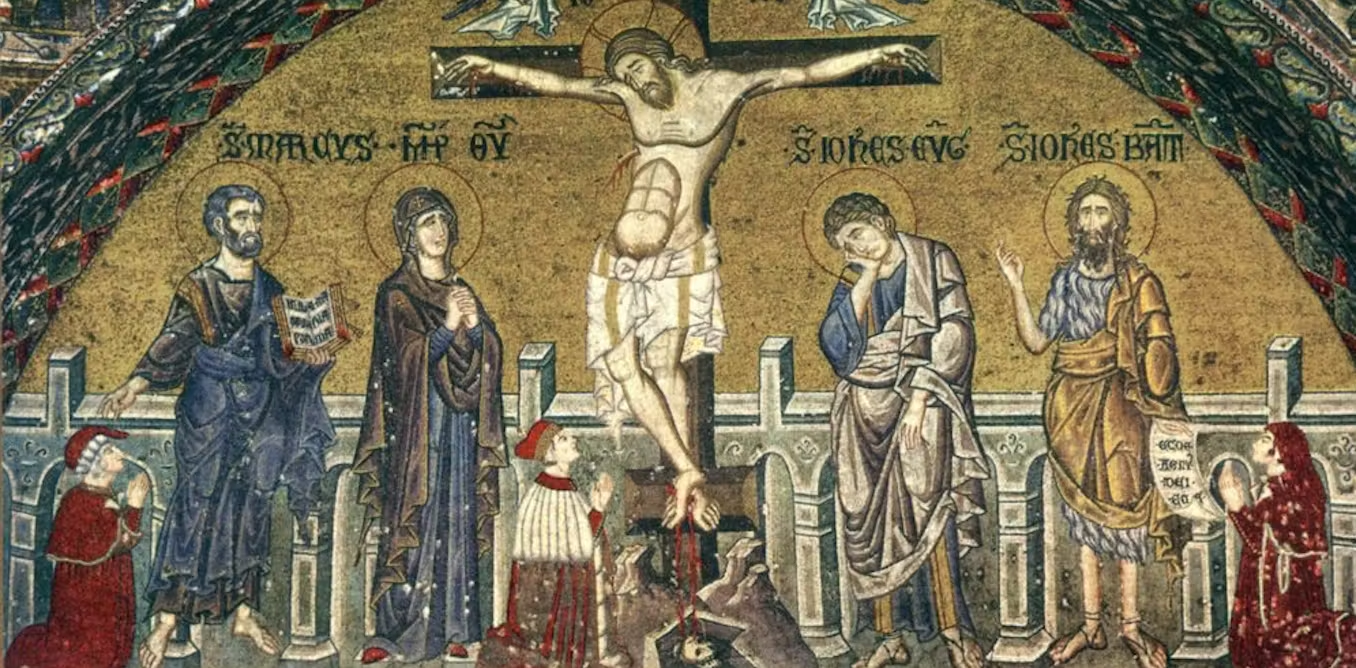
Drawing on her recent book, Facing Crisis: Art as Politics in Fourteenth-Century Venice, Stefania Gerevini on a historical reminder of the crucial role that art can play in times like these…
In an increasingly polarised world, the arts and humanities play a key role in sustaining democracy. They foster critical thinking, open dialogue, emotional intelligence and understanding across different perspectives, all of which are essential for a healthy democratic society. Also, people who participate in cultural activities are much more likely to engage in civic and democratic life.
Yet the way the arts are funded differs widely from country to country, especially in times of economic hardship or significant change. During and after the pandemic, for instance, some EU countries increased public spending on culture, while others made significant cuts.
The reasons for these contrasting attitudes are many, from local cultural values, to shifting economic priorities and politics. But at their core, different funding strategies express different attitudes towards two questions: what contribution does art make in times of crisis? And how do communities express their experiences of uncertainty?…
… the medieval city of Venice provides a remarkable historical example for addressing these questions.
Between the sixth and 12th centuries, Venice grew into an independent city-state ruled by an elected council and an elected head of state, called the doge.
Set on an island, the city lacked some of the resources necessary to its survival, so it quickly established strong maritime trade networks across the Mediterranean. It gradually developed into an international merchant empire, acquiring strategic territories along the eastern Adriatic Coast, Greece and the Aegean Sea.
By the mid-14th century, Venice was a leading global power. Yet, between 1340 and 1355, the city also faced famine, plague, a violent earthquake and fierce military conflicts with Genoa and the Ottomans.
Internally, Venice tackled dramatic political tensions (including a coup and the public execution of a doge in 1355), as non-noble citizens were gradually excluded from public office. Strikingly, it was during this period of acute crisis that the government initiated a series of ambitious artistic projects in the state church of San Marco.
A new baptistery and a chapel dedicated to Saint Isidore of Chios were lavishly decorated with mosaics. In addition, the high altar, which provided religious focus for the faithful, was revamped. This included turning its uniquely precious golden altarpiece into spectacular moving machinery that would open and close to reveal different images daily, and on feast days.
These projects, which required substantial public spending at a time of financial strain, hardly represented business as usual for Venetian policymakers. Instead, they were a central part of the government’s wider response to crisis.
On one level, these new projects revealed the range of pressing concerns that engulfed the Venetian government and people at the time. The painted altarpiece displayed on the altar of San Marco on non-festive days exhibits an emphasis on human suffering, miracles and saintly interventions that may relate the need for reassurance in uncertain times.
The bloody conflict against Genoa likely influenced the dedication of a chapel to St Isidore. The saint’s body was transported to Venice from the Greek island of Chios, a vital Genoese stronghold in the 14th century. To the people of Venice, the physical presence of St Isidore’s relics in San Marco provided reassurance and the promise of protection and victory as their state engaged in a risky conflict.
Finally, uncertainty about the nature and boundaries of citizenship and political authority – which the expansion of Venice’s overseas territories transformed into an ever more urgent problem – offer a valuable way to interpret the imagery in the baptistery. Here the apostles are rendered in mosaic as they baptise the “nations of the earth”, offering an idealised image of union in diversity.
Yet, on another level, the projects sponsored by the Venetian government during this period represented the active exercising of the political imagination. In ways that some of us may find alarmingly familiar, Venice’s ongoing instability made traditional approaches to decision-making, communication and control ineffective in dealing with the challenges it faced.
Venice’s governors responded to the crisis which threatened the very survival and stability of the city and its political foundations with a wide-ranging strategy of legal, institutional and historical revision, aimed at clarifying the nature and functions of the Venetian state.
The government reaffirmed Venice’s civic laws and reorganised its international treaties. The authority of the doge was progressively restricted, and over time, the government clarified the rules for holding public office. The first official history of Venice was completed in 1352.
In this context, the San Marco projects did not merely express the anxiety of the Venetian people, or their hopes for renewed stability. They represented the establishing of a new political landscape, which was envisioned most clearly on the east wall of the baptistery.
Three secular figures – a doge and two officers – are depicted as kneeling supplicants within a monumental mosaic of the crucifixion (see the main headline image above). Blending the sacred with the secular, this image offered an abstract “state portrait” that simultaneously expressed a political reality and suggested a new political ideal.
The mosaic now rendered Venice’s doge as a humble ruler, and it represented the business of government as a collective enterprise. In so doing, this image articulated a new vision of government as public service and shared responsibility. This idea, which developed through political reforms in Venice and from broader debates in other medieval Italian city states, has went on to influence western approaches to government and public life to this day.
Venice’s state-sponsored artistic commissions were not propaganda in the modern sense. Instead, they offered a compelling visual reflection on the nature of leadership and the necessary limits of authority. They kindled a new vision of government that enabled Venice to navigate one of the most turbulent phases of its history – reminding us, too, of the power of the arts to inspire and imagine new futures in difficult times…
Learning from history: “Medieval Venice shows us the good art can do in times of crisis,” from @theconversation.com.
* Pablo Picasso
###
As we appreciate art, we might send imaginative birthday greetings to Odilon Redon; he was born on this date in 1840. A lithographer, etcher, and painter, he was influential in the development of modern French art in two different ways. His prints explore haunted, fantastic, often macabre themes, earning him a leading place among emerging French Symbolists and foreshadowing the Surrealist and Dadaist movements. His oils and pastels, chiefly still lifes with flowers, won him the admiration of Henri Matisse and other painters as an important colorist.

“The world of reality has its limits; the world of imagination is boundless”*…

Still, it’s useful to know the difference… and as Yasemin Saplakoglu explains, that’s a complex process– one that science takes very seriously…
As I sit at my desk typing up this newsletter, I can see a plant to my left, a water bottle to my right and a gorilla sitting across from me. The plant and bottle are real, but the gorilla is a product of my mind — and I intuitively know that this is true. That’s because my brain, like most people’s, has the ability to distinguish reality from imagination. If it didn’t, or if I had a condition that disrupts this distinction, I’d constantly see gorillas and elephants where they don’t exist.
Imagination is sometimes described as perception in reverse. When we look at an object, electromagnetic waves enter the eyes, where they are translated into neural signals that are then sent to the visual cortex at the back of the brain. This process generates an image: “plant.” With imagination, we start with what we want to see, and the brain’s memory and semantic centers send signals to the same brain region: “gorilla.”
In both cases, the visual cortex is activated. Recalling memories can also activate some of the same regions. Yet the brain can clearly distinguish between imagination, perception and memory in most cases (though it is still possible to get confused). How does it keep everything straight?
By probing the differences between these processes, neuroscientists are untangling how the human brain creates our experience. They’re finding that even our perception of reality is in many ways imagined. “Underneath our skull, everything is made up,” Lars Muckli, a professor of visual and cognitive neurosciences at the University of Glasgow, told me. “We entirely construct the world in its richness and detail and color and sound and content and excitement. … It is created by our neurons.”
To distinguish reality and imagination, the brain might have some kind of “reality threshold,” according to one theory. Researchers recently tested this by asking people to imagine specific images against a backdrop — and then secretly projected faint outlines of those images there. Participants typically recognized when they saw a real projection versus their imagined one, and those who rated images as more vivid were also more likely to identify them as real. The study suggested that when processing images, the brain might make a judgment on reality based on signal strength. If the signal is weak, the brain takes it for imagination. If it’s strong, the brain deems it real. “The brain has this really careful balancing act that it has to perform,” Thomas Naselaris, a neuroscientist at the University of Minnesota, told me. “In some sense it is going to interpret mental imagery as literally as it does visual imagery.”
Although recalling memories is a creative and imaginative process, it activates the visual cortex as if we were seeing. “It started to raise the question of whether a memory representation is actually different from a perceptual representation at all,” Sam Ling, a neuroscientist at Boston University, told me. A recent study looked to identify how memories and perceptions are constructed differently at the neurobiological level. When we perceive something, visual cues undergo layers of processing in the visual cortex that increase in complexity. Neurons in earlier parts of this process fire more precisely than those that get involved later. In the study, researchers found that during memory recall, neurons fired in a much blurrier way through all the layers. That might explain why our memories aren’t often as crisp as what we’re seeing in front of us…
“How Do Brains Tell Reality From Imagination?” from @yaseminsaplakoglu.bsky.social in @quantamagazine.bsky.social.
* Jean-Jacques Rousseau
###
As we parse perception, we might send mindful birthday greetings to a man whose work figures into the history of science’s struggle on this issue, Franz Brentano; he was born on this date in 1838. A philosopher and psychologist, his 1874 Psychology from an Empirical Standpoint, considered his magnum opus and is credited with having reintroduced the medieval scholastic concept of intentionality into contemporary philosophy and psychology.
Brentano also studied perception, with conclusions that prefigure the discussion above…
He is also well known for claiming that Wahrnehmung ist Falschnehmung (‘perception is misconception’) that is to say perception is erroneous. In fact he maintained that external, sensory perception could not tell us anything about the de facto existence of the perceived world, which could simply be illusion. However, we can be absolutely sure of our internal perception. When I hear a tone, I cannot be completely sure that there is a tone in the real world, but I am absolutely certain that I do hear. This awareness, of the fact that I hear, is called internal perception. External perception, sensory perception, can only yield hypotheses about the perceived world, but not truth. Hence he and many of his pupils (in particular Carl Stumpf and Edmund Husserl) thought that the natural sciences could only yield hypotheses and never universal, absolute truths as in pure logic or mathematics.
However, in a reprinting of his Psychologie vom Empirischen Standpunkte (Psychology from an Empirical Standpoint), he recanted this previous view. He attempted to do so without reworking the previous arguments within that work, but it has been said that he was wholly unsuccessful. The new view states that when we hear a sound, we hear something from the external world; there are no physical phenomena of internal perception… – source

“It turns out that we’re actually capable of something other than neoliberalism and actually we’re really capable of enjoying ourselves more than we do under neoliberalism”*…

… but the path from here to there, the estimable Brad DeLong warns, could be overcast. In notes for his lectures to his Econ 135 class at Berkeley (“The History of Economic Growth,” shared in his terrific newsletter, Grasping Reality) he begins with an explanation of neoliberalism [also explained here– source of the image above], then considers what might be next…
So what is coming after neoliberalism?
First, one thing that is coming, at least here in America, is renewed or perhaps novel attention to places. Places have never been important in American identity. American identity has, instead, long been defined by a focus on mobility and opportunity. Americans are people who have moved to new places—undertaken errands unto the Wilderness—precisely because of the mistakes being made in and the limitations circumscribing their choices where they were. Americans are people who have abandoned some Old World because of its mistakes, and have moved to a New World to remake themselves and make a new society that will at least make different mistakes. The promise of more abundant resources and the chance to build a better life has driven this pattern of migration and reinvention. Thus the advice given to those who find their birth-region constraining or insufficiently prosperous has always been “go west!”: move to opportunity.
My Richardson ancestors were farmers in the hilly, rocky terrain of New England in the 1840s. Farming the land was difficult. To say that New England soil is “stony” is to greatly understate the case, as you can see even today from the ubiquitous stone walls found throughout New England all built from rocks that had to be removed from the fields before farming could even begin.
The Richardson family decided to leave New Hampshire and traveled down the Ohio River to St. Louis, where they established a pharmaceutical company: the Richardson Drug Company. The family story is that they specialized in cocaine—legal at the time, and their cocaine products were very low concentration, nothing like lines or crack. But, still, my ancestors became the very first cocaine pushers west of the Mississippi in St. Louis. The company was quite successful for two generations. Then, one New Year’s Day, a catastrophic fire destroyed their chemical plant. The fire department was, the story goes, slow to respond, as they were recovering from New Year’s Eve. And how does a catastrophic fire start when the plant is entirely shut down for the holiday. I am suspicious of my ancestors.
Rather than rebuild the plant, the Richardsons opted to take the large insurance settlement and shift their focus to banking. The course of the Richardsons is thus a very American story: change who you are and what you are doing and where you are doing several times over the course of even a few generations.
The Neoliberal Order was about capitalism but it was also about freedom. And one aspect of this freedom was freedom to successfully organize to resist being dominated by the behemoths of the New Deal Order: Big Government, Big Business, Big Labor, and also Big Cultural Expectations. The assumption that your husband should get a job with a large corporation and commute by car as you moved to suburbia and that you alone should raise the children was an essential part of the New Deal Order. And it called forth a middle-class feminist rebellion. The assumption that Blacks should largely stay in their place and be happy with slow advances toward equal rights and a small share of the benefits from social-insurance programs was an essential part of the bargains in the 1930s that formed the New Deal Order. The Black Civil Rights movement was not in itself neoliberal, but was an expression of the underlying anti-system anti-bureaucracy current. And with respect to land-use planning—Big Government bureaucrats should not be able to assist Big Finance money and Big Business bulldozers to order you around and bulldoze and “renew” your community. It was individual unbureaucratic enterpreneurship that was supposed to be beautiful. Hence NIMBYism (Not In My Backyard-ism) as we know it today is an important piece of the Neoliberal Order, as it actually was on the ground.
Consider San Francisco’s Embarcadero Freeway, an 8-story, 90-foot high structure that blocked views of the ocean and bay. Residents preferred to maintain the open views rather than prioritize faster commutes for drivers from Marin County. This was seen as a victory for rational, people-centered development at the time. And the post-1989 earthquake removal of the initial parts of the Embarcadero Freeway was a huge win—it resulted in a much more pleasant and open waterfront area for residents and visitors to enjoy.
But in the long run NIMBYism has been a disaster. Berkeley houses no more people now than it did fifty years ago. So housing prices have skyrocketed, and the guy who runs the Little Farm Children’s Center in Tilden Park has to commute from beyond the Altamont Pass.
NIMBYism killed America’s tradition of moving to opportunity stone dead. This has been a very powerful if indirect cause of rage against The Neoliberal Order Machine. Thus the growing call for place-based policies to make opportunity move to where people are, instead of assuming people will move to opportunity. The Polanyian right to the land—to keep Schumpeterian creative-destruction from destroying your community as a side-effect of its pursuit of profit—is and will take a more prominent role in whatever comes after the Neoliberal Order.
Second, the “after” will include explicit industrial policies. The Neoliberal Order was about hyperglobalization. Under the Neoliberal Order it was assumed that free trade and laissez-faire policies were beneficial for all. They were beneficial for the Global North as they heightened the concentration of high-value and high-externality activities like science, engineering, and worthwhile manufacturing within itself. And they were beneficial for the Global South because only the threat that economic activity and talented people would leave could curb the predatory instincts of Global South governments. The concerns of economists like W. Arthur Lewis that trade in a globalized market on terms increasingly tilted against primary products actually developed the fact of underdevelopment were pushed to one side.
But now the assumption that free trade works to concentrate high-value and high-externality activities like science, engineering, and worthwhile manufacturing in the United States is very much in doubt. The CHIPS Act of the Biden administration signals the end of the belief that the global market was working in America’s favor. The CHIPS Act represents a shift away from the implicit acceptance of the global market’s inequities now that they no longer seem to be working so strongly in America’s favor. Instead, there is now a demand for more explicit industrial policies as an alternative..
Third, the “after” will include a strong demand for champions of the people. There is growing recognition that neoliberalism has led to an unfair domestic plutocracy. The 2008 Republican presidential and vice-presidential ticket was almost composed of individuals who collectively owned 20 houses—John McCain owned 12 houses, and Mitt Romney owned 8. Political advisors felt that that foreclosed choosing Romney as likely to make the ticket look ridiculous, and so they prevailed on McCain to choose the very odd Alaska Governor Sarah Palin insted.
What to do about plutocracy, where there is a growing belief that the system is working not for the people but for the super-rich and for their rootless cosmopolite allies and clients? Power requires countervailing power. Hence what is needed is someone powerful to vindicate the interests of the common people, rather than of some privileged élite: a strongman to disrupt the status quo and the inertia of “business as usual”.
It has never been the case that the “strongman” has to come from the people. Indeed, often in history a plutocrat, oligarch, or aristocrat has been preferred—a “class traitor” as other members of Harvard’s Porcellian Society whispered about their fellow member, New Deal President Franklin Delano Roosevelt. The idea is that only someone who has thoroughly benefitted from being in the system and knows it inside and out will know enough about its vulnerability to be able to disrupt it.
Analogously, consider Andrew Jackson. He positioned himself as a defender of the common people against the system—land speculators, Philadelphia financiers, and corrupt politicians who together made sure that the people could not prosper as America grew.vJackson presented himself as an outsider who would protect the interests of the “Kentucky frontiersmen” against the domestic élite, even though he himself was no true frontiersman.
Indeed, the earliest examples of strongman politicians overthrowing existing oligarchic systems to vindicate at least the short-run interests of a broader “people” come from the early days of Classical Hellenic civilization. Peisistratos, Tyrant of Athens in the -500s, is the prime historical example. The Tyrants abolished debt slavery, canceled the debts of the overindebted, and redistributed land more equitably—paving the way for the establishment of Hellenic democracy, which was a very attractive civilization as far as the societies of domination of those days went.
Unfortunately for us, the champions of the people being chosen today appear more fascist than populist—more interested in telling people what to do to make them followers to burnish the glory of the leader than in lifting the burdens from the people by cancelling the debts and redistributing the land—and more kleptocrat than plutocrat, with the leader’s skills more in running a con game than in understanding the workings of the system.
Fourth, what is coming after the Neoliberal Order appears to be a politics of fear: fear of the diverse, fear of the woke, fear of the other—whatever the other is, people who seem strange and weird—and fear of the rootless cosmopolite.
In the last analysis, the Neoliberal Order fell because it did not deliver the goods. Free markets and largely ineffectual gestures at freeing-up individual autonomy from bureaucracy were not enough to create a society where people felt at home, even if there was a great expansion of individual freedom to choose elsewise than commanded by formerly-dominant social norms. But the failure of the past Order did not in itself bring a new one into existence. In this sense we are in a similar period of uncertainty to that of the late 1920s and early 1930s. Back then, before he died in Mussolini’s jail, the Marxist thinker Antonio Gramsci observed: “The Old Order is dying, and the New Order appears perhaps to be stillborn: now is a time of monsters”…
Oh, to be able to go back to school… Eminently worth reading in full: “Neoliberalism & After,” from @delong.bsky.social. See also the notes from a proximate lecture: “Post-2010 “Polycrisis”: Culture, Communications, Politics, & War.”
* “It turns out that we’re actually capable of something other than neoliberalism and actually we’re really capable of enjoying ourselves more than we do under neoliberalism. It feels that if neoliberalism is first about privatizing desire and imagination before the economy, then we’re in this process of publicizing it again.” – Rebecca Solnit
###
As we fumble with the future, we might recall that it was on this date in 1968 that 60 Minutes, which had premiered two months earlier, introduced its trademark “ticking stopwatch” opening logo/transition. 60 Minutes is, of course, the most-watched television news show in history.

Since near the show’s inception in 1968, the opening of 60 Minutes features a stopwatch. The Aristo (Heuer) design first appeared in 1978. On October 29, 2006, the background changed to red, the title text color changed to white, and the stopwatch was shifted to the upright position. This version was used from 1992 to 2006 (the Square 721 type was changed in 1998). Source
“By reducing the scale of events it can introduce much larger events”*…

In the Regency era (early 1800s), live theater was so popular that it regularly inspired riots. In 1809, when the Covent Garden Theater tried to raise ticket prices, audiences were so incensed that they revolted. For more than two months straight, they shouted, shook rattles, rung bells, and even brought pigs into the theater to drown out the actors. The protest was successful, and the administration gave up on the price hike.
Meanwhile, crowds packed into the “blood tubs,” unofficial performances held in abandoned warehouses and holes dug into the ground. The typical fare included lewd songs, dramatizations of shocking local crimes, and twenty-minute abridgements of Shakespeare. The shows changed so frequently that the actors tended to make up the stories as they went along. The theaters were unlicensed, meaning that both audiences and actors risked imprisonment for participating. Nonetheless, the blood tubs were so popular that they sometimes gave as many as six performances a day to audiences of hundreds, most of them children.
Clearly, people were hungry for entertainment. And in this time before Netflix and YouTube, enterprising toymakers developed a novel way to bring entertainment into the home: paper theaters. For “one penny plain, two cents colored,” you got a tiny cardboard stage about the size of a paperback book, complete with a proscenium arch, curtains, and sometimes even a paper audience. The characters were laid out on sheets of paper, frozen in dramatic poses: villains brandish revolvers capped with clouds of gunpowder, jolly sailors hook arms and dance, clowns emerge from barrels…
This short-lived children’s toy left… an enduring cultural legacy. Before Robert Louis Stevenson wrote Treasure Island, before Jean Cocteau directed his iconic, dreamlike Beauty and the Beast, before Wagner composed his Ring Cycle, they each acted out their big stories on these tiny stages. As the literary scholar Monica Cohens points out, Stevenson’s Treasure Island reads almost like a paper-theater drama writ large. Pirates were an unshakeable cliché of Victorian melodrama, and the grim tales of cruelty and violence that featured on the Victorian stage were brightened into candy colors in their miniature theater editions. Likewise, Stevenson’s dashing pirates come to us filtered through a sunny lens…
In the nineteenth century, enterprising toymakers developed a novel way to bring theater into the home. An appreciation of the Dungeons and Dragons of its day: “Paper Theaters: The Home Entertainment of Yesteryear.”
* G. K. Chesterton
###
As we revel in role-playing, we might recall that it was on this date in 1951 that I Love Lucy premiered on CBS. The chronicle of Lucy Ricardo’s (Lucille Ball’s) efforts to break into show business alongside her bandleader husband Desi (Desi Arnaz) via schemes hatched with her neighbors (William Frawley and Vivian Vance), it ran for six seasons, 180 episodes, it became the most watched show in the United States in four of its six seasons, and it was the first to end its run atop the Nielsen ratings (an accomplishment later matched only by The Andy Griffith Show in 1968 and Seinfeld in 1998).
A pioneer– it was the first scripted show shot in 35mm, the first ensemble cast, the first “three camera” scripted production– it created the template for sit-coms to come. It won five Emmys and is regarded as one of the greatest and most influential sitcoms in history. In 2012, it was voted the ‘Best TV Show of All Time’ in a survey conducted by ABC News and People magazine.

You must be logged in to post a comment.