Posts Tagged ‘Matisse’
“The most beautiful experience we can have is the mysterious”*…

Eminent art critic and historian Hal Foster has started what will be a four-part series in The Paris Review on looking at– and seeing– art…
Many of us look at art in the company of others; I have done so with a close friend, off and on, for five decades. We meet at a museum, wander around, settle on a painting (or, rather, it settles on us), look, talk, look more, talk more. We attend to the work and to each other; we enter its world together. Only recently and rarely have we written up our reactions, which we do individually. A testament to our friendship, this writing is also a tribute to the art, to the discursivity that informs it and the sociability that it allows.
Paintings call out to us in myriad ways. My friend and I are most drawn to pictures that are reflexive about looking, that anticipate it, that sharpen it, that alter our habits of seeing. This may be a Modernist criterion, but it hardly disqualifies older art; we have ranged as far back as Early Netherlandish painting. In this selection, though, I focus on pictures that date from the past hundred and fifty years. (For better or worse, that’s also my academic field.)
My aim in this exercise isn’t to tease out context, which is almost too present in wall texts today. Immediacy may be a mirage, but I try to come to my chosen works as directly as possible. It’s not that I ignore the texts on the walls; I just don’t get stuck there. I don’t pretend to see with a “period eye,” as Michael Baxandall called the attempt to perceive as historical viewers may have. Contextual information may often be necessary, but I keep it at a useful minimum. And though I sometimes get speculative, that’s part of the fun. In fact, one purpose of these studies is to be loosened from my scholarly superego (which isn’t very strong, in any case). I want to demystify the viewing of art a little, not to deskill it exactly, but to suggest that anyone can do it. Ignorant Art History is a big tent.
Looking at a painting is a welcome respite from scanning a screen. In that sense, this exercise is reactive: I labor in the small cottage industry of attention that has sprouted up in the cracks of the massive complex of distraction all around us. A phenomenological turn often occurs at times of intensive mediation, but the point is not simply to have our perceptions mirrored back to us. T. J. Clark has put the aim nicely: “When I am in front of a picture the thing I most want is to enter the picture’s world: it is the possibility of doing so that makes pictures worth looking at for me.” To look at a painting is also to exit our world for a while, and then to return to it cast in a different—distant—light. The time travel is often wonderful, and almost free…
The first of his short essays, on the Matisse pictured above, just dropped…
… As we approach this painting, we have little idea of what it depicts, or whether it depicts anything at all. A washy blue covers the entire surface unevenly, and its space is traversed by several black vectors. A vertical line stretches the length of the canvas on the far right, where it intersects with two horizontal lines that cut across the center of the picture. In the lower half of the painting, three diagonal lines run roughly parallel to one another, also toward the right.
The main motif floats in the top third of the painting. Outlined heavily in black, its interior is made up of the same blue as elsewhere except for one white blotch and a few black planes, scratched to reveal the white underneath. Three thin, white planes also appear in the interior, each crossed with a horizontal black stripe; the central plane divides the space in two.
All this is hard to sort out, and two more pieces on the right—a green blob beside a black one—only add to the puzzle. It is a complicated painting, but its complication is borne of simplicity. Completed in 1914, at the beginning of World War I, it is an austere work in an austere time.
The title offers a kind of lifeline: View of Notre Dame. But what kind of view and from where? And what are all the black lines? Neither abstract nor representational, the painting requires a shift in our way of looking: its elements are less images of things than signs for them.
We know that the Notre-Dame sits on the western end of the Île de la Cité in Paris. So the three diagonals might signify the quai along the Left Bank, the low path alongside the Seine, and the great river. The two horizontal lines then read as a bridge over the Seine, and the slight curve underneath them as its arched support. Finally, the long vertical line serves as the near edge of the quai, or perhaps of the very building from which the view is taken. The angles suggest that we look down on the scene from a Left Bank apartment several floors up. The overall blue signifies air and water where that seems appropriate, and anything else (or nothing at all) where it does not.
How does the squarish motif convey the famous cathedral? If the bisected shape suggests the two great towers, the white plane between them might evoke the rose window. Since we view the cathedral from the Left Bank, it appears turned away from us slightly, its south side more exposed. If the black areas register the sides of the building in deep shadow, the white ones might signify the play of light across the facade. And the blobs in green and black? The green could be a plant, and the black its shadow.
The pieces don’t add up completely or neatly. But then signification is about signaling-just-enough rather than representing-in-full. Here, seeing is guesswork. It often is elsewhere, too; we just don’t acknowledge it. Sometimes a sign doesn’t signify and sometimes it suggests more than one thing. The diagonals evoke both the quai and the river; the black areas convey a material thing here and an immaterial shadow there.
Around this time, Matisse kept a studio above the quai Saint-Michel. Might View of Notre Dame double as a view of the interior from which it was painted? In that case, the Paris cathedral is also a French window, with blue sky and white clouds seen in or through the glass; the green shrub is also a plant on the sill; the lines of the bridge are also the molding in the room; and—who knows?—the diagonals of the bank are also the easel on which this very painting was produced…
The remaining three installments will drop weekly into May.
* “The most beautiful experience we can have is the mysterious. It is the fundamental emotion that stands at the cradle of true art and true science.” – Albert Einstein
###
As we appreciate art, we might recall that on this date in 1808, at the outbreak of the Peninsular War, the people of Madrid rose up in rebellion against French occupation.
In 1814, Francisco de Goya memorialized the event in his painting The Second of May 1808.

“Art is the lie that enables us to realize the truth”*…
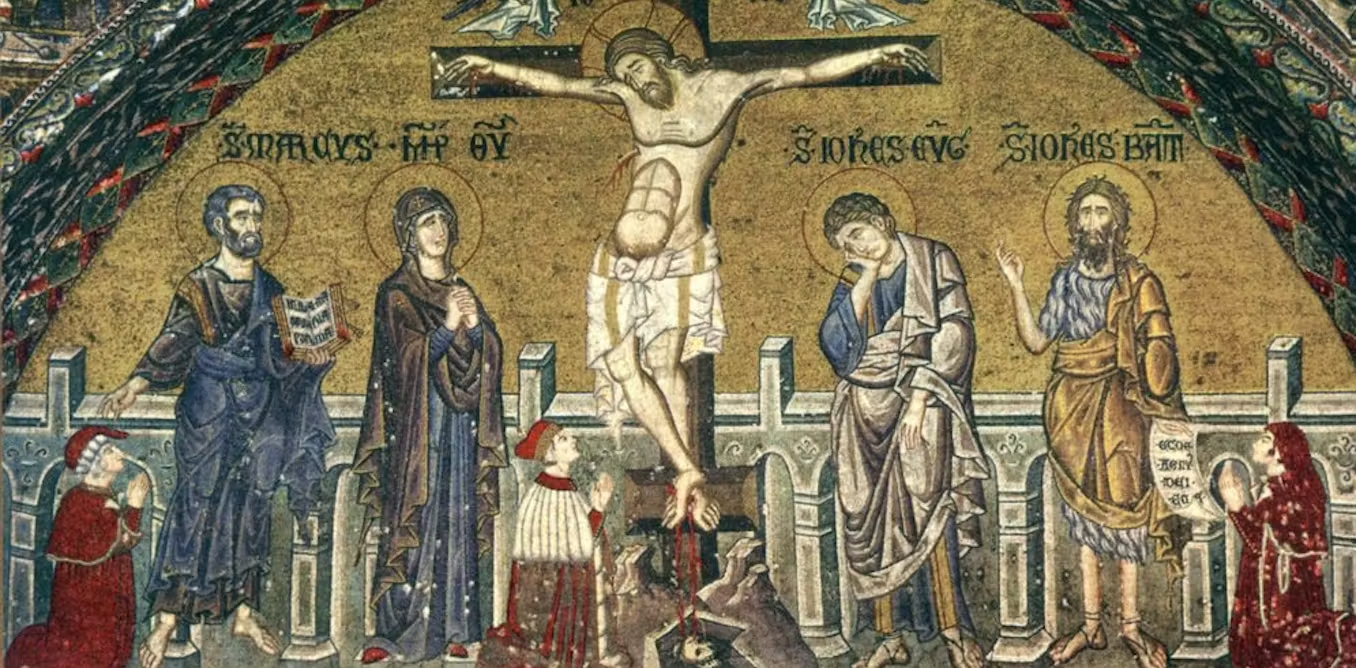
Drawing on her recent book, Facing Crisis: Art as Politics in Fourteenth-Century Venice, Stefania Gerevini on a historical reminder of the crucial role that art can play in times like these…
In an increasingly polarised world, the arts and humanities play a key role in sustaining democracy. They foster critical thinking, open dialogue, emotional intelligence and understanding across different perspectives, all of which are essential for a healthy democratic society. Also, people who participate in cultural activities are much more likely to engage in civic and democratic life.
Yet the way the arts are funded differs widely from country to country, especially in times of economic hardship or significant change. During and after the pandemic, for instance, some EU countries increased public spending on culture, while others made significant cuts.
The reasons for these contrasting attitudes are many, from local cultural values, to shifting economic priorities and politics. But at their core, different funding strategies express different attitudes towards two questions: what contribution does art make in times of crisis? And how do communities express their experiences of uncertainty?…
… the medieval city of Venice provides a remarkable historical example for addressing these questions.
Between the sixth and 12th centuries, Venice grew into an independent city-state ruled by an elected council and an elected head of state, called the doge.
Set on an island, the city lacked some of the resources necessary to its survival, so it quickly established strong maritime trade networks across the Mediterranean. It gradually developed into an international merchant empire, acquiring strategic territories along the eastern Adriatic Coast, Greece and the Aegean Sea.
By the mid-14th century, Venice was a leading global power. Yet, between 1340 and 1355, the city also faced famine, plague, a violent earthquake and fierce military conflicts with Genoa and the Ottomans.
Internally, Venice tackled dramatic political tensions (including a coup and the public execution of a doge in 1355), as non-noble citizens were gradually excluded from public office. Strikingly, it was during this period of acute crisis that the government initiated a series of ambitious artistic projects in the state church of San Marco.
A new baptistery and a chapel dedicated to Saint Isidore of Chios were lavishly decorated with mosaics. In addition, the high altar, which provided religious focus for the faithful, was revamped. This included turning its uniquely precious golden altarpiece into spectacular moving machinery that would open and close to reveal different images daily, and on feast days.
These projects, which required substantial public spending at a time of financial strain, hardly represented business as usual for Venetian policymakers. Instead, they were a central part of the government’s wider response to crisis.
On one level, these new projects revealed the range of pressing concerns that engulfed the Venetian government and people at the time. The painted altarpiece displayed on the altar of San Marco on non-festive days exhibits an emphasis on human suffering, miracles and saintly interventions that may relate the need for reassurance in uncertain times.
The bloody conflict against Genoa likely influenced the dedication of a chapel to St Isidore. The saint’s body was transported to Venice from the Greek island of Chios, a vital Genoese stronghold in the 14th century. To the people of Venice, the physical presence of St Isidore’s relics in San Marco provided reassurance and the promise of protection and victory as their state engaged in a risky conflict.
Finally, uncertainty about the nature and boundaries of citizenship and political authority – which the expansion of Venice’s overseas territories transformed into an ever more urgent problem – offer a valuable way to interpret the imagery in the baptistery. Here the apostles are rendered in mosaic as they baptise the “nations of the earth”, offering an idealised image of union in diversity.
Yet, on another level, the projects sponsored by the Venetian government during this period represented the active exercising of the political imagination. In ways that some of us may find alarmingly familiar, Venice’s ongoing instability made traditional approaches to decision-making, communication and control ineffective in dealing with the challenges it faced.
Venice’s governors responded to the crisis which threatened the very survival and stability of the city and its political foundations with a wide-ranging strategy of legal, institutional and historical revision, aimed at clarifying the nature and functions of the Venetian state.
The government reaffirmed Venice’s civic laws and reorganised its international treaties. The authority of the doge was progressively restricted, and over time, the government clarified the rules for holding public office. The first official history of Venice was completed in 1352.
In this context, the San Marco projects did not merely express the anxiety of the Venetian people, or their hopes for renewed stability. They represented the establishing of a new political landscape, which was envisioned most clearly on the east wall of the baptistery.
Three secular figures – a doge and two officers – are depicted as kneeling supplicants within a monumental mosaic of the crucifixion (see the main headline image above). Blending the sacred with the secular, this image offered an abstract “state portrait” that simultaneously expressed a political reality and suggested a new political ideal.
The mosaic now rendered Venice’s doge as a humble ruler, and it represented the business of government as a collective enterprise. In so doing, this image articulated a new vision of government as public service and shared responsibility. This idea, which developed through political reforms in Venice and from broader debates in other medieval Italian city states, has went on to influence western approaches to government and public life to this day.
Venice’s state-sponsored artistic commissions were not propaganda in the modern sense. Instead, they offered a compelling visual reflection on the nature of leadership and the necessary limits of authority. They kindled a new vision of government that enabled Venice to navigate one of the most turbulent phases of its history – reminding us, too, of the power of the arts to inspire and imagine new futures in difficult times…
Learning from history: “Medieval Venice shows us the good art can do in times of crisis,” from @theconversation.com.
* Pablo Picasso
###
As we appreciate art, we might send imaginative birthday greetings to Odilon Redon; he was born on this date in 1840. A lithographer, etcher, and painter, he was influential in the development of modern French art in two different ways. His prints explore haunted, fantastic, often macabre themes, earning him a leading place among emerging French Symbolists and foreshadowing the Surrealist and Dadaist movements. His oils and pastels, chiefly still lifes with flowers, won him the admiration of Henri Matisse and other painters as an important colorist.

“Coming soon!”*…

The tag line explains the concept of this 1918 movie, which was an anthology of clips from the films Chaplin made for the Essanay Film Manufacturing Company.
(R)D has explored the history of movie trailers. Now, from the remarkable Rebecca Onion, a look at their pre-history…
In the silent film era, these colorized lantern slides were the equivalent of previews or trailers, alerting the audience to the theater’s upcoming schedule. Blank spaces in the slide’s design allowed for a small degree of customization by hand.
Films tended to be short by modern standards, so audiences would watch them in batches, rather than seeing one at a time as we do today. Film scholar Lisa Kernan writes that these magic lantern slides were “projected between features, much like today’s slides of local restaurant advertising and movie trivia quizzes.”

The famous feline, who starred in multiple short cartoons between 1919 and the early 1930s, had a reusable slide that could be repurposed when new installments came out.
Even at the time the slides were in common use, Kernan writes, some theaters experimented with showing short bits of film to advertise coming attractions. By the 1920s, a company called National Screen Service was making trailers for major studio films using moving footage; by the 1930s, studios began to make their own, much more sophisticated preview trailers.
These lantern images were collected by W. Ward Marsh, a movie critic for theCleveland Plain Dealer from 1919 until his death in 1971. The Cleveland Public Library holds Marsh’s movie memorabilia and has digitized almost 700 examples of these slides…

A 1919 version of the L.M. Montgomery novel, starring prolific child actress Mary Miles Minter, was the first of many such adaptations for the big and small screens.
Read and see more at “The Lantern Slides That Advertised Coming Attractions in the Silent Film Era.”
* ubiquitous line in movie trailers
###
As we take our seats and silence our phones, we might recall that it was on this date in 1967 that “La Bateau,” a 1953 paper cut by Henri Matisse was hung in New York’s Museum of Modern Art… upside down. It remained on inverted display for 47 days. Genevieve Habert, a stockbroker, noticed the mistake (by comparing the hanging to the photo in the catalogue). As it was a Sunday night and there were no curatorial officials on duty, Habert informed the New York Times, which in turn notified Monroe Wheeler, the Museum’s art director… who had the piece rehung correctly on Monday.
Matisse’s cut-outs are back at MoMA… right-side up, one trusts.


Social Media: Systematically Gaming the System…

As we reconsider acting on those Yelp reviews, we might recall that it was on this date in 1967 that “La Bateau,” a 1953 paper cut by Henri Matisse was hung in New York’s Museum of Modern Art… upside down. It remained on inverted display for 47 days. Genevieve Habert, a stockbroker, noticed the mistake (by comparing the hanging to the photo in the catalogue). As it was a Sunday night and there were no curatorial officials on duty, Habert informed the New York Times, which in turn notified Monroe Wheeler, the Museum’s art director… who had the piece rehung correctly on Monday.
Elegant Endings (and Blissful Beginnings)…

Best reason to go adventuring in Wonderland:
Lastly, she pictured to herself how this same little sister of hers would, in the after-time, be herself a grown woman; and how she would keep, through all her riper years, the simple and loving heart of her childhood; and how she would gather about her other little children, and make their eyes bright and eager with many a strange tale, perhaps even with the dream of Wonderland of long ago; and how she would feel with all their simple sorrows, and find a pleasure in all their simple joys, remembering her own child-life, and the happy summer days.
– the last line of Alice’s Adventures in Wonderland, Lewis Carroll
19 other conclusive gems at Flavorwire’s “Famous Last Words: Our 20 Favorite Final Lines in Literature.”
And for a complementary collection of such wonders as…
Many years later, as he faced the firing squad, Colonel Aureliano Buendía was to remember that distant afternoon when his father took him to discover ice.
—the opening line of Gabriel García Márquez’ One Hundred Years of Solitude (1967; trans. Gregory Rabassa)
…visit the American Book Review’s “100 Best First Lines from Novels.”
As we reach for our library cards, we might recall that it was on this date in 1910 that Alice B. Toklas moved in permanently with Gertrude Stein. The two women turned their Paris home (22 rue de Fleurus) into an artistic and literary salon, where they hosted Picasso, Matisse, Hemingway, Fitzgerald, and many others– several of whom appear, with Ms. Stein herself, in the lists above.
 Cecil Beaton’s photo of Stein and Toklas at home (source)
You must be logged in to post a comment.