Posts Tagged ‘Lewis Carroll’
“Two possibilities exist: Either we are alone in the Universe or we are not. Both are equally terrifying.”*…

Happy Charles Dodgson’s (Lewis Carroll’s) Birthday!
Just when we thought that there was nothing else about which to worry, a different kind of “alien” concern: Helen McCaw, and economist and former senior analyst at the Bank of England, has written to her former employer with a warning…
The UK must plan for a financial crisis that would be triggered if the US government announces that aliens exist, a former Bank of England expert has said.
Helen McCaw, who served as a senior analyst in financial security at the UK’s central bank, has written to Andrew Bailey, the Bank of England’s governor, urging him to set out contingencies in case the White House ever confirms the existence of alien life, according to The Times.
Ms McCaw, who worked for the Bank of England for 10 years until 2012, said politicians and bankers can no longer afford to dismiss talk of alien life, and warned a declaration of this nature could trigger bank collapses…
Read on: “Bank of England must plan for a financial crisis triggered by aliens, says former policy expert,” from @the-independent.com.
* often attributed to Arthur C. Clarke (but likely from Stanley Kubrick, quoting Carl Sagan [who was riffing on a Walt Kelly Pogo quote])
###
As we acclimate to chaos, we might recall that it was on this date in 2021 that Resident Alien debuted (on Syfy).
Resident Alien is based on a comic book of the same name [by Peter Hogan and Steve Parkhouse]. Created by Chris Sheridan, Alan Tudyk plays an alien who crash-lands in Patience, Colorado and immediately goes on a killing spree including the town’s doctor, Harry Vanderspeigle.
Taking on the form of Harry, the alien continued killing thinking that by doing so, it would be good for planet Earth. But then, he was overcome with human emotions and started questioning the morality of it all…
– source

“But I don’t want to go among mad people,” Alice remarked.
“Oh, you can’t help that,” said the Cat: “we’re all mad here. I’m mad. You’re mad.”
“How do you know I’m mad?” said Alice.
“You must be,” said the Cat, “or you wouldn’t have come here.”
– Lewis Carroll
“Say what you will about the ten commandments, you must always come back to the pleasant fact that there are only ten of them”*…
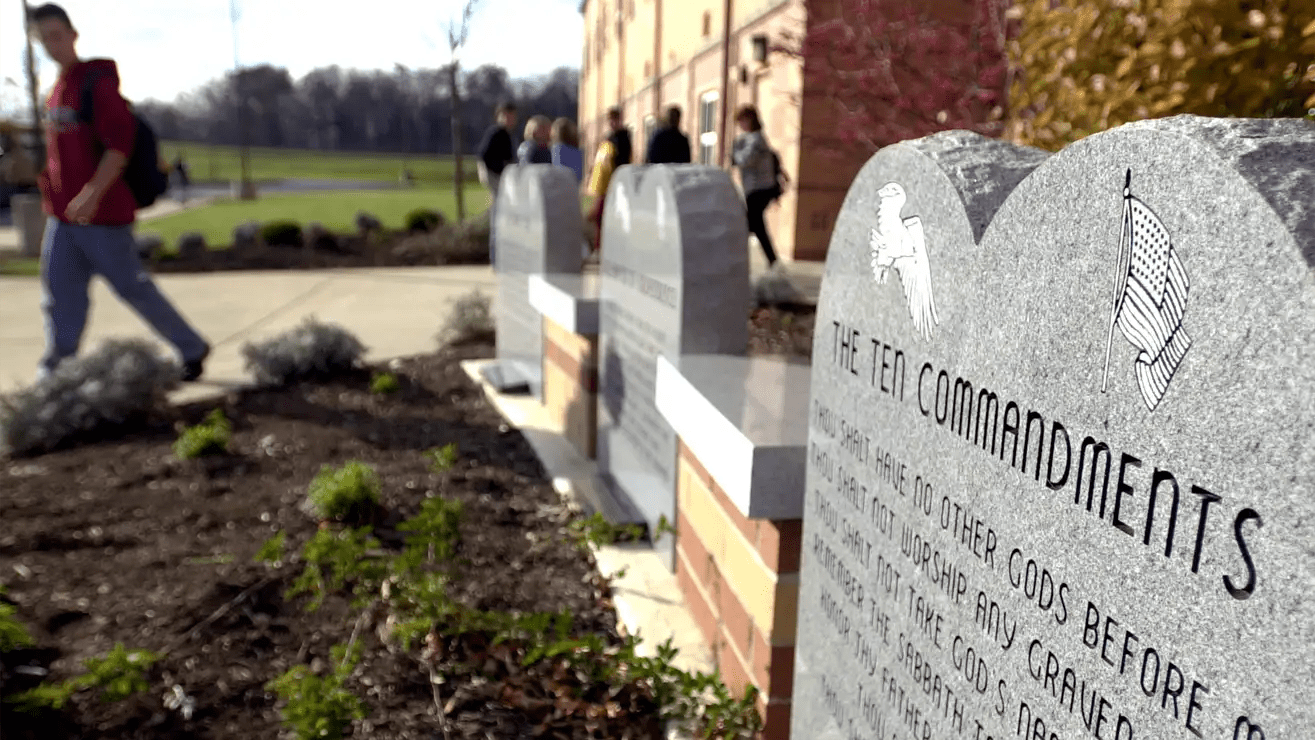
The Republican Governor of Louisiana, Jeff Landry, recently signed a law requiring state’s classrooms to display a copy of the Ten Commandments. The Onion explores the pros and cons of requiring religious doctrine in public schools…
- PRO: A good way to cover up the bullet holes.
- CON: Use of woke “Thou/Thy” pronouns.
- PRO: Great example of counting to 10 in the real world.
- CON: Just finished building golden calf.
- PRO: Least out-of-date thing in classroom.
- CON: True believers would display the entirety of the King James Bible.
- PRO: Distracts from how weird the Pledge of Allegiance is.
- CON: Not enough funding to print it out.
“Pros And Cons of Displaying The 10 Commandments in Every Classroom,” from @TheOnion.
* H. L. Mencken
###
As we ponder piety, we might recall that on this date in 1862, Charles Lutwidge Dodgson, a young Oxford mathematics don, took the daughters of the Dean of Christ Church College– Alice Liddell and her sisters– on a boating picnic on the River Thames in Oxford. To amuse the children he told them the story of a little girl, bored by a riverbank, whose adventure begins when she tumbles down a rabbit hole into a topsy-turvy world called “Wonderland.” The story so captivated the 10-year-old Alice that she begged him to write it down. The result was Alice’s Adventures in Wonderland, published in 1865 under the pen name “Lewis Carroll,” with illustrations by John Tenniel.

“To understand anything, you just need to understand the little bits”*…

Oscar Schwartz begs to differ. Here, excerpts from his provocative critique of TED Talks…
Bill Gates wheels a hefty metal barrel out onto a stage. He carefully places it down and then faces the audience, which sits silent in a darkened theater. “When I was a kid, the disaster we worried about most was a nuclear war,” he begins. Gates is speaking at TED’s flagship conference, held in Vancouver in 2015. He wears a salmon pink sweater, and his hair is combed down over his forehead, Caesar-style. “That’s why we had a barrel like this down in our basement, filled with cans of food and water,” he says. “When the nuclear attack came, we were supposed to go downstairs, hunker down, and eat out of that barrel.”
Now that he is an adult, Gates continues, it is no longer nuclear apocalypse that scares him, but pestilence. A year ago, Ebola killed over ten thousand people in West Africa. If the virus had been airborne or spread to a large city center, things would have been far worse. It might’ve snowballed into a pandemic and killed tens of millions of people. Gates tells the TED attendees that humanity is not ready for this scenario — that a pandemic would trigger a global catastrophe at an unimaginable scale. We have no basement to retreat to and no metal barrel filled with supplies to rely on.
But, Gates adds, the future might turn out okay. He has an idea. Back when he was a kid, the U.S. military had sufficient funding to mobilize for war at any minute. Gates says that we must prepare for a pandemic with the same fearful intensity. We need to build a medical reserve corps. We need to play germ games like generals play war games. We need to make alliances with other virus-fighting nations. We need to build an arsenal of biomedical weapons to attack any non-human entity that might attack our bodies. “If we start now, we can be ready for the next epidemic,” Gates concludes, to a round of applause.
Of course, Gates’s popular and well-shared TED talk — viewed millions of times — didn’t alter the course of history. Neither did any of the other “ideas worth spreading” (the organization’s tagline) presented at the TED conference that year — including Monica Lewinsky’s massively viral speech about how to stop online bullying through compassion and empathy, or a Google engineer’s talk about how driverless cars would make roads smarter and safer in the near future. In fact, seven years after TED 2015, it feels like we are living in a reality that is the exact opposite of the future envisioned that year. A president took office in part because of his talent for online bullying. Driverless cars are nowhere near as widespread as predicted, and those that do share our roads keep crashing. Covid has killed five million people and counting.
At the start of the pandemic, I noticed people sharing Gates’s 2015 talk. The general sentiment was one of remorse and lamentation: the tech-prophet had predicted the future for us! If only we had heeded his warning! I wasn’t so sure. It seems to me that Gates’s prediction and proposed solution are at least part of what landed us here. I don’t mean to suggest that Gates’s TED talk is somehow directly responsible for the lack of global preparedness for Covid. But it embodies a certain story about “the future” that TED talks have been telling for the past two decades — one that has contributed to our unending present crisis.
The story goes like this: there are problems in the world that make the future a scary prospect. Fortunately, though, there are solutions to each of these problems, and the solutions have been formulated by extremely smart, tech-adjacent people. For their ideas to become realities, they merely need to be articulated and spread as widely as possible. And the best way to spread ideas is through stories — hence Gates’s opening anecdote about the barrel. In other words, in the TED episteme, the function of a story isn’t to transform via metaphor or indirection, but to actually manifest a new world. Stories about the future create the future. Or as Chris Anderson, TED’s longtime curator, puts it, “We live in an era where the best way to make a dent on the world… may be simply to stand up and say something.” And yet, TED’s archive is a graveyard of ideas. It is a seemingly endless index of stories about the future — the future of science, the future of the environment, the future of work, the future of love and sex, the future of what it means to be human — that never materialized. By this measure alone, TED, and its attendant ways of thinking, should have been abandoned…
…
… TED talks began to take on a distinct rhetorical style, later laid out in Anderson’s book TED Talks: The Official TED Guide to Public Speaking. In it, Anderson insists anyone is capable of giving a TED-esque talk. You just need an interesting topic and then you need to attach that topic to an inspirational story. Robots are interesting. Using them to eat trash in Nairobi is inspiring. Put the two together, and you have a TED talk.
I like to call this fusion “the inspiresting.” Stylistically, the inspiresting is earnest and contrived. It is smart but not quite intellectual, personal but not sincere, jokey but not funny. It is an aesthetic of populist elitism. Politically, the inspiresting performs a certain kind of progressivism, as it is concerned with making the world a better place, however vaguely…
…
Perhaps the most incisive critique came, ironically, at a 2013 TEDx conference. In “What’s Wrong with TED Talks?” media theorist Benjamin Bratton told a story about a friend of his, an astrophysicist, who gave a complex presentation on his research before a donor, hoping to secure funding. When he was finished, the donor decided to pass on the project. “I’m just not inspired,” he told the astrophysicist. “You should be more like Malcolm Gladwell.” Bratton was outraged. He felt that the rhetorical style TED helped popularize was “middlebrow megachurch infotainment,” and had begun to directly influence the type of intellectual work that could be undertaken. If the research wasn’t entertaining or moving, it was seen as somehow less valuable. TED’s influence on intellectual culture was “taking something with value and substance and coring it out so that it can be swallowed without chewing,” Bratton said. “This is not the solution to our most frightening problems — rather, this is one of our most frightening problems.” (Online, his talk proved to be one of many ideas worth spreading. “This is by far the most interesting and challenging thing I’ve heard on TED,” one commenter posted. “Very glad to come across it!”)…
Some thoughts on the “inspiresting”: “What Was the TED Talk?” from @scarschwartz in @thedrift_mag.
* Chris Anderson, proprietor and curator of TED
###
As we unchain our curiosity, we might send ruthless curious (and immensely entertaining) birthday greetings to Martin Gardner; he was born on this date in 1914. Though not an academic, nor ever a formal student of math or science, he wrote widely and prolifically on both subjects in such popular books as The Ambidextrous Universe and The Relativity Explosion and as the “Mathematical Games” columnist for Scientific American. Indeed, his elegant– and understandable– puzzles delighted professional and amateur readers alike, and helped inspire a generation of young mathematicians.
Gardner’s interests were wide; in addition to the math and science that were his power alley, he studied and wrote on topics that included magic, philosophy, religion, and literature (c.f., especially his work on Lewis Carroll– including the delightful Annotated Alice— and on G.K. Chesterton). And he was a fierce debunker of pseudoscience: a founding member of CSICOP, and contributor of a monthly column (“Notes of a Fringe Watcher,” from 1983 to 2002) in Skeptical Inquirer, that organization’s monthly magazine.
Gardner died in 2010, having never given a TED Talk.


“The snake that cannot shed its skin perishes”*…

From Rebecca Saltzman…
As America’s seventh-ranked patriotic bunting company, we’re proud to fulfill all of your Fourth of July decorating needs this year. Also, due to a factory mix-up, our bunting this year is made of live snakes.
The American people rely on us for red, white, and blue fabric to hang on their porches. However, it has recently come to our attention that many customers have instead received a writhing mass of serpents. Are they at least harmless? No, they’re quite deadly. But we hope you will be reassured to know that the snakes can play “Yankee Doodle” on their rattles, which is a step up from our plastic bunting option.
How could this mistake happen? Our bunting factory operates under lax, or one might say non-existent, quality control standards. We also built our factory on top of a known snake nesting habitat. Our entire factory is infested with snakes.
To determine whether you’ve received bunting or snakes, we have put together the following helpful guidance…
Read on: “We Apologize That Instead of July Fourth Bunting, We Accidentally Shipped You a Box Full of Snakes,” from @beccasaltz in @mcsweeneys.
* Friedrich Nietzsche
###
As we parse patriotism, we might recall that on this date in 1862 (88 years after the Declaration of Independence was adopted by the Second Continental Congress on this same date), Charles Lutwidge Dodgson, a young Oxford mathematics don, took the daughters of the Dean of Christ Church College– Alice Liddell and her sisters– on a boating picnic on the River Thames in Oxford. To amuse the children he told them the story of a little girl, bored by a riverbank, whose adventure begins when she tumbles down a rabbit hole into a topsy-turvy world called “Wonderland.” The story so captivated the 10-year-old Alice that she begged him to write it down. The result was Alice’s Adventures in Wonderland, published in 1865 under the pen name “Lewis Carroll,” with illustrations by John Tenniel.
“When somebody says it’s not about the money, it’s about the money”*…

Further to yesterday’s post (about the relevance of Edith Wharton’s observations of her Gilded Age to ours), Dorinda Evans takes a look at rough contemporary of Wharton’s, and at his (similarly relevant) work…
After supposedly stealing 500,000 francs from his bank, the mysterious Victor Dubreuil (b. 1842) turned up penniless in the United States and began to paint dazzling trompe l’oeil images of dollar bills. Once associated with counterfeiting and subject to seizures by the Treasury Department, these artworks [are nowconsidered] unique anti-capitalist visions among the most daring and socially critical of his time…

The fascinating story of Victor Dubreuil’s cryptic currencies and the questions they raise about value and values: “Illusory Wealth,” in @PublicDomainRev.
For an illuminating look at Dubreuil’s spiritual successor, see Lawrence Weschler’s wonderful Boggs: A Comedy of Values.
For a loosely analogous artist: “Nobody knows what a dollar is, what the word means, what holds the thing up, what it stands in for… what the hell are they? What do they do? How do they do it?”
And for an appreciation of trompe l’oeil (and its influence on Cubism), see “Feinting Spells.”
* H.L. Mencken
###
As we contemplate currency, we might pour a cup of birthday tea for English mathematician, logician, photographer, and Anglican cleric, Charles Lutwidge Dodgson– better known as the author Lewis Carroll– born on this date in 1832.
“There is no use in trying,” said Alice; “one can’t believe impossible things.”
“I dare say you haven’t had much practice,” said the Queen. “When I was your age, I always did it for half an hour a day. Why, sometimes I’ve believed as many as six impossible things before breakfast.”
– Alice in Wonderland (nee “Alice’s Adventures Underground,” then “Alice’s Adventures in Wonderland”)

Oh, and… Happy Mozart’s Birthday!
You must be logged in to post a comment.