Posts Tagged ‘Aliens’
“Conspiracy theories also bring another reward: power.”*…

Barrett Brown interrogates our fascination with conspiracies and conspiracy theories…
Over a period of several years in the early seventeenth century, there appeared in Western Europe three manifestos laying out the history of the theretofore unheard-of Rosicrucian order, whose secret directorate was said to employ powerful magical-scientific techniques in service to sociopolitical reform. This naturally led to quite a bit of public speculation, which gradually abated in the absence of further pronouncements; within a few generations the only parties ascribing any significance to the incident tended to be dubious characters claiming to be Rosicrucians themselves, rarely with much to show for it. Thus, as a result of its gradual association with cranks, the Rosicrucian story developed a kind of inoculation against serious scrutiny.
It wasn’t until the sixties that the British historian Dame Frances A. Yates breached the actual nature and extent of the thought movement that informed both the manifestos and its audience. In her book The Rosicrucian Enlightenment, she demonstrates that the texts were written as anti-Hapsburg, proreformist propaganda drawing on doctrines associated with the sixteenth-century philosopher Francis Bacon, and that this was understood by commentators on both sides; that the surreal “alchemical wedding” described therein references the 1613 marriage of England’s Elizabeth Stuart and Frederick V of the Palatinate, widely heralded as the linchpin of a proto-Protestant alliance capable of establishing such reform by force; that the broader proposals were indeed taken seriously by scholars, not as scripture but rather as a set of visionary policy proposals dressed in metaphor, akin to Bacon’s The New Atlantis; and that enthusiasts such as Elias Ashmole would directly implement those proposals by founding the Royal Society, establishing the primacy of science. Rather than being a footnote to premodern folly, the Rosicrucian affair turns out to sit at the narrative center of the modern world.
There’s a lesson here that bears attention today, at the apparent twilight of the same modern world, when the fundamental problem we face involves the degree to which the truth must now compete with such a vast multiplicity of falsehoods that discovering truth itself becomes unviable. Consider that so much of consequence to our own heritage should have been so misunderstood for as long as the Rosicrucian manifestos; it seems that crucial facts can be effectively concealed from serious attention simply by being visibly subject to the unserious sort. Such facts are gradually imbued with a sort of de facto defense mechanism against scrutiny, whereby the mere act of taking an interest in them serves to discredit professional researchers and journalists…
From the 1600s to recent history and the insights of Umberto Eco, what’s going on– and why: “The Ur-“Conspiracy”: History of a Pseudoconcept,” from @parisreview.bsky.social.
Apposite: “Revisionist History — Aliens, Secrets and Conspiracies,” by Steve Blank
* “The emotional appeal of a conspiracy theory is in its simplicity. It explains away complex phenomena, accounts for chance and accidents, offers the believer the satisfying sense of having special, privileged access to the truth. For those who become the one-party state’s gatekeepers, the repetition of these conspiracy theories also brings another reward: power.” – Anne Applebaum, Twilight of Democracy: The Seductive Lure of Authoritarianism
###
As we ponder perspicacity, we might we send inquisitive birthday greetings to Michel Eyquem de Montaigne; he was born on this date in 1533. Best known during his lifetime as a statesman, Montaigne is remembered for popularizing the essay as a literary form. His massive volume Essais (translated literally as “Attempts” or “Trials”)– contain what are, to this day, some of the most widely-influential essays ever written. Montaigne had a powerful impact on writers ever after, from Descartes, Pascal, and Rousseau through Hazlitt, Emerson, and Nietzsche, to Zweig, Hoffer, and Asimov. Indeed, he’s believed to have been an influence on the later works of Shakespeare.
And while he pre-dates the “Rosicrucian” publications mentioned above, he observed (in Essais) “the truth of these days is not that which really is, but what every man persuades another man to believe.”

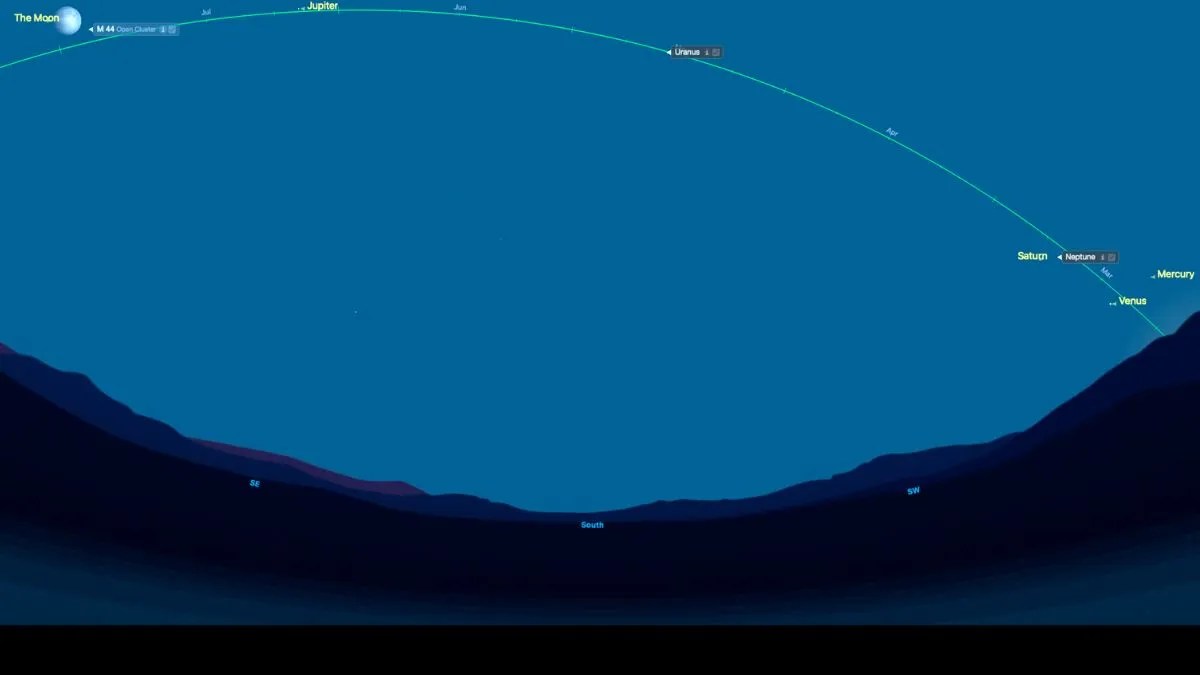
Lastly, a good reason to step outside and look up early this evening: “February’s ‘rare planetary alignment’ is coming — here’s what to expect from the planet parade“
“Two possibilities exist: Either we are alone in the Universe or we are not. Both are equally terrifying.”*…
Happy Charles Dodgson’s (Lewis Carroll’s) Birthday!
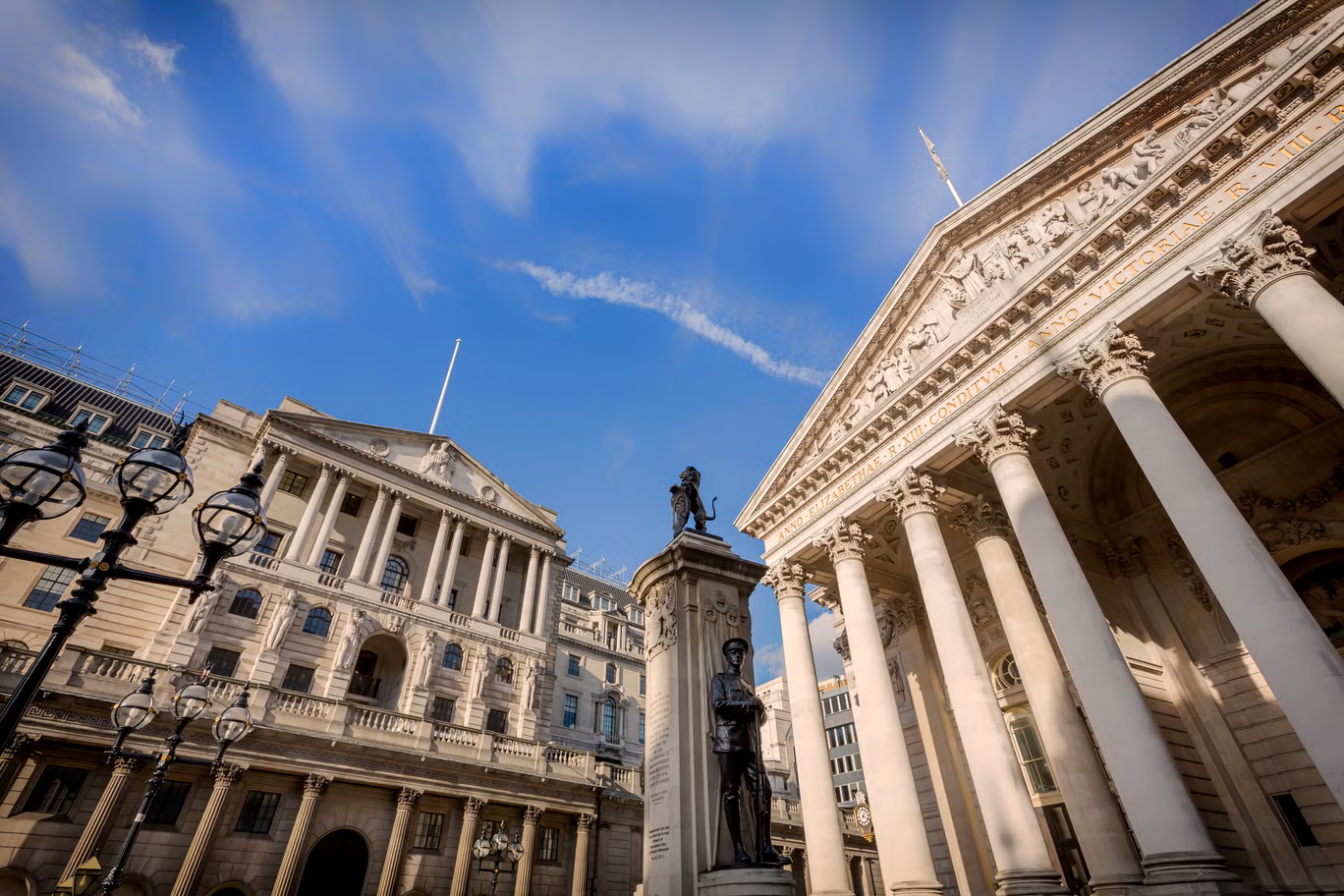
Just when we thought that there was nothing else about which to worry, a different kind of “alien” concern: Helen McCaw, and economist and former senior analyst at the Bank of England, has written to her former employer with a warning…
The UK must plan for a financial crisis that would be triggered if the US government announces that aliens exist, a former Bank of England expert has said.
Helen McCaw, who served as a senior analyst in financial security at the UK’s central bank, has written to Andrew Bailey, the Bank of England’s governor, urging him to set out contingencies in case the White House ever confirms the existence of alien life, according to The Times.
Ms McCaw, who worked for the Bank of England for 10 years until 2012, said politicians and bankers can no longer afford to dismiss talk of alien life, and warned a declaration of this nature could trigger bank collapses…
Read on: “Bank of England must plan for a financial crisis triggered by aliens, says former policy expert,” from @the-independent.com.
* often attributed to Arthur C. Clarke (but likely from Stanley Kubrick, quoting Carl Sagan [who was riffing on a Walt Kelly Pogo quote])
###
As we acclimate to chaos, we might recall that it was on this date in 2021 that Resident Alien debuted (on Syfy).
Resident Alien is based on a comic book of the same name [by Peter Hogan and Steve Parkhouse]. Created by Chris Sheridan, Alan Tudyk plays an alien who crash-lands in Patience, Colorado and immediately goes on a killing spree including the town’s doctor, Harry Vanderspeigle.
Taking on the form of Harry, the alien continued killing thinking that by doing so, it would be good for planet Earth. But then, he was overcome with human emotions and started questioning the morality of it all…
– source

“But I don’t want to go among mad people,” Alice remarked.
“Oh, you can’t help that,” said the Cat: “we’re all mad here. I’m mad. You’re mad.”
“How do you know I’m mad?” said Alice.
“You must be,” said the Cat, “or you wouldn’t have come here.”
– Lewis Carroll
“In the deepest sense the search for extraterrestrial intelligence is a search for ourselves”*…

Will the monumental moment of first contact fuel division among war-hungry humanity, or will it inspire our better angels and unite us? Becky Ferreira considers…
Do intelligent aliens exist somewhere out there in the universe? It is a grand mystery that has captivated humans for generations, fueling ever-more sophisticated searches of the skies for signs of advanced civilizations. But while aliens have taken many forms in our imaginations—from hostile invaders to inscrutable ciphers—we have absolutely no idea what extraterrestrial life-forms might look like, how they would communicate, or even if they exist at all.
We can, however, make some assumptions about the only intelligent space-faring species that we know of—humans—and how we might react to contact with an alien civilization. Indeed, people have spent decades developing protocols that attempt to anticipate this momentous event and all of the extraordinary potential consequences it could have on our civilization. It’s an especially important question now, as the world appears more strongly divided than at any time in recent memory, with major powers taking on increasingly antagonistic stances toward each other.
In 2020, a pair of researchers dug into this question in an article in Space Policy by suggesting that humans might pose as big a risk to ourselves in the aftermath of alien contact as any extraterrestrial species…
The potential consequences of first contact: “Scientists Are Gaming Out What Humanity Will Do If Aliens Make Contact,” from @beckyferreira in @VICE.
* Carl Sagan
###
As we listen carefully, we might note that today is the (fictional) birthday of ALF (Alien Life Form), from the 1980s TV series of the same name; he was born on this date in 1756 on the planet Melmac. ALF follows an amateur radio signal to Earth and crash-lands into the garage of the Tanners, a suburban middle-class family who live in the San Fernando Valley area of California. While largely a sit-com, it wove thematic threads (that echo that echo films like The Day the Earth Stood Still and ET) to explore exactly the issues raised in the piece linked above.

“Time and space are modes by which we think and not conditions in which we live”*…

A new kind of matter?…
In a preprint posted online… researchers at Google in collaboration with physicists at Stanford, Princeton and other universities say that they have used Google’s quantum computer to demonstrate a genuine “time crystal.” In addition, a separate research group claimed earlier this month to have created a time crystal in a diamond.
A novel phase of matter that physicists have strived to realize for many years, a time crystal is an object whose parts move in a regular, repeating cycle, sustaining this constant change without burning any energy.
“The consequence is amazing: You evade the second law of thermodynamics,” said Roderich Moessner, director of the Max Planck Institute for the Physics of Complex Systems in Dresden, Germany, and a co-author on the Google paper. That’s the law that says disorder always increases.
Time crystals are also the first objects to spontaneously break “time-translation symmetry,” the usual rule that a stable object will remain the same throughout time. A time crystal is both stable and ever-changing, with special moments that come at periodic intervals in time.
The time crystal is a new category of phases of matter, expanding the definition of what a phase is. All other known phases, like water or ice, are in thermal equilibrium: Their constituent atoms have settled into the state with the lowest energy permitted by the ambient temperature, and their properties don’t change with time. The time crystal is the first “out-of-equilibrium” phase: It has order and perfect stability despite being in an excited and evolving state…
Like a perpetual motion machine, a time crystal forever cycles between states without consuming energy. Physicists claim to have built this new phase of matter inside a quantum computer: “Eternal Change for No Energy: A Time Crystal Finally Made Real.”
See also: Time Crystals #1 (source of the image above).
And for a not-altogether-apposite, but equally mind-blowing read, see “Scientist Claims That Aliens May Be Communicating via Starlight.”
* Albert Einstein
###
As we push through purported paradoxes, we might send accomplished birthday greetings to James Bowdoin II; he was born on this date in 1726. A successful businessman who was a political and intellectual leader during in the decade after the American Revolution (for a time, as Governor of Massachusetts), he was also an important experimental scientist. His work on electricity with his friend Benjamin Franklin earned him election to both the Royal Society of London and the American Philosophical Society. He was a founder and first president of the American Academy of Arts and Sciences, to whom he bequeathed his library. Bowdoin College in Maine was named in his honor after a bequest by his son James III.

“Somewhere, something incredible is waiting to be known”*…

Astrobiology – the study of life on other planets – has grown from a fringe sub-discipline of biology, chemistry and astronomy to a leading interdisciplinary field, attracting researchers from top institutions across the globe, and large sums of money from both NASA and private funders. But what exactly is it that astrobiologists are looking for? How will we know when it’s time to pop the Champagne?…
Find out at “Proof of life: how would we recognize an alien if we saw one?”
[Image above from NASA’s Astrobiology Institute]
* Carl Sagan
###
As we look for life, we might send inventive birthday greetings to William “Willy” A. Higinbotham; he was born on this date in 1910. A physicist who was a member of the team that developed the first atomic bomb, he later became a leader in the nuclear non-proliferation movement.
But Higinbotham may be better remembered as the creator of Tennis for Two, the first interactive analog computer game and one of the first electronic games to use a graphical display, which he built for the 1958 visitor day at Brookhaven National Laboratory. It used a small analogue computer with ten direct-connected operational amplifiers and output a side view of the curved flight of the tennis ball on an oscilloscope only five inches in diameter. Each player had a control knob and a button.


The 1958 Tennis for Two exhibit

You must be logged in to post a comment.